Blog 2026 - English translation

Dreams are part of this journey and appear here regularly.
A Familiar Road That Is Never the Same
27 September 2026
It is Sunday today. The gym I go to every day is closed on Sundays. Probably because we live in a village that is traditionally Christian. It’s funny, we used to have no idea what day of the week it was anymore. That’s what retirement can do to you. But now we immediately know: we’re not going to train, so it must be Sunday.
Sunday now feels, just as it did when we were still working, like the day when you pay a little extra attention to breakfast. A day when you feel like making something nice. We have plenty of fruit in the house, so Ton starts making an apple and pear pie. A delicious smell drifts through the house, giving it that warm feeling of home.
I had set up a date poll to see whether I could get all the children and grandchildren together on one weekend day. Our whole family has to deal with divorced parents, which means Christmas always becomes a bit of a struggle over who goes where, when, and to which parent or grandparents. From the moment Ton and I got together, I stepped away from that. Instead, we organise a day out at a theme park in December, so that we can be crossed off the ‘Christmas list’. There are usually about twenty of us. It’s lovely to spend an entire day outdoors together, having fun. It has become something of a tradition.
This year, I thought we might take the whole group to Phantasialand for a change. The only date everyone turned out to be available was 12 December. All the tickets for that day were sold out!!! Well, this is getting ridiculous. So this year it will be the Efteling again. I bought the tickets online and felt very satisfied afterwards. Next year I’ll probably have to start planning in August if I still want to have a choice.
After a pleasant, quiet morning, we go cycling. It is lovely late-summer weather, 21 degrees with a fresh but not cold breeze. Last week I had already seen lots of fungi and mushrooms again, but they are already starting to shrivel. I think it is because of the unusually warm days we have had recently. Everywhere I see signs of autumn, while at the same time completely new young shoots are appearing. Well, my body has to adjust to all these constant transitions, and apparently nature does too.
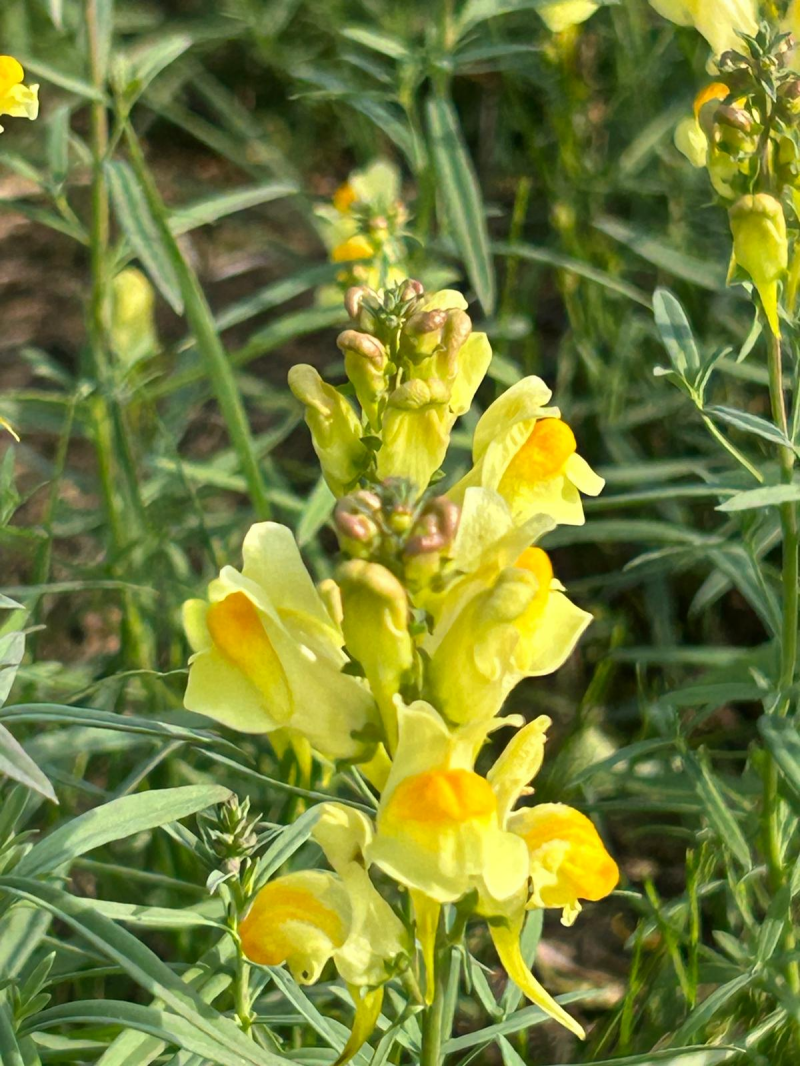
I had already noticed that certain little flowers seem to have been given more space and have therefore become much more visible, such as common toadflax. It is a beautiful yellow flower with such a gentle appearance. Up close, you can see an orange centre that makes it look a little like a snapdragon.
Lady’s bedstraw is also appearing more prominently among the grasses and nettles. Like a soft, pale cloud. Up close, the flowers are tiny little white stars. I have to stop to take a photograph and simply look at them for a while.
Then suddenly I notice a large thorn apple growing right beside the cycle path. A highly poisonous plant for humans and animals, but fascinating to look at: its trumpet-shaped flowers, its thorny seed pods and its pointed leaves. It makes me think of Halloween.
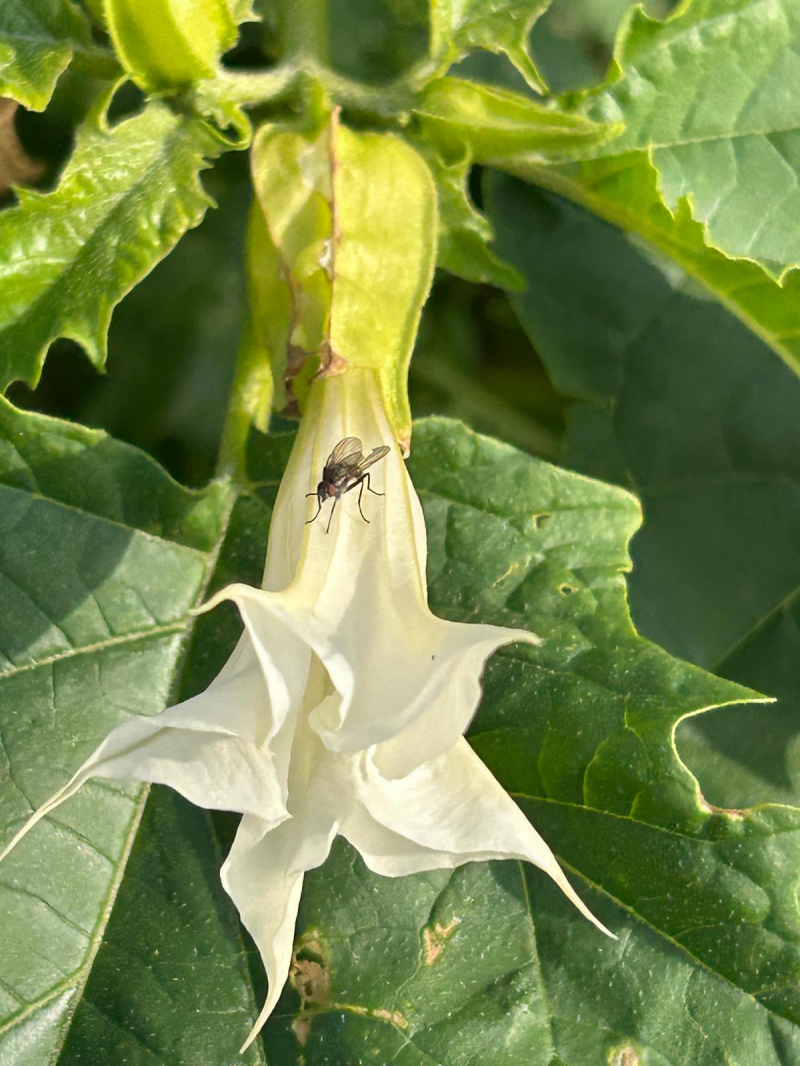
This is another plant that should be reported when you encounter it in a public space. A while ago, I registered with waarneming.nl, where I can upload my observations together with a photograph and location. It gives me a good feeling to contribute by keeping an eye on nature and helping to protect it.
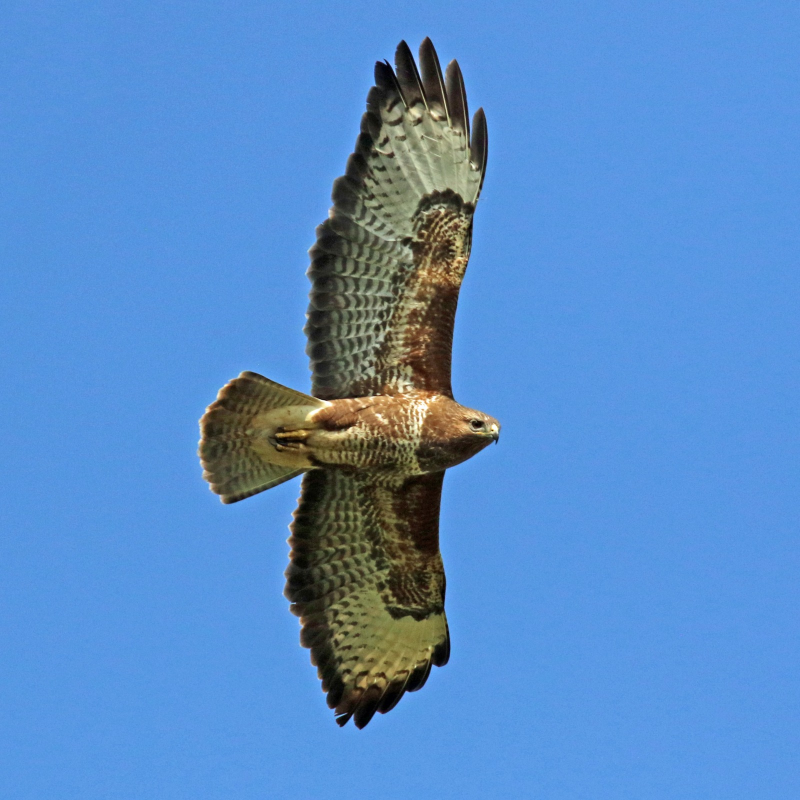
Because I regularly stop to look at a plant or an animal, we usually end up being out for several extra hours. This time I hear a sound in the sky and see a large buzzard with two youngsters. It really looks as though the adult bird is showing the two young ones how to make use of the thermals. She glides very slowly downwards, barely moving her wings, and then rises again towards the two youngsters above her. Again and again. As though she is demonstrating how it is done.
I get off my bike and simply enjoy watching them. I cannot describe how happy I was to see and experience this so clearly. It was wonderful. I have often seen buzzards sitting on a post, but this was so special. And the sounds they made were wonderful too, almost as though they were having fun playing a game.
A little further on, we sit down on a bench to have something to eat and drink. I feel so happy; nothing could spoil my day now. Ton still finds it remarkable how completely absorbed I can become in everything nature shows me. These three buzzards really were the highlight. The adult bird was flying low, with the two youngsters a little higher up, making their cheerful mewing calls.
We continue our ride through the villages on our way home. The streets are completely silent. Wherever a property has a gate, it is closed. No sound, not a person in sight.
I think out loud to Ton: “Oh, it’s Sunday, of course. That’s why I don’t hear or see anything. Nobody is working. Would God have forbidden it? Or would it have been advice? Did all those prohibitions and commandments come from God, or from human beings?”
Ton says, “Advice.”
A little later, I hear him say, “Why am I even answering that? God doesn’t exist.”
Well, I don’t know that, Ton. That wasn’t the question in my train of thought. How much of the Bible is an interpretation made by human beings themselves? And how truthful is that interpretation? That is what I wonder about, not whether God exists or not. I wouldn’t dare to give an answer to that.
For me, there is something. I was born here in the West, so that something is easily called God. Fine. I could just as easily call it the Source or something like that. I find it fascinating that the people here live so closely according to the letter of the book.
The church doors are closed. Not like during the past summer, when they were open and you could hear the congregation singing.
Now, in the silence, I hear the singing of nature.
It has been quite an experience again. Thirty kilometres along a familiar route, filled with countless new experiences.
Life can be this simple and this rich.
Reflection
Perhaps there is no such thing as a familiar road. Perhaps there is only a road we think we know, until we look again. Today there were tiny white stars among the grass, a poisonous plant with a wondrous flower, and three buzzards playing with the air. Tomorrow it will all be different again.
How many worlds pass us by every day, simply because we don’t stop for a moment to look?
Not Every Mirror Brings Recognition
25 and 26 September 2026
Two ordinary days in which I dutifully go to the gym, but otherwise feel little need to do anything. Watching films or series has completely lost its appeal at the moment. Nothing interests me right now. Nor can I see myself continuing with my painting, which has been standing in the living room staring at me for weeks.
Over the past few days, I have once again enjoyed watching reality shows in which, for example, people sign up for a training programme with the Marines. It requires perseverance, strength, flexibility, discipline, cooperation, the ability to keep a clear head in all circumstances, and resilience. All of this in one balanced package. I find it fascinating to see how this works. How people come face to face with themselves. How important it is to train all these qualities in order to become a good Marine or warrior.
It always reminds me of my yoga training. The specific form of yoga I have always practised also requires this entire package if you want to keep going. Someone told me that she had always done a lot of sport. I said that I too had spent many years doing a lot of physical training. Ton suddenly said, “Well, Annette didn’t do sport, she practised yoga.”
From his tone, I thought I could hear the suggestion that it could never have been as intense as sport. For a moment, I felt a stab in my heart. During the thirty years I taught, I saw dedicated athletes come to my classes who were unable to keep up. Kundalini yoga is a very dynamic and intensive form of yoga.
In any case, I have always found it interesting to see how people look at themselves and how far they can go within such broad and intensive training. How the physical affects the mental and vice versa. Yes, I don’t just see military training; I see something that goes beyond that. It strongly reminds me of the Eastern philosophies I have come to know.
After watching all the episodes, I found a programme I hadn’t seen before, which is already in its second season. It is a programme in which six well-known Dutch people, each together with a partner of their own choosing, take part in a challenge. They race overland from Istanbul to Singapore. They are given some money, €3,200 I believe. They have to hand in their bank cards and mobile phones. And so they set off backpacking on a journey of 14,000 kilometres. Along the way, they have to reach a number of checkpoints.
I find the idea of travelling like this and having to manage together fascinating. How do you do that? It is so much fun to watch how they experience it. They move from wonder to frustration, to amazement and powerlessness. You see how the pairs interact with each other. Sometimes they are friends, a couple, or a parent and child.
You see magnificent nature, and they come into contact with local people. They visit non-touristy places that are incredibly beautiful too. The local people are often so friendly and generous. I really enjoy watching it at the moment.
These are things I love too. Nature, avoiding tourist attractions. Travelling without a fixed plan and allowing myself to be surprised by a country and its people.
But there was something that caught my attention in which I don’t recognise myself at all. You sometimes see the pairs becoming a little grumpy with each other, perhaps because of exhaustion or the stress of not having enough money and needing to find a solution together. I recognise that.
I assume every pair has a cameraman or woman travelling with them, otherwise we wouldn’t be able to follow their journey in this way. But every now and then, they talk about what the experience is doing to them. The confrontations, the insights, the gratitude for being allowed to experience this. I can relate to that too.
But then they start talking about how much they love each other. Whether they are friends, lovers or family, they all do this in their own way.
I could never do that in the same way.
I can tell someone that I love them, but I don’t think I could do it with that emotion in my eyes or voice, or in such a tactile way. When I watch them, I briefly wonder whether I love people enough. Or whether they are performing it because there is a camera watching them.
Why am I such a cool customer?
Yes, that is genuinely what I feel when I watch it. Their journey, with all the emotions that come with it, seems truthful to me.
Is there something wrong with me? Am I unable to show love? What is it?
I cuddle my animals an enormous amount. There are very few childhood photographs of me, but whenever there is one, I am always cuddling a dog or a cat.
Why does this affect me?
I am watching people making a beautiful but raw journey, filled with beautiful and raw emotions. Only that one particular emotion, expressed in that particular way, is something I don’t recognise in myself.
Reflection
Perhaps this is why I enjoy watching human behaviour so much. I can understand or relate to much of it, even when I would behave differently myself. But sometimes I look at someone and there is no recognition at all.
For a moment, the other person becomes a mirror in which I specifically do not see myself.
Perhaps that doesn’t mean that I feel less. Perhaps it only means that what I feel looks different when it finds its way to the outside.
I don’t need to have the same tears in my eyes, the same warmth in my voice, or touch someone in the same way in order to love them.
And yet, it affects me when I see it in others.
Perhaps this question doesn’t need an immediate answer either.
What does my love look like when I don’t compare it with someone else’s?
From Distress to Calm
24 September 2026
My day began with a feeling of distress. I wrote it down immediately.
What I have just experienced was so intense and so difficult to describe, but I am going to try. I think I need to begin with a conversation I had with my sister yesterday.
She is fourteen years older than I am. She has a very different character. We have always felt that we lived very different lives, despite coming from the same family. Over time, however, we began to see that, within different contexts, we had ended up dealing with more or less the same issues.
Yesterday we talked about lies. We grew up in a lie surrounded by even more lies. Somehow, throughout the rest of our lives, we have repeatedly found ourselves in situations where we encountered this again. As though we had become some kind of magnet for lies.
I specifically mean the kind of lies where someone tells something untrue about me. Probably to clear themselves of blame. Probably out of fear or fear of losing face. Or worse, deliberately to hurt me.
We talked about the pain, humiliation and emotions this evokes in both of us. At the same time, we can see that the people who have done this to us may not be able to change themselves. The fact that we can see it means that we are able to change ourselves. Through understanding or forgiveness, for example.
That is enough about the conversation with my sister.
Last night I dream about this subject. Hundreds of moments pass by in which, in this way, I became the ‘victim’ of a lie. I no longer want to talk about the actual events. Not here either. What matters to me is purely the feeling.
It was overwhelming to see all of this again in my dream. The humiliation runs deep. The powerlessness is almost impossible to bear; it nearly drives me out of my mind.
And then something happens in my dream.
I start trembling, shaking, every muscle in my body. So violently!!! I am having an attack, and I recognise it. I have no control over my body whatsoever. I regularly had attacks like this when I was younger, until somewhere in my mid-thirties. When an attack finally passed, I often needed months of rehabilitation to recover from it.
In my dream, I suddenly recognise what is happening.
At that moment, I take over the dream myself.
In my dream, I think:
Okay, I recognise this. And I can see now that it is a reaction to the powerlessness and humiliation caused by lies. That means I need to turn the powerlessness into power.
How do I do that? Why do I feel this powerlessness and humiliation? Probably because I want to understand it. I used to want to understand everything. But is that possible? Can I truly understand another person’s deepest fears?
No.
So instead of being hurt by it, perhaps I can see it as something sad or painful arising from another person’s inability.
Feel the emotion, Annette, but don’t let it become yours.
At that moment, the violent shaking begins to subside, and I wake up gasping for breath, drenched in sweat.
I stare at the ceiling in the darkness and realise that my body really did react to what was happening, and that it was not merely an experience within my dream. I also realise that, in my dream, I was able to stop it myself, that it did not continue raging for hours.
Ton senses that something is wrong. I briefly tell him what happened to me. I also tell him that I am soaking wet and completely exhausted. I need to go back to sleep and cancel the gym. My body really needs to recover from this adventure.
Fortunately, I fall asleep again.
But my dream continues, showing me more of these kinds of events from my past, right up until about three months ago. That was the last time something like this happened to me.
Eventually, I wake up again. But this time, I am dry and calm.
It is already around midday, so I realise I am hungry. I eat and drink something. Suddenly, I break out in a sweat again, even though the only effort I am making is chewing my cracker. I immediately decide to go back to bed because I am already feeling incredibly tired again.
Ton checks my blood pressure, heart rate and oxygen saturation, which are all fine. Completely exhausted, I fall asleep again and wake up towards the end of the afternoon.
I have only been up for about five minutes when my niece comes to visit. She stays for dinner. We talk about the changing traffic situation caused by the closure of a bridge. It affects her commute to and from work. She has been experiencing some problems. She describes it herself as being overloaded and has sought professional help. She is 57 and has also developed heart problems, and now slowly seems to be experiencing some symptoms of burnout as well. There is a lot of stress at work.
The conversation naturally moves on to healthcare. We talk about changes within our families and changes within society. Conversation flows easily between us, without necessarily being about small talk.
That is important to me, because conversations about things that feel unimportant to me can drain me. For example, whether my hair looks good, whether or not I wear make-up, or statements that are simply thrown out without any reasoning behind them. I don’t have to agree with someone, but I am sensitive to the way a conversation develops. Especially now, after such a physically demanding day.
I experience it as a pleasant visit.
After the shock of last night, I am glad that I have still been able to end my day reasonably well.
Reflection
This morning, it seemed as though the entire day would be dominated by what had happened during the night. My body was exhausted, and even eating a cracker seemed to require too much effort.
Hours later, I am simply sitting at the table with my niece.
We eat, talk and exchange thoughts. No major event, no answer to what happened last night. Just a pleasant conversation in which thoughts are allowed to move.
Perhaps nothing else needs to be understood today.
Last night I said to myself:
Feel the emotion, Annette, but don’t let it become yours.
Today, my body has mostly slept.
And tonight, everything is calm.
For now, that is enough.
Beneath the Surface
23 September 2026
My day began with me waking up very sleepily from a dream. It felt as though this dream had kept me occupied all night. After the gym, I came home and decided to write it down and post it on my dream blog.
In it, I wrote that I wasn’t planning to go looking for a meaning. In the past, I was always searching for meanings in whatever happened in my life, in whatever area. By now, I have learned that searching prevents me from receiving. Searching allows interpretation to quietly sneak in through the back door. Not searching is a form of letting go that allows you to receive at the moment when you are willing and able to listen.
Having said that, I also know by now that what I receive today may become something entirely different after a while. Throughout a lifetime, you can receive several different meanings from a single event.
I have noticed before that writing often opens a little drawer I hadn’t seen coming myself. And so, after writing down my dream, an insight came to me after all. I think I am the one who can free myself from emotions and thoughts that might otherwise keep me imprisoned. That is why I identify with all those characters in my dream. I am the one who can become trapped in an emotion or thought. I am also the one trying to free myself from it. And at the same time, I am the one who can stand back and observe it.
It was my dream, telling me something about myself, or perhaps saying something to me. And yet I think this applies to everyone. Essentially, we are all individuals responsible for our own existence. That is what autonomy is: making your own choices and your own mistakes, in freedom, without others restricting or forcing you.
But every individual is a drop in the ocean. The autonomous drop does not exist separately from that ocean. If you were to separate yourself from it, you would be nothing more than a drop, and soon evaporate. Without the whole, there is no individual, and without the individual, there is no whole. It is as though my dream wanted to remind me of that once again.
During my bike ride to another town, where I want to run an errand, I cycle along an asphalt bike path. About every two metres, the path is cracked. Horizontal bumps have formed. As I bumpety-bump my way over the cracks, I say to Ton, “Those tree roots must be incredibly strong to be able to crack even the asphalt.”
My thoughts go to the Wood Wide Web, and I think about how even with this kind of human interference, we still cannot manage to restrain those roots. I love the thought that nature speaks its own language, that everything is connected, and that invisibly, without actually waging war, it simply continues.
My thoughts fly to a documentary about Chernobyl. How nature rapidly reclaimed an abandoned city. No longer habitable for humans, yet plants, flowers, shrubs and even trees find their way through this contaminated world. Animals, too, found their way back to this uncanny place.
Yes, it all remains possible. Nature quickly finds connection again after it has suffered.
The dream tells me that I am everything and can be everything. Only when that truly sinks in will I understand that the same is true for everyone. By seeing that connection within myself, I naturally become connected to the people around me. The emergence of a Human Connection We
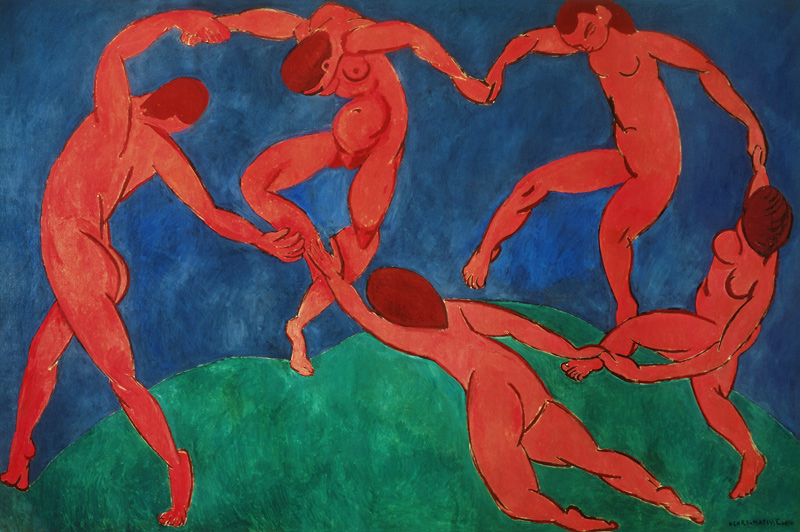
The image of Henri Matisse’s La Danse appears in my mind. As I enjoy the wind and the views, these movements continue to ripple gently through my thoughts.
And then I think, gosh, if roots are so strong and almost indestructible, what about my own roots? Can I ignore them? Is that even possible? Or am I meant to embrace them? Whether they feel good or not?
Well, those strong roots as a metaphor for human life and its meaning kept me occupied for a while. Clearly, no insight was coming to me, so I turned my attention back to the road and the nature around me.
I saw a remarkable number of birds. Lots of water birds in the polder beside the river, and a cheeky coot standing right beside the bike path with its peculiar feet and toes. The herons all stood remarkably majestic and upright, their necks stretched as long as possible and their beaks pointing into the air. A male pheasant ran off towards the woods. Jackdaws along the path, beautifully grey and black, with those clever little eyes that made me think they were keeping just as close an eye on me as I was on them.
Another quiet, but wonderful day.
Reflection
Perhaps not every question needs an immediate answer. Some questions are allowed to disappear underground like roots, without me knowing exactly where they are growing.
I don’t have to dig them up to know they are there.
Perhaps one day, somewhere, a little crack will appear in the asphalt and suddenly I will see something that has been growing beneath the surface with me all along.
And until then, I’ll simply keep cycling.
Appendix – On Roots and Responsibility
After writing, the question about my roots stayed with me for a while.
I think every human being takes root in the place where they are born. With parents, in a country, a culture and circumstances they did not choose for themselves. That soil can be loving and nourishing, but it can also be terrible. We all begin as babies from that one starting point.
We are not responsible for the soil in which our roots happen to grow. Not for where we are born, to whom, or for what is done to us. But I do believe in another kind of responsibility: the responsibility for how, throughout our lives, we develop in relation to that soil and learn to relate to it.
That does not mean that everything is within our control or that any of it is easy. Some people have endured almost unimaginable tragedies and later still found a path on which, instead of hatred, forgiveness, for example, found a place. Not because forgiveness is something we must offer, or because everyone should be capable of it, but because it shows just how far human inner development can sometimes reach.
Perhaps that is what I mean by autonomy and responsibility. Not that I am responsible for everything that happens to me, but that ultimately my life is still mine. No one else can do my development for me.
My roots tell the story of where my growth began. They do not completely determine who I eventually become.
And perhaps that is why I don’t need to ignore my roots, dig them up, or even embrace them.
I can acknowledge them.
This is my soil. I did not choose it. But whatever continues to grow from that soil is my life — and therefore also my responsibility.
Who Is Actually Accepting Whom?
21 + 22 September 2026
Once again, I have had two ‘ordinary’ days. My familiar daily rhythm. Getting up, showering, having breakfast, going to the gym. Taking off my wet clothes, washing and drying myself again, chilling, having lunch and going cycling, sometimes with a destination, sometimes without one. Dinner, followed by my laptop, TV and a book. Writing my blog and going to bed around midnight.
It may sound boring, but my body responds best to a certain amount of regularity. It probably also has something to do with my age and circumstances that seeking excitement no longer gives me what it certainly used to. The movements outward are increasingly becoming movements inward. There is always so much happening inside me that I never get bored.
As soon as I start my car, the radio comes on, often tuned to stations where people talk about subjects that seem relevant at the moment. I usually come into these conversations halfway through, so I only hear fragments.
This time I hear: LGBTQIA+ tolerance is declining dramatically in the Netherlands.
Ton and I both stumble over the word ‘tolerance’ at exactly the same moment. A little later, someone uses the word ‘acceptance’.
Both tolerance and acceptance seem to suggest precisely that which people hope to change. I mean, we are all human beings with different gender identities. Why should heterosexual people have to tolerate all other gender identities? Isn’t that rather strangely phrased? Or why should one human being have to accept another human being?
The very fact that it is described in this way already creates a distinction. And it seems to me that this is precisely what we are trying to avoid.
It also reminds me of how I kept hearing the phrase ‘ordinary people’ during parliamentary debates. What kind of dreadful expression is that? Does that mean there are also extraordinary or abnormal people? And who gets to decide?
Or I think back to the time when I met politicians, administrators and others to discuss poverty. They would give PowerPoint presentations and talk about ‘the vulnerable’ or ‘the weaker members of our society’. The only thing I could ask was whether they realised how strong people must be to survive with virtually nothing. To call this group ‘the weak’ seems rather presumptuous to me.
Ultimately, I always return to the importance of words. How the wrong use of a word can shift reality, both for the person using it and for the person being described by it.
A little later, they start talking about the growing influence of the manosphere. Man, oh man, how on earth is anyone supposed to keep up with all these new words?
The basic idea is that groups within the manosphere share the belief that men have lost their traditional and dominant position in society because of feminism and emancipation. There are concerns about misogynistic ideas reaching young boys as well. Yes, I can imagine this becoming a growing problem.
I also think that throughout history, progress, both material and mental, has always moved in waves. The emancipation of the 1960s and 1970s will probably return in another generation, but from a renewed perspective. We have seen this with religion and social morality throughout the centuries.
I am wary of the idea that everything used to be ‘better’. There is movement. No development ever stands still, and no development ever moves upwards in a perfectly straight line. It moves like waves in the sea.
As I have mentioned before, my grandmother was born into a world of long dresses, horse-drawn carriages and no television; only the wealthiest people perhaps had a telephone or an automobile. She died in a world of miniskirts, free love and computers. Two world wars, destruction and reconstruction.
I am not worried. For as long as I live, I look with curiosity at the development of humanity and its world.
Life has two sides: white and black, darkness and light, and so on. I choose to see and feel joy as much as possible, because nobody can steal the joy inside me.
Reflection
Perhaps that is also why words can affect me so deeply. A word may seem to be nothing more than a word, but unnoticed, it can create a reality. ‘Tolerating’, ‘accepting’, ‘ordinary people’, ‘the weak’ — before you know it, language itself has already created a distinction between the person who is looking and the person being looked at.
At the same time, I don’t want to draw a gloomy conclusion about the world from every word I hear. Humanity moves. Sometimes forwards, sometimes backwards, and perhaps forwards and backwards are not even as straightforward as we think. Within a single lifetime, my grandmother watched the world change beyond recognition.
Who knows how much more will change during mine.
I don’t have to understand all of it, and I certainly don’t have to control all of it. I can watch, listen, wonder and occasionally stumble over a word.
And then continue on my way.
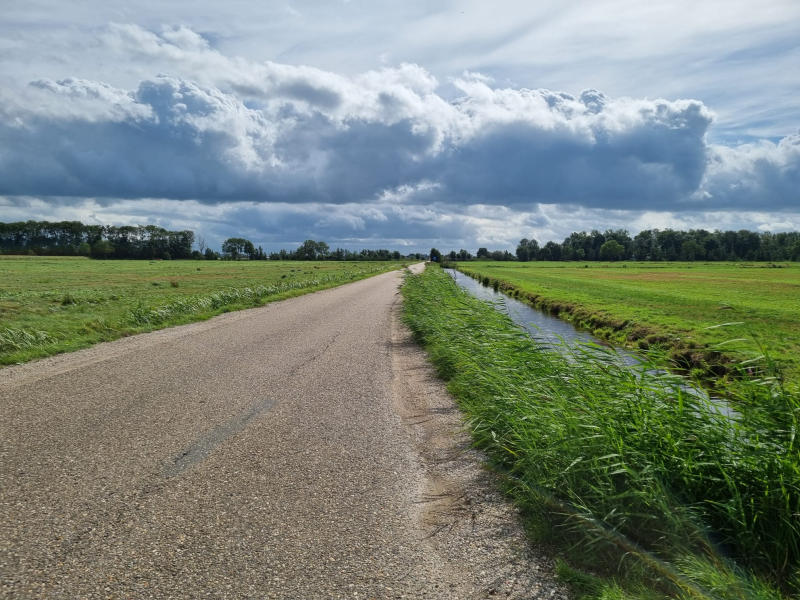
We get out of the car and onto our bicycles. I see the landscape changing into a new season, and with my face in the wind, I start to sing:
“That beautiful summer is over again.
That summer that started sometime around May….”
Is My Life Mine Alone?
20 September 2026
My coach’s grandmother suddenly became ill and was diagnosed with double pneumonia. She is in her eighties and was admitted to the ICU. His mother told me about it and described how, from one day to the next, a lively, bright older woman had suddenly become a truly old lady.
The doctor had asked her, “Would you want to be resuscitated?”
Her daughter and grandson found this a shocking question. Well, I can understand that. The answer is difficult too. You don’t know what condition you will be in afterwards. Whether the life you return to will still be a life worth living.
My coach and his mother did get involved in Grandma’s answer. I find that difficult too. At the time, I stayed out of all the decisions Michel made about his life. I think this is something deeply personal that others should stay away from. He did ask me for my opinion, but I didn’t give it to him. In the end, he made decisions that I myself would not have made. I never told him that either.
When I was admitted to hospital with my stroke, I was asked the same question. I didn’t feel ill. Certain things simply stop working or you can no longer feel them, and in my case I could barely speak and had some paralysis on the right side of my body. Because of my illness, things like that don’t easily overwhelm me, so I wasn’t afraid. In that situation, it was clear that I still wanted to live.
But because of my congenital illness, I sometimes go through difficult periods in which I can feel somewhat depressed. In such a state, my answer might be: I would rather not be resuscitated. As soon as I start feeling better again, not only physically but mentally too, I want exactly the opposite: to live at almost any cost.
So yes, it really is a difficult question, both for the patient and for those closest to them.
Who or what determines that we are born? Leaving the mechanics of reproduction aside for a moment. Who or what determines when we die? How and when?
To what extent do we actually have Life Itself in our own hands? I can make plans for tomorrow, but will tomorrow really unfold that way? Sometimes it will and sometimes it won’t.
I talk about it with Ton for a little while longer and then let the subject go.
At home, a series is playing. One of the main characters is writing a letter in which he quotes a line attributed to Mahatma Gandhi:
“Whatever you do will be insignificant, but it is very important that you do it.”
It is a powerful paradox that reminds you of the importance of action, however small or insignificant your own role within the greater whole may seem. On the scale of the universe or history, our individual contribution is minuscule and, in that sense, ‘meaningless’. That is, of course, very humbling, especially when you realise that a life of anywhere between zero and a hundred years is nothing compared with the existence of this world.
I believe in the importance of that single drop in the ocean. Precisely because nobody else can make your unique contribution, it is essential that you make it anyway. Your action is an indispensable link in the chain. That is why this quote resonates so strongly with me.
In the series, that thought is taken further:
“Whatever you do in life will be insignificant, but it’s very important that you do it, because you can’t know. You can never really know the true meaning of your life. And you don’t need to. Every life has meaning, whether it lasts a hundred years or a hundred seconds. Every life, and every death, changes the world in its own way. You can’t know. So don’t take it for granted. But don’t take it too seriously either. Don’t put off what you want to do. Leave nothing misunderstood. Make sure the people you care about know. Make sure they know how you really feel. Because just like that... it could be over.”
Perhaps I do look at it all a little too individualistically.
Perhaps it does matter how the people closest to you feel about it. Perhaps my life is not mine alone.
And as I write that down, I notice that I almost stumble over my own philosophy of life. After all, I believe that we are not separate individuals, but part of a greater whole. That single drop in the ocean. Minuscule on its own, but what is an ocean without all those individual drops?
If, on the one hand, I say that I am part of the whole, how can I then, whenever it suits me, want to separate myself from that whole?
That does not suddenly mean, for me, that someone else should be allowed to decide what happens to my life or my body. My autonomy is far too fundamental for that. But perhaps autonomy does not mean that a decision concerns only me. Perhaps I can make my own decision while at the same time recognising that my life is intertwined with the lives of others.
Just as Michel’s life remained part of mine after his death.
As I sit here writing this and thinking about it, I notice something shifting inside me for the first time. Not because anyone has convinced me. Not because I suddenly think my previous conviction was wrong.
Something has simply been added.
Reflection
Perhaps that is one of the strange and wonderful things about writing down your thoughts. Today I started with an elderly woman in an ICU and a question about resuscitation. I thought I knew what I believed about it: every person decides about their own life.
But as I write, I travel through Michel, my own stroke, life and death, a line from a television series and that single drop in the ocean, only to arrive at a question I wasn’t asking myself at all when I began.
Is my life really mine alone?
I don’t know.
Perhaps that question doesn’t need an answer today.
Sometimes a new question is movement enough.
Pulling the Handbrake
19 September 2026
Yesterday I wrote: I slept badly last night, so I slept in a little longer. Ton cancelled training. Apart from that, I felt fine all day. Still, I decided to make it a low-profile day. That’s how it feels, and I no longer fight it. It feels good that I no longer want or need to justify having a day like that.
Today I did go to training, and it went well. Still, once I got home, I continued my low-profile day.
The radio was on in the car. There was a conversation going on that I came into halfway through. It was quite difficult to follow, but they were playing around with words a great deal. At one point I heard someone say, “Yes, it’s a kind of sacred-sauce Catholicism.” I had to laugh because it sounded so strange. The speakers were talking very quickly and seemed completely convinced of what they were saying. I also heard them say, “Socially engaged people lie less than antisocial people.”
I asked Ton, “What is this conversation actually about?”
Neither of us could work it out.
Only now, twelve hours later, while I’m writing something about my low-profile day, do those remarks surface again.
Do you know that feeling, when something very old suddenly pops into your head out of nowhere? After training, I came home and the moment I stepped through my front door, I heard myself singing in my head: “We Were All Wounded at Wounded Knee. You and Me.” A song by Redbone, a Native American group. From the seventies, I believe. It became a hit in Europe, but if I remember correctly, it wasn’t allowed to be played in America.
Normally, you assume you must have picked up a tune somewhere in the background, causing you to suddenly start singing a particular song. But where on earth did this come from? I don’t think I secretly heard it somewhere. It seemed to come from somewhere deep inside me.
Even as a child, I loved the series Hawkeye and the Last of the Mohicans. A romantic image in which, in my experience, the Native Americans always won their struggle against the white oppressors. There was also the image of a white woman marrying a Native American man. Later, I fell in love with a man with long black hair who looked like a Native American, and indeed, he became my husband.
Was it my romantic imagination that was briefly touched today? Or was it the pain and betrayal they sing about that somehow stirred something in my subconscious? After all, doesn’t ‘sacred sauce’ suggest something like that too?
When I think about Native Americans being driven onto reservations and how, even there, attempts were made to destroy their people, it touches me and I feel horror and pain. When I think about a ‘sacred sauce’, which might mean that someone professes a religion while outward appearances conceal something inhumane, or perhaps a kind of sauce that makes something appear more elevated than it really is, I feel less pain. More a feeling of: what a shame.
I’ll just assume I was in a romantic mood and happened to laugh at a slightly sardonic expression like ‘sacred sauce’.
It is wonderful that we receive information through so many different forms of media. But you can wonder: to what extent does all of that secretly shape our perception?
I mean, I often say that I’m not a particularly social person. But am I even using the right words? Would that mean I lie more than a more social person?
What is a social person, and what is an antisocial person?
A social person is someone who gets along well with others, takes their surroundings into consideration and is oriented towards connection within society. An antisocial person is someone who persistently disregards the rights and feelings of others and the rules of society.
Pfffft, in that case I suppose I am a social person after all.
Still, I think it is quite a statement to say that one type of person lies more or less than another. Don’t we all lie? Perhaps the lies simply serve different purposes. I mean, there is a little white lie, or a lie intended to hurt someone or shift the blame.
And then, suddenly, I think about my mother, who had narcissistic personality disorder. Her lies went very far. But then I find myself in another dilemma, because can someone with a personality disorder do anything about it or change it? I have a neurological disorder that has meant I have never been able to run in my entire life. Can I do anything about that or change it? To what extent, then, is a physical illness different from a mental illness?
I don’t know.
Perhaps they cannot be compared in this way at all. It is simply a question that arises in me. Where does what you have, or what you are, end, and where does your own responsibility for what you do with it begin? I don’t know that either.
That is why listening to an interview with people who are knowledgeable in certain fields or know a great deal about a particular subject can be quite intrusive when things are presented so radically. I also miss a certain way of asking questions nowadays. Open questions followed by questions that reach further seem to have almost disappeared. Instead, questions are asked that already contain an opinion or a direction within them.
I experience this kind of information as pollution of my mind. It is one of the reasons why I prefer listening to music or watching documentaries and films that fall within my own interests. More and more information and opinions enter us unconsciously.
I am beginning to understand more and more why I am learning to embrace my low-profile days instead of feeling guilty about them.
Old films are much slower than films nowadays. The transitions between images, but also the silences between the words, when you get to see something of the surroundings and can hear the music more clearly. There is space. Not every moment has to be filled.
We humans are being driven out of our tranquillity. We have ended up in a current that is moving faster and faster, and each of us has to learn to pull the handbrake ourselves.
Reflection
Perhaps a low-profile day isn’t a day on which I do very little at all. Perhaps it is a day on which I allow less in.
My feelers are always switched on. A remark on the radio, from a conversation I don’t even understand, can still be floating around somewhere inside me twelve hours later. A few words can awaken a song from fifty years ago and, with it, images, feelings, questions and memories.
Some of those seeds I am happy to receive. They take me somewhere, open an old door or allow me to experience something again, but differently. But not everything that enters my mind needs to stay there.
Perhaps tranquillity isn’t only silence around me.
Perhaps tranquillity is also being able to choose for myself what I give my attention to.
The world can keep rushing by.
Every now and then, I’ll simply pull my own handbrake.
What Suddenly Comes Around the Corner Again
17 September 2026
My feelers are always switched on, through all my senses. I don’t need to read the newspaper or watch television to know what is going on in the world. Somehow, it finds its way to me anyway. Sometimes I hear something that sticks. These days, I put it in a memo on my phone.
This morning at breakfast, I see two phrases written there: “You can't take revenge with only hatred” and “undying flowers”. I slept well and for a long time, and I carry these quotes with me into my day. What is it that I find so beautiful or intriguing about them?
While we are standing in the lift on our way to training, I tell Ton about them. He immediately starts building a story around them, and I instantly shut myself off from that. No, I say, try to feel it first. Make it poetic. See the metaphors in front of you.
There is nobody at the gym. Ton goes grocery shopping, so I am alone, hanging from the machines with my thoughts.
You can’t take revenge with only hatred. Well, normally I already stumble over the very idea of taking revenge. Okay, then I’ll start with ‘hatred’.
To me, hatred is the opposite of love. One cannot exist without the other. Two sides of the same coin, minus and plus. Life as we humans experience it is, in every respect, a dualistic existence. So acting from only one side of the coin is incomplete. You need to know the other side in order to reach a decision that is balanced.
The opposite of revenge is forgiveness.
Okay, suddenly a little light switches on in my head. I am a Naruto fan. It is a Japanese manga series that was also made into an anime.
The main character, Naruto, is an orphan boy who grows up in Konoha, the Hidden Leaf Village of the ninja. His greatest dream is to become Hokage, the leader and strongest protector of his village, so that everyone will respect him. It is about his adventures and the life lessons he learns along the way. And he literally says: “You can't take revenge with only hatred.”
Naruto had every reason to seek revenge. Rejected, feared and held responsible for things he had never chosen. Someone else might have hated the world. But Naruto understood something that most people do not understand. Revenge does not put an end to pain; it multiplies it. A cycle of hatred. And so Naruto chose something more difficult than revenge: forgiveness. That is true strength. And that choice saved more lives than any Jutsu — the techniques ninja can use — ever could. That is why Naruto became Hokage.
I felt very connected to this character. That is also why this manga touched me so deeply at the time. I even made a painting inspired by the song ‘Blue Bird’ that appears in the anime. This painting was presented to a friend by the company she worked for when she left. Her boss asked me to say something about it when it was handed over.
My thoughts were suddenly completely immersed in this manga and that period of my life again, as if this one little sentence made me relive it once more. At the time, it was very emotional for me. At home, I looked up the text I wrote back then and was allowed to read aloud. Perhaps I have already posted it somewhere on my website. I don’t know, but I want to share it again anyway, because apparently it is still alive.
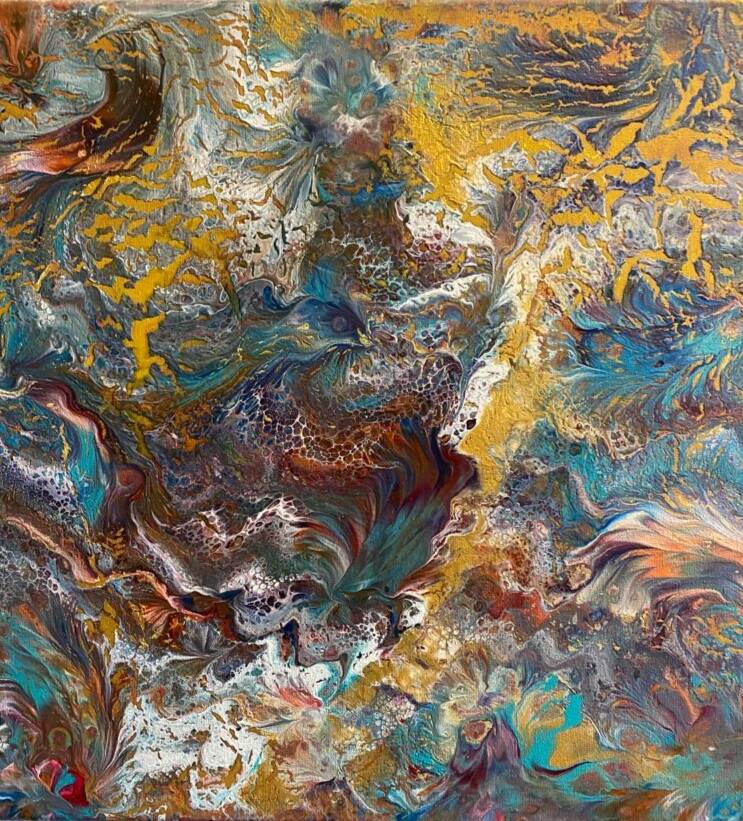
Blue Bird
The painting Blue Bird is very close to my heart. It hung in my new home. With love, I took it down from the wall so that Carin’s colleagues could give it to her.
Mark (Carin’s boss) asked me to say something about the painting. At first I hesitated, but immediately thought, oh well, why not.
It represents my past, in which I decided that I was not disabled, but merely had a disability. I became a student in a Sikh Ashram. There I learned to look differently at my temple (my body), and therefore to treat it differently as well. Fourteen years of strict discipline, from student to master. Something quite unique here in the West. The philosophy of life of the Sikhs shaped me. Of course I haven’t forgotten it, but I live in the moment, and suddenly I was confronted again with this journey in my development.
Blue Bird also reminds me of my remarkable children. Consciously or unconsciously, they absorbed this philosophy and, from a very young age, watched Japanese and Chinese animation. Stories with a moral, and often more realistic about human behaviour. Not always, “and they lived happily ever after.” My youngest daughter was already writing and speaking Japanese at a young age and even earned her first university credits in Leiden while still in her teens.
All of this came back to me when Mark asked me to say something about the painting.
Naruto is a Japanese anime, with the theme song: Blue Bird.
The English translations essentially say that if something stands in the way of your dreams, you should not allow it to stop you from reaching them. It is also about how far you can go in life when you are willing to fight for your dreams.
In Eastern philosophies, metaphors involving animals, imaginary creatures and/or gods are often used.
In the Mahabharata there is a story about a little bird (Blue Bird) that lays her eggs on the beach. A tidal wave carries the eggs away into the ocean. Drop by drop, the bird begins drinking the ocean dry so that she can find her eggs again. Arjuna (the god of rebirth) sees the bird and asks what she is doing. “Isn’t this an impossible task?” Arjuna asks. “No, if I drink for long enough, I will find my eggs.”
In the story, the little bird and Arjuna have many conversations. The bird has enormous faith that, with perseverance and love, she will succeed in finding her eggs. After many tests, and through being simplicity, selflessness, perseverance, trust in herself, and above all patience with love (called BuddhiMudra), Arjuna eventually decides to drink the ocean dry in one go. The little bird experiences a miracle and finds her eggs.
For me, this is the way to live. To enjoy every moment, transforming difficult moments into golden ones.
The technique I use in this painting imitates a kind of craquelure, as a reference to Kintsugi.
Kintsugi (‘golden connection’), also called Kintsukuroi (‘golden repair’), is the Japanese art of repairing broken ceramics with gold- or silver-coloured lacquer. In Japanese aesthetics, the traces of breakage and repair contribute to the beauty of an object.
The philosophy of Wabi Sabi has contributed significantly to the appreciation of kintsugi. This originally Buddhist worldview emphasises the beauty of imperfection and impermanence. Traces of use add to the value of an object. Kintsugi emphasises the cracks in a ceramic object, thereby revealing part of its history.
Wabi Sabi:
In traditional Japanese aesthetics, wabi-sabi is a worldview centred on accepting impermanence and imperfection. The aesthetic is sometimes described as appreciating beauty that is “imperfect, impermanent and incomplete” in nature.
But that is not the whole story, because both wabi and sabi represent an entire world of meaning. Wabi stands for simplicity and restraint, for the essence of things, but also for a way of living, a spiritual path. Sabi is something like ‘beauty through the passage of time’; it concerns what is beautiful, objects and art. You could also say: wabi is space, sabi is time. However you describe it, together they represent a sense of impermanence, of seeing the passage of time reflected in simple things.
This is everything my painting represents. Unfortunately, I wasn’t able to explain it very well at the time because I was overwhelmed by emotion. The translations on the canvas express, at the deepest level, the person I am. It touches so many layers. It was already difficult for me to show my paintings to the ‘outside world’; talking about them was even harder.
Lots of love, wisdom and happiness with Blue Bird.
Big hug, Annette
--------------------------
Today I am not going any further with ‘undying flowers’. Those thoughts will eventually come flying past again of their own accord. Just like Naruto, every now and then, sometimes with years in between, a sentence, a scent or something else suddenly comes around the corner again, asking to be experienced, felt and lived for a moment.
Only now, I feel pleasure and warmth instead of pain and sadness.
Reflection
Perhaps nothing that truly becomes part of us ever disappears. It doesn’t have to be consciously present every day. A thought, a story, a painting can lie quietly somewhere for years, until a single sentence opens a door.
What lies behind that door is still the same, but the person opening it is no longer the same.
Today Blue Bird came around the corner again for a moment. Not to take me back to the pain of that time, but to let me feel how much of it has meanwhile turned into gold.
And the undying flowers?
I’ll leave those standing for a while.
Apparently, they don’t wither anyway.
The Apple and the Old Table
16 September 2026
Last night it started raining, and today we’ve had heavy showers all day long. During the night, Thor, the god of thunder, made himself heard. My little dogs, along with other dogs in our apartment building, started barking. I woke with a start for a moment and then enjoyed the sound. To me, there is something protective about it. As though the heavens are making themselves heard, letting me and the earth know they are there. I know other people may have very different feelings and ideas about this, but when the heavens make this much noise, I actually fall peacefully back to sleep.
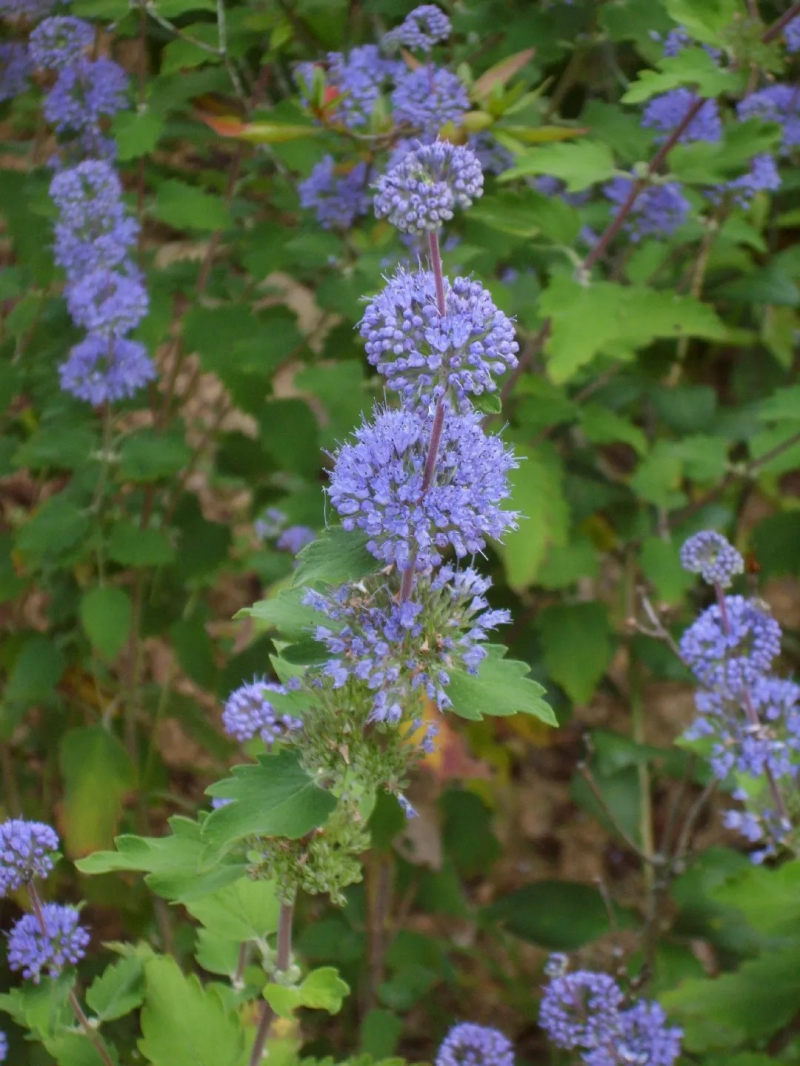
When I wake up, I hear the rain beating against the outside wall. Completely happy, I get out of bed and go into the living room to see how hard it is raining. Normally Ton gets up before I do. Now I’m sitting in the living room early in the morning, beaming as I watch nature come back to life. I think some hydration is probably very welcome after those dry, hot months. When we leave for the gym, I can smell the fresh air that has been released. I breathe it in deeply and enjoy it. We park the car beside a flowerbed filled with blue-purple flowers. The bluebeard seems just as happy as I am. Or am I only imagining that? This wonderful feeling clearly gives me more strength, and my workout comes easily.
As trapped as I can sometimes feel in our apartment during summer, that’s how cosy it feels now. Watching my series, window open so I can enjoy the fresh air, still lukewarm for now, and the sound of the raindrops.
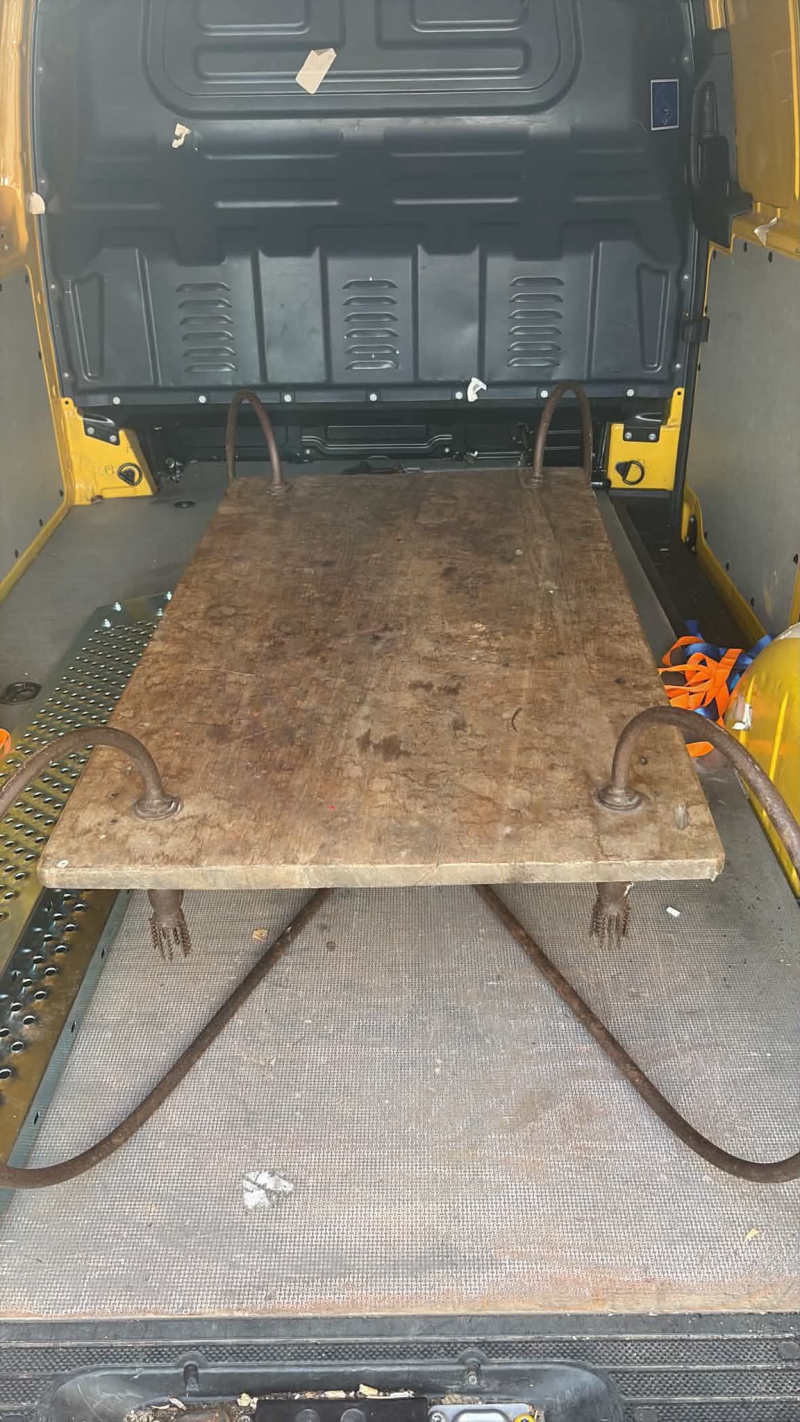
My youngest son calls to ask whether Ton can help him collect our old coffee table from storage. Ton is happy to go with him, because a rainy day like this works very differently for him than it does for me. My son has decided to stay in his house after all and is now going to furnish the larger room that has become vacant. He longs to sit against the sofa, just like he used to, and eat at this table. The memory brings him close to his father and mother and to the cosy family we once were. He has connected that feeling very strongly to this table. It is also the reason I kept it, especially for him.
It gives me a warm feeling that he describes this so specifically. His years of pain seem to be behind him. More and more, I see a young man embracing the beautiful memories and warm moments from the past. And he tells me about them too, as though now, at the age of 28, he is bringing some balance into the story of his life so far.
In astrology, this is his first Saturn return. After this, he begins his second cycle. Saturn is seen as a strict but wise teacher, one who appears in all kinds of areas of your life to confront you with obstacles and illusions. You may experience setbacks, delays or even complete standstills. But the question is: can you persevere or take responsibility? The second 28 years are the years in which you can begin to mature through this.
Yes, I think, my son is changing. It may seem as though I am covering all of this with an astrological explanation. That is not my intention. It is simply what passes through my mind when I suddenly see him building a kind of ‘real’ nest for himself.
There is something unusual about the way he moves through life. I don’t say that simply because he is my son; Ton has also been able to experience this during the years we have been together. So when Ton comes home again, I ask him, “And, has my son experienced or told you anything unusual again?”
Ton tells me that he has been talking about cars that were built in the Netherlands. That isn’t really the case anymore, but he has invented a new car himself, with different models. The brand would be called Zant, and the models would be named after Dutch rivers. Zant-Maas, Zant-Rijn, Zant-Waal, and so on. He has even designed a logo and shows it to Ton.
Ton looks at me, laughing, and says, “He talked about this in great detail the entire time. And yes, it is a little unusual.”
Hahaha, I understand, because I can picture exactly how this must have gone. Last year he wanted to buy leather so he could design and make his own shoes. He can go incredibly deep into his creative thoughts and ideas. He resembles his father, but I’m beginning to see more and more that there are also a few peculiarities from his mother in there. I too have always been able to dive very deeply into an idea. Not because I necessarily intend to do anything with it afterwards. No, it simply has to come out.
Last week he called with a depressive message, which unsettled me for a moment. Fortunately, I was able to pull myself out of that feeling quite quickly, knowing that for him it is something he feels very strongly in that particular moment. But it passes again. In his case, creative ideas emerge and he gives them space. Without even realising it, they lift him out of a heavy mood again.
By seeing and getting to know myself more and more, I can look at the movements of my children with greater calm. The apple doesn’t fall far from the tree with my youngest son, nor with my youngest daughter, with whom I haven’t had contact for more than a year. I hope I may live long enough to see how they develop as unique individuals. What will they take with them, and what will they add? How will they love life, and learn to love it?
He cleans the table, sands it and gives it a coat of wax. He sends me a photograph of himself working on it.
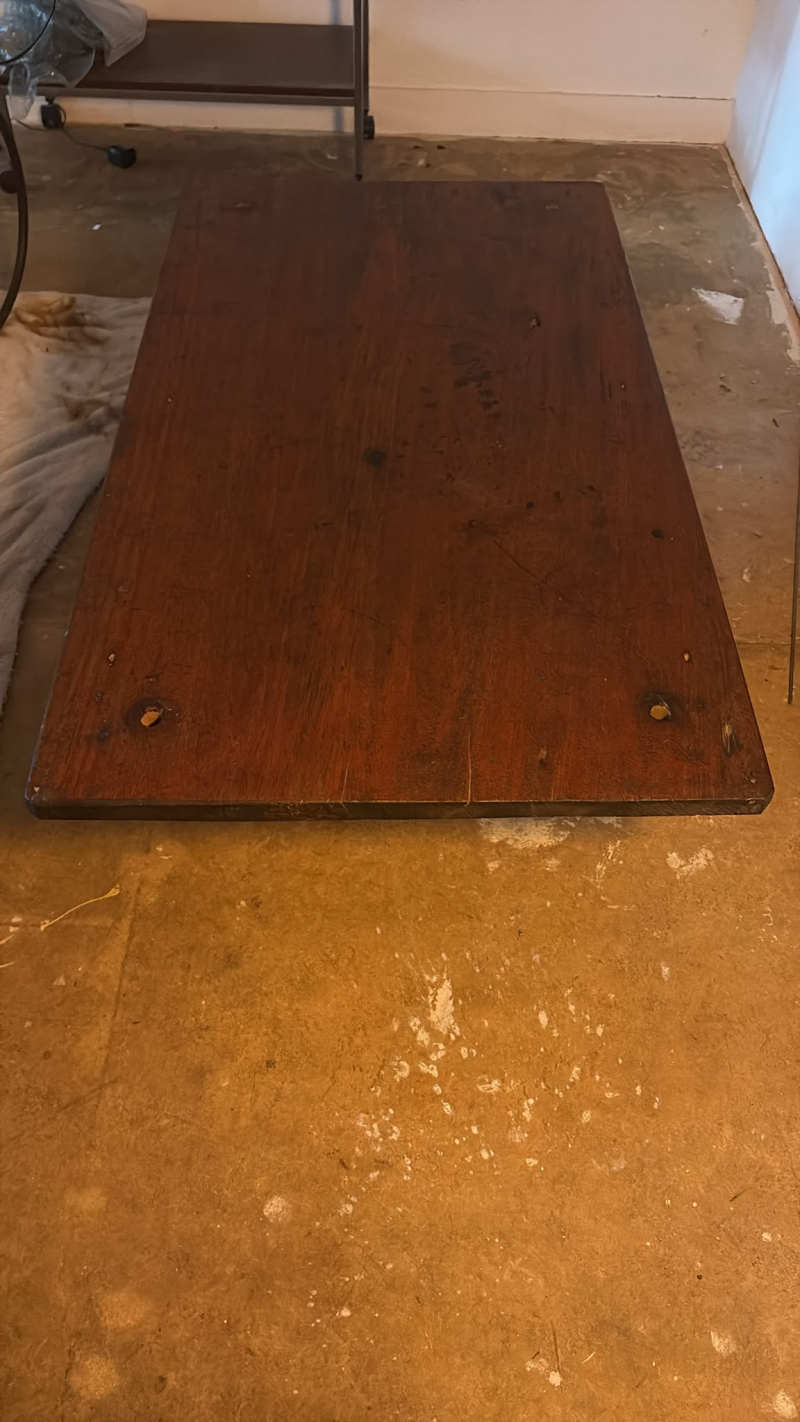
I see love and write to him:
19:28 — I’m glad you have this special table.
19:29 — Papa would like that too 🙏🏻
And I get back:
Xoxoxoox
Reflection
Perhaps objects carry far more of a life within them than we realise. An old table is just wood, until someone wants to sit beside it again the way they used to. And suddenly it contains meals, voices, parents, children, safety, and a family that once existed exactly like that.
My son isn’t simply taking an old table into his new room. He is taking a piece of his origins with him and giving it a place in his life again.
And as I watch him, perhaps I see the same thing happening that I recognise in myself: you don’t have to leave your past behind in order to move forward. Sometimes you take with you the parts that are still warm.
The apple doesn’t fall far from the tree.
And perhaps it doesn’t need to.
Just Follow the Stone
15 September 2026
After spending several days worrying and getting angry about all sorts of things, last night I dreamed about the worries in my life that I bury deep inside. After all, in my case worries, fears or uncertainties are about things that might happen, but that are not actually happening yet. My past can already begin to colour the future in my thoughts. At least when I’m not feeling quite myself, or when my energy is low, as it has been these past few days.
The ordinary, strong Annette doesn’t believe in the worries of tomorrow. No, she lives now and moves with whatever is here, or whatever presents itself in this moment. The only thing I know is that my dream showed me the worries that had apparently been moving through me these past few days. I no longer remember exactly how or what, but I do remember the one sentence I woke up with:
“Just follow the stone.”
Those words resonated in my mind all day. I dream in other languages more often, especially in English. How that works is a mystery to me. Perhaps because I always watch TV series with English subtitles. In the past I also dreamed in English because my studies were entirely in English.
It sounded as though I was being told: keep trusting yourself. Follow that path, the path you have been walking all your life. Just follow the stone.
The imperishable, wise stone, a symbol of timelessness and memory. It is the first time a stone has appeared to me as a metaphor for my inner guide. I didn’t picture a mineral, but rather a boulder or ancient rock. On the one hand I think: that is very hard and solid, perhaps even immovable. On the other hand, there is something about it that is deeply anchored in the earth, a stability that feels safe and has existed for as long as the Earth itself. Hahaha, following that stone might actually be rather clever, because it is difficult to imagine anything wiser.
An image came to mind of the rock formations in South Africa, some of the oldest geological formations in the world, in the Barberton Makhonjwa Mountains. Once, on a flight to South Africa, I learned that some of the oldest rocks on our planet could be found there. I immediately thought I absolutely had to go there. The idea of touching something 3.5 billion years old reduces the perspective of a human life to a drop in the ocean.
And yes… what worries now?
Follow the stone within me and life will unfold as it is meant to unfold for me.
I don’t particularly like hugging people, for all sorts of reasons, but I hugged and touched that ancient rock. It was twenty years ago. And now, because of that one sentence in my dream just before I woke up, for a moment I was there again.
I felt good and recharged. For the first time in weeks I went to the gym in the morning, and in the afternoon we cycled to the hospital and turned it into another beautiful 25-kilometre ride. It was warm, around 25 degrees Celsius. According to the forecast, this would be the last warm day. From tomorrow onwards the temperature will drop and there will be plenty of rain for a while.
We passed a terrace by the water and decided to stop there for a bite to eat, as a farewell to summer.
We were served by a lovely waitress who spoke Dutch with some difficulty. I asked whether she was from Ukraine. She was. Then I asked whether her family was here with her as well. When she said yes, I told her I was glad.
Tears appeared in her eyes and she spoke with a lump in her throat. She asked whether I minded that she was here and working here.
Oh no, Ton and I said almost in unison. We’re glad you’re here and that you’re doing well.
It hurts to realise that such a thought even occurs to her. She had to flee her home with her family. How were they received here? How many unkind reactions must she have encountered? I looked at her and saw a young woman who had already been through so much.
And then she said something extraordinary.
She asked, “Did you enjoy the food?”
Yes, we said, it was delicious.
And then it came… that one little remark that went straight to my heart:
“Yes, it has to be, because it was made with love.”
It came out so sweetly and so sincerely.
At home we watched parts of Prinsjesdag in a talk show that showed and discussed some of it. One of the guests said that, to him, it was a call for connection. Only connection can move a country and its people forward.
Yes, that seems obvious.
But why, then, is it so difficult?
Ton showed me an interview from England with a famous actor who read a passage by Shakespeare about refugees four hundred years ago. People called them barbarians, and Shakespeare described the way they were being treated. Even then, he was trying to expose how inhumane and short-sighted this was.
The actor could only say, quite simply:
“Well, then we haven’t made much progress in 400 years.”
Yes, I try to learn from my mistakes. I think individual people generally try to do that.
But why is it so difficult for us to do the same as a group, as a country, or globally?
Reflection
Perhaps that is why the stone returned to me.
A stone does not hurry. It does not worry about tomorrow. It carries everything that has happened without ceasing to be what it is. For billions of years it has witnessed change, destruction, growth and new beginnings.
Maybe Just follow the stone does not mean that I should become harder or more immovable.
Perhaps it means: stay grounded. Remember. Learn. Keep moving without losing what lies beneath you.
And perhaps, as human beings, we still have a great deal to learn.
How old must the rocks become before we do?
Three Days of Angry Rain Showers
14 September 2026
Last night at 12:01 a.m., I FaceTimed with my youngest son. I sang Happy Birthday to him. It is always lovely to see how such a big guy can still be so happy that his mother calls him. Funny how I can still see the little baby Buddha in this 1.90-metre-tall man. Everything is and remains a matter of personal perception; this is a good example of that. Perception is coloured by memories, experiences, feelings and the position of the person looking. As his mother, I can only hope that other people, and the world, can see something of him that I see. That is my silent wish for him.
I have a good, long night’s sleep, but wake up with a woolly head. After breakfast, I feel nauseous and tearful. Damn, it throws me off a little. I can’t go training when I feel this nauseous. Today, that feels like a personal failure. Of course it isn’t, but apparently I am slipping back into my angry, obstinate mood.
So what can I do? No laptop or television, and certainly no painting in this state of mind. Okay, a long, extensive shower. Giving myself some attention and letting the water literally wash something away. I have long, thick hair that I have to wash three times to get it properly clean. At the same time, I massage my scalp thoroughly. That usually works wonders.
And indeed, I feel considerably better afterwards and can go to the hospital with Ton. He has to be there for an examination, an exercise stress test. As it happens, the cardiology outpatient clinic in this hospital is right at the very end. Ton walks quickly ahead because we are running a little late. As I make my way down that endlessly long, sterile corridor, I talk to myself. Since the stroke, I have been dependent on a walking stick. It is really difficult to keep walking straight and not lose my balance. I am slow too, and many people pass me.
Meanwhile, I put things into perspective. I am alive. It is a shame that I have lost my balance, and a shame that talking is tiring for me. But I am here, and I do everything in my own way.
In the waiting room, I sit at a table with magazines and try to pass the time. There is a man sitting behind me who burps. I jump. A little later, I hear the sound of heels approaching. I jump again. Then a doctor enters the room and calls out a name, and there I go again, startled. Clearly, something inside me is overstimulated, more than usual. I simply observe it.
Ton returns quite quickly and tells me that he has to wait for a Holter monitor because they have seen clear heart rhythm disturbances. We walk back down that same long corridor. This time, I have my walking stick on one side and hold Ton’s hand with the other. We are glad they are immediately looking into it further. Tomorrow afternoon we have to come back, and in a week there is an appointment with the cardiologist.
I observe myself, weighing up how much support I need to keep moving forward. I am behind the wheel when a car suddenly comes towards me on the wrong side of the road, probably trying to take a shortcut around the road diversion. I startle and let out a few choice words. It feels good to do that, almost liberating. Ton laughs because normally I remain very calm in situations like this.
At home, we are quiet. I cuddle my dogs while Ton prepares dinner. After dinner, there is a talk show in which a top athlete talks about his stroke. He describes what it was like and how quickly people responded when he could no longer speak. At the hospital, he was immediately given blood-thinning medication, which, according to his account, helped limit further damage. Coincidentally, my sister also had a stroke four days ago and was treated immediately as well.
After the interview, I walk into the living room, where Ton is watching the same programme. In my case, it took more than twenty-four hours before I was admitted to hospital. Far too long for them to still give me acute treatment at that point. After that, it was a matter of waiting for the stroke to pass and then seeing what still had not returned after a year of rehabilitation.
Ton was very clear with the doctor’s assistant, I remember that. I could no longer speak. It had nothing to do with a sore throat or having a cold. She kept insisting that the GP had no time to see me and that if I was still like that around five o’clock, I should just go to the hospital.
The memory makes me angry again, and I need to let that anger out for a moment. It didn’t have to be this way, I think. Perhaps I could still have had my balance and been able to speak normally. The GP apologised, but what good does that do me now?
Should I confront that assistant one more time? Ask her whether she ever goes for walks. How wonderful that is. Tell her that I can no longer do that the way I used to and that, at the time, she refused to pass my symptoms on to the GP. Would she respond differently if another patient came to her with the same symptoms?
So there you have it. Apparently, there have been a few rain showers trapped inside me over the past few days.
Hopefully, those showers have passed again. I am not going to confront anyone. Who doesn’t make mistakes? Perhaps we ourselves should have been more assertive. I don’t know. It doesn’t matter anymore.
I’ll just say that I have had three days of angry rain showers. And as I write this, I have a smile on my face. So things are never quite as fierce as they seem in the heat of the moment.
Not even with Annetje.
Reflection
Perhaps anger doesn’t always have to be put into perspective immediately. Over the past few days, I knew perfectly well what I couldn’t change. I knew when I was running into a concrete wall. I also knew that staying angry wouldn’t solve anything. And yet the anger was there.
Perhaps that was reason enough simply to let it be there for a while.
Today, it turned out that there was an older shower hiding behind it as well. A memory of something that can no longer be changed, and I will never know what my life might have looked like if things had gone differently at the time. I can think about it rationally, accept what is and know that people make mistakes. But apparently, that doesn’t mean I am never allowed to feel angry about it again.
Three days ago, I cycled beneath a sky that was light and dark at the same time. Yesterday, rain poured down outside while my own inner storm slowly subsided. Today, another heavy shower passed through.
And now I am smiling.
Perhaps that is simply my way. Not pretending the rain isn’t there, but not turning it into a permanent climate either.
Sometimes a shower simply has to fall.
Afterwards, we’ll see what the weather brings.
Understanding Myself Better
13 September 2026
As I wake up, I just manage to catch the final sentence from my dream. I hear myself say: “Yes, I’m beginning to understand myself better and better.”
I lie on my back with my hands folded across my chest and think about this for a moment. Gosh, that’s interesting. Do we actually know who we are? Why do we do the things we do? Why do we think the way we think? Does a person really know exactly what moves them?
How I was made, okay, the story of the birds and the bees. But why me? Why in this particular place? Within this family? In these circumstances? Well, I could fill in the answers based on something I believe. But the word itself says it all… belief. Truthfully, I don’t know. I even think that human beings know very little about existence. Life, and my own existence in particular, is a great mystery. That is my conclusion. I get out of bed and write this down first, before my day has even begun.
I have no plans. Heavy rain is forecast for the entire day. It is Sunday, so a pyjama day is certainly a possibility. I’ll see what happens………..
In the end, it turns into binge-watching Empress Ki. I also continue for a while with yesterday’s conflict with Ton. Why? Perhaps sometimes a person simply needs to let the frustration out. Even though I know I’m running into a concrete wall. I know I can’t change it, and yet this time I want to seek out the tension for a while. Why shouldn’t I be allowed to simply let that frustration out?
Normally, I tend to avoid conflict. Whether that is always a good thing, I don’t know. I can put things into perspective fairly easily and when I can’t change something, I usually accept it. Klaro. But perhaps that doesn’t always have to happen immediately. Perhaps I don’t have to understand, put into perspective or let go of every emotion straight away. After all, even a pitcher will eventually break if it goes to the well often enough.
While the emotions are still raging through me, I watch the series. Slowly but surely, my mind switches off and calm returns. Outside, it pours with rain all day. Inside, the rain eventually seems to ease as well.
Hopefully, I have managed to leave my inner storms behind me again, at least a little. The season in which I feel most at home has announced its arrival, so the sun inside me may begin to shine.
Reflection
“Yes, I’m beginning to understand myself better and better.” Those were the final words from my dream, and perhaps this ordinary Sunday has already added another small piece to that understanding.
Understanding yourself may not mean being able to explain everything about yourself. Nor does it mean that you always have to react sensibly simply because by now you know how something works. I knew I couldn’t resolve the conflict. I knew I couldn’t change Ton. I even knew I was running into a concrete wall. And yet the frustration was there inside me. So why shouldn’t I be allowed to feel it for a while and let it out?
Perhaps acceptance is something different from skipping over something. I can know that something cannot be changed and at the same time feel angry, sad or frustrated about it. One does not have to exclude the other.
This morning I wondered whether a person ever truly knows what moves them. Tonight my answer is still: no, probably not. My existence remains a great mystery to me, and perhaps I will always remain a little bit of a mystery to myself as well.
But every now and then, I understand another little piece.
Nothing and Everything at the Same Time
12 September 2026
For me, this has turned into a special day. After a dream in which I was being chased, I wake up drenched in sweat. I wasn’t afraid, more frustrated and exhausted. Instead of going to the gym, we decide to go cycling around the Reeuwijkse Plassen, an area neither of us knows except from maps. Using my cycling junction app, I plan a route of about 21 kilometres.
Before we set off, I have a clash with my husband. He is someone who focuses on a few things in life and forgets a lot of everything else. Sometimes he can no longer remember things that are important to me. Fortunately not always, but often enough. Sometimes it hurts me and makes me feel powerless. And from that feeling, I become angry. I am exactly the opposite. Perhaps in an extreme way too, but I remember an enormous amount, right down to the smallest details.
According to him, his forgetfulness comes from having too much on his mind. And that is another place where we clash, because I think it is unnecessary to worry about things you cannot change. I am very simple about that: if I cannot change a situation, I accept it. Klaro. Then I focus on the things I can do. Difficult situations that I can no longer change will eventually move towards change by themselves. Nothing stays the same, not even unpleasant things.
Our communication doesn’t work this morning. In the car on the way to Haastrecht, where I have chosen the starting point for our cycling trip, I am still silently mindfucking. I am a talker and Ton shuts down. By now I have learned that at such moments I had better stop talking and keep the dialogue inside my own head, so that my frustration doesn’t rise even further when there is no response whatsoever to what I am saying.
Fortunately, a switch flips inside me as soon as the bicycles are out of the car and we can begin our ride. The weather is mild, about twenty degrees. The sky is light and dark, there is a breeze, so a cardigan and a headband are necessary now.
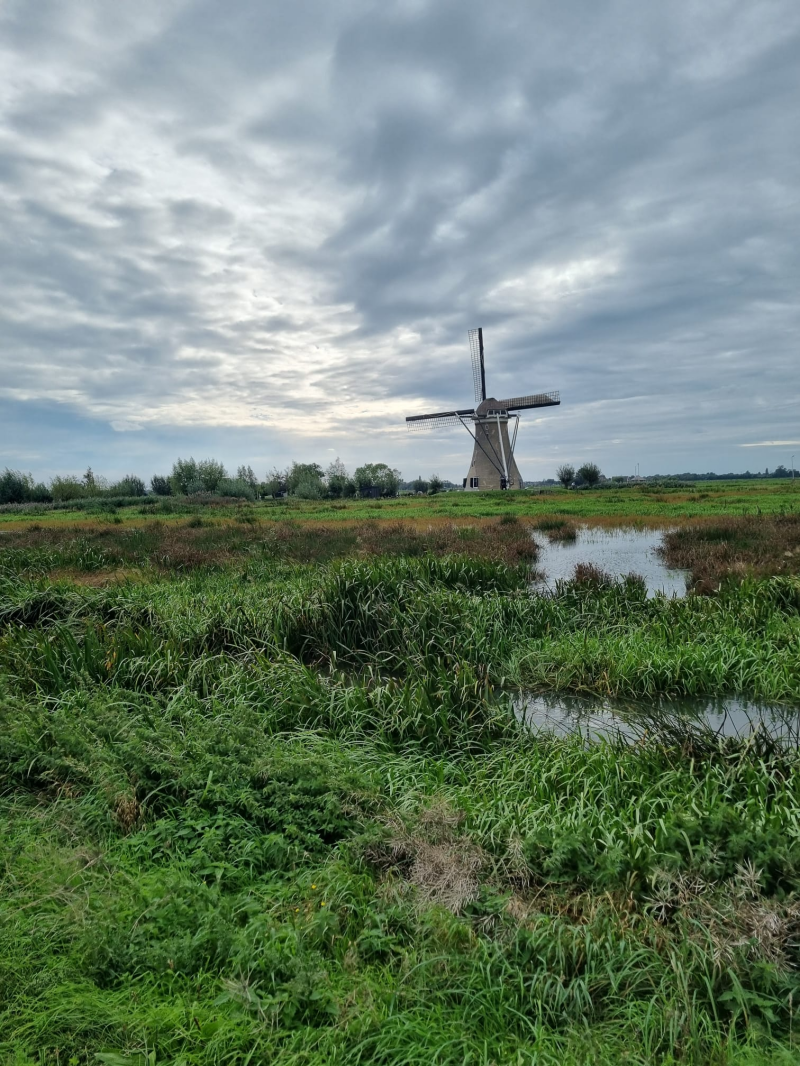
Since we have been cycling so much over the past few years, we have discovered so many places in the Netherlands. Beautiful areas we know by name but have never actually visited. By car, you often travel along the main roads from A to B, but you rarely pass through the villages and farmland. There are also so many cycle paths where cars never come, often straight through beautiful nature reserves. And then there are the names of villages that are completely unfamiliar to us. Like today. We end up sitting on a terrace in Hekendorp, on a street called Goejanverwellestraat. Wonderful, isn’t it?
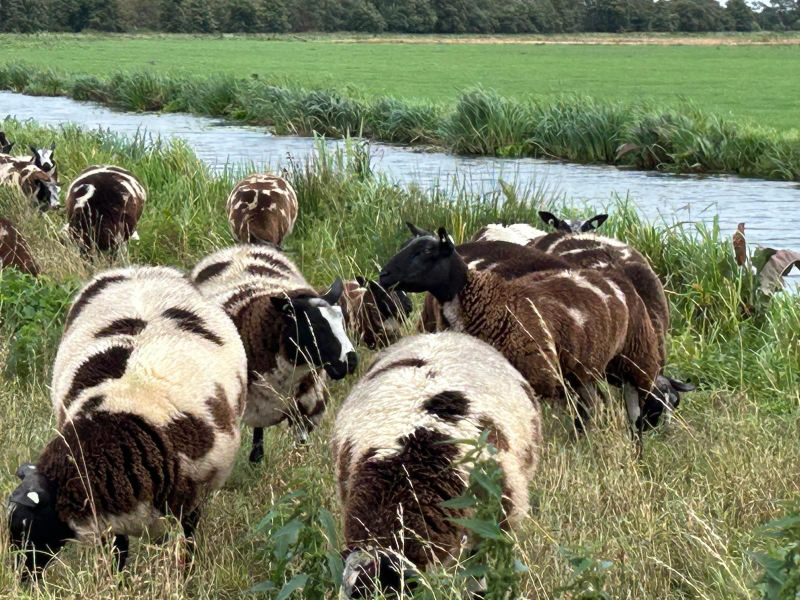
Apart from the Reeuwijkse Plassen, we see an incredible number of ditches, little locks and bridges. Vast stretches of farmland, and this time lots and lots of sheep, all kinds of different breeds.
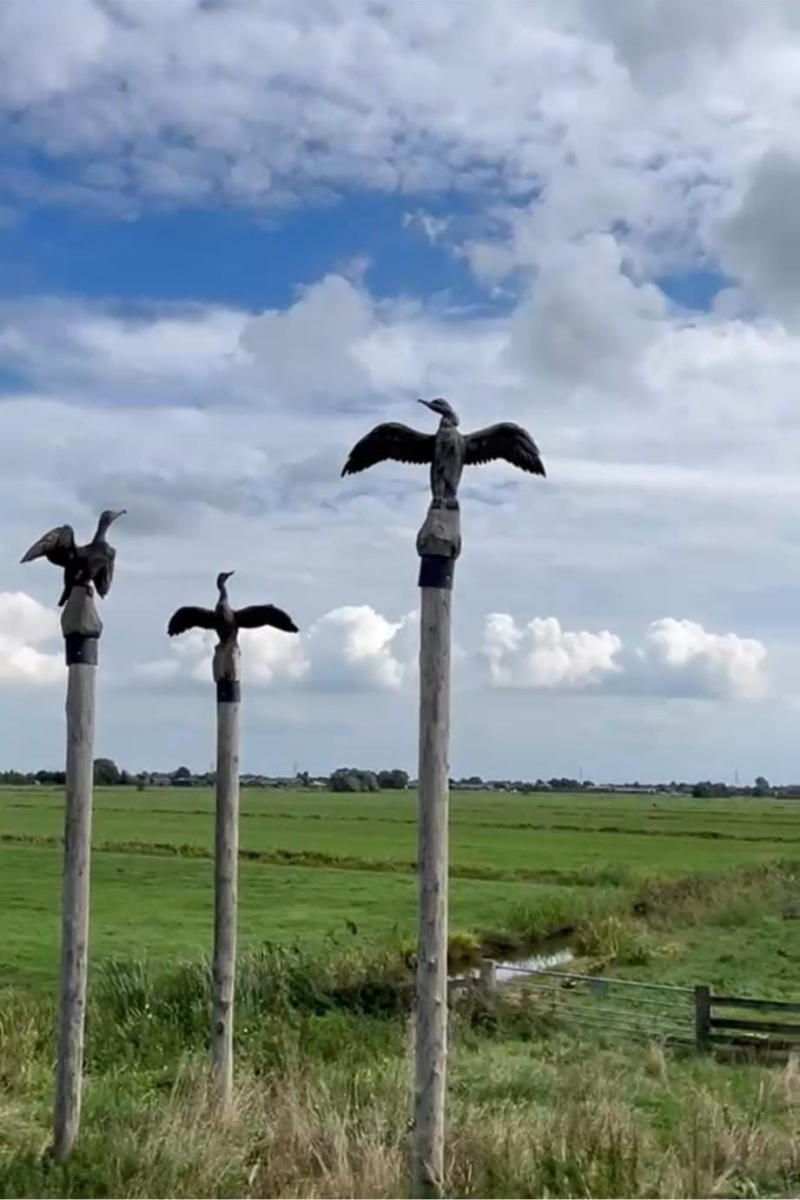
In a somewhat marshy landscape, we come across three tall poles with wooden cormorants perched on top. Works of art in the middle of the landscape.
Less than ten minutes later, we see a real cormorant standing in the field with its wings spread wide. I stand watching him for about fifteen minutes. He simply stays there, happily drying his wings. I take a photograph with my phone. It is a little difficult because he is actually slightly too far away, but for me the photograph is still worth having as a memory.
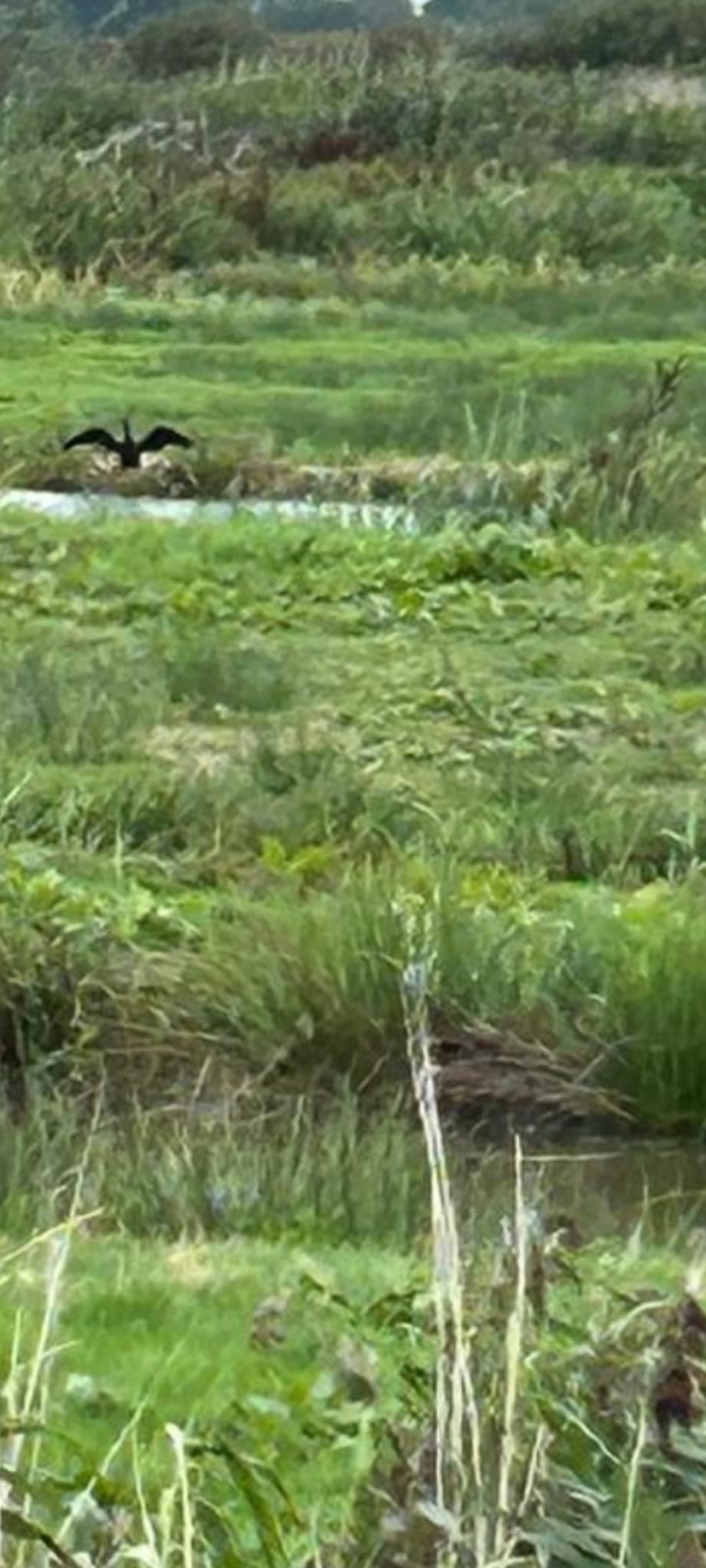
On the other side of the cormorant lies the marshland, with a windmill beneath a beautiful sky. These are the moments when I simply am. Nothing has to be done. Nothing is required. No thoughts, no emotions, absolutely nothing.
And at the same time, it is everything. Breath. Life.
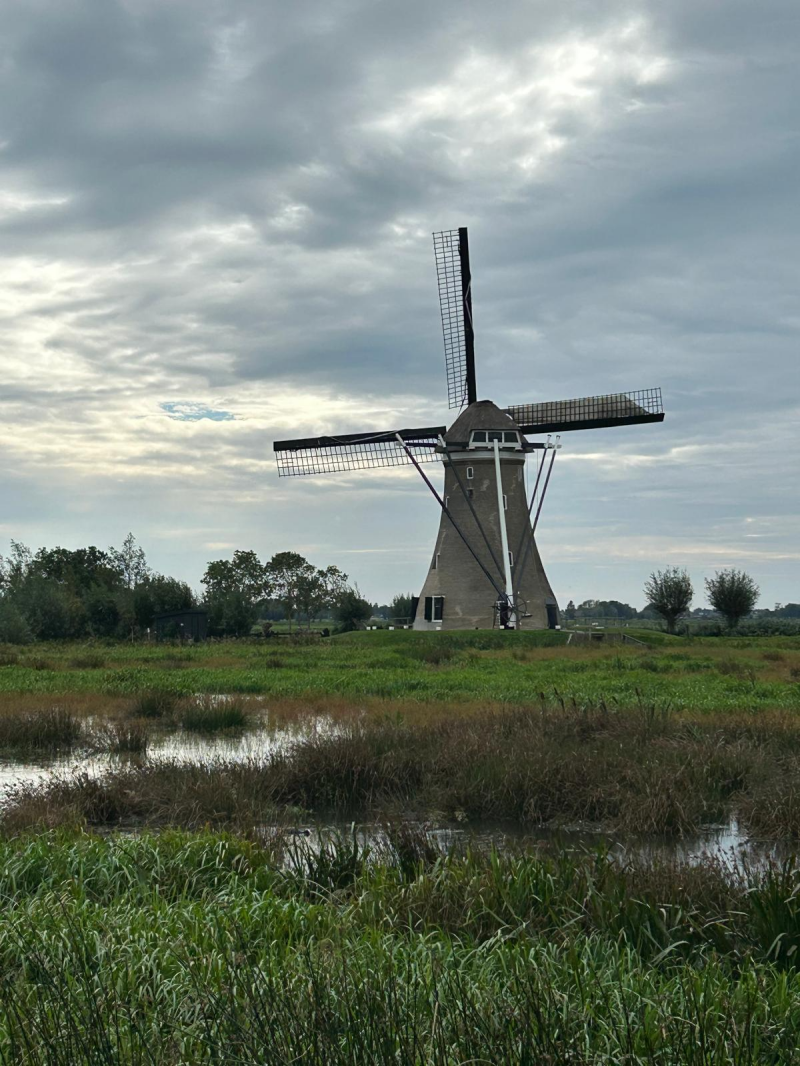
Eventually, we arrive home at 6:00 p.m. As always, I walk straight to my bedroom and take off all my clothes, right down to my underwear. Then I put on my comfortable clothes, lovely loose-fitting things.
And then I make a discovery.
For the first time in months, I am dry!!! Not clammy or wet, but completely, utterly dry.
OH my God, how wonderful that feels!!! What a blessing this is!!!!
My body and I are happy.
Reflection
This morning my head was still full. A dream in which I was being chased, frustration because Ton and I couldn’t reach each other, and then, in the car, an entire conversation continuing only inside my own head. It wasn’t resolved. We didn’t talk it through, and there was no wonderful insight that suddenly made everything different.
We simply took the bicycles out of the car.
Somewhere along the way, apparently, there was no longer any need for conversation. There were cycle paths, unfamiliar villages, ditches, little bridges, sheep and a street called Goejanverwellestraat. There were three wooden cormorants perched on poles and, a little later, a real one standing with its wings spread wide. For fifteen minutes, I didn’t have to go anywhere. I simply watched.
Perhaps that is what does me so much good in moments like these. I don’t have to process anything, understand anything or even feel anything. I don’t have to search for light when it is dark, nor push the darkness away when light appears somewhere. It can all exist at the same time, just as the sky today could be light and dark at once.
And sometimes happiness isn’t complicated or grand at all. Sometimes it is a bird that stays in one place long enough for me to watch it for fifteen minutes. An unfamiliar cycle path. A beautiful sky. Or coming home after months, taking off my clothes and discovering that, for once, my body is completely dry.
Nothing has to be done. Nothing is required.
Sometimes, for a moment, there is nothing.
And at the same time, it is everything. Breath. Life.
As Vast as the Universe
10 September 2026
Last night I wished my sister a happy birthday. She responded immediately, so it was obvious that she, too, was unable to sleep. After my fifth short night in a row, I still wake up on time. Ton isn’t there, but my housekeeper is. I have known her for more than twenty years, and during those years she has been through quite a few personal dramas. I have regularly been able to offer her help and advice. With matters that were perhaps a little less urgent, she often didn’t do what I had advised her to do. Only when the knife was figuratively at her throat would she follow my advice and accept my help.
What is it about human beings that makes us prefer to keep stumbling or bumping into the same stone rather than learning from it? Once again, she has a story about something that has happened to her. Clearly another case of the proverbial donkey bumping into the same stone again and again. This time, I simply listen and wish her strength. As she is leaving, she stands there looking at me somewhat hesitantly. I say, “You will probably keep encountering these kinds of things until you take responsibility and learn from them, so I wish you strength.” She nods, straightens her shoulders and leaves.
Shortly afterwards, Ton comes home. I ask, “Do you love me?” Hahaha. “Yes, do you want to know how much?” Of course. “Do you know the universe? Well, that much.” I like hearing this. If my beloved doesn’t spontaneously say these kinds of things to me regularly, I simply ask. I could apply all kinds of psychology to why this is important to me, but I no longer feel the need. I enjoy this little game between us. Best not to change a thing, I would say.
I decide to call my sister as well, to wish her a happy birthday this way too. Another year older, already 78.
And that is where my musings begin. With my housekeeper, the word reflection came to me. Ton mentioned the universe, and with my sister the word perception arose.
To me, reflection means consciously pausing to consider my own actions, thoughts and experiences in order to learn from them and develop myself. I have never liked photographs or selfies of myself. I rarely look in the mirror either, except for practical purposes, shall we say. I know, perhaps not typically feminine, but it simply isn’t in me. I do remember, however, that in the past I could stand in front of a mirror, look deeply into my own eyes and literally have a conversation with myself out loud. That reflection gave me insight into how I was feeling. Apparently, I couldn’t always reach those feelings in another way. By looking into my own eyes, I could see, as it were, the pools of my soul. I could see the pain, the sadness or the joy. If there were tears inside my body that wouldn’t come out, the mirror could help set them free. The reflective and far-reaching questions I asked myself also helped me move forward.
I am not saying that certain things never repeat themselves in my life in another or a new form. No, they certainly do. It tells me that there is still something I haven’t seen or felt. Self-reflection is an important part of my life. Sometimes I find it difficult to notice that someone else doesn’t seem to engage in it, but instead appears to prefer remaining stuck in a negative feeling. Isn’t the point precisely to notice every mustard seed of happiness? To allow ourselves to experience it? Especially through the painful parts of life? So that this minuscule happiness can be experienced as something as vast as the universe?
And there it is... the universe.
Whole and All. The whole, completely joined with everything. Everything as the totality of existence. The entirety of everything. The totality of all that exists. How beautiful is that? Happiness is like a drop in the ocean. But what is the ocean without drops? To me, it matters that I see and experience those drops, because that is how I become part of that ocean. A star in the sky. It all depends on how I choose to look.
And that brings me to perception. Precisely by reflecting, by seeing more and more seeds or stars of happiness in life, my perception of the world—and really of everything—naturally begins to shift. I don’t experience my sister as an old lady of 78, but simply as my sister. We talk about our lives and how we relate to them. We see each other’s growth, notice shifts, and yet at our core we remain the same.
There is something that doesn’t change. But what is it? Is it the Source? Is it the Soul? What is it? Do I actually want to know? Or may I simply experience it?
I myself always use the word universe. Uni comes from the Latin unus, meaning one. The second part is related to vertere: to turn, rotate or change direction. Universus carries the meaning of the whole, everything together. You could almost read the separate parts poetically as ‘turned into one’ or ‘turned together into a single whole’. All the individual parts forming one whole together.
And suddenly, for me, those three words come together: reflection, universe and perception. Through reflection, my perception can turn, rotate or change direction. Not necessarily because the world changes, but because I look at that same world differently. A mustard seed can suddenly become enormous. A drop can contain the ocean. A woman of 78 is not an old woman to me, but my sister. And when I ask how much someone loves me, the answer can effortlessly encompass the entire universe.
I know, my mind is making enormous twists and turns again. But that is what goes on inside me on a day like this.
Reflection
Perhaps not everything that repeats itself in a life has to be resolved immediately. But when I keep stumbling over the same stone, I can at least try to see why that stone keeps lying there in my path. Not to judge myself, but to see, to feel and perhaps to learn something. Reflection does not change what happened, but it can change the way I look at it. And with that, my perception changes.
Perhaps that is ultimately what connects all these thoughts today. The mirror in which I once searched my own eyes, my sister turning 78 and still simply being my sister to me, a mustard seed of happiness, a drop in an ocean, and Ton’s universe in which his love for me apparently fits with ease. The minuscule and the immeasurable do not have to be opposites. Perhaps all those individual drops, stars, experiences and people are precisely what form the whole.
And perhaps life itself does not always have to change. Sometimes all that needs to happen is for my perspective to turn just a little.
A Day of All Days
9 September 2026
After several nights of sleeping badly, I wake up early again today. At 7:00 a.m., but this time wide awake and with a purpose. Ton’s youngest son came third at the World Masters Squash in Australia and is due to arrive at Schiphol around ten o’clock. We are going to pick him up. Public transport in the Netherlands is on strike today—trains, trams and buses—so we expect traffic jams and allow plenty of time for the drive to Schiphol.
Just before Schiphol, we stop for coffee and wait for a message from Ton’s son once he has left the plane and is heading towards the baggage carousels. That all goes smoothly. We have been on the road a little longer than expected, and along the way we get caught in several heavy downpours, so fierce that at one point even the windscreen wipers can barely cope. We are sitting less than five minutes from the airport drinking coffee when we see on the app that there is now a traffic jam at the exit. Five minutes has become thirty-five!
Nowadays you can only get to Arrivals via the car park, so we would rather wait at one of the departure halls to pick him up. You are allowed to drop someone off there and then have to drive on immediately, but these days you also see lots of people being collected there. Security staff walk around making sure nobody stays too long. At each departure hall there are two disabled parking spaces where you are allowed to stay for an hour. It is so busy that the cars keep edging forward centimetre by centimetre. Rain is pouring from the sky and the disabled spaces at the first departure hall are occupied, the second as well, but at the third one a car is just pulling away. Pffft, what luck.
The car windows fog up completely despite the blowers. Opening the window even a crack is no solution either, because then we get soaked. Ton turns on the radio. His son calls to say that the luggage will not be coming for a while because of delays. So we wait for well over an hour. Then suddenly the sky breaks open. The air turns blue and I can feel the sun through the glass on my skin. Security comes by to tell us we have to leave, but they are understanding when they see that we have a disabled parking permit. Not long afterwards, Ton’s son messages that he can see his suitcase in the distance and will be at the car in about ten minutes.
Ton tries to start the car and absolutely nothing happens!!! My car is completely dead. Dark. Nothing.
Okay, call the ANWB roadside assistance service. First fill everything in online and report the problem. They call back after only a few minutes. Wow, I think, that was quick. The friendly woman tells me that the ANWB itself is dealing with a system failure and that they cannot send anyone out anywhere in the Netherlands because no information can be entered into the system. Maybe we can try contacting them again in an hour and a half. Okay, that is a blow. No public transport, far more cars on the road because of it, torrential rain with even some hail here and there, and now no ANWB assistance available for breakdowns either.
Strangely enough, we both remain calm. What now? Maybe it is simply the battery and we need to ask someone whether they can help us with jump leads. Ton goes off to look for someone, and by now his son has arrived as well. A taxi driver is kind enough to help us. And it works!!!! At the exact moment we are able to drive away, the sky closes over again and we are hit by a downpour unlike anything before. For a moment, we genuinely cannot see where we are driving. Fortunately, everything ends well and we can go home. In the end, we have spent eight hours simply picking up a son from Schiphol.
You would think I would be exhausted afterwards, but actually it is not too bad at all. I settle comfortably on the bed with my laptop, a book and the television. Time to chill for a while. While I am sitting there, my youngest son calls. He is completely at the end of his tether, he tells me. He wants to quit his job. His housemate has suddenly left and now he cannot afford the rent on his own. He has to leave the house anyway, but where will he go and how? No job, no money, blah blah blah. While he talks, I suddenly feel quite frightened by it all. I feel a sob catching in my throat and a band tightening around my heart. At that moment there is nothing I can do to change his situation, so I decide to watch something pleasant.
Why does a person actually become tired? Probably because of stress. And yet after all those hours, Ton and I are barely tired. The traffic jams, the downpours, the waiting, the delays, the dead battery and the ANWB being unable to come—we both remained calm through all of it. One phone call from my son, on the other hand, immediately produces a physical reaction. Hahaha, what a strange creature a human being is.
This week is Light Week at the windmills of Kinderdijk. It was on my list of things I wanted to do. I wanted to go when it was dark and not raining, preferably on a weekday and not on Friday or during the weekend. So every evening I check the rain radar and decide whether we can go. Tonight it looks good. So we cycle to Kinderdijk.
We come here often, but in the dark it is a completely different experience. It is quite busy and there are an enormous number of people walking on the cycle path. I used to be able to see so well in the dark, but nowadays I struggle badly with it. Even with the good lights on my bicycle, I really have to pay attention so that I do not run people over. And yet the darkness does not make me feel claustrophobic. Normally, being surrounded by so many people can quickly make me restless. Now, instead, there is something mysterious and magical about it. The windmills glow warmly against the deep-blue sky, their light is reflected in the water and there is movement everywhere around us.
We stop at the café and have a waffle. It is very busy, but we sit outside. Lovely and cool, and cosy.
When we are ready to leave again, my bicycle appears to have died. Yes, yes... dead battery. Okay, I think, that is going to be hard work cycling home with my cargo bike, but I will get home one way or another. Still, I first move over near the little shop where there is some light, just to check whether something else might be wrong. And indeed, it turns out that a small cable had come loose when I switched off my light. After a lot of fiddling, I manage to reconnect it and we can set off home.
Twenty kilometres of cycling in the dark, quite cold and with damp air. Somewhere along the way, I suddenly realise that the sob in my throat and the band around my heart that I felt after my son’s phone call have completely disappeared. I have not solved his problems. Nothing has changed about his situation. But apparently my body has let go of something. I cycle through the darkness, alongside the water and the windmills, and I feel good.
It is a wonderful ending to a day of all days.
Reflection
What actually determines how much energy a day costs? Today we spend eight hours picking someone up from Schiphol. We sit in traffic jams, wait for hours, get drenched by downpours, the car refuses to start and at exactly that moment the ANWB turns out to have a nationwide system failure. And yet we remain calm and are barely tired when we get home. Afterwards, one phone call is enough to put my body immediately on edge. A sob in my throat and a band around my heart. Not because something is happening to me, but because someone I love is struggling and I cannot solve it for him.
A few hours later, I am cycling through the dark. I have to concentrate, it is cold and damp and there are lots of people around. Things that could also cost energy. But somewhere between the illuminated windmills, the water, the fresh air and twenty kilometres of pedalling, the tension actually disappears from my body.
Perhaps exertion is not the same as exhaustion, and rest is not always the same as recovery. Perhaps something that physically demands energy can simultaneously calm something else within us. Today, first the battery of my car seemed to be dead, and later I thought the same thing about my bicycle. One needed the help of a kind taxi driver, the other only needed a loose little cable to be reconnected.
And my own battery? After a day of all days, it still turned out to have enough energy left for twenty kilometres of cycling through the dark. Maybe in my case, too, there had only been a little cable disconnected for a while.
What Remains Caught
8 September 2026
There are some things I never forget. It can be anything: a facial expression, an unusual tree, a birthmark, a word, a sentence, something. Anything at all is possible. What matters to me is that experience has taught me that when something is not simply a memory, but somehow remains caught, there is something I haven’t seen, felt or understood. I don’t go looking for it, because there is no point. Sometimes the answer comes quickly, sometimes it takes a little longer. It can even take years before that small piece that remained caught finally becomes clear.
I am watching a Chinese series in which four roommates, two women and two men, develop a deep friendship. One of the men develops feelings for one of his female roommates. To avoid damaging their friendship, he keeps those feelings to himself. The years pass, they grow and develop, find jobs, relationships and other friendships, but they remain there for one another through thick and thin. Their friendship comes first. Three of them enter into relationships; only the man with his hidden love does not. You don’t really notice how unhappy he is because of it. It seems as though his work and his friendships with his roommates give him enough fulfilment. Meanwhile, the woman he is in love with has a difficult relationship. Not because there is no love, but because they both react from patterns and conditioning that tend to clash. They learn to communicate, there are misunderstandings and consequences, but she remains in love with her boyfriend. She genuinely loves her roommates, but she has never had romantic feelings for him.
One day, the two women arrange to meet their male roommate after work so they can all go out together. They are looking forward to spending time together again because their individual lives are increasingly taking over. When they arrive at the tall office building where he works, there is a commotion. People, police and an ambulance. Their roommate has taken his own life. After the enormous shock, they have to clear out his room and find letters and a diary. These reveal how deeply he suffered because of his unrequited love. As I watch, I find myself thinking: “Are there really people who eventually come to such an end because of something like this?”
And that is where something catches inside me. I step away from the series for a while and drink my coffee, but my body is in a mild state of shock. I begin telling Ton about my own experience. The memory of a friend who, a long time ago, did the same thing. And suddenly the realisation that perhaps this may also have been one of his reasons. Tears spring to my eyes because over all those years I have thought of so many possibilities, but never this one!!! Ton is genuinely astonished that only now, after so many years, this occurs to me.
My friend had once, long before, told me that he had feelings for me. I had been very clear: there would never be anything between us. After that, it was never mentioned again. To me, he was my friend. No different from the other men and women who came into my life and sat at my kitchen table to talk. Ton now wonders whether certain things might have meant something after all. The fact that he also came to visit when Michel wasn’t there, for example. I don’t know. To me, that meant nothing unusual. My house was always full of people, men and women. Nor do I believe that friendship between a man and a woman becomes impossible simply because one of them once had other feelings. Perhaps different forms of love can even exist alongside each other without making one another less genuine.
But there is one memory I have never forgotten. The last time I saw him. He came to our house to watch the Tour de France. He looked remarkably well dressed and groomed, so noticeably so that I even commented on it. His wife and children were at home. He had brought some beers with him and stayed with us to watch that day’s stage until the end. When he left, I walked with him to the gate to say goodbye. Cheerfully, I said: “See you tomorrow.” He hesitated for a moment.
Afterwards, he went to his holiday bungalow and ended his life. We later discovered that this had not been an impulsive decision. For months, he had been thinking about how and where he would do it. We also discovered that I had been the last person to see him.
I have never forgotten that hesitation at the gate.
Could I have changed it? Could I have done something? If I had known then what I perhaps realise now, would I have responded differently? No. I didn’t know what he was planning. I didn’t know what was going on inside him. And even now, I don’t know whether his feelings for me had anything to do with his eventual decision. Perhaps they did. Perhaps they didn’t. Today I have not found the answer to why he ended his life. I have only seen a possibility that had never occurred to me in all those years.
Have I been naive for decades? I don’t know. Is this perhaps only now the moment when I am able to fully realise this? Is this simply how consciousness and the unconscious work? That something we cannot yet grasp or understand is put away somewhere until something happens that allows us to look at it differently? Or until we are able to handle it?
Reflection
Perhaps that is why some memories never disappear. Not because they are constantly trying to tell us something we ought to understand, but because they contain something for which, at the time, we have no words, meaning or connection. The image remains. A look, a gesture, a brief hesitation. We continue living and, without even knowing it, carry it with us.
Decades later, I am watching a Chinese series and hear myself thinking: “Are there really people who eventually come to such an end because of something like this?” And suddenly my friend is standing at my gate again. Not because I now know why he did what he did. I still don’t. But for the first time, I see a possibility that I couldn’t see then, nor in all the years that followed.
Perhaps some things do not need to be solved. Perhaps one day they simply become visible from a different angle. The event does not change, the past does not change, and neither does what I knew at the time. Only my perspective shifts. And somewhere within that shift, I suddenly understand why one tiny moment, that single hesitation after my cheerful “see you tomorrow”, has remained caught inside me all these years.
Where Clouds Meet Verdure
3 September 2026
Fortunately, Ton doesn’t wake me up. I am beginning to realise how important it is for me to sleep for as long as my body wants to. Why set an alarm or have someone wake me? My time belongs to me, and it is up to me how I choose to use it. I also wake up properly much faster now. Instead of taking hours to get going, it may take only a few minutes. I walk into the living room and find Ton and his ex-wife sitting prominently in front of the television. They are watching their son, who is now playing his third match in the championship. I arrive just in time to see the final game. He wins again!!! So cool.
My helper arrives and I can see from her face that she isn’t happy. She comes from a different culture and thinks it is inappropriate for Ton’s ex-wife to be here. Once she has left and Ton is out walking the dogs, she immediately brings it up. She doesn’t understand me. Why am I not jealous? Why don’t I set boundaries? I ask her why it shouldn’t be possible to have this kind of relationship with the mother of Ton’s children. She looks troubled and asks me how Ton would feel if my ex-husband were still so close by. Well, I don’t know. What I do know is that hardly a day goes by without me saying or writing something about Michel, and I have never noticed any resistance to that from Ton. He is simply kind to the people he loves. The fact that he is divorced doesn’t mean he no longer loves the mother of his children. I think that is only beautiful.
When I really think about it, setting boundaries begins on such a small scale. There is so much mine and yours in this world. Wars and hatred between races and nations. Perhaps we should begin with the people closest to us. They are the small drops that can eventually fill an ocean. Change the world, start with yourself. It is a cliché, but I think it is the only thing I can actually do.
At the gym, there is only one other woman there, someone Ton and I get along with well. Nice and quiet, but with pleasant conversations and lots of laughter while we are working out on the machines. She tells me that she reads my blog from time to time and enjoys the way I write. That is nice to hear because I often feel as though my thoughts jump all over the place. Like right now, for example, while I am writing this, Dolly Parton’s I Will Always Love You is being sung. It hits me and immediately the tears begin to roll. Yes, deep feelings of love, that connection, are not necessarily something that disappears when circumstances change. At least not for me. Nor is this feeling of connection, this deep love, something enclosed within boundaries. Only for him or her, or for this or that. I think love is a space that keeps expanding, like the expansion of our universe. I also feel a connection with this fellow gym-goer. It is always lovely to see her. For me, it is the connection I feel with people, animals and nature that makes my heart sing.
Things are going well. I no longer have muscle pain, which means I can complete three rounds. Outside it is cloudy again, just like yesterday. Even so, we decide not to go home but to head out cycling straight away. There is a strong wind. The long grasses along the water are almost lying flat, and the branches of the pollard willows are all blowing in the same direction. For now, the wind is behind us and feels like a warm hairdryer. We pass a sign showing a temperature of 24 degrees. Perfect for cycling. The cloud formations are magnificent, with the sun shining brightly above and through them, giving the landscape something magical and at the same time wonderfully still.
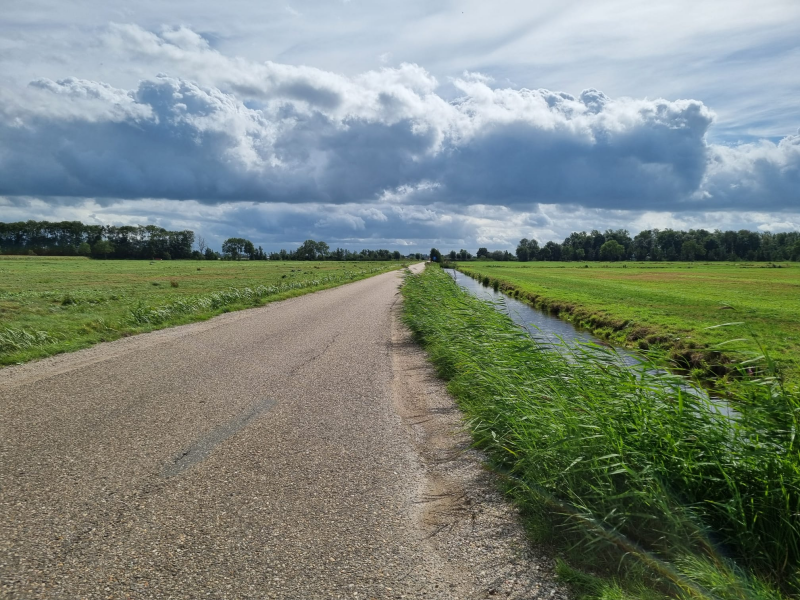
It reminds me of an Asian series in which a pavilion is called Where Clouds Meet Verdure. The literal meaning is ‘where clouds and greenery meet’. You might imagine a high landscape where, in the mountains, the clouds literally meet the earth, yet cycling here through the flat polder gives me exactly the same feeling. My thoughts wander further towards the clouds as representing a kind of higher consciousness. Something intangible too, perhaps even searching. The living earth shows and gives fertility, growth and vitality, as a physical manifestation. These two come together, creating a space that shows me that the intangible and the tangible are connected.
I don’t care what people call it, but for me, by becoming one with the landscape and the elements as a whole, I can catch a breath of something true or sacred. This connection too fills my heart and makes me intensely happy. Perhaps some people would find that exaggerated, but it turns my day into pure bliss. It was wonderful again!!
Reflection
Perhaps, for me, this day is about boundaries that turn out to be less fixed than we sometimes think. Where does love end when a relationship changes? Why should affection disappear because two people have separated? Why should love for someone who is no longer here have to make way for love for someone who is here now? To me, love doesn’t seem to become smaller when someone else enters that space. Quite the opposite. It seems to be a space capable of expanding further and further.
Perhaps that is also what touches me about Where Clouds Meet Verdure. Clouds and earth seem like two different worlds: the intangible above and the tangible below. But somewhere they meet. Not only at the horizon, but also in my experience as I cycle through that landscape. For a moment, I don’t need to know where one ends and the other begins. Human and nature, body and consciousness, love for someone who was here and love for someone who is here now; perhaps we don’t need to draw a boundary around everything in order to know what it means.
There is so much mine and yours in the world. Perhaps change really does begin on a very small scale: with the space we dare to give one another. And perhaps love is ultimately exactly such a space. Not something that becomes smaller when we share it, but something that can keep expanding — like a landscape beneath an endless sky, where clouds and verdure meet.
What Keeps Appearing
1 + 2 September 2026
I haven’t seen my neighbour yet, but I have thought about her a lot today because of the planned death of her granddaughter. Fortunately not constantly, but every now and then it drifts into my thoughts. As a child and throughout my teenage years, I always had the feeling that I didn’t want to be here. It never led me to attempt suicide, although I thought about it often. I had the feeling that my birth had been some kind of mistake made by the universe. I can still remember and feel the decision I made when I was twenty to fully commit myself to living. Perhaps that is why what is happening in my neighbour’s life affects me so deeply.
A long-time student of mine comes to visit. I have known her since she was a baby. She looked like a little angel when she was small. She is someone who has been moving in and around my world for as long as she has been alive. Not consciously, but through circumstances and via all sorts of connections. What would you call someone like that? A friend? A soulmate? No, it is a kind of cosmic connection that draws itself more and more clearly throughout the course of your life. Someone who, one way or another, always reappears in your life. The funny thing is that Ton knew her too, because she was once his patient. Michel knew her because her brother was his colleague. Her father was once my sister’s landlord. That is how I first got to know her. Years later she came to my yoga classes and never left.
She hasn’t seen my children since Michel died. She always asks how they are doing and now, in particular, what Max looks like these days. I show her a photo from a few weeks ago and call him at the same time. I tell her that he adores her and will probably be very happy to see her. She cannot imagine that he will even remember who she is. He answers while we are on FaceTime and reacts exactly as I said he would. Of course, that is lovely. My son makes her feel how her presence and her bond with me and my family are experienced by us. A lovely feeling for all of us. The rest of the day is quiet. Ton asks whether he should wake me early tomorrow morning so we can watch his son’s squash match in Australia again. After a week of some fatigue, muscle pain and mild headaches, I want to sleep and wake up naturally.
And indeed, I wake up feeling rested. The match is already over and he has won, which is a nice boost. After our late-morning rituals, we cycle to the gym. When we get there, I discover that I have forgotten my wristband, which means I can’t log into the machines. Damn it. Immediately afterwards I think: “Okay, fate has decided there will be no training today.” So we decide to go cycling instead. It is nineteen degrees, and the sky is dark and threatening. But then again, I’m not going to melt if it starts raining. If it gets really bad, we can always take the shortest route home.
It is wonderful cycling along the river towards Kinderdijk, with wind and, indeed, rain. Big drops, but manageable. The dark and light clouds are magnificent. As soon as the rain stops again, I feel that the wind will simply blow me dry.
Everywhere I see plants that have finished flowering and dried-out stalks, but among them a very fresh little yellow flower keeps popping up. It looks like rapeseed, but it isn’t. It is perennial wall-rocket. To me, this small yellow flower radiates something of vital life energy, inner strength and abundance.
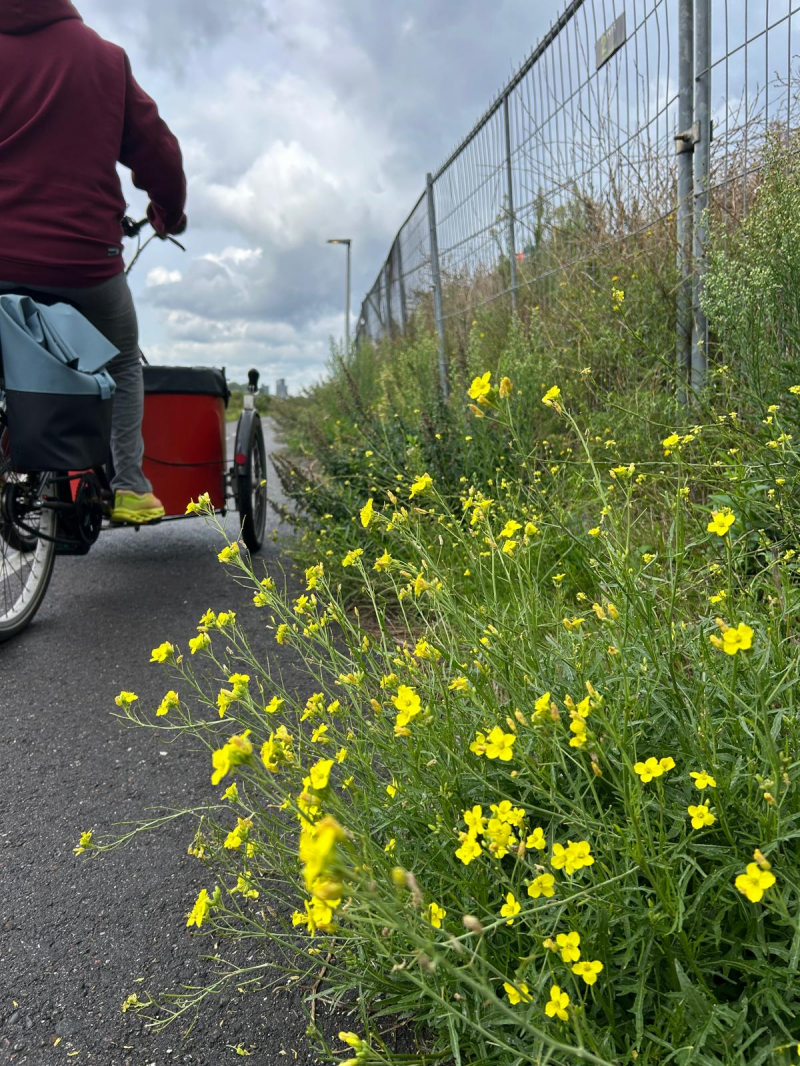
Apparently, it has waited until these final days of summer to spread a little more strength. I notice that the lilac-coloured wild chicory is also producing flowers again from its half-withered branches. It seemed to have disappeared completely, but apparently it still enjoys adding some colour and serenity to this unruly late summer together with the perennial wall-rocket.
As we cycle past the windmills of Kinderdijk, we discover entire stretches of ditch that seem to have become completely overgrown, even covering the large leaves of the water lilies. It is a species we have never seen here before. It turns out to be floating pennywort. People are asked to report this plant to the local water authority when they encounter it, to help limit further spread of this invasive species and the ecological damage it can cause. Once home, I report it online at Waarneming.nl and add two photos.
After cycling twenty-five kilometres, I arrive home completely recharged. I feel good, comfortable in my own skin, in a way I haven’t felt for more than a week. Time and again, it proves to me that nature, the elements and immersing myself in them help my physical and mental well-being.
Reflection
Perhaps life is constantly about what keeps appearing. People disappear from view and reappear years later by all sorts of different routes. A bond you don’t even quite know how to name turns out still to exist. A son instantly recognises someone from long ago. Flowers seem to have finished blooming and suddenly fresh yellow and lilac appear again among the dried-out stalks. Even a plant that doesn’t belong there at all finds a way to take over a ditch.
Yesterday I thought about someone who could no longer, or no longer wanted to, carry life, and I remembered how I myself once consciously decided that I did want to live. Today I get on my bicycle beneath a dark sky, feel rain and wind against me and see everywhere around me how life behaves. It withers, grows again, blows, spreads, disappears and appears. Not everything that grows is wanted, and not everything that disappears should have had to leave. Perhaps living is not only about holding on to what is there, but about responding, again and again, to whatever appears.
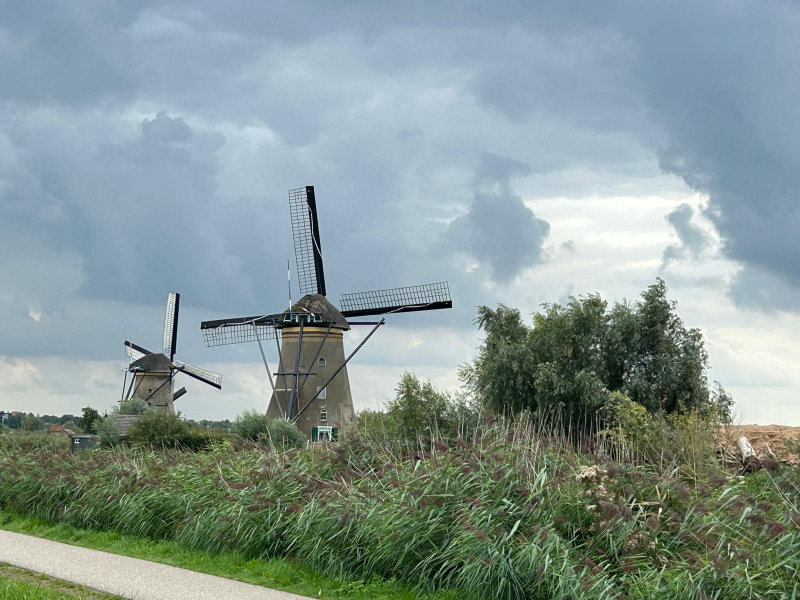
After twenty-five kilometres I arrive home recharged. The dark sky has not disappeared and summer is visibly coming to an end. Yet among the dried-out stalks, something yellow and something lilac are blooming again. Perhaps that is exactly what life force is: not waiting for circumstances to become perfect, but appearing wherever there is still a possibility to bloom.
My Body Has a Therefore
30 + 31 August 2026
Tearful, that is what I call a day like today. Something inside me doesn’t want to do anything. I feel fine, but tearful. On a day like this, Ton invariably asks, “Why?” I wouldn’t know.
Michel used to call it Weltschmerz. When I look up the meaning of the word, it says: Weltschmerz is a feeling of deep sadness and melancholy caused by the imperfection of the world. Well, is that really it? I am not melancholic by nature, quite the opposite, I am cheerful and full of life. My view of the world is not gloomy, despite changes that may sometimes be worrying. No, I understand the word world-weariness, but I see far more beautiful things than ugly or painful ones.
This week, however, I have often seen troubled relationships between parents and children in all sorts of ways. A father who was more concerned with his ambition than with his family. A child who now chooses to treat him in the same way. A child who did not feel seen or heard as a teenager and who, as an adult, has distanced themselves from their parents. Parents who failed to notice their children’s physical or emotional pain, resulting in the child feeling anger as an adult and withdrawing from them. I don’t know, perhaps it is because of the pain I am feeling at the moment that all these stories affect me so deeply. They are ordinary storylines in a series, but they get to me. Tears roll down my cheeks. At the same time, I am glad those tears are falling. They release something.
Because Ton thinks the word tearful is rather meaningless, especially since I don’t seem to know why I feel that way, I look that up too. Is it really so strange? It says: feeling tearful means having a lump in your throat and feeling as though you could cry easily or for no apparent reason. Yes, look, that’s exactly what I mean!!! So it isn’t that strange after all. Where might it come from? Perhaps one day I will be able to answer the question why.
Stress and exhaustion: Your body and brain have had too much stimulation or pressure and use tears to release tension. In my case, that isn’t so strange. Simply existing already requires a considerable amount of energy and tension from me. My response to feeling tearful is always the same: do as little as possible and rest. Emotional release: There may be old grief or pent-up emotion that wants to come out. That is quite possible and not so strange in my case either, but it isn’t something I am consciously occupied with. These days I react emotionally more often when I come across something that feels familiar and was, or still is, painful. I don’t have the feeling that I remain stuck in it. I wipe the tears from my face and a minute later I am laughing again at something funny that comes along. Dwelling on the past? No, not really, I don’t think. Hormonal fluctuations: Think of menstruation, pregnancy or menopause. Well, I don’t know. Those things were relevant a very long time ago. Menopause was twenty years ago too. But perhaps hormonal fluctuations continue to have an influence throughout your life. They might. I don’t know. Low mood or depression: Your mood remains empty or down for a longer period of time. Hahaha, that sounds terribly dark! No, I recognise that feeling from the past, but I haven’t felt it for years.
I admit, it is enormously painful and emotionally difficult when a young adult child no longer wants contact with you. It brings feelings of sadness, powerlessness and grief. I acknowledge that my daughter feels the way she does. I know for certain that I have made mistakes. I also know how much I love her. The only thing I can do now, and have been doing for more than a year, is give her the space she needs for as long as she needs it. She has blocked me, so I cannot let her know that the door will always remain open. That is a pity. Still, I believe that deep down she probably knows this. I have Ton and my sister as sounding boards when the absence becomes difficult for me. This absence is there, but I think it works much the same way for me as my health. It is there, it isn’t going away, and I will have to live with it and find a way to deal with it. By giving it space while also seeing and experiencing the beautiful parts of my life. I think I manage that quite well.
Ton and I have now been together for more than eight years. Every so often I have a day when I say that I feel tearful. He always asks me why. I always shrug my shoulders. There is one thing that also always happens. I rest, literally and figuratively, and as the day goes on the feeling disappears by itself. As though there has only been a light drizzle. The sun comes out again. When I am tearful there is no why; my body has a therefore.
After a short night, Ton wakes me up so we can watch his son’s squash match live online. He is competing in the World Masters in Australia. His mother comes over too, so early in the morning the three of us are sitting together watching squash. I always notice how deeply I become absorbed in it, almost as though I move into him. I can also feel how he is doing in the match, and I find myself almost curling my toes. Fortunately, he won this first match. Later he calls and it turns out that he has strained a muscle that had been bothering him. So I had sensed that correctly. It reminds me of coming out of a ballet performance once. I had become so intensely absorbed in the prima ballerina that I actually had sore muscles when I walked outside. Here I am talking about people I am watching, but in reality I experience life intensely anyway. So perhaps a tearful day every now and then isn’t so strange after all.
Reflection
Perhaps I am searching for a why when there doesn’t always need to be one. I experience many things intensely. Not only in my head, but apparently with my body as well. I can watch a ballet performance and have sore muscles afterwards, follow a squash match and almost feel how someone else is moving, or be touched by a story that recognises something inside me. Perhaps the tears are not a problem that needs to be solved, but simply one of the ways my body allows tension to flow away.
I don’t have to trace every tear back to the place it came from. Some will belong to missing my daughter, others perhaps to old pain, tiredness or something I am not even consciously aware of. Apparently, it is allowed to drizzle for a while without immediately needing a weather report. By now I know what helps. Doing less, resting and allowing it to happen. The shower passes again by itself.
Perhaps that is why Ton keeps asking, “Why?” and I cannot give him an answer. My mind doesn’t know. Perhaps it doesn’t need to know either. When I am tearful there is no why; my body has a therefore.
After the gym, which I went to early this afternoon, I settle down comfortably on the bed with my little dogs, laptop and TV on. Just chilling. And then I come across a cartoon that I want to use to end today’s blog.
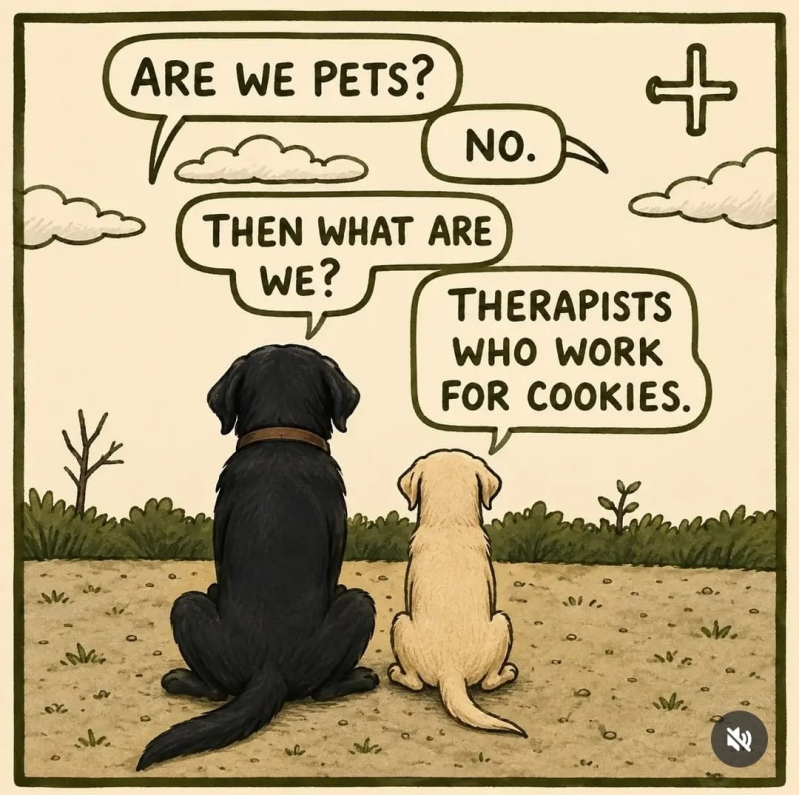
Not Avoiding It
29 August 2026
An ordinary Saturday. During my workout I could clearly feel that some of the muscles in my neck were tensing up and hurting. I recognised it, because they have been doing that for quite a while. I decided to pay attention to why I tense these particular muscles and whether that is actually necessary to perform the exercise properly. It turns out that I draw strength from muscles that are not needed for the movements I am making. By focusing on relaxing these muscles instead of focusing on the movement itself, I had the feeling that I was beginning to untangle myself just a little. I need to improve my posture again by paying attention to which muscles are needed and which are not. Strange that I can forget something I am actually a master at.
Then I started thinking about how we might see time and change. Change is the constant and therefore predictable. I drew a graph with time on the horizontal axis and change on the vertical axis. Now my own focus is shifting back towards my breathing and relaxing my body. I believe now that my body has become stronger; I trust that. The idea occupied my thoughts for a while, but I haven’t quite figured it out yet. This idea about time and change probably needs to ripen a little longer.
Cycling home, I talk to Ton about our neighbour. I want to find a card and put it through her letterbox. Some time ago she told us that her son has a wife and three children. A lovely family, she said. Sadly, her granddaughter has not been happy with life since puberty. She has been through all kinds of institutions and psychological treatment. She has attempted suicide. All of it has been terrible. She is now twenty-seven years old and will receive euthanasia in a few days. A very extensive process has to be completed before euthanasia can be granted in this way. Physical illness is simply easier to understand than mental illness. Your body is healthy. Why, then, proceed with euthanasia? I wrote the date in my diary so that I could put a card through our neighbour’s letterbox beforehand. To offer support and let her know that we are thinking of her. It is so difficult to comprehend that this is happening, and yet for the young woman it may be a relief to finally find peace. Losing a child seems to me one of the worst things imaginable. Losing a child in this way is simply impossible to truly comprehend unless you are experiencing it yourself. On the other hand, I think her parents may also find some peace. I imagine these have been incredibly difficult years for them too. And for the other children in the family; it could hardly have been otherwise. For the grandmother who lives next door to us, all we can do is let her know that we are there if she needs us.
I found a beautiful card showing a dandelion releasing its seeds into the wind against a beautiful blue sky.
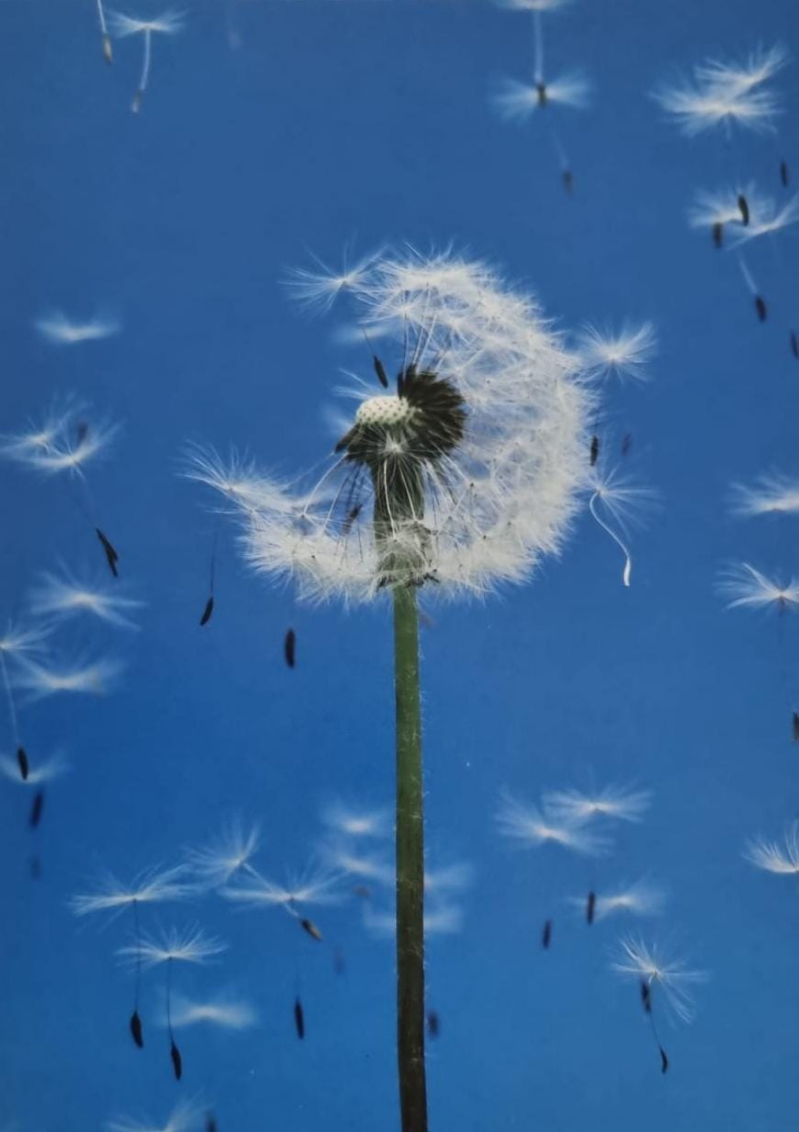
A little later, a friend calls and asks whether I can help her prepare a living will online herself, which she can then have signed by a notary. She will come over sometime next week so we can do it together. She also has paperwork to arrange for her body to be donated to science after her death. Her sons don’t really want to talk about it. Still, she wants to arrange as much as possible herself so that her sons will not have too much to deal with when the time eventually comes. I think that is very sensible.
And so this turned out to be today’s theme. It is a shame that in what appears to be such a modern society and open culture, subjects such as death and sex are still taboo and things we would rather not talk about. I try not to avoid them. That is why it is important to me to let my neighbour know that I am thinking about her loss and her grief. And I am glad that a friend asks for my help with this particular subject.
Reflection
Perhaps we do not have to understand death in order to talk about it. Today it appeared in several different ways. A young woman who, after a long and difficult journey, is approaching the end of her life by her own choice, a family who must let her go, and a friend who, while very much alive, wants to arrange now what should happen one day after her death. I cannot know how another person experiences their own death or the loss of someone they love. Perhaps I do not need to know. I can listen, help with paperwork or put a card through a letterbox.
On that card is a dandelion whose seeds are being carried away by the wind. Yesterday I was still writing about flowers, seeds, growing and letting go. Today those same images suddenly took on a very different meaning. A seed that lets go disappears from sight, but that does not mean it does not land somewhere else.
Perhaps not avoiding it is sometimes all you can do. Not trying to find the right words for something for which there really are no right words, but simply letting someone know: I see what is happening, I am thinking of you, and I dare to remain beside you.
These Days Speak Through Flowers
26, 27 and 28 August 2026
The twenty-sixth of August is a day I would rather forget quickly. It gave me quite a fright, which once again showed me just how much impact the stroke has had on me. As level-headed as I can be in the way I talk and act, my body sometimes gives very different signals. At the gym I had a strength assessment and moved into the adaptive phase, which means that the resistance in kilos gradually decreases. It was hard, and it stayed hard. From the very beginning I developed a headache and it only got worse. After one circuit I was completely exhausted, had a severe headache and stopped. It turned out that the equipment was no longer functioning properly. At home I could barely say a word and spent most of the day in bed with the curtains closed. In the evening we briefly went to say goodbye to Ton’s youngest son, who is taking part in a squash tournament in Perth, Australia. For Ton, I managed to pull myself together for a while so we could do that. Well, it is remarkable how love can get a person moving for a little while, even when you feel terrible.
Fortunately, the next day went much better. The coach switched the machines back to classic fitness mode and confirmed that the adaptive setting had not been working. The strength assessment went very well and I managed four circuits. Pfffft, what a relief to know that the collapse the day before had not been caused by me. My friend came to visit. She told me that she had also been doing something creative. She cleans oyster shells, then follows the patterns inside them and paints them. She showed me some photos, pleasantly surprised that I liked them. She has a transgender child. He is an adult now, but we often talk together about how different things are compared with the past. We now have to learn about LGBTQI+ in order to understand the world of this generation of young people. We certainly try, but sometimes it is difficult to follow. The language and words they use, cis, cunt and so on, are completely new discoveries for us as well. Not the phenomenon itself, but the terminology and the diversity.
I watch and listen to her and see how she too is gradually changing along with it, how her frame of reference shifts, how her boundaries shift and how she is increasingly able to let go, until what really matters remains: the love for your child. Nothing more and nothing less. As a parent, a child teaches you to peel away all those layers of conditioning, norms and morals. Often through pain on both sides, misunderstanding and simply not being able to comprehend. As a parent, you learn to grow along with a world that is changing right in front of you. Your child mirrors you, giving you the possibility of insight and letting go. Children do not belong to you; they belong to life. So what does love mean? Holding on? Continuing to care? Remaining responsible for them, regardless of their age? Or letting go? Allowing them to fall and get back up again themselves. Simply being a listening ear if that is what they want. And being okay if they don’t want that either. Well, what is this thing called love? Is it a fixed concept? Does it grow? Does it change?
We have been friends since our first year of secondary school. There have been storms and rain in our relationship. Every time, somehow, we found our way back to each other. We discover similarities in our lives. Perhaps because we are literally the same age? Perhaps because, despite our differences, we still have so much in common? Or is it a connection that may be called love? Something that reaches through time and space?
After she left, Ton and I decided to cycle to my sister’s house. Just to see how things were going there. The bridge here has been closed for nine months, so we take the ferry. My brother-in-law has mild dementia and is due to have surgery the following day. My sister needs oxygen 24/7 because of COPD/pulmonary embolism. My brother-in-law is 85 and my sister is 78. I see two elderly people who need help, but I know that this is how it looks, not necessarily how it feels. Funny, as I grow older myself and develop my own physical limitations, I increasingly realise that looking old or becoming old has nothing to do with how a person feels inside. The body seems to follow a horizontal timeline in this existence; the mind does not. I don’t want to, and cannot, make any statements about people with dementia. I understand what it is like for those around them, but how the person ultimately experiences it themselves, I simply don’t know.
Happy that we have seen them for a while, we head home. Close to my sister’s house is a Chinese restaurant that will close its doors permanently this weekend. Ton and I both have memories of the place, independently of each other. As a child, I sometimes ate there with my parents and brothers. More than fifty years ago. For nostalgic reasons, Ton orders a spring roll and a few more to put in the freezer. I actually find it rather sweet that he is being a little sentimental. In the end, I have had a very pleasant day. Tomorrow afternoon Ton has to go out with his eldest son. We could still go to the gym, but this weekend an exhibition at Kunsthal Rotterdam that I would really like to see is also coming to an end: Flowers Forever. If I wake up early enough tomorrow morning, I’ll cancel the gym and we’ll go to Rotterdam, I promise Ton.
And yes, I wake up early enough for us to go to the Kunsthal. Flowers in art and culture. As I had expected, it was very colourful, but more diverse than I had imagined. Here and there were explanations about, for example, enslaved women who were also sexually abused. The peacock flower was used to prevent pregnancy. There was also the realisation that flowers have often been used in politics as symbols of power or, conversely, resistance. Throughout the centuries, people have had to learn that not everything that looks beautiful is also edible. You see dualism reflected in nature. Flowers as symbols of beauty, as metaphors for emotions, virtues, love and so on. I realised that I use flowers or seeds in my own paintings too. Often with an underlying feeling or meaning.
One sculpture I find particularly beautiful is Ode to Meditation by Ru Xiao Fan. The head covered in flowers appears frequently in his work. He says about this: “Many flowers mean that we think a lot.” “When we become Buddha, we no longer need these flowers.” It is a figure sitting quietly in meditation. The artwork is an ode to meditation as a way of reaching inner peace and wisdom. I like the idea of seeing thoughts not only as clouds, but also as flowers.
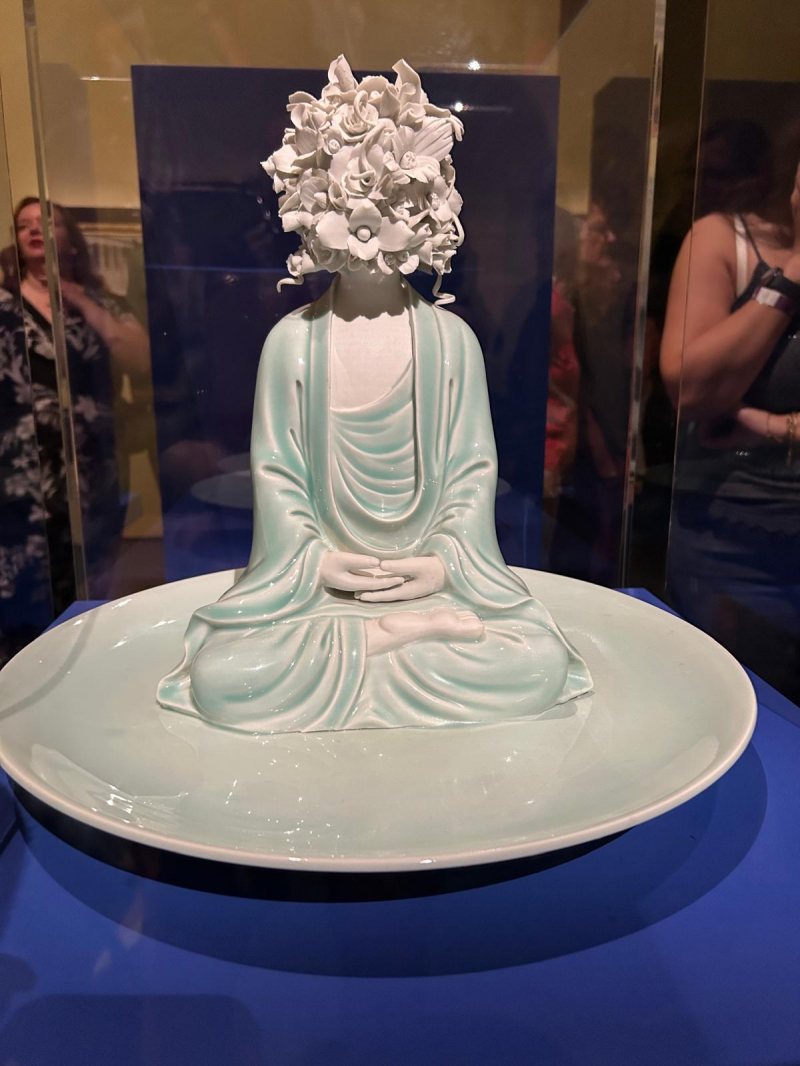
Being surrounded by art again makes me feel happy and recharged. In the car I said to Ton, “It was a friendly exhibition.” Ton repeated my words with a smile, as though tasting them.
We drive home and turn on the radio. Tears for Fears, a band I was a fan of when I was young. Sowing the Seeds of Love. How appropriate this is once again, a song from the eighties that emerged as a political protest during the Margaret Thatcher era, calling for compassion, love and a break with the conservative policies of the time. A plea for ‘sowing the seeds of love’ as a peaceful response to social coldness, hatred and division. Yes, I can do something with this image too. Just like the painting Flowering, which I once painted for my youngest daughter after being inspired by an Osho tarot card. The seeds in the sleeves of the woman sitting on the lotus flower. Just as a flower shares its fragrance with the whole world, this card invites you to share your qualities and joy with others. The flowers in her aura represent inner growth; it is the moment when your consciousness opens, just like a flower unfolding its petals.
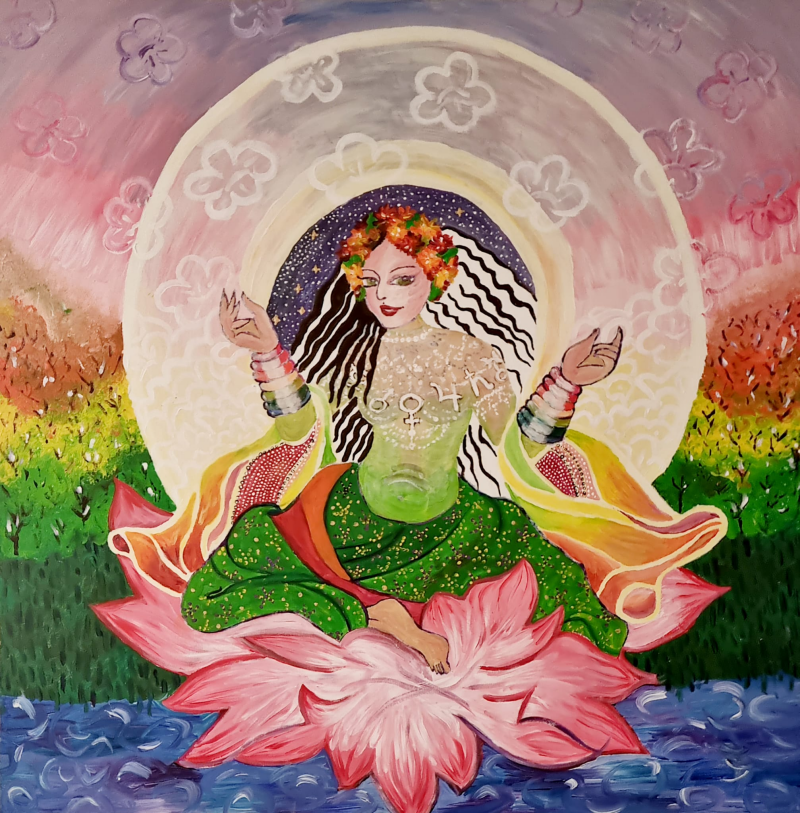
Yes, this lovely day tells its story through flowers.
Reflection
Perhaps, looking back, these were not three separate days at all. On the first day, my body made me feel how vulnerable I can still be. The second day was about love, children, friendship, growing older, holding on and letting go. About what remains when you peel away more and more layers of expectations, norms and conditioning. And today, suddenly, there were the flowers. Flowers for thoughts, beauty, power, resistance, love and inner growth. Seeds you can sow without knowing what will grow from them.
Perhaps life works like that too. We are constantly sowing something in one another. As a parent in a child, as a child in a parent, as lovers and as friends. Sometimes something grows immediately, sometimes only years later and sometimes it disappears again. You cannot force a flower to bloom, and probably not a person either. The most you can do is create the conditions in which something is given the space to grow.
Perhaps love, in the end, is also such a seed. Not something you can hold on to or define, but something that changes along with us. Sometimes you have to nurture it, sometimes you have to let it go, and sometimes it is only much later that you discover what has blossomed from a seed planted long ago. These days speak through flowers.
The Vulnerability of Connection
25 August 2026
My phone pulled me abruptly out of my dream this morning. I know that this time it was something very bizarre. My little dog was wide awake from the noise too, so first she started headbutting me, then jumping and barking, and finally gently biting me over and over again. At that point there is only one thing to do: get up. I see that one of my daughters has messaged me because she hears a strange noise coming from her car. This particular daughter calls me from places on the other side of the world when she doesn’t know how to start her car or park it, or when she has ended up against a tree on a hill, and so on. It is actually quite funny. Facetiming from Brazil, Thailand, Japan and so on; this time she is a little closer, in the south of France, where I have to look under the bonnet with her or explain how to do a hill start. This particular daughter can also call when she has a stomach ache or some other complaint. She lives her own life and I have very little insight into it anymore, but at moments like these, Mama is still always there.
Meanwhile, Ton is busy organising paperwork for one of his sons. He works and has an appointment with an official organisation. Ton is helping him out and will go along this afternoon for company as well. First, of course, I go to the gym, where my coach is very pleased with how quickly I have improved my food intake. I no longer wait until I am hungry before eating, which meant I was consuming only around 1,300 calories a day. Now I eat three meals a day and have something in between twice a day, bringing me to around 2,000 calories. This amount was calculated specifically for me. At first it frightened me, but I do feel better and my stomach is much calmer. Today went considerably better than yesterday.
The ladies who were also working out were having a conversation about getting older and how the body starts responding with more difficulty or simply not as well as it used to. They mentioned all sorts of things and, of course, eyesight came up too. I was listening and suddenly said, “Do you recognise that feeling of being much younger on the inside than you look on the outside or than your body feels?” Yes, they certainly did. “So perhaps it is nature’s way of helping us that we can’t see as well without our glasses. That way you stay younger when you look in the mirror, and without your glasses your husband looks a lot better too.” Everyone laughed and the atmosphere of discussing physical ailments immediately changed. Of course what I said is nonsense, but sometimes a little humorous perspective is necessary, I think.
Feeling fresh and cheerful, I cycled home afterwards. My daughter had sent another message with a recording of the noise her car was making. I advised her to check the oil level. According to her it was fine, so I thought the best thing would be to call roadside assistance. It is evening now and I have just received a message with photos showing that roadside assistance has arrived and that there was, in fact, no oil left in the car. I wonder when I’ll hear from her again. Usually, when everything is fine, I hear nothing more.
Ton spent the whole afternoon out with his eldest son while I watched The Good Doctor. It is about an autistic young man who becomes a surgeon and the difficulties he encounters in adapting socially. I know that I am not autistic, but I do recognise a number of aspects that also appear in this series. I don’t like being touched. I absolutely cannot cope with too much light and sound all mixed together. I prefer being alone. I avoid places with lots of people. I find it difficult to worry about things that cannot be undone. People expect emotions from me that I often don’t show. Asking someone how they are feeling is another thing. Ton sometimes points out to me that I forget to ask how someone feels.
Coincidentally, we had a conversation about this while cycling home. When Ton hurts himself, my first reaction is often to get angry. Initially, I think about myself. If he is incapacitated, I have a problem. He laughs when I explain it like that. Because I am consciously aware 24/7 of what I am doing and how I move, it has become a kind of unconscious conscious focus for me. The moment he stumbles, it initially feels as though he is an extension of me. For a moment I am angry with him, but in reality it has to do with the connection I feel. A split second later, I respond to Ton’s injury.
Although Ton is a doctor himself, he takes good care of me, but he doesn’t watch over me. I, on the other hand, do watch over him. Michel always watched over me. He never took his eyes off me. Apparently, that was how he needed to experience his connection with me. He spotted the branches or uneven paving stones before I did. When it became chilly, he would fetch thick socks for me, knowing I was getting cold without noticing it myself. When I stumbled, he would get angry with me. The same mechanism I now recognise in myself with Ton. So it is about connection. How are you connected to someone? It is not better or worse, it is simply different.
Sometimes it used to make me sad. How could someone be angry with me when I was the one who stumbled? Now I do the same thing with Ton. Not because I am selfish. I am startled, just as Michel used to be startled. What happens to Ton has consequences for both him and me. After the anger comes the concern. I can see that more clearly now. And Ton understood my explanation. It is not about distance, quite the opposite. It is about connection.
It is late. Ton comes into the bedroom and says, “Dolly Parton died today. She was 80 years old.” “Oh, damn, another icon, and still so young. I don’t like hearing this.” Ton is 77 and knows that I get frightened by hearing about all these people who have already died. We have no control over it, but the older you become, the more realistic a possible ending becomes. With Michel, I was completely unprepared. Now I feel a jolt of fear in my heart with every announcement of someone’s death. I know now what it feels like to lose someone you love. Please let this remain far away for many, many years. The thought makes me vulnerable. That is a difficult emotion for me. This lady has lost her level-headedness when it comes to this particular connection.
Reflection
Perhaps being connected is much more than taking care of someone, loving someone or asking how they are doing. Today I saw how many different forms it can take. A daughter calling Mama from abroad when her car starts making a strange noise. A father helping his adult son with his paperwork. Michel spotting the branch in my path before I did and becoming angry when I stumbled anyway. Me now doing exactly the same when something happens to Ton. The expression may differ, but somewhere underneath lies the same vulnerability: whatever is connected to me affects me.
Perhaps that is also the price that comes with connection. The more someone becomes part of your life, the larger the vulnerable place becomes when something happens to them. I now know what loss feels like, and perhaps that is precisely why I can no longer be quite so level-headed when death suddenly comes close to our own ages. Loving someone makes life richer, but at the same time gives you something that can be lost.
This morning I still thought: at moments like these,
Mama is always there. Tonight I realise that no one will always be there.
Perhaps that is precisely what makes connection so precious:
knowing that it can be finite and still having the courage to connect yourself fully to another person, again and again.
It Is Allowed to Move
24 August 2026
I have dreamed on four days this week! I had a very long series of dreams, but that seemed to have stopped. Suddenly they are back, and what is even more striking is that they don’t immediately fade away. I can calmly drink my coffee and talk to Ton for a while before writing them down. I often recognise elements in my dreams from something I have read, seen on television or encountered in real life. The strange thing is that the dreams I have had this week cannot immediately be traced back to anything I have recently experienced or seen. I write them down as I remember them, but leave any possible meaning or interpretation aside. What I have discovered is that no matter how bizarre the dream may be, I always recognise my character as it is when I am awake. Writing them down has made me aware of this: Annette is very consistently Annette. Under all circumstances, whether active, at rest or unconscious, I seem to show the same unchanging nature.
I don’t know whether this is true for everyone, but it is something I have noticed without immediately trying to say anything psychological about it. I like discipline and regularity. It is allowed to move. By that I mean that I am not rigid or overly strict. If something doesn’t work out, that has to be okay too. Regularity, on average is perhaps what I would call it, is good for your health. I learned this especially during my yoga training. I could literally experience the effects: I slept better, felt less stress and my digestion improved. For me, it is important that there is always room for something that falls outside that regularity. Again, hence the word ‘average’.
Because of the heat and the malaise that came with it, I stopped training for a while. I did still go cycling in the evenings, until even that became too hot. Today I went back to the gym for the first time. Oh my God, I was so tired afterwards!!!! I cycled back home and spent a few hours in bed watching television. At the moment, I’m in a romcom vibe: relaxing, laughing and simple storylines. I always have very distinct periods in which I watch one particular genre until I get bored with it. Those periods can last anywhere from a few days to several months. I have never examined this psychologically either. Hahaha, I enjoy almost every genre there is. There are only a few things I don’t like watching, such as football and sport in general, unless there is a story surrounding it. Films like Spiderman and Superman aren’t really my thing either. Nor are soaps or reality TV. But I do like science fiction and supernatural stories, action films, war films, horror, romantic dramas, historical films, anime and documentaries. I can also endlessly watch Asian films or films in other languages. They all seem to belong to different states of mind in which I immerse myself in a particular genre and language. I know this is how it works for me, and I listen to that need. Sometimes, when I am in my murder-and-mayhem phase, Ton doesn’t understand how I can sit watching that stuff for days on end. He does laugh about it. Probably because it isn’t something you would immediately expect of me. In any case, I go with the flow of my moods.
After a romcom and a pizza, we went cycling this evening. Lovely, wearing a cardigan, a bit of wind, but comfortable. Nature already seems to be slowly withdrawing. Much has finished flowering and withered. Yet after the few heavy rain showers of the past two days, here and there a boldly coloured little flower still peeks around the corner. I realise that we are slowly moving towards a new season again. Experience has taught me that autumn and spring are the best seasons for me. With my face turned towards the evening sun, I am already looking forward to feeling physically better, knowing that for the time being I will be able to train every day again. Wonderful, back in my rhythm.
Ton is watching As Good as It Gets, in which Nicholson says: “You make me want to be a better man.” He comes into the bedroom to tell me how beautiful he thinks that sentence is. So I ask him why. “Because of you, and for you, I’ve given up some bad habits,” he says. So sweet, the way he stands there telling me this like a little boy. It is true, but by being with Ton, I have done the same. He has, for example, started drinking less alcohol and I stopped smoking. We have both let go of bad habits and disciplines for each other, so that we can be here for one another longer and in better health. Separately, circumstances had led both of us into an unhealthy rhythm. By being together, we changed that. Not by putting pressure on each other, but through the space we were able to give one another. We both felt the need to change something, for each other as well as for ourselves.
Yes, only now do I realise that after eight years together, we have grown into a rhythm that belongs to both of us and is no longer coloured by our separate pasts. My pink leaves and his yellow leaves have unconsciously turned orange.
Reflection
Perhaps having a nature of your own does not mean that you have to remain unchanged. I recognise myself even in my dreams as the same Annette, while my rhythms are constantly moving. My body moves with the weather, my attention with my mood, my daily routine with what is possible and my life with the people who appear in it. Even discipline does not have to be a straight line. Perhaps its strength lies precisely in being able to return again and again without every deviation becoming a failure.
And living together does not seem to mean losing yourself in another person either. After eight years, Ton is still Ton and I am still Annette. And yet, without us really noticing, something has emerged that belongs to neither of us separately. Not because yellow had to become pink or pink had to become yellow, but because both colours were allowed to exist beside and with each other, to move and to change.
Perhaps that is what a shared rhythm is: remaining yourself while still allowing yourself to be coloured by one another.
My leaves pink, his yellow, and somewhere, without us consciously mixing them, orange suddenly begins to grow in between.
Perhaps We Live on Different Floors
23 August 2026
Earlier this week, I received another one of those emails. Because I have an account with astro.com, I get them more often, and normally I delete them straight away. This time I started reading, but almost immediately I found myself stumbling over what it said. It was about my Moon in Leo. About a creative or spiritual gift calling me back, a lunar eclipse, dreams and the veil between the visible and invisible worlds becoming thinner. Then I was told that someone who has died might reach me through my dreams. Not as a possibility or a thought, but almost as an established fact. The deceased person is really there and has come to tell me something. I should pay close attention.
That is where I lose interest. Not because I think such a thing is impossible. I simply don’t know. Perhaps I am actually too down-to-earth to immediately attach an explanation to it. I have had experiences in my life that I cannot really explain. Sometimes they are very clear and real to me, but what are they? I have no idea. Nor do I feel the need to call them paranormal, supernatural or divine. By doing so, I would be filling in something I simply do not know. At the same time, I don’t want to deny them either. After all, they are my experiences. They come to me and I respect them. Perhaps one day I will understand them. Perhaps I never will. That is fine too.
Ton does not believe in God. I don’t know whether I believe in God. At least not in the form in which I see God represented by many people. And yet I certainly believe there is more connecting us and setting us in motion than we are capable of perceiving. But what? I have no idea. Perhaps it is precisely that not-knowing that I find so interesting.
The same applies to time. For as long as I can remember, I have had a somewhat strange relationship with time. Of course, like everyone else, I live with hours, days and years. Yesterday is behind me, tomorrow is yet to come, and at three o’clock I have an appointment. All very useful. But somewhere inside, I have always felt that this human perception of time is a learned and rather simple way of organising something that may not be simple at all.
For myself, I sometimes call it vertical time, although I realise that even those words don’t quite fit. I cannot see into the future. I don’t know what will happen next week, and unfortunately the winning lottery numbers don’t come through to me either. Yet sometimes I literally find myself standing in my future. Even as I write this, I notice how impossible that sentence actually is. Because the moment I use the word future, it sounds as though I am predicting something. That is not what I mean. It is more as though, for a moment, I am simply there.
For as long as I can remember, I have also experienced myself at different ages. Not merely as a memory of the child I once was or as an image of the old woman I may one day become. Sometimes it feels as though those different ages are not neatly arranged one after another. Perhaps we live on different floors. Most of the time, we move around on one floor and call it the present. We have left the past behind us and the future still has to be built. But what if those other floors, in some way, are also there? What if sometimes you find yourself standing with one foot on another floor?
Of course, even that is already far too spatial a way of thinking about it. I am searching for words for something our language may simply not have been made to describe. Past, present, future, before, later, forward, back. Almost all the words we use to describe time lie along a line. Perhaps time is not a line at all. Or perhaps it is. I don’t know.
Years ago, I watched Cloud Atlas. I was genuinely excited when I saw that film. Not because I thought: what a fantastic idea these people have come up with. The idea itself was not new to me at all. It was recognition. At last, I saw something outside myself depicting what I had experienced for a very long time but could barely explain. Different times, lives and realities do not exist neatly separated from one another in the film. They touch, move through one another and seem to be connected across different layers. To me, it was not chaotic at all. It felt like coming home.
My friend went to the cinema afterwards to see the film too. She came back more or less angry. “What a terrible film. I couldn’t make head nor tail of it.” I actually had to laugh. Apparently, for her, the thread that was supposed to connect everything was missing. For me, no thread was needed at all.
Later, I showed the film to Ton. Perhaps I thought that through the film I could finally let him see what I meant by my strange experience of time. After ten minutes, he was asleep. When he woke up again, he said he simply couldn’t watch it. Oh well.
Perhaps you cannot make another person experience what your reality sometimes feels like. You can only try to find words, images or comparisons for it. And perhaps that is exactly what bothers me so much about the emails with which this story began. Not the spiritual. Not the inexplicable. Not even the idea that things may happen that we do not understand. It is the certainty. The veil is becoming thinner. A deceased person comes to you. Your dream means this. This sign means that. How do you know?
There is so much I do not know, and the older I get, the less of a problem that seems to be. Perhaps time exists in a completely different way from how we experience it. Perhaps those moments when I experience myself at another age are simply peculiarities of my brain. Perhaps our consciousness sometimes touches something that does not fit within our ordinary experience of time. Perhaps there is yet another possibility for which I do not even have words. I don’t have to choose.
What I experience is allowed to exist without my knowing what it is. I don’t have to elevate it into something supernatural, nor do I have to explain it away. Perhaps one day I will understand it. Perhaps I never will. That is fine too. For now, I’ll just keep wandering around on my own floor. With one foot occasionally somewhere else.
Reflection
Perhaps not everything we do not understand is a mystery that needs to be solved. Perhaps space opens up precisely when we do not immediately name, explain or deny. What if time, consciousness and connectedness are far greater than the small part we are able to perceive? I don’t know. And perhaps I don’t need to. Sometimes an experience is enough to make us stop for a moment and consider the possibility that our reality has more floors than we can see.
The Invisible Umbilical Cord
22 August 2026
Yesterday was a very long, busy day. A day that lasted seventeen hours straight for me. So today, I’m taking a step back.
Today is my youngest daughter’s birthday. She lives in Spain and prefers to stay under the radar, which makes contact difficult. My children live within me. As long as I live, I will always feel that they are there and that I love them. I’m not a cuddly mother and certainly not a perfect one, probably a mother who has made plenty of mistakes, but I am a mother down to every cell in my body. Perhaps other mothers reading this will recognise it, but it feels like an invisible umbilical cord that will only come loose when I am no longer here. And who knows how things continue to work in this universe?
I don’t know exactly how, but with my stepdaughter and foster son I also wove a bond from day one, almost as if it were an umbilical cord. Perhaps it has something to do with the fact that I myself am not necessarily a biological daughter, yet I have always been able to experience the people who raised me as my own. Once you take a child into your heart, that child can never leave it again. That is how it works for me. The same applies to my friendships. Their form or intensity may change over the years, but never the bond I feel deep inside.
Yesterday I found myself thinking about the first time Michel and I went out for the day together. The youngest children were about five or six years old. A friend had offered to look after them. Full of enthusiasm, we set off and decided to follow the Taxandria Route so that we wouldn’t simply be driving around aimlessly. Getting out along the way, exploring villages, the surroundings, museums and castles.
Our conversation was about the children.
“Oooh, we have to remember this. The children would love it.”
“Oooh, what a shame the children aren’t here.”
“Can you imagine what they would think of this place?”
Hahaha, that was how it went all day. We came to the conclusion that we enjoyed ourselves most when the children were simply with us. We had become accustomed to looking at everything through the eyes of our children. Apparently, as parents, that was what gave us the greatest pleasure. After all, they are so deeply connected to us, to our hearts, to our very being.
At the Pop-Up Dinner, I said something similar to Ton: “Oooh, my three girls, and especially the youngest, would absolutely love this and get so much inspiration from it. She organised a Pop-Up Restaurant herself several times in Japan. She cares about nature just as much as Yacinth does. I would so love to share experiences like this with her again.”
Meanwhile, my other daughter is on her way to Marseillan and sends me some photos. She writes that she is making another stop along the way and hopes to enjoy some oysters there tomorrow. The moment she writes that, my thoughts immediately return to the time when Michel and I, together with our friends in Vendays-Montalivet, would go to the market in the morning. We would put the children on a carousel at the fair while we enjoyed oysters with caviar and champagne. Living like gods in France.
While my memories are travelling back there, my daughter sends me a message:
“Mama, I keep thinking about Dad so much.”
“And then I started driving and suddenly I felt that familiar Dad feeling again, as if it were inside my own body?”
“That calmness of his, haha.”
For a moment, a sob rises inside me.
My children adore Ton and are very happy that he is with their mother. The absence of their father remains. I tell her that I still think about him every day and that I say his name almost every day too. Fortunately, Ton is very comfortable with that.
Michel radiated an enormous sense of calm, but inside him there was a whole world of uncertainty and tension. As his partner, I knew that, and I also knew the impact it had on him. As though he carried the entire history of the Jewish people on his shoulders. Yet to his children, he was a rock they could depend on, their place of safety.
I know how I felt when I was almost forty and lost my father. That feeling of exposure, of insecurity, even though I was well into adulthood. So what must it have felt like for my children? The youngest were still teenagers and the others were young adults. The eldest had become a mother only a month earlier, itself such an emotionally vulnerable time.
It must have been unimaginably difficult for all of the children, and probably still is at times. They will never be able to share the rest of their lives with him. All the profound events in their lives will happen without Dad.
Yes, sigh. I understand it. But of course I can never truly feel it in the way they do.
As a mother, my back is against the wall. That is why I am grateful that at least this daughter, while on holiday, shares a little of this feeling with me. Perhaps that is the only thing I can be: someone with whom the sorrow can be shared.
Perhaps that is also the other side of the invisible umbilical cord. I will always carry my children with me, but I cannot carry everything for them. I cannot take away their sense of loss, take over their grief or bring their father back. I can only listen when one of them gives that cord a little tug and lets some of her sadness travel towards me.
Perhaps shared sorrow does not have to become smaller in order to be shared.
Perhaps sometimes it is enough for my child to know that at the other end of that invisible umbilical cord is someone who misses the same person and, for a little while, will hold her grief with her.
The Day of Kindness
21 August 2026
Yesterday it suddenly occurred to me to check whether I am still allowed to park in Amsterdam without restrictions. It turns out that my permit expired in May this year and I have to apply for a new one for the next five years. Damn, and we’re going to Amsterdam on the 21st. That’s going to cost a lot in parking fees. I decide to call the municipality of Amsterdam. I tell a woman that I have just submitted the new application online. “When?” she asks. “Just now, nine minutes ago.” At first she can’t find it in her system, but after a few minutes she says the application has come through. She is going to ask whether it can already be activated by tomorrow. Normally it takes several working days and she can’t promise me that it will work. She is incredibly friendly and you can feel that there is a real human being on the other end of the line.
This morning I get out of bed and open my laptop to check my emails. To my surprise, the approval is already there!!! It doesn’t happen all that often anymore, but fortunately helpfulness still exists in this world. What I mean specifically is that nowadays, at official institutions, people sometimes hide behind the system rather than trying to get something done even a millimetre faster.
Ton had said, “Oh, we’ll just park the car somewhere and if we get a ticket, you can appeal.” That goes a step too far for me. In that case, we’ll visit Amsterdam another time and today we’ll only go to Yacinth’s Pop-Up Dinner. Ton doesn’t understand this kind of righteousness of mine. He isn’t quite as particular about traffic regulations when ignoring them happens to suit him better. Fortunately, there is no need to continue that discussion. We can simply go.
First, the Rijksmuseum. We both went there once as children with our parents and haven’t been back since. We have brought my wheelchair because we expect there will be a lot of walking. We are directed to a special entrance for disabled visitors. There we are asked about our time slot, because apparently we should have booked tickets online. The man tells us that the museum is fully booked. I shrug and think, that’s a shame. In my head I’m already considering the Moco Museum or the Van Gogh Museum. There is plenty to see in Amsterdam. As I take hold of the wheels of my wheelchair to turn around, the man says, “But just this once, I’m going to let you in anyway.”
Well, there we go again. Another friendly person!!!
We enter the enormous hall with a circular information desk and I pick up a map of the museum. The woman behind the desk gets up and takes plenty of time to explain exactly which way we need to go to find the right lift. Once again, nothing but kindness. Whatever the reason, when people are this friendly, you immediately feel better yourself. It simply makes your day a little sunnier.
We decide to start on the second floor with The Night Watch. I am impressed by the museum itself. What a magnificent building! It has been restored so beautifully. The powdery colours are simply gorgeous and the paintings are displayed so beautifully in these rooms. The way it has been restored reminds me of Notre-Dame in Paris. It seems as though a similar kind of paint has been used, only here in somewhat softer shades.
It is busy, but it doesn’t bother me. The Night Watch is being restored and in the arrival hall on the second floor they have also hung a reproduction. It appears to be an extremely good, sharp, life-size photograph of the actual painting, but the colours and the light absolutely cannot match the real thing. We can’t stop looking. We haven’t even made it through the entire second floor when an announcement says that the museum will soon be closing. Good grief, we need several days to see everything. So that has now gone onto our list: visiting the Rijksmuseum in several stages. Booking tickets online first, of course.
Afterwards we drive to an industrial warehouse where a Pop-Up Dinner called Atlantis 2.0 is being held. The menu contains all kinds of seaweed, such as serrated wrack, bladderwrack, the beautiful knotted wrack, velvet horn, devil’s tongue and sea lettuce. Samphire is really the only thing I recognise. All sorts of vegetarian dishes and I have no idea what most of them are. Experience has taught me that everything Yacinth serves is delicious, so I have complete confidence in it.
Inside the hall are four very long tables that curve through the space like waves. We are seated opposite each other, which means there are strangers sitting on either side of us. The concept naturally creates a social setting. The whole arrangement in the warehouse is new. The food and drinks are unfamiliar to almost everyone. These are all people who are curious and willing to come away one experience richer.
Beside us are two very beautiful and friendly women. They introduce themselves and we stay in contact with them throughout the evening. I never use the real names of people I write about. Purely for their privacy; it simply seems the decent thing to do. The woman sitting next to me has a Hebrew name meaning ‘my light’ or ‘ray of sunshine’. Her eyes, too, radiate an enormous amount of light and warmth. Of course, I immediately think of my youngest son, who also has a Hebrew name meaning ‘radiant’ or ‘he who illuminates’. I don’t tell her that, because for this evening I want to grant her alone the grace of shining.
The other woman, sitting beside Ton, is a sweetheart too. Her name means ‘violet’ or ‘purple’. The flower is associated with modesty, love and refinement, while the colour is often associated with spirituality and creativity. I really like the questions she asks: very open and sincere. She asks Ton, for example, how old he is and what it feels like to be seventy-seven. They are both beautiful people, inside and out. I feel blessed to have met them.
We are sitting on wooden chairs. Ton goes to fetch a cushion for me. I think he is making a bit too much of a fuss, but the two women immediately leap to his defence. They think he is sweet.
After four hours I’ve had enough and want to go home. Dessert is still to come, but these two lovely women have been my dessert today, the cherry on top. We get to give them a hug and then we leave for home.
At around one o’clock in the morning, we are back home. We have experienced the day of KINDNESS.
There is so much talk about love and sex, but isn’t kindness something we talk about far too little? Or teach our children too little about? Kindness makes a day so much more beautiful and so much richer. It gives you energy; it feels like fuel in your engine. I’m certainly not antisocial, but I don’t naturally seek people out. I will, however, always respond kindly when a stranger asks me something. Still, what struck me today was just how much genuine kindness we encountered along the way. From a woman at the municipality, a man at the museum entrance and a woman at the information desk, to two strangers sitting beside us at a long table in an old industrial warehouse. All small encounters that cost nothing and yet add something.
Putting people next to each other in a restaurant isn’t such a bad idea after all.
A Tactile Diary
20 August 2026
I have decided to turn my diary into a real book every year. Not a book to publish or sell, but simply for myself. A hardcover, to put on the shelf. My own life, bound into a book year by year.
Because I still have a headache after the migraine, it seemed sensible not to undertake anything too complicated today. So I started putting my 2025 diary in chronological order. That turned out to be quite a task. I only started writing in March, stopped somewhere towards the end of August, and picked it up again every now and then in November. In the end, I arrived at 197 A4 pages. 98,300 words. That did make me stop for a moment. It is quite a lot. And I still need to check whether all the photographs are in there.
While putting everything in order, I naturally caught glimpses of pieces I had written. Normally, I don't read my diary back. I write and put it straight into my document. There it goes, straight from the pen and passed on immediately. I don't correct mistakes, I don't sit there polishing sentences, and I don't try to make things sound better afterwards.
What struck me most as I looked back at 2025 was how differently I wrote then. Messier. Less of a thread running through it. Thoughts and events tended to sit alongside one another rather than naturally flowing into each other. It wasn't until the final week of 2025 that I suddenly saw something begin to change. Something started to emerge that I recognise in the way I write now. I found that quite remarkable.
Apparently, I have developed as a writer without consciously working at it. I simply write. This year, there may have been five days when I didn't write. I don't practise, I don't analyse my texts, and I don't read them back afterwards. And yet I can see progress now. Perhaps, if I carry on like this, I might almost become a real writer one day.
At the same time, it occurred to me that I absolutely do not want to change anything in those older texts. Not even now that I can see that I would write certain things differently today. Especially not now.
For me, a diary has to be pure. Real. It was written from within the moment itself, with the emotions, thoughts and possibilities that existed at that particular time. An awkward sentence is allowed to remain awkward. If a thought shoots off in every direction, then apparently that was exactly what the thought was doing at the time. If I repeated myself, then clearly something was occupying my mind. If I start polishing all of that now, I might remove precisely what made it what it truly was.
Then I would be turning my 2025 diary into a story about 2025, written by the Annette of 2026.
I don't want that.
Actually, I approach writing in much the same way as I approach painting. If a painting doesn't turn out the way I had imagined, I don't throw it away. To me, there are no failures. There is simply what emerges, and I work with that. I continue from there. Apparently, the same applies to words.
The remarkable thing is that precisely because I haven't corrected anything, I can now see something I might otherwise have polished away: my own development. Those messy texts are part of it. The change at the end of the year is part of it. One isn't wrong and the other right. It shows movement.
So eventually, it can have a beautiful hardcover around it. Photographs in their proper places, page numbers added, and everything neatly prepared for printing.
But inside that beautiful cover, it will remain exactly what it was.
Raw from the press.
For me, a diary is not the place to go back afterwards and improve what I once wrote.
It is precisely the place where I can rediscover who I was, before I knew who I would become next.
Knowing that I will continue to change.
Sucking the Marrow Out of Life
19 August 2026
Damn, I woke up very early this morning with a terrible headache. Outside, the rain is pouring down. I feel feverish, and the pressure behind my eyes and in my head keeps me in bed. Moving makes it worse. I use a spray for my blocked sinuses and take two paracetamol. Ton rubs a cooling lotion onto my neck. Massage always helps a little. Fortunately, I fall asleep again and wake up around noon. Inwardly, I have already given up on being among the living today.
Maybe the joy of having Gwenn here for two days was simply too much. Maybe, for me, I put too much energy into it. Do I mind? No, certainly not. In the past, I often did things I really enjoyed and always had to pay the price afterwards in the form of a mild physical collapse. It was always worth it to me. If I cannot have fun or do the things I enjoy, then I don’t see the point of living. It is a choice I have made very consciously.
Since my stroke, I have become kinder to myself. In the sense that I try to find more balance between what I can and cannot do. Normally, that means making choices. I’ll do this today, but not that. In the past, I made no concessions because I felt I had to do everything. Painting, for example, as well as shopping, housework and cooking. Painting is my passion; the other things simply have to be done. Out of a sense of discipline, cleanliness, tidiness and a kind of misplaced sense of honour. I am much better at leaving things undone now. Ton plays a large part in that too. He enjoys doing the shopping and cooking. Only the housework gets left behind. These days, things are a little messier than I am used to. Now, after two days with Gwenn, I filled and experienced every second, from early morning until late at night. I only see her like this once a year, or sometimes even once every two years. So in this case, I think a little collapse is allowed.
Last week, Ton asked me if I wanted to watch the film Dead Poets Society with him. Yes, of course I wanted to see this film again after thirty-five years, but not at that particular moment. Now he comes around the corner to see how I am doing. I suggest we watch it together now. I remember that Robin Williams was in it and that it is about a strict English boys’ school. That Williams plays a free-spirited teacher. The rest will probably come back to me as we watch it again.
Right at the beginning, the words on the banners, the school’s motto, strike me: Tradition, Honor, Discipline, Excellence.
You immediately sense that these words, which can have beautiful meanings in themselves, are being applied here through strict rules and rigid definitions. Tradition can connect people and create a sense of belonging. Perhaps it can offer security or preserve meaningful moments that we can reflect upon. On the other hand, it can also become a fossilised idea that has failed to grow with the times. It can cause exclusion and even turn into coercion. Then it feels like a false sense of security. I can weigh the positive and negative sides of honour, discipline and excellence against each other in the same way.
I can feel how dogmatically the school system is portrayed here. It was something that greatly surprised me at university. Not in the way it is shown in this film, but even at that level, in my time, there seemed to be little room for pragmatism, relativism, experiential approaches or criticism. Without having been consciously aware of it when I was young, I have always been someone with a free spirit. People thought I was contrary, not very nice, but I did not want to be restricted. At least not in my own thinking. I was willing to follow rules, as long as they did not conflict too strongly with my inner principles.
As I watch, the film slowly gets under my skin. One of the characters is not allowed by his father to pursue his passion. Here you see the clash between following the rules by honouring his father and feeling alive and free through a passion. What is left then? Carry on living like some kind of zombie? Or death? This person chooses the latter.
Thirty-five years ago, I became absorbed in the story, as I always do with good films. Back then, I was saddened by his death. And now? Now I feel understanding and even experience it as a courageous choice. In his situation, it seemed like the only choice because not following his father’s rules was still a step too far for him. I recognise how my own father’s rules dominated my life for a very long time too. By getting divorced at the time, I broke free and was able to start searching for my own rules. Not that my father’s rules were bad, but they were not always right or fair for me.
More and more, I was then able to live my passion. That was when I discovered how much happiness it gives me. That this happiness exists within me, through practising yoga, for example, or painting and being creative. All things that make me lose track of time, where a strength is released that I would not normally be able to generate. Passion is the engine of my life. It is what makes me want to get up every day.
Where does the word actually come from?
The word comes from the Latin passio, which originally meant ‘suffering’. We still see this in the Passion of Christ. Later, it came to mean an intense emotion or ardour, because when you truly care about something, you are also willing to work hard for it or persevere. Or… as in this film, to die for it.
What would have happened if Neil had dared to pursue his passion? Would his father have said: you are no longer my son? Would he have stopped paying his school fees? Could Neil have lived in poverty? Eventually lived his passion? Or might there have been a middle way? Doing what his father wanted so that he could at least support and provide for himself? And then, later, living his passion from a place of his own authority?
Where is the boundary? I think it is different for everyone. What are you willing to let go of? Tradition, honour, discipline or perfection? One, two, three, or all of them?
After the student’s death, the teacher reads from his schoolbook:
“I went to the woods to live deliberately.
I wanted to suck the marrow out of life.
To rout all that was not life.
And not, when I came to die, discover that I had not lived.”
A famous passage from Walden (1854) by the American writer and philosopher Henry David Thoreau.
Yes, for me, this is exactly what it is. Perhaps living consciously is not about rejecting tradition, honour, discipline or perfection, but about discovering for myself which of them help me to live and which actually keep me from living. Sucking the marrow out of life does not mean to me that I have to pay every price or cross every boundary. It means that I want to know what I am willing to pay a price for.
This morning, I had already inwardly written off this day as one in which I would not be among the living. Now I am still lying in the same bed, with the same body that does not want to do very much today, but I am thinking about what it means to truly live.
Perhaps I don’t need to get out of bed at all today to do that.
From Where It Comes to Where It Goes
18 August 2026
It feels like a kind of wealth when I wake up in the morning, walk to the bathroom and see my granddaughter lying on the sofa in the living room, reading. She is reading the book I bought for her yesterday at the Fenix museum. It is a children’s book by writer Zindzi Zevenbergen and illustrator Hedy Tjin. It tells the true and colourful family story of Francisco de Freitas, who left Madeira for South America around 1900 and eventually introduced shaved ice to Suriname. The cover immediately catches the eye with its bright colours. I leafed through the book myself and was struck by the whole design and the illustrations. On several levels, it is a good book for a teenager to read. I can see that she is already at least halfway through it. She has literally dived into it. Her interest in migration has been awakened.
It is a rainy day and Ton has the idea of showing Gwenn Europoort and driving all the way to the very end of the Maasvlakte. Ton and I have talked about it before, about how much of an impression it made on both of us in the past. When I was very young, I used to drive through Europoort and across the Maasvlakte with my father. I can still remember how fascinating it was. As if you had landed on a strange planet. All those tanks, belonging to Pakhoed and Shell at the time, those strange pipes with stairways and the enormous spreaders used to move containers. The strange smell of burning and oil. Back then, ordinary secondary roads still ran through the area; now there is a motorway. At every exit there are barriers preventing you from driving farther onto the industrial sites.
We tell Gwenn how many everyday objects, clothes and all kinds of other things are manufactured in poorer countries. As an example, I mention the metallic pencils she saw yesterday. I tell her that perhaps they come from China and arrive here in one of these containers. We see what must be hundreds of thousands of containers. For her, it is about understanding how something travels from a ship into this enormous harbour that seems to have no end, and eventually arrives through the letterbox at her home. We show her the enormous warehouses too and explain what logistics means. Ton shows her on his phone exactly where we are driving and where, at the very tip of the Maasvlakte, we eventually cannot go any farther.
We stay there for a while and watch the containers being moved. How small they look from a distance and how enormous they are when the lorries drive past us at close range and onto the site. It is not Efteling or a zoo, but I can see a whole new world opening up for her, especially because of what we tell her about it. We explain that this port serves an enormous hinterland, not only the Netherlands but other parts of Europe as well. We talk about pollution and about what economics means. We also explain that, however much we might wish things were different, we cannot escape being part of the problem ourselves. After all, we too have a mobile phone, laptop, television, furniture, accessories and clothes in our home. We can explain how it works, how impressive it is and how harmful it can be at the same time. We try to live as consciously as possible while also participating in society as it exists. She listens and looks around in amazement.
Afterwards we drive to Ouddorp to get something to eat at a beach restaurant. The moment you take the exit towards Zeeland, everything becomes quiet, green and rural. As if someone has waved a magic wand and, within a minute, you have entered a completely different world. Suddenly we are driving through a polder behind a lorry carrying an Evergreen container. Gwenn recognises it and immediately makes the connection, now seeing it as part of something much larger.
On the way home we drive to Grandpa Ton’s hometown. We show her where he grew up. We tell her what it was like in the past and how it has changed. The locks, the dams; we show her areas of land that were reclaimed from the water. A whole day spent down memory lane, while also being educational for our grandchild.
As soon as we get home, she picks up her book again and continues reading. For Ton and me, it has been a rich day, being able to share all of this with such willing eyes and ears.
Later I hear Ton telling her that Grandma knows so much about so many different things. Earlier I had asked her, “Do you know why I know a lot?” No, she didn’t. “Because I’m curious.” When her mother is there later, I hear Gwenn repeat it herself. Curiosity, wanting to know what lies behind something and asking open questions, makes a person richer.
When it is time for her to go home, she actually wants to stay. She lives an hour’s drive away from us and tomorrow she is going away to a holiday camp. She tells us that she wants to learn how to travel by train on her own. Then she can come and visit us more often.
Yesterday at Fenix, we looked at people leaving, travelling and arriving somewhere. Today we followed the journey of things around the world and travelled through Ton’s and my own history. Meanwhile, this morning there was a girl lying on my sofa reading about someone who once left his homeland, and within her grew the desire to learn how to travel independently herself.
Perhaps that is what we can truly give her:
not telling her which direction to take, but making her curious about what lies beyond the horizon.
Where she eventually goes is up to her.
As long as she knows that somewhere along the way, there will always be a train back to Grandma.
Where Do You Come From, Where Are You Going?
17 August 2026
Early this morning, my daughter brought my granddaughter over. Getting up at nine o’clock isn’t exactly easy for me, but knowing I was going to see my little girl made it easier than I could have expected. I’ve always dreamed of taking this grandchild to cities such as Paris, Barcelona, Berlin, Rome, Vienna and so on, to soak up culture and art together. Suddenly I had the idea of packing some things, getting into the car and spending the day in Paris. It’s something I used to do regularly in the past, including with my daughter. My daughter and granddaughter immediately thought it was a fantastic idea, but Ton slowly put on the brakes and shifted into reverse. By the end of it, the plan was off. I did promise that we would definitely do it sometime this year.
Ton wanted to cycle to Kinderdijk. So the three of us set off. On the dike I spotted the waterbus stop in the distance and immediately had another idea. Shall we take the waterbus to Rotterdam and visit the Fenix museum? Gwenn had never travelled on a waterbus before, and cycling through Rotterdam is an experience in itself. This time Ton didn’t object, so off we went to Fenix. Along the way we even passed Noah’s Ark, still with the giraffe at the bow. Quite a remarkable sight.
The Fenix museum is an art museum filled with stories about migration. First we went to see the almost two hundred photographs about migration from all over the world. In The Family of Migrants you see photographs dating from the late nineteenth century to the present day. It says that the exhibition is structured as a journey consisting of three chapters: departure, journey and arrival. We look at every single one of them and literally read the information about what each photograph shows and where it was taken. I’m proud of Gwenn, who seriously looks at and reads everything too. Halfway through, Ton and I begin to struggle because it affects both of us deeply. It is enormously confronting, but we continue and complete the journey through the entire series of photographs. I don’t cry, but tears are rolling down my cheeks. Every now and then Gwenn looks at my face but says nothing. The realization that people all over the world are fleeing because of all kinds of circumstances, and under the most horrific conditions, makes me feel almost ashamed, and I feel as though a band is tightening around my heart.
Afterwards we walk through the suitcase maze, a place where the images of those penetrating photographs can slowly begin to slip away from us. We decide to get something to eat first, to shake off the intensity of the experience for a while. Not in order to forget, but in the hope that we can pass something on to ourselves, our children and our grandchildren. To be there for people in need, regardless of colour, race, culture, religion, gender or anything else. A person in need is a person who should be helped. As far as I’m concerned, the same applies to an animal in need or nature in need.
Gwenn walks up the silver staircase that curls like a snail shell towards the outside and up into the sky. Rotterdam’s rooftop, the place where so many migrants once arrived.
On the first floor, the artworks are displayed in an enormous, spacious hall. At least that gives us some breathing room. I want to share a few works that particularly stood out to me.
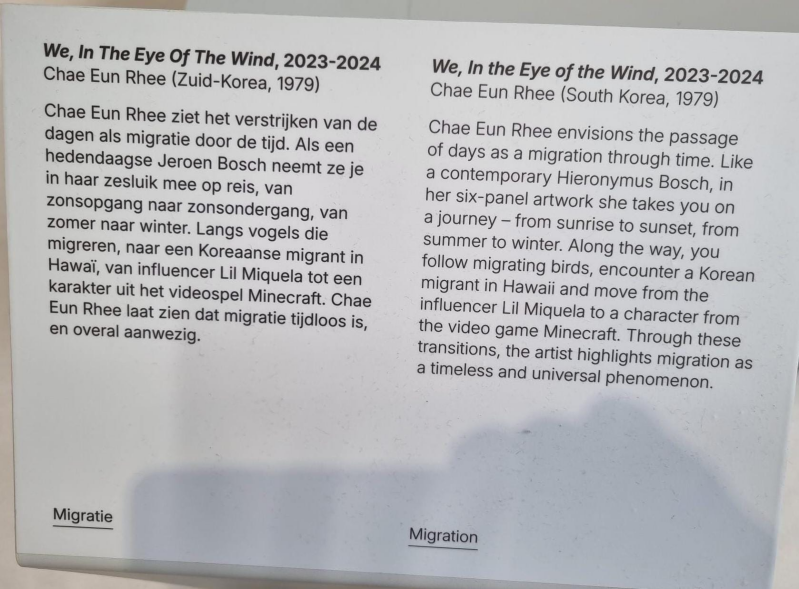
I was drawn into the six-panel work; there is so much to see. You feel the optimism, but also the pessimism. The duality of life in form and colour. In young and old, in image and imagination, in the natural and the unnatural. Beautiful, like a dream that emerges without laws or rules.
Then I hear Gwenn say, “Grandma, look, the Statue of Liberty.” I turn around and immediately say, “Yes, but can you see the difference? This isn’t the face of a white person. Let’s read what it says about it.” It also immediately reminds me of what Michel always used to say about depictions of Jesus Christ on the cross. It always bothered him that Jesus was portrayed with blond hair and blue eyes. If you know where he was born, that is extremely unlikely. He always had difficulty with the way history was given a white interpretation.
We continue walking and see a gate swing open and slam violently into the wall. It really does make an enormous bang.
There are so many artworks that have touched me. Not in the same way as the photographs; those felt raw. The artworks seem to have been created very much from an inner movement, and within them you can almost always find something optimistic as well. As though the artist’s subconscious is processing trauma while at the same time revealing the gift of beauty or freedom, which, despite the chains, remains an intrinsic part of being human.
I bought a book by an artist named Efrat Zehavi. She approached people at the market in Rotterdam and asked them, “Where are you going?” Most people then started telling her where they came from. Efrat models the faces of the people she talks to. She says, “It seems that if we want to know where we are going, we first have to understand where we come from and who we are.” This immediately reminded me of a blog piece I wrote earlier this week. How important is it to know where you come from or what your history is?
The final painting I want to share here struck me enormously, as did the text accompanying it. I discussed it at length with Gwenn. She is eleven now. I wonder what will stay with her from this museum visit.
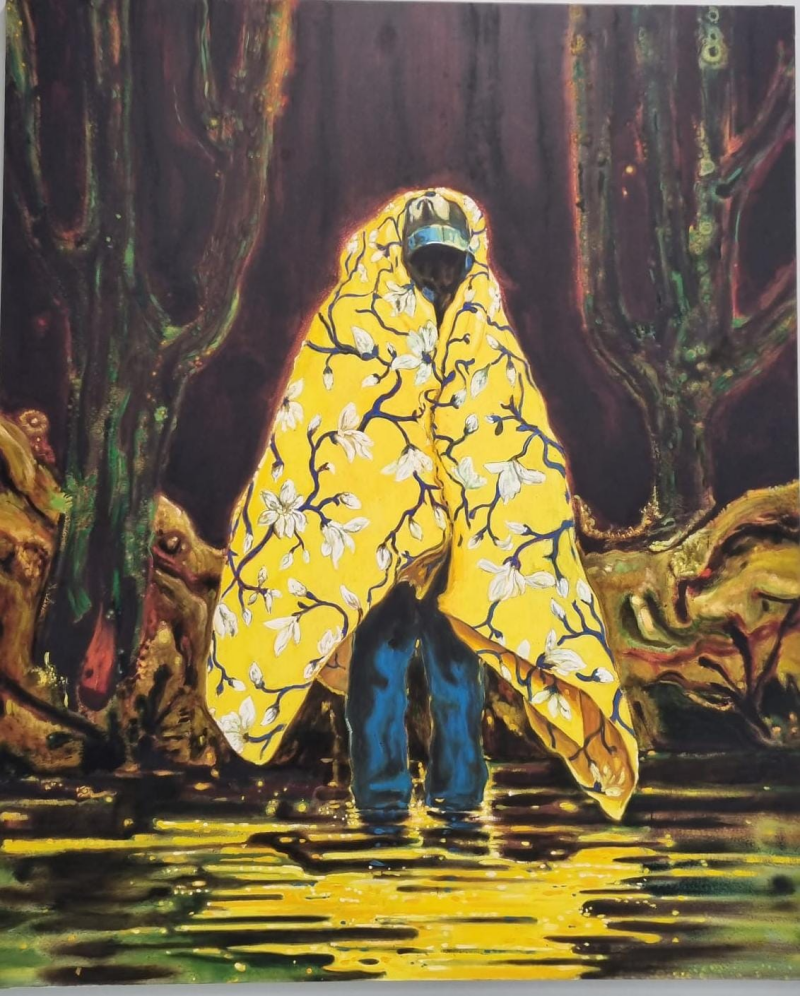
We spent the entire afternoon there. It made a deep impression on me, and I could probably say something about every single artwork. About what it stirred in me and all the associations it brought to mind. But I think I would recommend this museum to everyone. If only to place our own worries into a larger perspective. And to realize that somewhere inside each of us, a king or queen lives.
Back home, I asked Gwenn which film she wanted to watch with me. She chose Avatar 1. Lying together on the bed, I thought: this story is essentially about the same things as everything we were able to see today. And of course I shared that thought out loud with my granddaughter.
We left home this morning without knowing where we were going.
Paris became Kinderdijk, Kinderdijk became Rotterdam, and Rotterdam became a journey alongside people who once departed from somewhere, travelled and arrived somewhere else.
Perhaps that is what I most want to show Gwenn during all those journeys I hope we will make together:
not only art, cities and history, but above all the human being hidden within them.
Today, we didn’t need to go all the way to Paris for that.
Symbiosis
16 August 2026
The weather forecast was right: today it would only reach 23 degrees. Now that is a much better temperature to wake up to feeling fit. Breakfast in bed, with the prospect of finally going cycling again after several days of rest.
My granddaughter calls. We FaceTime; she is coming tomorrow and wants to know what she should bring. Her bicycle, perhaps her own pillow and duvet as well? She has such a sweet face. Of course every grandmother says that about her grandchildren. She may not be the prettiest child to look at, but she is the sweetest child I know. In a very particular way, not necessarily cute, but just like her mother. Alert, caring and helpful, naturally so. Someone whose presence brings calm. Her mother had that gift at such a young age too. A golden character, with some insecurities as well, again just like her mother. I am very happy that she is coming to stay for a while. Quality time with my granddaughter. I tell her that I am going to train tomorrow. She wants to come along to film me, she giggles. Teasing Grandma and doing silly things is the best thing there is.
It is Sunday, so we start the day nice and slowly. A long shower, making myself feel fresh and fruity again so we can go out. Ton is not much of a talker, but today he apparently feels like talking while we cycle. He tells me about his childhood, his upbringing and his friendships, prompted by what he sees happening in my life. Inside, I smile. He sees it all happening, but rarely talks about it. At least, not of his own accord. For me, it is an important moment, that feeling of being truly connected.
The streets are quiet. In the surrounding villages most people are religious and everything is closed as well. There is nowhere for us to sit down for a little refreshment. Because the weather is pleasant and there is greenery and flowers everywhere, and because the old façades of the Dutch houses are so beautifully maintained, it is still lovely to cycle through these villages. In darkness or bad weather, the silence might feel gloomy.
A memory surfaces about my grandmother and her family. I tell Ton that, as a child, I was frightened of those people dressed in black. My grandmother was always dressed in black, with a rolled-up braid pinned against either side of her head. Ton asks why I was afraid of them. Yes, why actually? There was something stern and unyielding about those people. Their homes were austere and sombre. As a child, I did not even want to shake their hands. Hahaha, I genuinely thought it was horrifying.
I continue musing while telling Ton how it felt to me as a child. I almost felt that simply being alive was a sin. In my mind I could not conform to strict rules, so I was sinful and unworthy in their eyes. How frightening can you make it? Ton responds to this. He himself comes from Goeree-Overflakkee, an island. He too grew up among very religious people like these. His worst experience was that they made him feel inferior to those who believed or professed their faith. Yes, he remained a convinced atheist; I did not. I certainly believe there is more than what the eye can perceive. I simply do not want to, and cannot, pin it down to one fixed concept or form. And certainly not to laws and rules. To me, God lives within me and within everything. It is a source, essentially a mystery of life, with us humans standing behind a curtain. Every now and then, by lifting it slightly or sliding it aside, you can catch a glimpse of something. To me, life is a path inward, through becoming conscious of what touches me on the outside and outside of myself.
I notice that it is not only the cycling that gives me a boost, but also having a conversation like this and musing together.
The grass has turned brown in many places because of the drought. Many flowering plants have withered somewhat as well. What does catch my eye are the many clumps of salvia. Apparently they have not suffered much from the drought, or perhaps they have been able to absorb and retain more water than the flowers growing beside them. I stop to take a closer look. The flowers are tiny; they are called Hot Lips. The place is buzzing with bees.
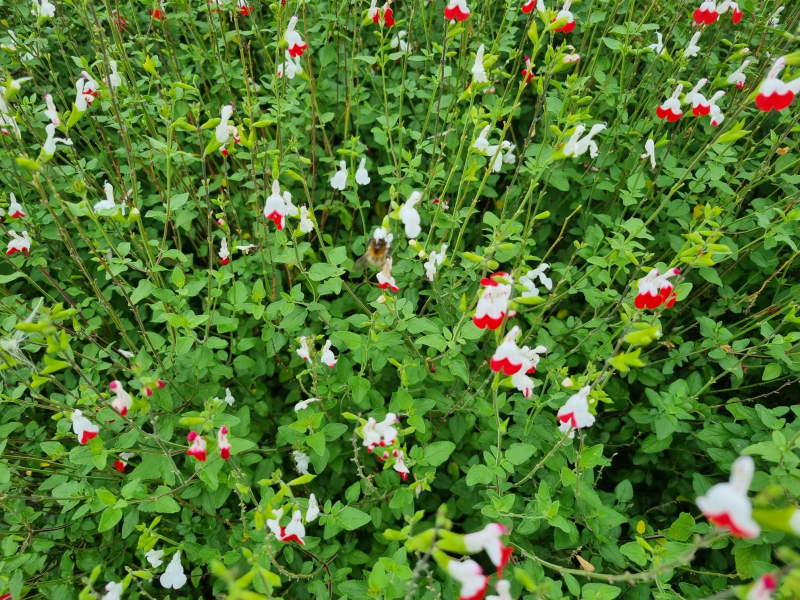
Funny, earlier this week I wrote a piece in my document about commensalism, mutualism and parasitism. They are three forms of symbiosis: the long-term coexistence of two different species of organisms. The difference lies in who benefits, who is harmed, or who remains unaffected. I find things like this fascinating because I often use nature as a metaphor. How does symbiosis work in humans, in interaction with another kind of organism? How far have we distanced ourselves from it? It is something I sometimes worry about. But on the other hand, perhaps something first has to change so fundamentally that people are forced to become conscious of it again. I say ‘change’ because I do not know whether decline, from an evolutionary perspective, is necessarily bad. So perhaps my concerns are unfounded. From my perspective, I simply find it a pity that so many people have become so detached from nature. Let me put it that way.
In any case, the bees on the salvia are an example of mutualism. The bee receives food in the form of sweet nectar and pollen. The bee pollinates the flower, allowing the plant to produce seeds and reproduce. There, that is my contribution for today. The teacher in me simply cannot resist.
Perhaps symbiosis begins with recognising that nothing truly exists entirely on its own. The bee and the flower each follow their own nature, yet in their encounter they both flourish.
Maybe that is true for people as well.
We do not have to become one in order to be connected.
Sometimes it is enough to meet, to exchange something, and then continue along our own path.
The Direction of the Current
August 15, 2026
A day like yesterday. No messages or other forms of communication. My day just drifts along. My body shows signs of things failing here and there. Fortunately, it shifts from my left leg to my right arm, then to my hip and left arm. I say fortunately because, happening this way, it doesn't seem like a stroke or TIA, but simply the condition I was born with. After these hot, inactive days, my body needs to recover again.
Ton spends the entire day preparing an Italian recipe. He brings me a sorbet, lemon with blood orange. He takes care of me and occasionally peeks around the corner to see how I'm doing.
A feeling I know from long ago begins to creep over me. A kind of nausea, a slight sense of stress because I have to go back to school the next day. It's really quite strange, because it's a feeling I had about fifty years ago. Tomorrow is Sunday and I have absolutely no obligations, and haven't had any for years. So where does this feeling, this restlessness, come from?
Or is it even stranger than that? Back then I experienced the feeling, but perhaps not the meaning behind it. That was how I always felt when I had to go to school. And now, fifty years later, I recognize this feeling as something from back then. The difference is that now I connect it with fear and aversion.
I have a series playing that I'm watching with half an eye and listening to with half an ear. I hear a grandmother explaining to her grandson: “It is important to know your own history.” I turn up the volume for a moment to hear what this is about. She means the history of your family. That way, you can know who you are. Your origins show you where your roots lie. If you understand the struggles your ancestors faced, you can see how your own problems or triumphs fit into a larger story.
Hmmm, well, what if circumstances mean you don't know that history? Then what? I only know mine on my mother's side. Is it true? Am I now ‘doomed’ to repeat the same blunders or crises from the past because I don't see the warnings? Does that leave me without a sense of direction or belonging? Does it really imply that I am therefore more likely to make mistakes, or to make them sooner? Do I have no anchor or solid foundation to fall back on?
Okay, I turn the TV down again. It all sounds plausible enough, but I don't think it's necessarily an immutable law. The feeling of never belonging anywhere, or never wanting to belong anywhere, is certainly clear to me. Whether that is a consequence of not fully knowing my own history, I don't know. But… it could be. Do I think that means I stumble into trouble more often? No. I have never really gone looking for direction. I have tended to wait and see which way the current of my life was flowing and adapted myself to it.
It just goes to show how an apparently simple quote can make me stop and think about how something feels to me. And not wanting to go to school? Yes, perhaps that was because I never liked other people determining my direction for me. Being required to function within a group wasn't my thing either. School, courses, all those kinds of things were always situations my body responded to with nausea.
Today, for the first time, I felt where that resistance back then might have come from. It's amazing what a few days of rest can do to a person! Is there any use in knowing and recognizing this feeling? I don't know. It simply happens.
Over the past few nights, I watched trails of light in the sky and saw a stream of life. Today that current appeared again, but this time within me. Perhaps I don't always need to know where it began in order to feel which way it is moving. My history may contain roots I don't know, and my body may carry memories whose meaning I only recognize much later.
Perhaps I don't always need to know the direction.
Sometimes it is enough to notice that something has begun to move,
to recognize it when it appears, and then to see where the current takes me.
An Empty Day Full of Space
August 14, 2026
After we went stargazing in the polder last night, I stayed awake until half past three. I wrote my blog and was able to enjoy the slightly cooler atmosphere for a little while longer. I didn't wake up until around noon. Fortunately, Ton had already turned on the air conditioning in the bedroom, so I woke up feeling reasonably okay. Inside the house, I immediately noticed the difference between the cool breeze from the air conditioner and the suffocating heat the moment you stepped even slightly outside its airflow. It was immediately clear that I needed to take this day carefully. Even indoors, I shouldn't move around too much if I wanted to keep feeling reasonably well. In bed with my little dog Puck, the TV on, my laptop beside me on one side and my books on the other. Let this empty day come and fill itself with space!!!
In the end, I filled it mostly with sleep. I dreamed. It was actually an almost literal replay of the series Moon Lovers: Scarlet Heart Ryeo. On my Fitbit I saw that I had spent more than an hour in deep sleep, with the rest in lighter sleep. Apparently, the solar eclipse had briefly taken my subconscious back to this story and to the layers within it that resonate with my imagination and experience. How love connects, but also how it can wound. How love can illuminate another person's inner darkness, like the light of the moon. The mask, so fascinating and symbolic at the same time. Just as the moon has a dark side that remains hidden, the mask conceals physical and emotional scars and a frightening reputation. The bittersweet pain of the open ending emphasizes how deep connections can transcend time, even when physical separation and grief are inevitable. The relationships within the family, the changing view of human rights, uprisings, arguments, joy, loneliness; so many aspects are present in this series. Today, they were all there again in my dream.
I didn't wake up again until around dinnertime. Was it a wasted day? I don't think so. I dreamed this story with more calm than I had when I watched it back then. At the time, it affected me physically. The recognition touched my own deep wounds. Now I had a beautiful, full dream and woke up feeling refreshed. Satisfied that this day feels so much better than yesterday, I sit down at the table to eat the delicious salad Ton has made.
Then back to my bedroom again. I leaf through a magazine and see the words: ‘Make room for colour.’ I look around my bedroom and have to laugh. That's not exactly my problem. A little further on it says: ‘Don't forget to sit still for a while.’ Well, that's not a problem for me either. What other chapter headings are there? ‘Meander through life every now and then.’ Every now and then? Take it from me, life is not a straight road. Sometimes progress means spontaneously taking a turn onto a winding path. ‘Let nature do its work.’ Without reading the rest of the piece, I completely agree. I even once wrote something about it: ‘The Meaning of Nonsense versus the Nonsense of Meaning.’
The last little chapter heading I notice is: ‘Plant a seed for others.’ I don't read this one any further either, but it makes me think of a message from my sister. She is fourteen years older than I am, which means that in terms of life experience she is literally that many years ahead of me. Her children and grandchildren are just a little older than mine. We have both been divorced, which brought certain difficulties with it. We come from the same family, where time did not stand still either, but everything changed. Now that she and her husband are showing the ailments that come with growing older, their children respond to this in their own ways. I have often stored away what happened in her life as a kind of lesson for myself, for when something similar might arrive at my own door. Through her experiences, she has often planted seeds for me. Probably without realizing it, but I think that may be what we can mean to one another.
Last night I watched tiny trails of light move criss-cross through the sky and saw sperm cells in them, a descending stream of life. Today, without hardly leaving my bed, I find myself returning to seeds. Perhaps we don't even know which seeds we leave behind in someone else along the way. We live our lives, tell our stories, make our mistakes, change, and sometimes find our way. Someone else watches and, without realizing it, carries something of that with them.
Yesterday I saw a stream of life moving across the sky.
Today I realize that perhaps that stream simply continues,
from person to person,
in seeds whose place and time of germination we ourselves may never know.
A Stream of Life
August 13, 2026
On August 12, two remarkable celestial events could be seen from the Netherlands and Belgium. In the evening there was a partial solar eclipse, and a few hours later, during the night of August 12 to 13, the Perseids reached their peak. Because the peak almost coincided with the new moon, there was hardly any interfering moonlight. From a dark location, with clear skies, dozens of shooting stars per hour could potentially be seen.
Last night I went out to see it. Ton was sleeping soundly, so I went into the polder by myself. Sure enough, here and there I saw streaks of light shoot across the sky. I experienced this once before in Belgium. In 1991, in the Ardennes, I saw a truly spectacular meteor shower, as if there were a fireworks display in the sky. An image and a memory I will never forget. This time the sky was beautiful, but the meteor shower was much more softly present. I had to keep staring carefully upwards to see the shooting stars.
Back home, unfortunately, I once again couldn't sleep because of the nerve pain that has been persisting for days. The temperature reached 35 degrees, and together with my exhaustion it made for a day when I didn't feel particularly well. At times like that I feel tearful. I don't cry, I'm not really depressed, but I do nothing and I can't do anything. It remained warm until midnight.
Ton didn't take the dogs out until one o'clock in the morning. I went with him, just to get some movement and be outside for a while. The night was balmy. Together we decided to head into the polder again to see whether the meteor shower might be a little clearer tonight.
It was just as softly present as yesterday. But now it looked more like sperm cells moving criss-cross through the sky. Like tiny points of light or sparks leaving behind a stream that you perceive as little streaks. They are what we call shooting stars, but to me it feels more like a descending stream of life.
I'm glad Ton came along for a while. Stargazing together is much more fun. Tonight I also see a haze light up in the shape of something like a horseshoe. A feeling of new life and happiness comes over me.
We ride back home. Ton and the dogs quickly dive back into bed, while I stay awake for a while longer. My body finally feels a little better again. Tomorrow will be even hotter, so I had better enjoy these hours in which the night lies softly around me and gives my body a little more space again.
Perhaps something doesn't have to be spectacular to make an impression. In 1991, the sky seemed to be on fire for me. Tonight I had to search, wait and keep looking. Tiny lights traced their brief paths through the darkness, hardly more than sparks. And yet I saw life in them.
Sometimes life doesn't arrive with fireworks.
Sometimes it passes through the darkness like a tiny streak of light, and all you have to do is keep looking up long enough to see it.
Perfect in Imperfection
12 August 2026
Lately, I have been finding it difficult to wake up, which means it takes me a long time to get going. Around lunchtime, we have arranged to meet my brother and his girlfriend. It is about half an hour by bike. I can manage that, but it means I will have to cancel my training. A shame that I cannot do it, but it is what it is. My brother’s girlfriend tends to make rather firm, fairly unyielding statements that, unfortunately, I sometimes react to. This can cause some friction. I resolve not to respond and to keep steering the conversation towards something pleasant and cheerful. Or simply let her finish, not really respond to what she has said, and then move on to an easier subject. My brother tells me that the sense of togetherness we once experienced as a family seems to have disappeared. He wonders whether it might still be possible to bring us a little closer together again. Times change. We acquire partners, children, grandchildren. There have been divorces and our parents have died. The longing for a family home where children and grandchildren visit Grandpa and Grandma and where we all meet may be understandable, but in our new situation it is no longer really practical. Our children no longer automatically have one family home, because parents have separated and live elsewhere. And we, as parents and grandparents, are much more inclined to go out and do things together rather than sit at home every Sunday waiting for children who might come by. Life is different from the way we knew it. Organising family gatherings no longer seems like a good idea to me. Just visit a brother or sister when you feel like seeing them. That is what I do, I tell him. Stop wondering why it does not happen the other way around; that only causes frustration. Do what feels good to you and what your heart tells you to do. I do understand the nostalgia he feels. I sometimes long for it too. At the same time, I think nostalgia and longing can hold you in place, making your world smaller. Accept that times change and that life is different, and space opens up for new paths or lovely things you cannot yet see. After eating delicious mussels and chatting pleasantly, we say goodbye. Ton and I cycle a little farther near Kinderdijk, through the polder and back home. From 7.15 to 8.15 p.m. there will be a solar eclipse. So we want to head out into the polder again to watch it. This time, along the way, we do encounter people sitting in the grass waiting for it. On the little country road where we often cycle, several people are standing by the roadside waiting for the eclipse as well. Not many, but a few. I take photographs. You cannot really see the eclipse with the naked eye, and I cannot capture it directly with my phone either, but indirectly I can. A tiny crescent beneath the sun can be found in the photographs, even on Ton’s face. It is not a second little moon in the sky, but a lens flare. During a partial solar eclipse, such an internal reflection in the lens can take on the shape of the eclipsed sun. So, indirectly, I have actually captured the eclipse crescent.
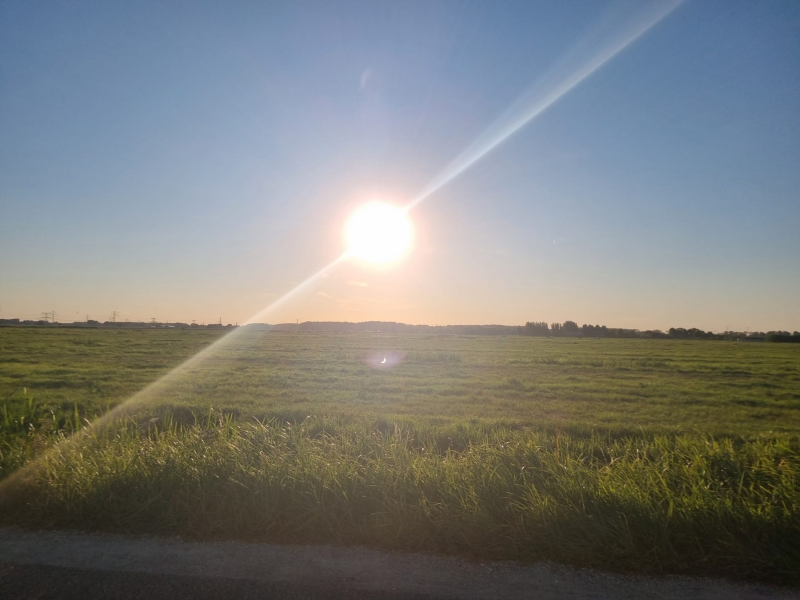
While we stand there watching the brilliant light of the eclipse, I see a kestrel hunting. Its wings beat rapidly while it remains almost perfectly still in one place in the air. And whoosh, down it goes to catch its prey. A little later, the same ritual again, all beneath the eclipse. As the eclipse progresses, suddenly another flock of swallows appears, but this time they are flying extremely low. I feel as though I need to duck. I know that swallows can fly low when rain is approaching, but this surprises me because I can feel that this is not what is happening now. We pass a field where hundreds of geese have landed. Instead of grazing, pottering about, raising their heads and moving on again, as I normally see them doing there, almost all of them are lying down as though they are resting. A striking and, to me, slightly surreal sight. I often watch Asian series in which phenomena such as eclipses are given a role in the story. In one of my favourite series, Moon Lovers: Scarlet Heart Ryeo, a solar eclipse serves as a mystical vehicle for time travel. During a total solar eclipse, the main character Go Ha Jin is transported from the modern era into the body of Hae Soo in the Goryeo dynasty. The phenomenon becomes a temporary tear in time. A fascinating idea. For years, I have explored the spiritual and astrological symbolism associated with phenomena like these. In that symbolism, an eclipse is connected, among other things, with change, bringing what was hidden into view, letting go and a new beginning. Those meanings still speak enormously to my imagination. They inspire me. But perhaps the physical phenomena themselves speak even more strongly to my imagination. The diamond, the intense remnant of the solar disc breaking through a lunar valley. The ring, the delicate solar corona visible as a circle around the moon. The so-called Baily’s beads, beads of light in which the final points of sunlight sparkle through the irregularities of the lunar surface. Diamond, ring, pearls. All images that continue to work their way into my imagination and my dreams. And perhaps what I find most beautiful about all this is that the phenomenon possesses a certain perfection, while its execution does not. It looks like a diamond. It looks like a ring. They look like pearls. But they are not quite those things! Even the moon itself is not the perfectly smooth circle we imagine we see from a distance. It is precisely because of its mountains and valleys that those beads of light appear. The irregularity is what makes the phenomenon beautiful. Nature is perfect in its imperfection. That thought gives me peace and, the older I become, makes me increasingly content. Perhaps the same is true of life. We can long for the form it once had, for a family home, for the togetherness we once knew, for people and times that will not return. But when the old form disappears, its beauty does not necessarily disappear with it. Other openings appear through which the light can fall.
Like sunlight through the valleys of the moon.
No perfect ring. No real pearls. No diamond.
And precisely because of that, so incredibly beautiful.
The Same Place, a Different Silence
11 August 2026
Every day I do the same thing. Wake up, drink coffee, drink a shake, shower or wash, go to the toilet, get dressed, go to training, come home, get undressed again, check my emails, have another coffee, but this time with two crackers. How I fill the rest of the day depends on how I feel, the weather and the circumstances. Until two o’clock, I have a fixed routine. You could call it discipline or regularity. Perhaps even rigid or boring. But every day is different. Even when something seems the same, every second I see change. Like the cells in your body renewing or changing themselves: invisible, yet in constant motion.
Some days I sleep well, other days I don’t. Some days I wake up on time by myself, other days Ton wakes me. Some days, when he wakes me, I am instantly wide awake. On another day, like today, he wakes me, but my body doesn’t wake up with me. Then I need a long run-up to regain my mental and physical balance. On those days, I postpone my training for an hour. At the gym, too, the machines are the same every day. The people are different each day, although I am gradually beginning to recognize the faces. Sometimes it is busy, sometimes not at all. Some days everything feels easy, other days it feels heavy, even though I am doing exactly the same thing.
Our apartment building stands with its feet in the water. A canal runs alongside it and continues into a park with an enormous pond. The neighbourhoods in the municipality where I live have been designed with canals everywhere. There is a family of swans that was near the sports centre this morning, and this evening, when we came home from cycling, the family was in the canal beneath my apartment. It makes me happy to encounter them everywhere and to see how peacefully they move through an environment shared with people.
Because of the pain I experience, I sleep badly, and these days I allow myself to take naps in the afternoon. Or rather, I no longer resist when I fall asleep in bed while reading a book or watching television. I used to think that was something for elderly people, not for me. I see it differently now.
After dinner we go cycling again, taking a different road towards the same polder. In the same place as yesterday, at roughly the same time, I take three photographs while standing in one spot. I see silence again, but a completely different silence.
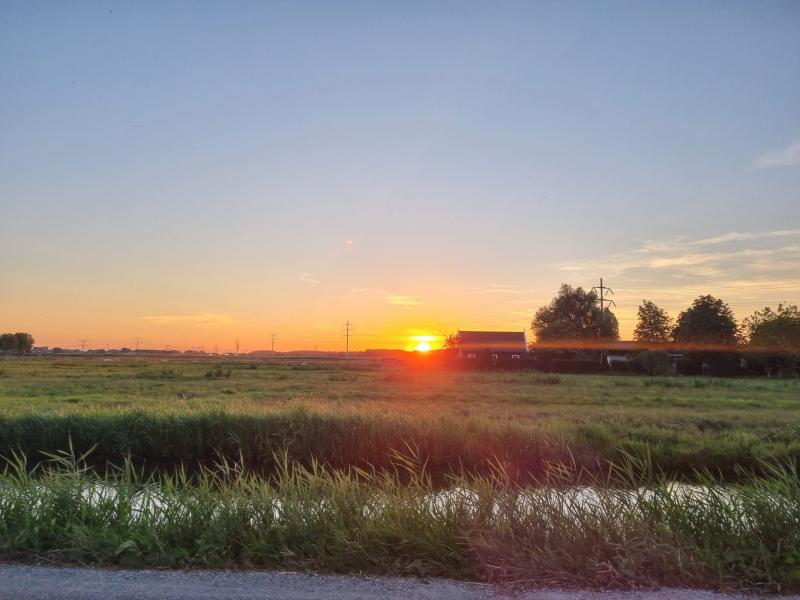
Yesterday I could still see feather-like clouds in the sky, heralding a beautiful day. Now the sky is almost completely clear, without a single cloud.
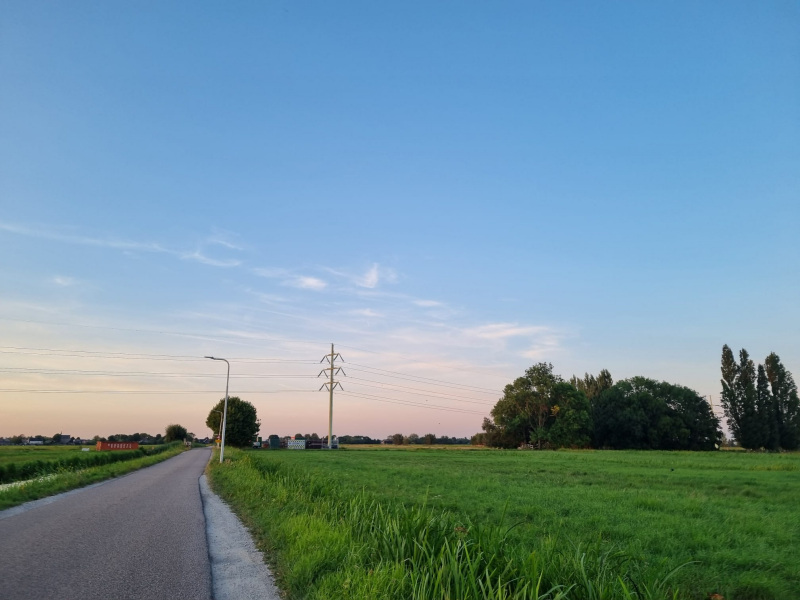
High above the field we see flocks of swallows. As we cycle past the meadows, we see thousands of them. Flocks of swallows everywhere, too high in the sky to photograph properly with my phone. Hundreds of swallows flying high above a field usually indicate good, dry weather and an abundance of insects. According to the familiar weather saying, it will remain dry as long as they fly high. The rising warm air carries the insects upwards and the swallows follow their food. And there it is again: the sky is clear now, while the field itself is much quieter. How much can the atmosphere change in a single day?
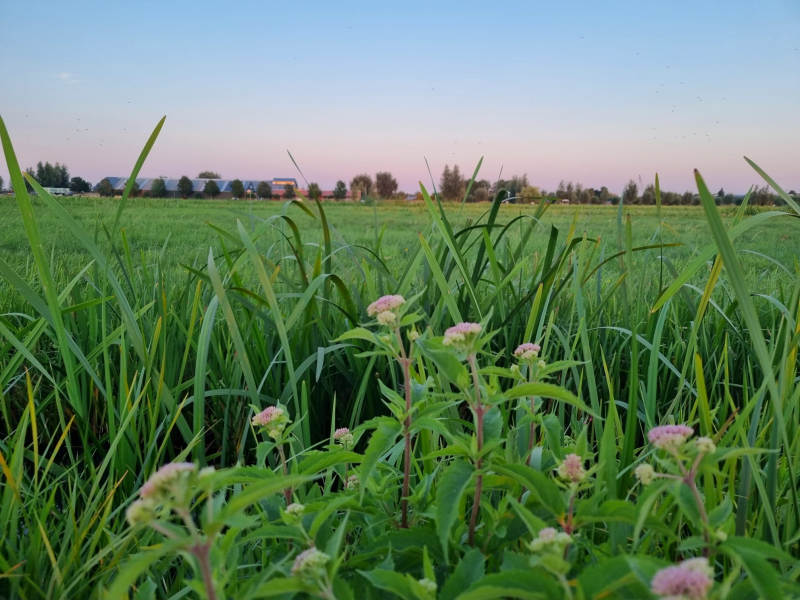
In my philosophy of life, I often use metaphors from nature because I think, or believe, that life, existence itself, moves according to the same rhythm. Movement and change are elements of existence. Nothing remains fixed. Wanting to fix something in place or hold on to it is a human intervention.
Perhaps it is precisely my fixed daily rhythm that gives me the space to see that change. I get up every day, do many of the same things and cycle through the same landscape. Yet no morning, no training session, no body, no sky and no silence ever exists twice in exactly the same way. Even when I stand in the same place, at roughly the same time, and look around me again, I cannot get yesterday back.
Existence cannot be held onto.
Perhaps all I can do is be present while it changes.
I See the Silence
August 10, 2026
Persistent nerve pain in my feet keeps me awake all night. It is difficult, but fortunately I have no obligations that require me to be well rested. My sleep has never been stable. In the past, I could wake up in the morning feeling perfectly fit, even if I hadn’t slept all night. That is different now. I have to be more mindful of how I distribute my energy. During my workout, sweat pours off me in streams. It feels good to sweat that much. It makes me feel healthy. Whether I actually am, I don’t know, but I enjoy working that hard. Perhaps the best part is how quickly I recover afterwards: the feeling of being strong, powerful and still young.
We agree to wait until after dinner before going cycling again today. Lying on the bed with the television on and taking the occasional nap is my remedy for my chronic fatigue. Ton doesn’t like the fact that I don’t wake him up at night so he can massage my feet until I fall asleep. He thinks I need to learn to do that. But it simply doesn’t occur to me to wake him when I’m in pain. I’m not used to bothering someone else with it. I never think of taking painkillers either. Only when Ton says, “Wouldn’t you perhaps…” Learning to be gentler with myself is one thing, but doing so at someone else’s expense is another. At least, that is how it feels to me. Ton then says, “You shouldn’t think of me as someone else.” And there is the next stumbling block. I do see a partner as someone else, not necessarily as someone who is one with me.
I hear a conversation in a film. He tells her that he sees her as his air. Without her he cannot breathe; he feels as though he is suffocating. She replies very calmly, “I’m not the air, I was merely a breeze. The wind cannot return to a place it has already left.”
Yes, I can do something with that. I am like the wind. Just as the wind is always moving and never sends exactly the same current of air back to the same place, life is always moving. We live together, but move separately, with our own feelings, thoughts and intentions. Sometimes there is no wind at all, sometimes there is a storm or even a hurricane, but we move independently of each other. Sometimes through each other, sometimes colliding. Time is irreversible and we move through it. Being the wind symbolises, for me, the necessity of accepting the past. Trying to return to how things once were is pointless. The road you travel keeps changing you. Wanting to remain the same is not how it works either, I think. Everything is constantly changing. Once you have left somewhere, that place, mentally or literally, is no longer the same place it was when you were there. No, you are the air I breathe may sound romantic, but to me it feels like seeking authority outside yourself.
I haven’t heard from my sister for almost two months. I think about her often, but now, while I’m caught up in these wandering thoughts, I take the bull by the horns and call her. It is good to talk again. We tell each other about things that are currently close to our hearts. Suddenly, in response to something I tell her, she says, “That is clearly a case of seeking authority outside yourself. I recognise it, because I have always done that too.” In doing so, she confirms something I have been sensing in exactly that way. It gives me an insight I can accept, allowing me to be at peace with the way things are going. What exactly we were talking about doesn’t matter. What does matter to me is the synchronicity of this very subject suddenly appearing in our conversation as well. Once again, we promise each other that we will try to stay in touch a little more often. A lovely intention.
After dinner, we do indeed go cycling. It is considerably cooler. As we enter the polder again, I say to Ton, “I see the silence.” I take a photograph, trying to capture that feeling. But can you really capture it? Doesn’t it blow away with the wind the moment you see it? The sky is filled with enormous feather-like clouds, almost a spectacle in itself.
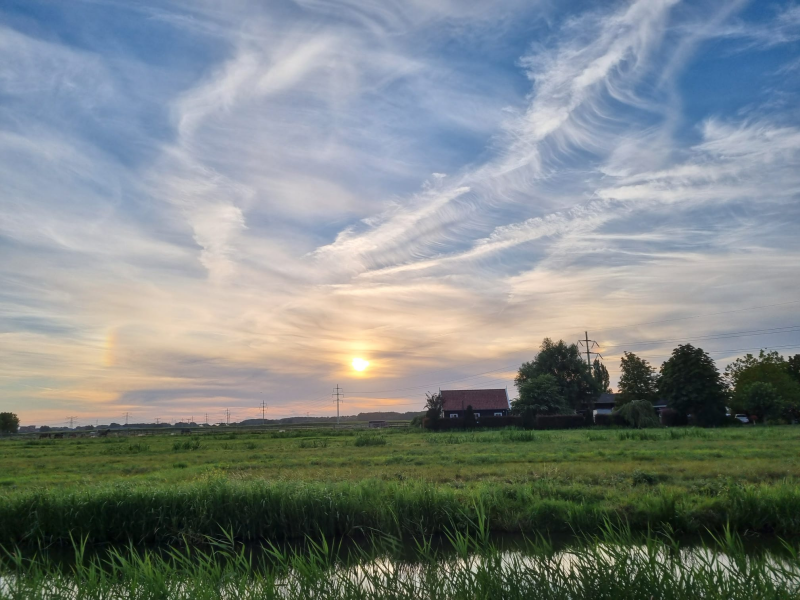
I take a photograph of that too. We continue cycling, but stop because it really is getting cold. A thick cardigan makes us comfortable again and we can carry on. The sky slowly changes from purple and lilac to orange. Beautiful.
In the twilight, I suddenly see light. It is a kind of light that makes the horizon sharper. During the day, everything close by is sharper than what lies farther away. Now it is clearly the other way around. The plants nearby have somehow softened, while the horizon seems to come towards me.
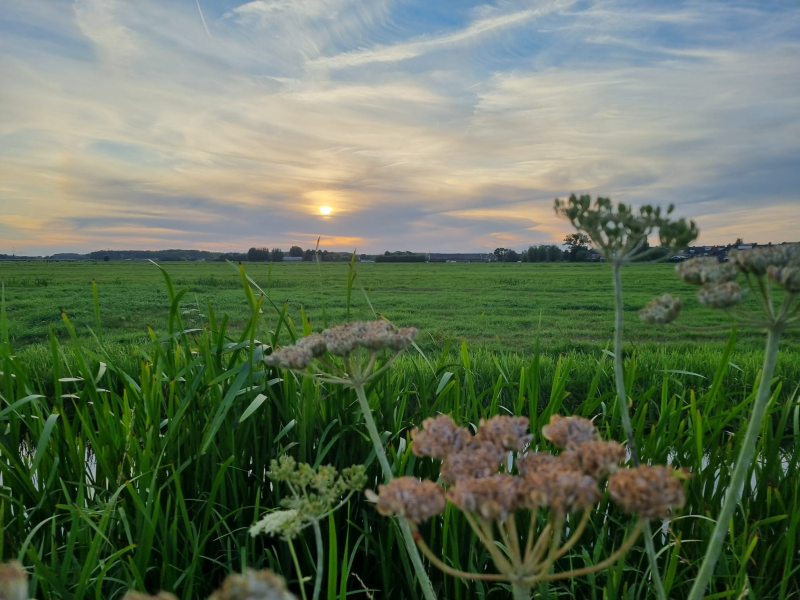
I arrive home feeling fresh and awake.
Perhaps I don’t have to merge with another person in order to be connected.
We can each be our own wind and still meet each other, sometimes colliding, sometimes flowing through one another, and sometimes almost completely still.
And perhaps it is precisely within that movement that, every now and then, I can see the silence before it blows away again.
Letting the Mud Settle
August 9, 2026
This morning I felt even worse than I did yesterday. I started to feel deeply unhappy. I even felt the urge to run away: pack up my things and disappear without a trace. Dark thoughts kept running through my mind, difficult memories and comparisons with my situation now. With every passing minute, I felt myself sinking deeper into my black hole.
Then I notice a book of quotes by Alan Watts.
“Muddy water is best cleared by leaving it alone.”
It means that sometimes the best way to deal with chaos, unrest or problems is to stop stirring them up so desperately. Just as mud naturally sinks to the bottom when water is left undisturbed, clarity returns on its own when you are patient and stop trying to force things for a while.
It is as if the book is lying there to tell me not to do anything rash while I am feeling this way. Coincidence or not, it reaches me. So I decide to pull myself out of my lethargy and suggest going for a bike ride.
We step outside and it immediately feels like a warm hairdryer blowing at us. We give it a try anyway and along the cycle path we see lots of Italian arum. Poisonous plants, with their orange-red berries standing out vividly among the dried grass. I take a photo.
Well, I think, that fits rather nicely with my poisonous thoughts.
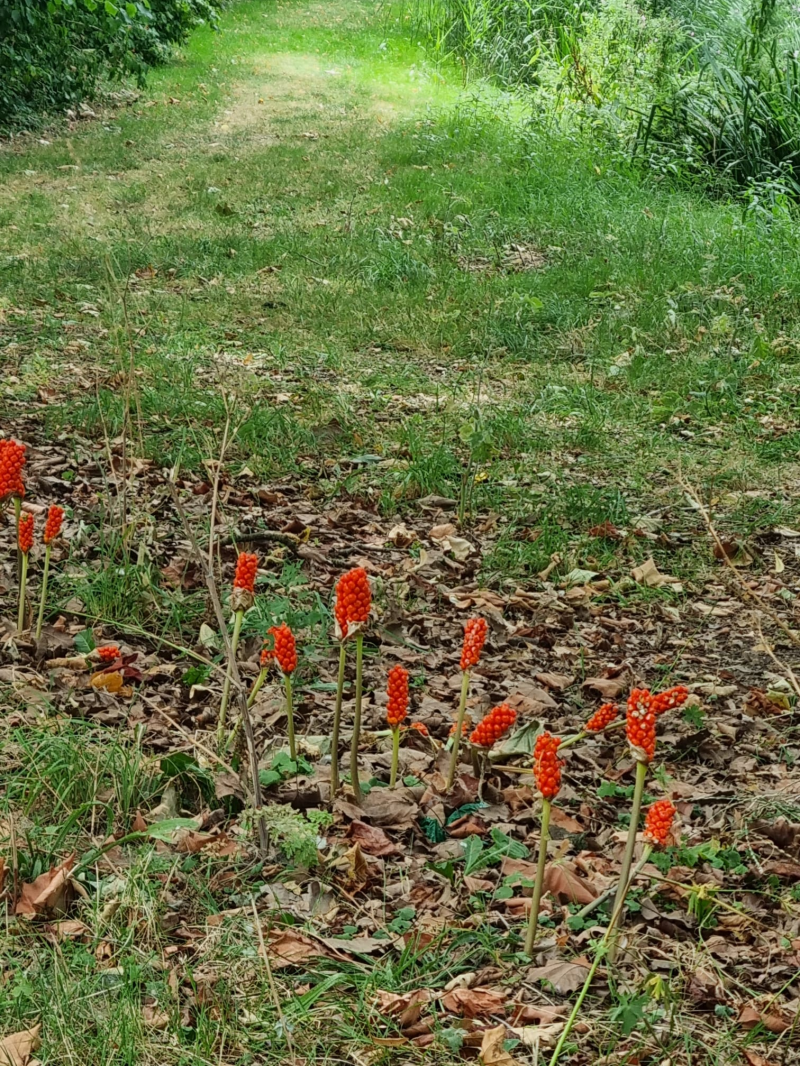
We cycle a little farther, but it is not pleasant because it really is too warm. After a short ride, we are back home.
Still with Watts’ wise words in my head, I agree with Ton that we will try cycling again this evening around dusk. Hahaha, it feels like I am taking giant steps by being so accommodating and friendly towards him. He has been irritating me for days. And yes, that says enough about me, but it still does not change the fact that this is how I feel.
At around eight o’clock it is cloudy and we set off again. We have barely left our street when we feel the first drops of rain. The temperature feels wonderful now, so I decide to enjoy the rain. They are big drops that fall every now and then, and it is actually quite refreshing.
We head back into the polder. It is truly silent. No cars, cyclists, nothing at all. We do not meet anyone.
The evening light is absolutely beautiful, so extraordinary, a living painting.
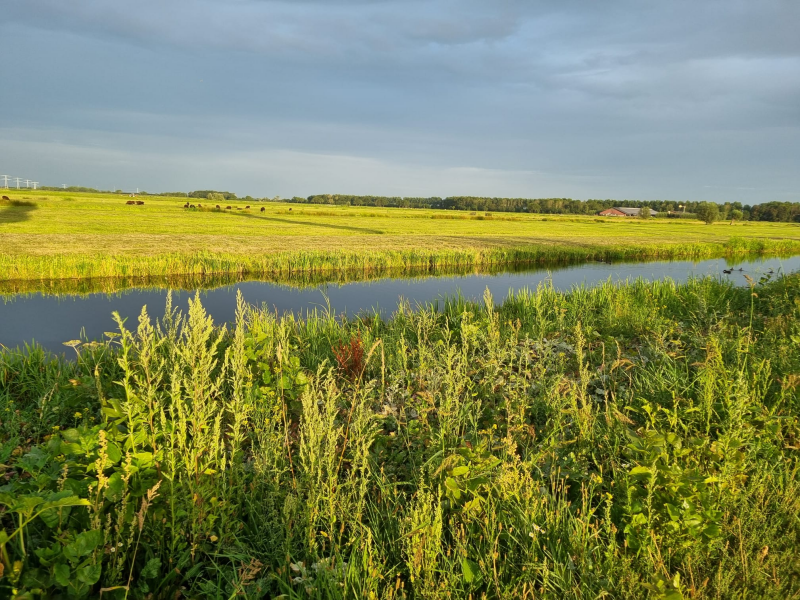
We see hares chasing one another and an enormous colony of great egrets. I have truly never seen anything like it, perhaps a hundred pure white egrets. We see dozens of storks, lapwings, buzzards, geese, moorhens, coots, swans and more. The fields are densely populated with animals. It feels as though we are cycling through an open-air wildlife park.
I become more and more enthusiastic and happy.
“Ton, look, over there! And there! Oooh, look how beautiful!”
Then, above the field in this beautiful light, a rainbow appears as well.
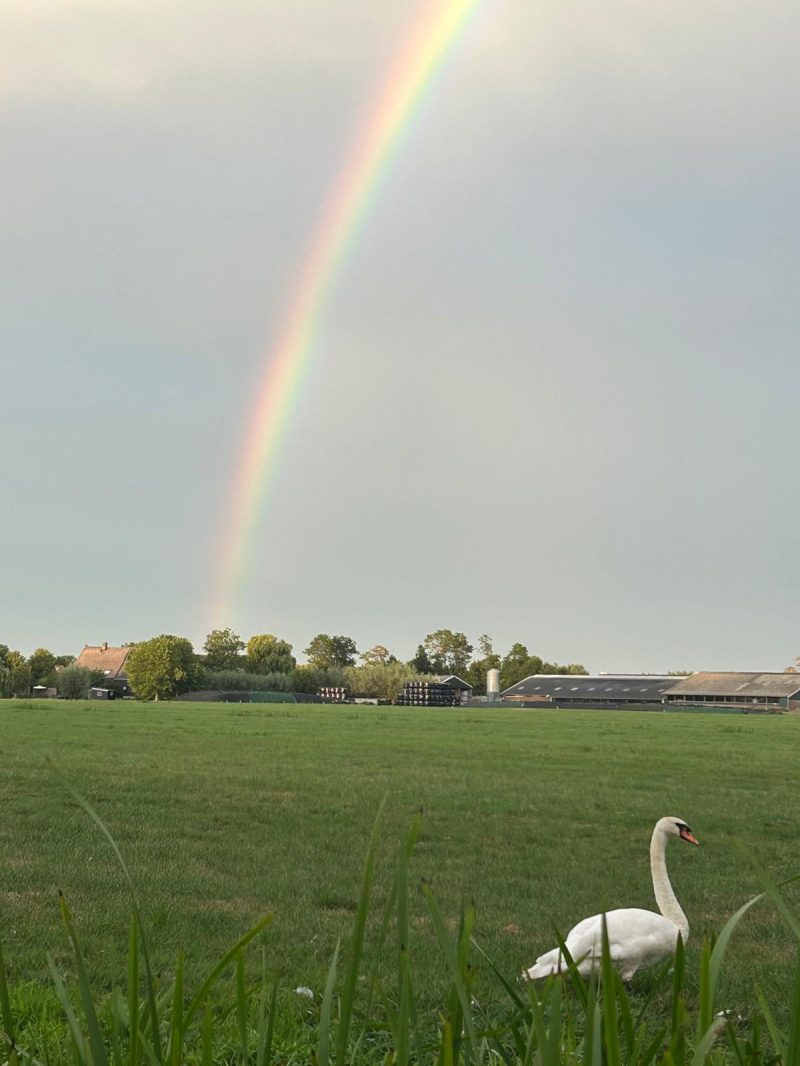
My day has literally and figuratively brightened.
Sometimes I do not have to solve anything. I do not have to understand where my dark thoughts come from, search for answers, or, above all, keep stirring them up. Maybe I only have to wait for the mud to settle.
Today the rain, the evening light and a polder full of animals gave it a helping hand.
I come home happy and content. The mud has clearly been slowly settling to the bottom.
My mind is clear as water again.
Complicated
8 August 2026
I haven’t been feeling well for two days now. Not ill, but tired and with a headache. The constant cycle of getting overheated and sweaty, cooling down quickly and then warming up again later leaves me feeling generally out of sorts. Really, everything feels like too much. Watching TV, painting, embroidering, reading—it’s all beyond me for the moment.
During dinner, the television is on with the news. I rarely watch it, because I already pick up enough negative messages about the world as it is. Usually, deliberately watching even more of it is a step too far for me. Today I actually ask Ton to turn up the volume. Funny, isn’t it? I already don’t feel okay, and now I want to let even more misery in. What is that about? Human beings really are strange creatures.
The wildfires come on, followed by meaningless interviews with a fire chief. The fire service is at its limit. Okay, but what does that tell the viewer? Within a few minutes, the word ‘complicated’ is used. Ton and I both stumble over it at exactly the same moment. Why use that word now? It feels like a smokescreen, a way of avoiding saying that this is a complex problem. Or, stranger still, a way of deflecting criticism or postponing difficult choices and decisions. I notice so often that words are used, especially in the media, that actually tell us nothing at all.
What are they trying to wrap up so we can’t see it? Or when someone explains the problems and the response is: “Yes, it’s complicated.” What does that mean? Did you actually listen? I genuinely wonder about that.
The next word I stumble over in the news is ‘challenge’. The problem is complicated and solving it is quite a challenge. Here too, I feel as though no responsibility is being taken. The word seems to soften the problem, while in reality there may have been a failure, or there may be a genuine crisis.
The next item is about how many non-native animal species there are in the Netherlands. Again, much ado about nothing. The words ‘complicated’ and ‘challenge’ make another appearance.
It actually cheers me up to realise why I stopped watching the news. Hahaha, apparently that’s how it works too. I feel bad, so I watch or listen to even more bad things, and somehow that makes me feel better again.
My empty days feel filled with empty news.
The Family I Needed
6 August 2026
My father died on Christmas Day in 2000. I will never forget that. Strangely enough, I no longer remember the date or even the year my mother died. Today is my father’s birthday. 6 August 1928. I thought about him several times today. Nothing was mentioned in the group chat with my brothers and sisters, and something in me kept me from bringing it up myself.
I do my best, but family remains a complicated thing for me. What is family? Blood relatives? Or the people who are not related to you by blood, but whom you trust the most? It is difficult to define.
More and more, I am beginning to feel like an uninhabited island, where people occasionally come to stay and then leave again. Is this island better off with people or without them? Being visited is nice. Too much activity, with the risk of pollution or obvious traces being left behind, is less pleasant, but almost impossible to avoid. Leaving the island alone for a while, allowing it to renew and cleanse itself in the silence of the elements, creates an ideal balance.
At the moment, I am in that quiet phase. My island is not being visited.
My youngest son calls to ask me how to prepare mussels. I see a phone call like that as a boat sailing towards the island and dropping anchor nearby, without anyone actually coming ashore.
I withdraw a little from the things Ton is occupied with. I recognise these moments in myself. Why does this happen? I don’t know. Sometimes it is a prelude to something I cannot yet see. Or perhaps it is a movement within me that is guiding me, although I don’t know why it moves the way it does.
I don’t fight the feeling. I let it happen. I don’t go looking for its meaning.
We go cycling. It is only twenty degrees, but there is a strong wind. For the first hour, we cycle straight into it. I notice that all I am doing is fighting against the wind. Using far too much strength just to move forward. Bent over my handlebars, completely ignoring my surroundings.
Puffing away, I think: “Yes, this rather fits how I feel.”
“The only thing I can do now is turn inward and let my body do the work.”
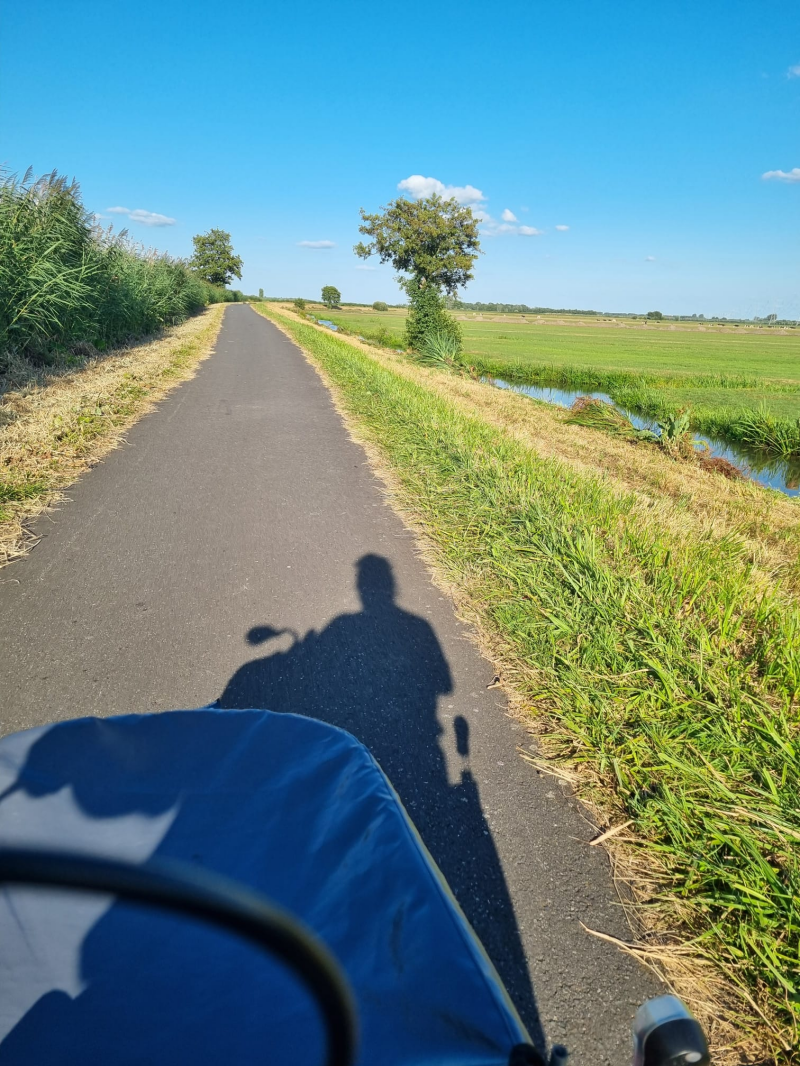
After twelve kilometres, we turn right into the polder. The windmills stand in a row in the early evening light. Clear and still. We are sheltered from the wind now. The plants along the banks of the ditches have grown to a metre and a half, sometimes two metres high, changing the view along the cycling routes near Kinderdijk.
There are at least ten fishermen, perhaps even more, each sitting on his own little platform. They are the only people we encounter. They too are sitting silently, staring at their floats.
I realise how completely different this place feels in the early evening.
And then we come across another family of swans.
We get off our bikes to watch them. The mother and father have already swum quite a distance ahead, while the four youngsters are splashing around in the water further back. They make no attempt to follow their parents.
Still, Ton and I remain standing there.
We watch them repeatedly put their heads underwater. They are searching for food on the bottom. This behaviour is called upending. Thanks to their long necks, swans can reach deeper than many other waterbirds. Their backsides and tails stick straight up into the air.
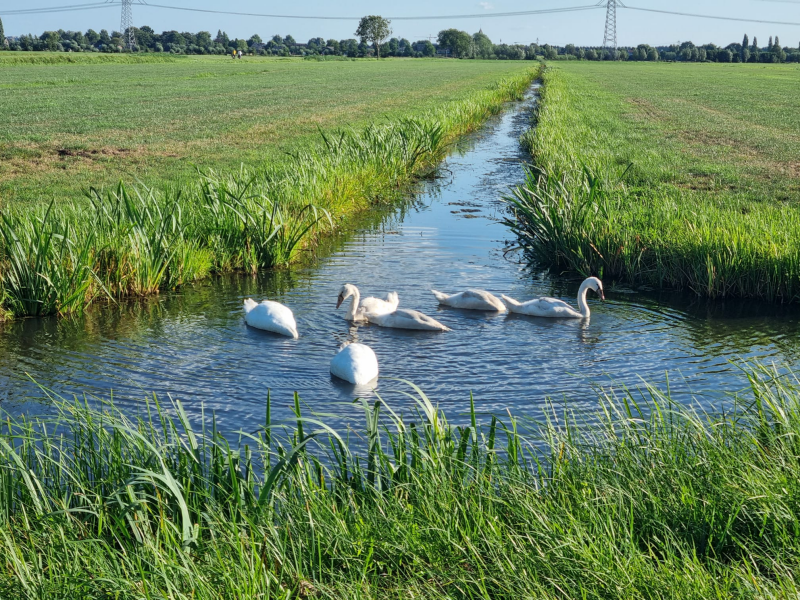
After a while, the four young swans begin to move in our direction. We are standing only two or three metres away from them, watching.
I look at Ton and ask whether it makes him feel as peaceful as it makes me.
Yes.
He experiences that same almost meditative moment.
This family gives me warmth. My heart rate slows. A calm, recharged feeling flows towards my heart and from there through my entire body. Then it seems to flow beyond me, until I genuinely feel at one with the whole.
This was the family I needed today.
The Heart Leads Home
August 5, 2026
Today, Ton and I met up with his brother and sister-in-law at the restaurant where we once celebrated our wedding. Thankfully, at twenty-seven degrees Celsius, it was much more comfortable than the past few days. There was, however, a strong wind as soon as I stepped outside.
It's only a twenty-minute bike ride. I feel just as happy as my little dogs when they know they're going out for a walk. After spending days indoors in the cool air from the air conditioner, I feel cheerful and carefree on my cargo e-bike. We cycle along a provincial road, with open fields on one side and woodland on the other. A truck rushes past.
In my head, I start singing:
With the wind at my back,
cycling through the Hoeksche Waard,
on my cargo e-bike,
far from home, on my way to nowhere.
To the melody of Met de vlam in de pijp by Henk Wijngaard. The song captures the feeling of freedom, of simply being on the road without the destination really mattering. I have to laugh at myself because we're not cycling through the Hoeksche Waard at all—we're in the Alblasserwaard. But that just doesn't fit the rhythm of the song. Laughing, I sing my new version to Ton. He seems happiest simply because I'm enjoying myself so much.
Ton's brother is normally extremely punctual, but today we end up waiting for half an hour. He thought he still knew the way and hadn't entered the address into his navigation system. Ton remarks that this is very unlike him. I reply dryly, "Well, there's a first time for everything, even at seventy-eight." The way I say it makes us both burst into laughter. That cheerful mood stays with us throughout lunch.
On our way home we stop at a farm to buy some homemade jam. We follow the River Alblas, where the houses seem to sit on little islands, surrounded by ditches that flow into the river. For the first time I notice a waterside plant with blue flowers instead of the usual water lilies or marsh marigolds. Of course we stop to take a picture. At home I look it up and discover it's pickerelweed (Pontederia cordata), also known as pickerel rush. It originally comes from Central and South America and was most likely planted here by people.
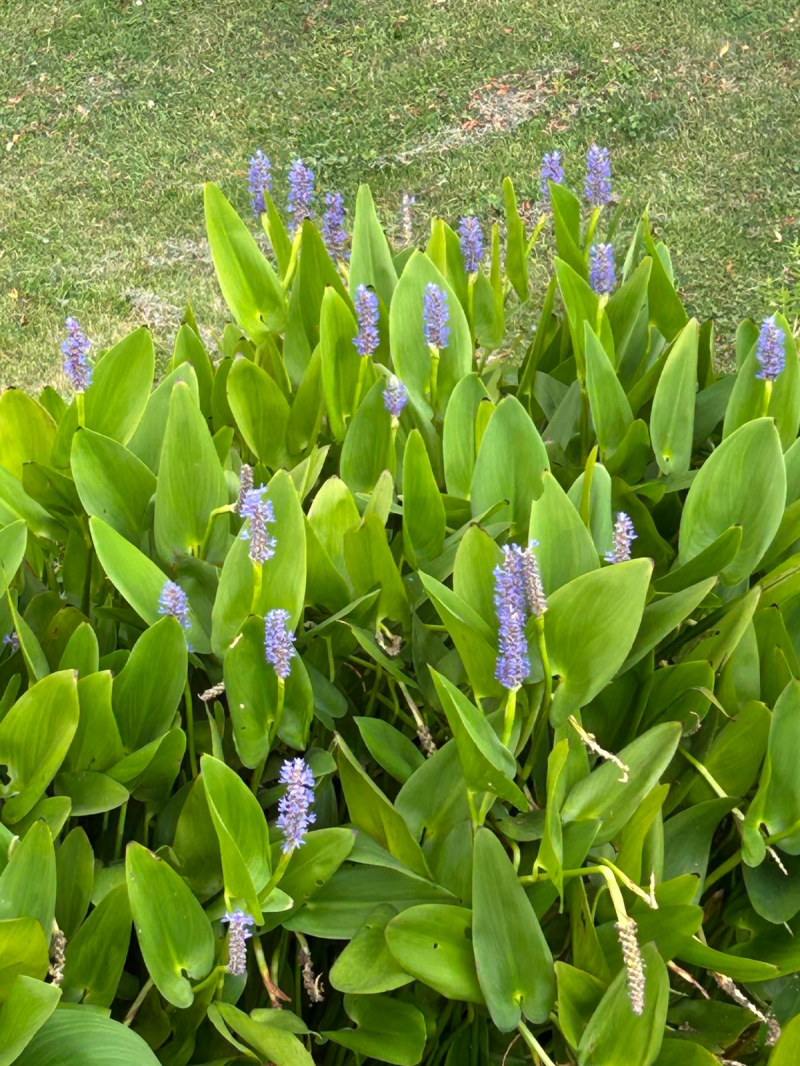
As the wind dies down, the air begins to feel warmer. To hold on to my cheerful energy, we cycle straight home instead of taking our usual twenty-kilometre detour. In front of our apartment, a family of swans glides in perfect formation through the duckweed: father, mother, and seven youngsters, now almost as large as their parents but still wearing their soft grey feathers. Every time I see them, I'm grateful that this little piece of nature lives right beneath my window.
Once home, the clothes come off, an old T-shirt goes on, the air conditioner is switched back on, and I climb onto the bed with the dogs while Netflix starts playing.
The series follows two people who have loved each other since their teenage years. Their lives keep crossing, but each time they drift apart again and follow their own paths. Thirty years later, they seem to end up in the same place, only not together.
Then the woman is given a piece of advice:
"Your heart will show you the right path. It will lead you home."
In this story, it means that the heart knows who you truly belong with. Not simply the person you fall in love with, but the one you continue to love through all the knots and complications life brings. Here, home is not a place but a person.
Lately, I've noticed how many sayings, images, and theories exist about the heart. The magical heart, the heart as a symbol of emotion, as a guide, as home, or as the centre of everything.
All these images seem to point toward the same thing.
It reminds me of the centre of a horoscope—the place where everything comes together. Where everything is possible. Where opposites disappear. The point that simply IS.
Perhaps we're all searching for words to describe the same mystery.
Not to explain it, but to catch an occasional glimpse of it.
Your Heart as Your Guide
4 August 2026
I couldn't sleep all night. That is what prolonged heat does to me. Inside the house, I can feel the cool air wherever the air conditioner is blowing. The moment I step outside that stream of cool air, it becomes oppressively warm. No disaster—it simply means adapting. Staying home, knowing there is always the option of a cold shower or a cold bath if it really becomes too much. For now, I watch a few series and breathe in the cool air.
It is remarkable how quotes about the heart keep finding their way to me through television series. I am not specifically looking for films or series with depth or hidden meaning. If you asked me exactly what I had been watching, I probably couldn't tell you. I watch with one eye. Only when a line catches my attention do I look up to follow it.
"Do you trust me?" an Arab man asks an English woman.
She says that she does.
Then he explains that in his country, in his culture, people say:
"Never trust people. Trust only your intuition."
Then he says:
"Alalbek Daleelek."
"Your heart is your guide."
Okay... now that is a statement.
The strange thing is that, by nature, I do not place a great deal of trust in people. People do not always say what they truly think or mean. Neither do I. We do that for many different reasons. We do not want to hurt one another, we may feel guilt or shame, or something entirely different. We speak the same language, we understand each other's words, yet in the end we sometimes say very little of what truly matters. That creates misunderstandings, which can eventually lead to distrust.
So, can you really trust people? Probably not, if you look at it from a strictly psychological perspective. But is trust a choice? I think it is. Why do you choose to trust someone completely? Are you looking for reassurance? Does it make you feel safe? Is it chemistry? Do you simply have a lot in common? What makes a person blind—or truly able to see?
Listening to your heart as your guide... How do you know it is truly your heart, and not secretly your thoughts, shaped by all your conditioning and life experiences? That is really where it begins. Can you even trust your own feelings? Or does something quietly shift inside you simply because you want to see things a certain way?
When do I know for certain that it is my heart, my guide, that I am listening to? Is there a real answer to that question? Or are there only assumptions from religious or spiritual perspectives? Must there always be proof? Or is faith—or inner knowing—perfectly valid in its own right?
For me, it means that you do not seek your true guidance outside yourself. It is the Ways to the Heart, the keys or insights you discover along the way, that gradually guide you. In the end, you are your own guide to your own heart.
By falling and getting back up again, by making good choices and wrong ones, you gradually come to know yourself better, and with that, your own heart. Within the heart there is no longer black or white; duality dissolves. Not through its absence, but through its very existence.
Perhaps you do not have to search for your heart.
Perhaps trust arises naturally while you continue walking the path towards it.
Home in Your Heart?
2 and 3 August 2026
Yesterday was Sunday, the only day of the week when I do not train. My body is struggling with the heat, so spending a quiet day in a cool house is the best remedy for now. Walking for five minutes every half hour is a good alternative on days like these. Most of all, I enjoy simply being at home, wearing my underwear and an old T-shirt, completely myself. A little embroidery, a little reading, a little walking, and a little television.
I discovered the Canadian series SkyMed. It follows young nurses and pilots working for an air ambulance service in Northern Canada, while also offering a glimpse of the rugged landscape, Indigenous communities, Indian immigrants, and the LGBTQ+ community. It made me curious about the country, its history, and the personal struggles of the people who live there.
Mainly because of my youngest children, I have become more familiar with the LGBTQ+ community. For my generation, it can sometimes be an adjustment to the many different expressions of gender identity that are recognised today. Through my daughter, I know how discrimination and hostility have increased. She and her wife lived in New York, but eventually no longer felt safe there. Watching this series, I realised for the first time how confusing and difficult that inner journey can be. In a way, it gives me a glimpse into the world of my children.
I also noticed how the Indian community tries to preserve its own traditions while at the same time becoming part of a new society. The same is true of Indigenous communities. That touches me deeply. All over the world, native peoples have been treated unjustly. Native Americans, Inuit, Aboriginal Australians, Māori, Papuans… time and again, colonisers regarded their own culture as the standard. From personal experience, I know how pain and humiliation can be carried through generations.
Then, suddenly, one of the characters says:
"Maybe home isn't a place. Maybe it's a feeling."
And there it is again.
The heart.
Home is where the heart is.
A familiar expression. But what does it really mean?
Is home the place where you feel safe, surrounded by the people you love? Or is home the state in which you can be completely yourself, without wearing any masks? Perhaps home is self-acceptance: the place where you are at peace with both your strengths and your weaknesses. Or do you carry your home within you, in the form of your inner compass, your intuition, or a deep sense of safety?
What is home, really?
And why is it so often connected to the heart?
Does home truly reside in your heart? Or is it different for everyone? Perhaps you only find a true home when you gradually discover the keys to all the Ways of the Heart.
I find myself smiling at my own thoughts. The more I write, the more freely my mind seems to wander and associate. More and more, I notice that language, feelings, and the true meaning of words never seem to fully meet.
Perhaps the same is true for the word home.
Perhaps home is neither a place nor a word.
Perhaps it is an experience that you only recognise when your heart quietly says:
"Here, I no longer have to become anything. Here, I can simply be."
The Key to the Heart
1 August 2026
After my rehabilitation, I started working out. I have now been training six days a week for eight months. My medication has finally been adjusted properly. For the first time in a long while, I feel healthy and full of energy again.
There was only one thing my cardiologist was still concerned about: my weight. She referred me to a lifestyle clinic, but after waiting for three months, I received a letter saying they were no longer accepting new patients.
I still do not understand how I gained so much weight.
My trainer looked at my metabolism and gave me nutritional advice. To my great surprise, he did not tell me to eat less, but to eat more. I asked him if that happened more often.
"Absolutely."
He said it with such conviction that it immediately reassured me. During the first few days, I even became a little anxious because I was counting my calories and realised I was nowhere near the amount he had recommended. We will not evaluate the results until the middle of October.
Remarkably, I hardly have to change what I eat. It turns out that Ton and I already have a healthy, varied, and well-balanced diet. I simply need to eat a little more, and more regularly.
In a way, I am practising again.
Taking good care of myself by exercising enough, eating well, and eating enough, while also making room for my passions: spending time in nature, painting, writing, and exploring the world together with Ton.
Recently, I heard someone say:
"Music is the key to my heart."
Naturally, my thoughts immediately turned to the Ten Ways of the Heart. To the discovery that they are not ten destinations, but ten ways of practising life.
But what, then, is the key to the heart?
Could it be that each path has its own key?
The phrase "the key to someone's heart" is often used as a metaphor for romantic love, trust, or vulnerability. I understand that, but to me, that meaning feels too limited.
Is it the key to my own heart? Or to someone else's? Perhaps those are two very different doorways.
For myself, it may mean becoming gentler. Being less hard on myself. Not immediately reasoning away pain and fear, but daring to feel them. Letting go of old anger. Forgiveness, especially towards myself. Continuing to seek silence.
Towards another person, perhaps it begins with truly listening. Allowing the other to be who they are. Giving love without expecting anything in return.
Perhaps that is what is usually meant by "the key to the heart."
And yet, when I heard someone say that music was the key to their heart, I found myself thinking:
Perhaps it isn't music. Perhaps it is passion.
And that passion looks different for everyone.
I believe some people have yet to discover what truly inspires them. And I believe that when you genuinely live from what deeply moves you, an inner path opens naturally. Not because you consciously try to make it happen, but because it simply does.
Perhaps passion is what unlocks one of the Ways of the Heart.
Or perhaps I am simply thinking out loud, trying to understand what is stirring within me.
Perhaps the key to the heart is not the same for everyone.
Perhaps the key is whatever allows you to become so completely absorbed in life that your heart opens of its own accord.
Another Way
31 July 2026
My son stayed with us because the hospital did not want him to spend the first night after his operation alone. It felt good to be able to take care of him. After Ton had taken him back home, I realised just how tired I really was. For the first time in eight months, I skipped my workout for the second day in a row. I decided to get a little more sleep instead. We did, however, agree to go cycling later that afternoon.
After an extra hour of sleep, I finally decided to embroider the Ten Ways of the Heart onto my painting. It did not take long before I noticed that I could no longer feel the needle. I could barely see the eye of the needle, even with my glasses on. Fortunately, I have a magnifying lamp. Then I discovered that the thick linen canvas was so stiff that I could not push the needle through with my hands. In my studio, I found a pair of curved pliers. With the painting on the floor, between my legs while sitting in my wheelchair, I eventually managed to pull the needle through the canvas with the pliers. That is how I worked, moving constantly from the front of the painting to the back, and back again.
After nine French knots, sweat was pouring down my face. That was enough for today. It was time to go cycling.
On the way, Ton said,
"You've really taken on quite a challenge again."
I responded a little sharply.
"Please don't react like Lucie. She always does that—so full of pity and overprotectiveness. I know I have limitations. I have no feeling in my hands, less strength, and poor eyesight. Having limitations does not mean something cannot be done. It simply means it has to be done differently. It may take longer, but it is still possible."
Ton immediately understood what I meant and let the subject rest.
I have endless patience for things like this. Perhaps I will only make ten knots a day. That means I will probably be working on it for months. That is perfectly fine. The painting is patient, and so am I.
We enjoyed another beautiful bike ride. Dark and light clouds alternated overhead, with patches of blue sky appearing here and there. The sun hardly showed itself, yet the air felt warm, almost as if a giant hairdryer was blowing across the landscape. Everywhere we looked, there were birds—not high in the sky, but on the land, among the green meadows and alongside winding ditches filled with water lilies and marsh marigolds. They searched for food, rested quietly in the grass, or preened their feathers. It felt as though we were visiting them.
Along the way, we came across handmade signs inviting people to stop and have a look. There were pumpkins, herbs, and potatoes for sale, with an old wooden box where you could leave your payment. Behind the farmhouse was a kind of labyrinth of wildflowers. There were paths, of course, but otherwise it did not feel as though anything had been designed. Butterflies and bees were everywhere. Sunflowers reaching two to three metres high and dahlias larger than I had ever seen before. Here you could clearly see how an abundance of flowers naturally attracts life.
I found myself thinking how wonderful it would be if cities simply sowed their green spaces with a mixture of flowers and plants and allowed nature to follow its own course. Instead of constantly pruning and controlling everything, we could simply give it room to grow. I believe many more insects would naturally return.
We bought a pumpkin and some wild garlic.
I am already looking forward to tomorrow's pumpkin soup.
Perhaps the same is true for people.
Having limitations does not mean something cannot be done.
Sometimes life simply asks for a different way.
And perhaps it is precisely there that something begins to bloom that otherwise might never have become visible.
The Silence Called Home
29 and 30 July 2026
Just after midnight, at one minute past twelve, the Mijs & Co app rings. It is Ton's birthday. Seventy-seven years young. The children and grandchildren are on holiday, but they FaceTime to wish him a happy birthday. Although I am not particularly fond of birthdays, this is a tradition I know from my own family as well. There is something special about letting someone know, right in the middle of the night: I love you.
I hardly ever drink alcohol, but on occasions like this, Ton and I enjoy opening a bottle of sparkling wine together. In the end, I do not get to bed until half past two.
I had postponed my workout until noon so I could get a little more sleep. By then, the temperature outside had reached thirty-three degrees Celsius. Not exactly a day for doing very much. We had told everyone that we wanted to spend the day together.
Then my daughter called. "Will you be home this afternoon?" "Uhh... yes, now we will." "Great, then we'll come over." A little later, one of my brothers sent a message. "Are you celebrating?" "No, we were planning to spend the day together." "Then we'll stop by around four." Not long after that, one of Ton's childhood friends called to say he would like to visit as well.
Ton and I looked at each other and laughed. Our plans were slowly, and lovingly, being pushed aside.
All of a sudden, we had to think about drinks and snacks. Everyone would probably stay for dinner too, but a friend spontaneously offered to prepare the evening meal.
And just like that, the day turned into a house full of people, laughter and warmth. The last guest did not leave until around one o'clock in the morning.
After twelve hours of company, I cannot fall asleep straight away. I always need an hour or two of silence before the restlessness in my body begins to settle. Perhaps it is adrenaline—I am not entirely sure.
But when I look at Ton, I can see how much he has enjoyed the day. That alone is a wonderful birthday present.
Even though this would never have been my own choice, I genuinely felt happy for him. That warm feeling turned out to be stronger than my own discomfort.
The next morning, I wake up late with a splitting headache. I shuffle to the dining table, feeling completely drained. Coffee and breakfast make no difference. There is nothing else for it but to go back to bed.
An hour later, the hospital calls. My son's operation has gone well, and I can pick him up later that afternoon.
Oh dear... In my diary I had written that it was tomorrow. Once again, the day unfolds very differently from what I had expected.
I notice that the effortless flexibility I once had is no longer there.
"Would you like to come over?" Of course.
"Would you like to stay for dinner?" Fine.
"Would you like to stay the night?" Certainly.
"Do you need a place to stay for a while?" We'll make room.
That was how I lived for many years.
Not anymore.
Is that a bad thing? Have I become rigid? Or have I simply grown older? Did I once allow circumstances to shape my life? And am I now living more and more in a way that truly suits me?
There was a time when silence was almost impossible to find. Life just kept rushing on. Now I have found silence, and I notice that it increasingly gives direction to my life.
Days like yesterday and today will no doubt come again.
But they are no longer the common thread.
Perhaps that is what the Ways of the Heart have slowly been teaching me.
Not that life becomes quieter,
but that I keep returning to the silence within myself.
And perhaps that, in the end, is the home I have been searching for all these years.
Practise Life
28 July 2026
After a busy, warm day, I am lying in bed watching television. I hear a character say, “Every accomplishment starts with the decision to try.” I pause the television. That one sentence immediately brings me to the theme I want to write about today.
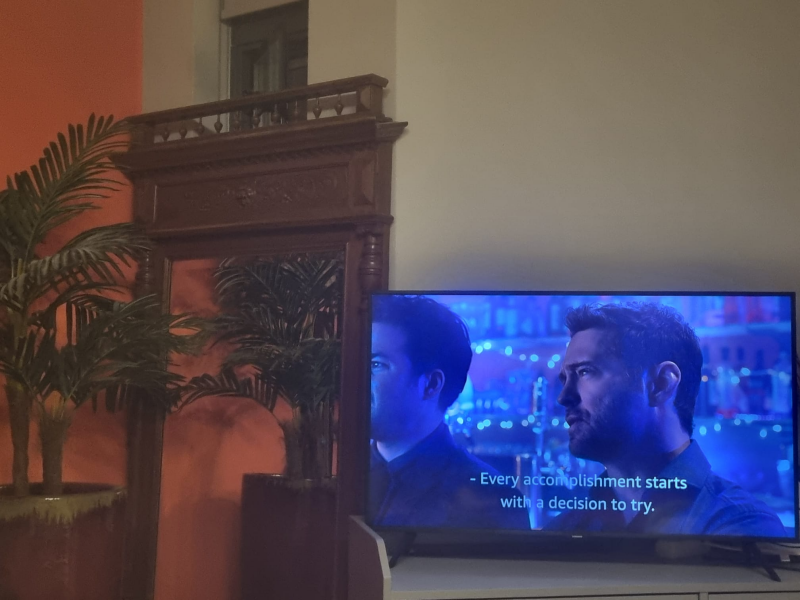
After exploring and walking the ten Ways of the Heart in my own way, I came to a realisation. I did not see it coming. It was precisely by writing about them and trying to make clear to myself what I meant that my pen gave something back to me.
With each way, a key word seemed to emerge naturally:
Generosity — selflessness
Ethics / Virtue / Morality — inner compass
Renunciation / Letting Go — acceptance
Wisdom — harmony
Energy — connectedness
Patience — trust
Honesty / Truth / Sincerity — awareness
Determination — responsibility
Loving-kindness — unconditionality
Equanimity — life
That final word, in particular, stayed with me. Life.
The advice of the cosmos is not that you should become perfect. The advice is: keep practising. Perhaps that is the meaning of my final key word. Life, not as something that simply happens to you, but as something you practise every single day.
Only then did I realise what I had actually been writing over the past ten days. No one has to be ‘finished’ before they are allowed to live. That is consciously how I see it too, but apparently I had already described it unconsciously through those ten ways. And somehow, that discovery was still able to surprise me.
The ten Ways of the Heart are not ten destinations. They are ten ways of practising life. Life is the practice. That is what I take from it.
Perhaps there is a certain rigidity in perfection. Something that becomes fixed, unyielding and unable to move with what happens. And whatever cannot move eventually becomes brittle. That is rather frightening when you think about it. How hard can you fall when you believe you are perfect, or that you are doing everything perfectly? Gluing all those broken pieces back together seems like quite a task.
Perfection leaves no room for practice. The moment you think you have arrived, learning stops. Perfection says, “I must not fall.” Life says, “Go ahead and fall. Get back up. Keep practising.”
That naturally brings me back to kintsugi, something that regularly appears in my creations. I use gold to make the breaks visible. Not to pretend they were never there, but precisely to allow them to become part of the whole.
Perhaps the same applies to people. The strongest person is not the one without cracks, but the one who does not need to hide their broken places and continues to practise anyway.
And that brings me back to the painting where all of this began. For weeks, I worked on it almost every day. The path kept changing. I would have an insight, turn everything upside down again, and continue. Just when the painting seemed ‘finished’, I dreamed about the ten Ways of the Heart. I knew then that it was not finished after all.
And yet my brushes and paints remained untouched. Another dream showed me that I had to embroider these ways. All right, I ordered DMC thread. I thought I was ready to begin.
But again: no.
First came a reflection on one of the ways, every single day. For ten days. The last one ended with:
“In fact, I am practising life while I am living it.”
And now the way seems clear for me to start practising with embroidery. Stitch by stitch. Not finished all at once. Not perfect. Simply the next stitch.
Perhaps, in the end, that is all that is being asked of me.
Practise life. Every day anew.
Fall. Get back up. Practise again.
And never stop.
Equanimity
26 and 27 July 2026
Something seems to be going on in my body. Strange. Overheated, but without a fever. Sluggish. Not ill, yet not feeling well either. Outside, dark clouds hang low. It drizzles throughout the day, interrupted now and then by heavy showers.
My granddaughter is celebrating her birthday, so we're going to a barbecue. That means taking a shower, putting on cheerful clothes, and heading out with a smile. As we're waiting for the lift, I say to Ton, "Is it strange that going to a birthday party feels as if I'm being led to the slaughterhouse?" Ton laughs and says it is indeed a rather unusual comparison.
We go by bicycle. Getting a little wet doesn't matter.
At the party, I greet everyone and choose a chair as close as possible to the open sliding doors leading to the garden. I enjoy chatting with the other grandparents, have a hamburger and a few fries, and quietly observe what's going on around me. After the barbecue, Ton's two sons and my three granddaughters leave together in one car for Spain. Bags and suitcases appear everywhere, people are walking back and forth, and everything looks pleasantly chaotic.
It doesn't bother me, but it is my signal to go home. In the past, I probably would have asked who was going to clean the house now that everyone was leaving for their holiday. Not anymore. I don't need to know.
Fortunately, Ton immediately understands when I say I'd like to leave. We cycle home and decide not to go out again. We simply relax together while the rain taps gently against the windows. Normally, a day like this would cost me a great deal of energy. Today, I mainly feel calm.
Today, equanimity reveals itself as the tenth Way of the Heart.
It is a word I hardly ever use myself. To me, it means a deep inner calm that allows you to remain emotionally balanced, no matter what is happening around you. Not because nothing happens, but because you no longer have to be carried away by everything that happens.
I think I managed that rather well today. I didn't feel well when I got up. I went to the birthday party anyway. And when I came home, I actually felt better than when I had left.
Perhaps that is what the Way of the Heart is really about: remaining balanced, even when circumstances are less than ideal.
I notice that birthday parties, household chores, and everyday social obligations disturb my balance far more than genuinely difficult situations. That may sound strange. Whenever life becomes truly challenging or painful, something seems to awaken within me. I gain energy, as though facing the challenge gives me strength and makes me feel more alive. It is the ordinary, everyday things that are more likely to throw me off balance.
That is why it always feels like a small victory when I return home from a day like this with my inner peace still intact.
Perhaps equanimity is not the first Way of the Heart, but the last. Perhaps it gradually emerges when all the other ways begin to find their place within your life.
That does not mean I have arrived there. Sometimes I experience that inner calm, and at other times I find myself standing right back in my old pitfalls.
The only thing I can do is keep practising. I think that practice will continue until my very last breath.
In truth, I am practising life while I am living it.
Loving-Kindness
25 July 2026
After a poor night's sleep, I feel exhausted. It takes me a long time to get going. On Saturdays, the gym is only open until noon, so I decide to skip my workout. Nothing is wrong. I simply choose to be kind to myself.
To avoid slipping into that sluggish feeling, Ton and I decide to go for a bike ride instead. Since I didn't train, we make it a long one. We cycle to my youngest brother's house, a round trip of about thirty-five to forty kilometres.
My brothers have never dropped by to visit me spontaneously. Nor have they ever called just to ask how I am doing. They do stay in touch with our oldest sister. Even so, I call them from time to time or stop by unexpectedly. Not because I feel obliged to, or because I expect anything in return, but simply because it feels right. I just follow my heart.
Today, loving-kindness reveals itself as the ninth Way of the Heart.
Kindness is often seen as being nice, helpful, and considerate towards others. But whether that alone is truly a way of the heart, I'm not so sure. That kind of behaviour can also be something we have learned.
Perhaps loving-kindness begins with yourself.
I know how hard I was on myself for many years and, without always realising it, sometimes on others as well. Only in recent years have I noticed myself becoming gentler. More loving. Kinder towards myself. And the kinder I become towards myself, the more naturally my heart softens towards others.
For me, loving-kindness begins with showing compassion for my own mistakes and my own pain.
Being kind to people who are kind to me is not that difficult. But remaining kind towards someone who is difficult or even unkind requires something deeper. That is where compassion can arise. Not because I approve of their behaviour, but because I increasingly understand that every person carries their own pain and struggles.
I also notice that the better I come to know and accept my own shadow sides, the easier it becomes to feel understanding for someone else.
And then there is another step.
How do you remain loving towards someone you simply do not understand? Someone whose behaviour you do not recognise, or perhaps even reject?
Perhaps loving-kindness begins precisely there.
Not in understanding, but in recognising that the other person also has their reasons, even if I may never know what they are.
The word that keeps returning to me is unconditionality.
We are all capable of being kind. But loving-kindness feels different. It is as if there are no conditions attached anymore. Not only towards myself, my family, and my friends, but also towards strangers, difficult people, angry people, and ultimately towards all living beings, nature, and perhaps even the entire cosmos.
Perhaps that is an ideal we will never fully reach.
I still get irritated from time to time, and I still complain now and then. Yet I increasingly notice that my irritation tells me something about myself. Because of that, I no longer need to attack the other person. I can remain kind, even when I find something difficult.
There is really only one exception.
Ton.
He is the only person I sometimes speak harshly to. Probably because he is the only one with whom I feel completely safe. I never doubt his love for me.
Curiously enough, writing this reveals something else to me.
Kindness can sometimes become a mask.
Why don't I simply say what is bothering me?
Because the other person has feelings too.
That is where the search for the middle way begins. Not saying everything that comes to mind, yet not swallowing everything either. Being as honest as I can, without hurting the other person unnecessarily.
Perhaps loving-kindness is exactly that.
Not diminishing yourself.
Not judging the other person.
But continuing, again and again, to look with an open heart.
Perhaps many of us, myself included, are still far from the loving-kindness the Buddha spoke of—unconditional and selfless, embracing all living beings, nature, and the cosmos.
Perhaps that kind of love does not begin with the other person, but with the way I am learning to look at myself.
Determination
24 July 2026
This morning I dreamed that everything was busy, busy, busy. I no longer remember what it was all about. Then, suddenly, I heard a voice say, "It is a miracle!" Poof... I woke up instantly, with those words still echoing in my mind.
I have no idea what that miracle is. Of course, I am curious, but the answer may take its time to appear—or perhaps it never will. Either way, it is a wonderful way to wake up.
During breakfast, Ton tells me about a large rat that had dug tunnels beneath the fire alley behind a friend's house. The rat is now lying dead against the kitchen wall, and outside the ground has collapsed. Our friend has reported the situation for several days, but keeps receiving the same answer: it has to be reported online by filling out a form.
As I listen, I think about all the elderly people who barely know how to use the internet, or who do not have access to it at all. How do they cope with this kind of bureaucracy?
I decide to call the pest control company myself. No, they tell me, it has to go through the municipality. The municipality reports it to another public agency, which then contacts the pest control company. Calling is possible, but they would still prefer that I fill out an online form as well.
So I do both.
Then I am told they will contact our friend in two weeks to arrange an appointment.
Two weeks.
No matter how much I explain the urgency, they cannot—and will not—do anything other than follow the boxes on their computer screen. The actual situation hardly seems to matter.
I find that absurd.
Children play there. Cats and dogs walk there. There is a collapsed fire alley, a network of rat tunnels, and a dead rat lying there.
I decide to get to the bottom of it.
Who is actually responsible?
I try to contact the alderman responsible for public health and safety. It turns out he has resigned. His responsibilities have been taken over by the mayor. Unfortunately, the mayor is on sick leave, and no replacement has yet been appointed.
Eventually, I speak to a municipal employee. Once again, I am told which procedures I need to follow.
"I have already followed those procedures," I reply politely. "But that means nothing will happen for at least another two weeks."
At first, nothing changes.
Then I ask,
"Are you the municipal official responsible for speaking with me about this matter?"
"Yes."
"Then I assume the municipality also has a responsibility for public health and safety."
For a moment, there is silence.
Then she tells me she will make sure it is dealt with as quickly as possible.
I find situations like this so remarkable that they bring out my determination. Not with anger. Not with confrontation. In fact, I rather enjoy politely refusing to be sent from pillar to post.
Today, determination reveals itself as the eighth Way of the Heart.
To me, determination means making a firm choice and then taking responsibility for it. Perseverance, courage, discipline, and purposefulness are all part of it.
I do not think determination is the opposite of doubt. On the contrary, I ask many questions. I investigate, weigh things carefully, and try to understand a situation as fully as I can—not to remain in doubt, but to arrive at a decision.
And once that decision has been made, I commit myself to it.
Whether it ultimately proves to be the right decision is something I discover later. In that sense, I do not really believe in wrong decisions. If things work out well, that is wonderful. If they turn out differently than expected, I learn from them. That, too, has value.
Yoga has taught me how important discipline is—not as a strict regime, but as a conscious way of living in which body, breath, and mind support one another.
At the same time, I also recognise the pitfalls of determination. Pushing too hard can turn into stubbornness or exhaustion. Continuing when my body has long been telling me it has had enough. Holding on to a chosen course when reality is asking me to adjust.
I am not blind to those pitfalls. Of course, I have encountered them myself. That is precisely why I keep trying to follow my inner compass. Not by pushing fear and uncertainty aside, but by examining them, allowing them to transform into courage.
Ultimately, determination is not about winning or reaching a goal at any cost.
It is about taking responsibility for my own path.
Discipline helps me do that—not because discipline is the goal, but because it keeps the unity of body, breath, and mind alive.
Perhaps that is the deepest form of determination.
Not stubbornly holding on to a goal, but remaining true to yourself.
Sincerity
23 July 2026
This morning, the moment I woke up, I knew that the seventh Way of the Heart is sincerity. Well then, I thought, I'll simply let that settle today and see how I experience and understand it.
Ton had already left early. I noticed a sharp pain in my back, halfway along my right side. While having my coffee and shake, I tried to sense whether going to the gym would be a good idea. Outside it was still overcast, with a fine drizzle, just like yesterday.
How do I ask myself this question? Do I go, or do I stay home? Is the pain an excuse? Is cycling through the drizzle an excuse? What is sincerity?
Less than half an hour after waking up, I was already facing the question that would apparently shape my day. When is it simply laziness, or just not feeling like it? Wouldn't it be more honest to go anyway and see how it feels? I could always lower the resistance on the machines. And only if the pain became worse would I decide that it truly wasn't possible.
That is what I chose to do. I don't regret it, because afterwards I actually felt better. I did, however, reduce the weight on several machines.
Ton picked me up afterwards so we could go cycling together. It was wonderful, riding into a strong headwind, passing farmland and small villages.
Near a farm shop we visit regularly, a large banner stood in the field. It read:
'Ask, and it will be given to you. Seek, and you will find. Knock, and the door will be opened to you.'
It is so large that every cyclist passing along that country road is bound to read it.
Immediately, it occupied my thoughts.
Behind me I heard Ton grumbling a little. He is an atheist and, I think, feels that a religious belief is being imposed on him. I experience it differently.
To me, these words are sincere. Only the interpretation is different.
I do not believe that praying makes wishes come true. I see prayer as a form of meditation, a way of going deeper within. What is truly happening inside me? Which truth wants to be seen? That insight is then revealed.
'Seek, and you will find' means the search within yourself. Why do I do this? Why do I feel this? Why do I say this? Open questions that eventually lead to your own inner truth.
'Knock, and the door will be opened' means much the same to me. As long as you dare to acknowledge that you often act from conditioning, and are willing to look at your own intentions without guilt or shame, a door slowly opens. Not to an absolute truth, but to deeper understanding.
Is it a religious message? Yes, it is.
Is it a universal message? Yes, it is.
Is it a human message? Yes, it is.
It doesn't matter to me who speaks these words or from which tradition they come. To me, they are meaningful.
In general, I see sacred writings as books that can serve as guides, just like fairy tales, myths, and legends. They have something to say to anyone who is truly willing to listen.
To me, sincerity means honesty, authenticity, and living without hidden motives. No deception, no secret agendas, and no inventing stories about someone else.
Being honest means expressing what feels true to you. That does not make it the truth. Our experiences, convictions, and personal history all shape how we see reality. That is why sincerity, for me, is not only about being honest with yourself, but also about realizing that someone else may experience an entirely different truth.
Reality presents itself. Do not try to control it. Allow it to unfold.
I try to live without masks, to be as open as possible. Yet last year I created a painting with eleven masks. Only later did I discover that they were my own masks.
The very moment I saw and accepted that felt, to me, like sincerity.
So sincerity does not lie in being perfectly honest. It lies in the willingness to keep looking at yourself with ever greater honesty, even when that is uncomfortable. Perhaps that is why sincerity is inseparably connected to becoming more aware.
Whenever I am creating, I am completely present. I can lose myself entirely in what I am doing, like a child so absorbed in play that time disappears. I live from a place where ego and control dissolve until only the act itself remains.
I am the brush.
I am the pen.
Perhaps those are the moments when I come closest to sincerity.
Not because I know everything, but because nothing needs to remain hidden anymore. Those are sacred moments for me. Not necessarily religious, but quiet, pure, and completely immersed in the greater whole.
Perhaps sincerity begins precisely there, where time dissolves into an eternal now.
Where the child within me plays once again.
Where acceptance becomes reality.
Patience
22 July 2026
After my workout, it seemed like a good idea to go cycling straight afterwards—cardio in the fresh air. When I left home, it was twenty degrees Celsius and overcast. Perfect weather for this lady! I happily announced how delighted I was with the cloudy sky. Ton always laughs at my unusual reactions. A bike ride in weather like this sounded absolutely wonderful.
As we set off, I noticed tiny droplets appearing on my glasses. It didn't even feel like it was raining. In fact, you couldn't really see it until I literally could no longer see through my glasses. I could barely feel the rain, so I took my glasses off and happily kept cycling. With a little patience, this almost invisible drizzle would surely stop on its own.
As I cycled along, I gradually noticed that my jacket and trousers were getting wetter and wetter. I asked Ton, "Do you remember when we cycled through this kind of drizzle and ended up soaked right through to our underwear?" There was nothing else for it but to turn around and head back home.
When we got home, I was indeed completely drenched, as if I had just stepped out of the shower. My face was absolutely dripping wet. It's remarkable how tiny, almost invisible droplets can eventually leave you wetter than a heavy downpour. It made me think about slowly but surely.
Patience is the sixth Way of the Heart.
That image takes me back to my childhood. When I was about eight years old, I received a projector that could play 8 mm films. The very first film I watched was the story of the hare and the tortoise competing in a race to see who would reach the finish line first after overcoming a series of obstacles.
The hare sprinted off at full speed but, because of his haste, overlooked all kinds of things and repeatedly had to turn back. The tortoise moved slowly but attentively. He missed nothing and eventually won the race.
Even then, the moral of the story was immediately clear to me.
I have never been fast in my movements, but I have always been patient. Because of that, I was often finished sooner than people who appeared to work much faster. Patience truly is a virtue. To me, patience is also closely connected to discipline: the ability to keep doing something consistently, even when you don't particularly feel like it.
During my yoga classes, I discovered that patience may well be one of the most difficult qualities for human beings. Of course, you could think of many other challenges, but patience, self-control, and persevering when something is difficult or simply boring seem to be an enormous challenge for many people.
Within yoga, there is even a hand gesture associated with these qualities: the Shuni Mudra. By gently touching the tip of the thumb to the tip of the middle finger while keeping the other fingers relaxed, it symbolizes patience, discipline, and inner calm.
I also used to tell my students that every quality has its opposite. Those who possess a great capacity for patience usually carry an equally great capacity for impatience within themselves. I recognize that in myself. I see myself as an extremely patient person, yet there are moments when I surprise myself with the intensity of my own impatience.
To me, patience means trusting the natural process and allowing things the space to unfold in their own time. My philosophy is simple: time chooses its own time. That sometimes requires courage, because it means not interfering, not pushing or pulling, but daring to wait. As I grow older, I find that I am becoming better at this.
I often use nature as a metaphor because I see human beings as part of the same whole, subject to the same natural laws. A plant begins as a tiny seed beneath the soil. It needs time to germinate, to grow, and eventually to bloom.
Psychology taught me something similar. When a stage of development is skipped because of life's circumstances, its absence often becomes noticeable later in life. Everything has its own season. Perhaps that is why moving slowly so often leads to something lasting.
For me, patience is ultimately inseparable from trust. Trust that everything unfolds when the time is right. A seed knows this. Nature knows this. And the older I become, the more I discover that we human beings cannot escape it either.
Perhaps life works much like that almost invisible drizzle.
Drop by drop, it seems as though nothing is happening,
until suddenly you realize how much has changed in the meantime.
Perhaps that, to me, is the true meaning of patience.
Energy
21 July 2026
Last night I got up to go to the bathroom. I always walk through the dark with one eye half open so I can fall straight back to sleep afterwards. As I walked back to bed and turned to sit down, my little dog suddenly let out a loud yelp. Kiba, with her dark coat, had apparently been sleeping under my bed, and I had accidentally stepped on her tiny paws. Quite a shock, of course. Kiba's sharp cry woke Ton as well, and he immediately turned on the light. By then I was already back in bed, covering my eyes with my arms to keep the bright light out. It seemed Ton had no intention of turning it off, so I rather irritably told him that it had to go off. Fortunately, he did, but then he got up himself to go to the bathroom. When he came back, he started tugging and pulling at the blankets to straighten everything out again. I was exhausted, but all this commotion left me wide awake. Annoyed, I got out of bed and went into the living room to watch something for an hour, hoping I would become sleepy again.
At the gym I noticed just how tired I was and how little energy I had. I decided to do only two rounds on the machines instead of my usual three. Ton also stopped early because he was tired. Fortunately, the weather outside was pleasant—not too warm—so we decided to go for a bike ride. After cycling fifteen kilometres, we returned home. Later that afternoon my son came by because I was helping him with his tax return. There was no time to lie down and rest. It was a lovely visit. He told me about his life, stayed for dinner, and then went home. A day like this demands a great deal of my energy.
Energy is the fifth Way of the Heart.
When Ton and I had only just started dating, he told me that he really disliked people talking about energy, especially when they used it as a spiritual concept. For Ton, energy is a physical quantity: the capacity to do work or bring about change. Its official unit is the joule. Think of gravity, kinetic energy, thermal energy, or electricity measured in kilowatt-hours. I'll never forget my immediate response: “Well, this is going to be interesting, because to me, everything is energy.” Hahaha. His obvious dislike of the invisible life force flowing through everything was immediately clear. We got married!
I still feel exactly the same. To me, energy represents the breath of life, meaning, and the vibration every person radiates. In yoga, this life energy is called prana. Through yoga I learned how to consciously use and direct this prana, for example towards parts of my body that need extra care. It helps relieve pain, calms my body, and sometimes even makes it stronger. I consider that a great gift. I completely understand that for people who have never experienced this, it may sound vague or unbelievable.
I also experience positive energy—people, places, and activities that recharge and inspire me. And, of course, there are the so-called energy drainers: situations or people that leave me feeling depleted. Yoga has taught me techniques for releasing heavy or excess energy and finding my balance again.
When it comes to energy, I notice that I have far fewer questions than I did with the previous Ways of the Heart. Perhaps that is because energy has never been a theory to me. I did not learn it from a book, nor did I adopt it from someone else. I experienced it. That is why it feels like such a natural part of my life. I am not saying it is the same for everyone. I can only say that, for me, it has become a deep and enduring knowing that guides the way I live each day.
Perhaps that is the greatest lesson energy has taught me.
Two people can use the same word and yet mean something entirely different.
Ton and I have never needed to convince each other.
His truth and mine can simply exist side by side.
And perhaps it is precisely that which creates the space for us to truly meet one another.
Wisdom
20 July 2026
How often do I find myself asking, “What is wisdom?” I asked myself that very question again this morning while training at the gym. I felt pain in my hips and wondered: should I stop, continue with less weight, or push through for a little while longer in the hope that it will simply disappear? What is the wisest thing to do?
Coincidentally, the fourth Way of the Heart is about wisdom. Perhaps this is the most difficult one of all for me to explore. My first response is not an answer, but a series of questions. How subjective is wisdom? Could what I consider wisdom be foolishness to someone else? Is wisdom connected to morality, to social rules or cultural values? Is wisdom knowledge, insight, or perhaps the realization that you actually know very little? The longer I think about it, the more questions arise.
To me, wisdom is certainly not a collection of knowledge or information. In fact, I think knowledge can sometimes move you further away from wisdom when it takes the place of your own lived experience. Don’t get me wrong: I am not placing the mind in opposition to the heart. To me, wisdom lies precisely in the cooperation between the two. It arises when you learn to listen to the voice of your heart and your intuition without silencing your rational mind. Sometimes that even requires the courage to let go of what seems logical or conventional and to do what feels deeply right inside. To me, wisdom also means becoming less and less guided by old memories and the fears for the future that grow out of them. It sounds simple—but how do you actually do that?
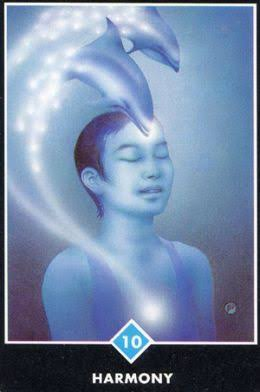
Whenever I think of wisdom, the Harmony card from the Zen Tarot naturally comes to mind. I see someone who has come completely to rest in her heart. From that heart, dolphins leap upward in an arc toward the head—or perhaps toward the third eye. To me, they symbolize the playfulness and intelligence that naturally emerge when thinking and feeling no longer oppose one another but work together. They remind me of a passage by Osho: “Listen to your heart. Do what your heart tells you, whatever the cost.” Those words touch me deeply. Simplicity may be one of the most difficult states to achieve. It asks you to let go of everything you think you have to be. Only a simple heart can truly live in harmony.
This is how I see wisdom at this moment. I have the feeling that all the Ways of the Heart ultimately lead to the same place: an authentic, happy, simple, and wise human being. Perhaps I need to study the Paramitas more deeply to understand why wisdom is presented as the fourth Way rather than the fruit of all the others. But perhaps that answer does not have to come today. For now, I am simply grateful that this chapter has once again left me with more questions than answers. Perhaps wisdom begins precisely there.
Perhaps wisdom is ultimately not about finding the right answers,
but about continuing to ask the right questions.
Letting Go
19 July 2026
My painting has deep edges; it is what is known as a 3D canvas. For days I had been thinking that I would paint those edges burgundy. What happens instead? I pick up my brush and paint them pink.
That happens to me almost every time. I end up doing something different from what I had planned.
I usually begin with a direction, much like a doodle. Then I trust myself enough to let go of my ideas, because the painting often asks something different of me. Experience has taught me that I do not need to protect my original plan. The painting creates itself. I simply move with it, and in the end I am often surprised by what has emerged. Everything begins with an idea, but that idea is no more than a direction. It is a form of inner listening.
In other words, I do not use intuition as the source of an idea; intuition is my way of working.
Sometimes the process comes to a halt because the painting has nothing more to tell me. Yet I can still feel that it is not finished. So I put it aside until I am ready to enter the next chapter of its story. That may take days, or it may take years. I would never call those paintings unfinished. I would say they are at rest.
Years ago, I used to ask myself, "How am I doing?" Nowadays, the question seems to be, "What does this painting still want to tell me?"
I have always known that conditioning separated me from my true feelings and emotions. Only through creativity did it seem possible for me, as an outsider, to look at the real Annette. Painting and writing gradually brought me closer to myself. The Annette who functions in everyday life wears a suit of survival armour. An armour that keeps much of the outside world at bay, but also prevents much of my inner world from fully coming through.
Whenever I paint or write, guided by my brush or my pen, that armour seems to disappear for a while. Those are the moments when I am free from thoughts, assumptions, judgments, and the feeling of being judged. I think that, for me, creating is the purest form of letting go.
Today I continued reading about the third Way of the Heart: Letting Go.
Once again, I stumbled over the explanation in the book.
It says:
"Letting go leads to self-control, as you come to realize that insatiable desire is the source of suffering."
And:
"It is supported by the realization that everything passes, including painful desires, and expresses itself through moderation."
Goodness...
To me, this explanation feels very mental. As if letting go were an action, like releasing a rope or dropping an object. I do not think letting go can ever become a truly internalized process in that way. When someone says, "I have let it go," I wonder whether that is really true, or whether it is simply a thought.
To me, letting go feels much more like acceptance.
Letting go is not walking away, but making space.
Letting go does not mean I no longer care, but recognizing that I cannot solve something for someone else.
Letting go is not powerlessness, but knowing that I do not control the outcome.
Letting go is trust.
Letting go is not blaming another person, but realizing that I can only change myself.
Letting go is allowing another person to be who they are, with all their beautiful and less beautiful qualities.
Letting go is not regretting the past, but seeing it as part of growth and becoming.
That is what letting go means to me.
Not a decision you make, but an inner process of acceptance that unfolds slowly. Perhaps it grows with the years.
I think letting go sometimes requires courage.
Not walking away, but staying.
Not acting immediately, but being lovingly present.
Not constantly trying to fix things, but trusting that silence has its own movement.
As human beings, we are strongly inclined to keep ourselves physically occupied. Perhaps that is precisely why inner movement is given so little space.
To me, letting go lives within that quiet movement. Words such as self-control, insatiable desire, and moderation do not belong there. Something arises that cannot be forced, only allowed to grow.
Perhaps letting go is ultimately not something I do.
Perhaps it is something that naturally arises once I stop trying to understand it.
An Inner Compass
18 July 2026
I am happy to see that, for the past eight months, my fitness measurements have remained remarkably stable. Despite a few falls and minor accidents, which have become a little more frequent now that I am moving more again. In my case, that simply comes with the territory. Because of my neurological condition, I will probably always stumble from time to time, but I also notice that I have become stronger and that I recover much more quickly after a setback.
That was the intention behind my plan from the very beginning. I am not training for quick results, but for lasting stability. A solid foundation—both physically and mentally—is ultimately more important than a brief period of progress. I want to become more resilient to the storms of everyday life, whether they come in the form of stress, physical strain, or an awkward fall.
As I reflected on this morning, I continued reading about the second Way of the Heart: Morality.
I actually use the word morality somewhat differently. To me, it is not about imposed rules or laws. I see it more as an inner compass. A way of living in which I try to be as free from judgment as possible, to feel compassion, and to remain understanding, even when I do not fully understand something. A compass that embraces love for people, animals, nature, and the cosmos. But it is also a compass that is never finished. It grows, changes, and moves along with new experiences.
In everyday language, morality usually refers to norms and values, to our ideas about right and wrong and how we are expected to behave. Sometimes it even refers to the moral lesson or deeper message of a story. That is exactly where it begins to feel somewhat dogmatic to me.
That brings Osho to mind, the once highly controversial spiritual teacher Bhagwan. Michel was the one who first introduced me to his books. They were the first books I could truly read without constantly stumbling over their meaning. Any judgment I may once have had about that 'crazy Bhagwan cult' melted away like snow in the sun. Not because I approved of everything that happened, but because I discovered something entirely different in his writings. To me, Osho revealed how easily we judge, take sides, and react as human beings. It was as if he deliberately magnified that tendency, allowing me to observe it with greater distance.
In the Osho Zen Tarot, the card Morality—the Queen of Clouds—symbolizes rigid beliefs. It warns that learned rules, judgments, and black-and-white thinking can limit your life energy and imprison you within a cage of your own making.
That resonated with me.
Perhaps that is why the words ethics or even virtue describe my own experience more accurately. Ethics invites reflection. Virtue goes one step further; it is not about rules, but about who you are and the intention from which you act. That comes much closer to what I experience as my inner compass.
I find it fascinating to explore these Ten Ways of the Heart. Not because I expect to find the truth. I am not even sure such a thing as the truth exists. I simply try to live with awareness and to keep exploring what feels authentic and true to me in this moment.
Perhaps the Ten Ways of the Heart are not a route I have to follow, but ten invitations to pause and reflect on how I live. Not to find answers, but to become better acquainted with my own questions. For now, I simply continue walking, curious about what the remaining eight paths may awaken within me.
Perhaps tomorrow the third path will reveal itself.
I am curious to discover where it will lead me.
Progress or Conviction
July 17, 2026
Yesterday was my grandmother's birthday. Today I suddenly found myself thinking about everything she experienced during her lifetime—not only personally, but also the tremendous changes she witnessed in the world around her.
She was born in 1906 and passed away in 1999. When she was born, women wore long dresses and hats. People travelled by horse and cart, automobiles were still a rarity, television did not yet exist, and the first cinema opened its doors that very year. There were no commercial airplanes, no highways, no computers, no internet, and no smartphones. Antibiotics and many modern medicines had yet to be discovered. By the time my grandmother died, the world had become almost unrecognizable.
We call that progress.
Out of curiosity, I looked up what else had happened in 1906. A devastating storm surge struck the Netherlands, prompting people to think much more seriously about protecting the country from the sea. Eventually, this would lead to the Delta Works. In the same year, San Francisco was hit by a massive earthquake, followed by fires that destroyed much of the city. The Dutch Federation of Trade Unions, the predecessor of today's FNV, was also founded.
Curiously enough, I now know I will never forget the year of her birth. That is simply how my memory works.
My grandmother lived through two World Wars. She witnessed the rebuilding of family life, home and business after the war, and later the bankruptcy of the family business. More than ninety years filled with change.
I have often wondered whether my own generation would experience changes just as profound.
After more than sixty years, I can only answer:
Yes.
Not in exactly the same way, but the speed at which the world is changing is unprecedented. Thanks to modern media, we see almost instantly what is happening across the globe. Personally, I do not always experience that as progress. Perhaps that is why I rarely read newspapers or watch the news. Even so, the world still reaches me.
After finally getting a good night's sleep, Ton and I did not go to the gym until around noon. The temperature had dropped to a pleasant twenty-three degrees Celsius. Afterwards, we decided to go for a bike ride. Tonight, the bridge to my hometown will close for nine months because of major maintenance. A small ferry has been arranged for cyclists, but today we could still cross the bridge one last time.
We cycled through the city centre, industrial areas, residential neighbourhoods and the surrounding countryside.
I noticed how much more asphalt there is than when I was a child. Streets have become major roads, and nature has gradually given way to buildings.
Again and again, I heard the same question in my mind.
Is this progress?
Progress?
Progress?
I realized that I do not want to become someone who says that everything was better in the past. That thought kept colliding with my desire to remain open to change.
Once I arrived home, something curious happened.
The word progress slowly changed into conviction.
Every time I searched for the word progress, my mind replaced it with conviction.
Perhaps I am simply not convinced by everything we call progress.
And then another question arose naturally.
What do I actually mean by progress?
Perhaps progress is not everything that is new.
Perhaps progress is everything that helps humanity live with greater awareness, freedom, and compassion.
Everything else may simply be change.
The Origin
July 16, 2026
Slowly I am beginning to recognize the pattern. After several consecutive days of warm weather, my body starts demanding more and more energy. At first, everything is manageable, but after a few days it simply can no longer cope with the heat. I spend the entire night awake because of persistent nerve pain. Sleeping becomes impossible. There is nothing else to do but sit in the living room with my laptop, read a little, watch a series, and quietly watch the morning arrive.
It is a strange combination. I become extremely tired, yet sleep is impossible. It is simply something I have to live with. Becoming frustrated or fighting against it only drains even more energy. More than anything, I feel sorry for Ton—a wife who spends half the night awake and most of the day sitting beside the air conditioner. Then again, perhaps he secretly enjoys having a day without cycling or working out together. Hahaha... that might actually be true.
Today is my grandmother's birthday—my mother's mother. She was the grandmother I loved dearly. A warm, kind woman who was, in her own way, remarkably stylish. Her home was always beautifully decorated, and she was the one person with whom I could share my frustrations about my mother.
Back then, nobody ever spoke about narcissistic personality disorder. My grandmother probably didn't even know such a diagnosis existed. Yet she understood perfectly well what I was struggling with. I mainly remember her gently shrugging her shoulders and telling me that my mother had always been that way. Ever since she was young, she had done exactly as she pleased, and opposing her usually led to emotional outbursts. I think my grandmother eventually chose to adapt rather than fight. She trusted my father to keep everything within reasonable limits.
And he did.
Of course, I have no idea whether my grandmother had always been so calm and accepting. Perhaps she too first struggled through disappointment, anger and sadness before eventually returning to acceptance. My aunt—my mother's only sister—once told me something similar. She had known her own struggles with my mother, yet she also loved her deeply.
When I was younger, that puzzled me.
Today, it no longer does.
Time has changed my own feelings as well.
Perhaps that is what I am only beginning to understand. My grandmother and my aunt may have walked exactly the same path that I have. I simply never witnessed that part of their journey because I had not yet been born, or I was too young to understand it.
During my marriage to Michel, whenever a relationship became difficult, I often asked myself the same question.
What did I feel when this relationship first began?
How genuine was that feeling?
Can a pure beginning truly turn into a dark well?
Or is it the circumstances that have gradually settled like a layer over the original spring?
I notice that I consciously choose to return to that beginning. Not because I want to ignore difficult situations, but because I remain curious about what may still exist underneath them. Perhaps growing older naturally brings us back to our origins. Of course there are exceptions, but that seems to be true for me.
Out of the corner of my eye I watch a television programme showing people diving and snorkeling near the island of Maui. Instantly I am transported back to the Maldives, where Michel and I snorkeled together and he also went scuba diving. I will never forget the underwater world. The colours of the fish, the coral and the sea anemones were so vibrant they almost seemed to emit light. I have never encountered colours like that on land.
Only in my dreams.
Of course the circumstances are different. Underwater, sunlight behaves differently than it does above the surface. Yet suddenly I realize something. Around dusk, I see something very similar. The greens become greener, colours seem brighter, almost separating themselves from their surroundings.
Perhaps that is true not only for colours.
Perhaps it is true for people as well.
Circumstances often determine which aspect becomes visible. Light does not change what something is; it changes how we perceive it.
And once again I arrive at the same question that has been returning to me so often lately.
Am I seeing the truth?
Or am I seeing only one aspect of a much larger whole?
Perhaps the truth does not lie in what happens to be visible at a particular moment, but in the source from which everything once emerged.
Perhaps understanding begins with the willingness to keep returning to that origin.
\
A Different Way of Giving
July 15, 2026
Has anything truly moved me today? Other than my workout and a short bike ride? The heat slows me down. The longer it lasts, the more naturally my pace begins to slow.
So once again, I found myself sitting on my bed in front of the air conditioner. The plan had been to visit my brother at the rehabilitation center, but the thought of stepping back into the heavy heat and then having to readjust once I got home didn't appeal to me. Even an evening bike ride didn't really tempt me today.
Mind at rest.
Body at rest.
Today, that felt like enough.
On television I heard someone say, "Life is a journey." Those words immediately brought me back to the Ten Paths of the Heart that I am currently painting. Today, it was the first path that stayed with me.
Generosity.
In the book I have started reading about the Paramitas, the perfected qualities of the heart, the author writes:
"Generosity leads to giving because you experience the joy of not feeling needy, the peace of a tranquil mind, and the possibility of bringing suffering to an end."
I notice that I do not stumble over the teachings of the great masters themselves. What I sometimes struggle with is the way we, as people today, interpret those teachings.
This explanation made me pause.
Not because I believe it is wrong, but because my own life has shown me something different.
My experience has been that the more someone has known need, the more generous that person can often become. That may sound like a generalization, but it is something I have observed again and again throughout my sixty-three years of life. Not only among people with little money, but also among those living with physical limitations, few opportunities, or profound loss.
Perhaps that makes sense.
The more we possess—whether it is wealth, health, beauty, or security—the harder it can sometimes become to let go. Those who have had to let go more often may discover that the fear of losing something again gradually becomes less overwhelming.
Again, this is not a judgment.
It is simply an observation.
For many years I taught without earning anything from it. I simply wanted to share what I had learned. In a way, I still do exactly that, only in a different form. Today I share my experiences through my blogs.
Everyone was welcome in my home. People could join us for dinner, stay the night, or, if necessary, even live with us for a while. I shared my life with many people, and I did so with great joy. I look back on those years with warmth.
After Michel passed away, something slowly began to change.
I realized that this way of giving was placing an ever greater burden on my body. Gradually I slowed down, and my need for peace and quiet became stronger. A house filled with people no longer suits me. Neither does cooking every day for a large group.
That form of generosity now belongs to my past.
Today it has taken on another form.
Perhaps less visible.
But no less sincere.
These days I may no longer offer space in my home, but I try to create space through my words.
Perhaps generosity does not change its meaning as the years go by.
Only its form.
Perhaps I have been walking the first path of the heart for much longer than I ever realized.
The path simply looks different today than it once did.
From Doodle to Awareness
July 14, 2026
Paper never judges. It is a place where everything is allowed to exist. Perhaps a better way to put it is this: it never talks back, yet it reflects.
Writing every day has given me so much. It has become a journal in which I record my life, my thoughts, my feelings, my questions and my curiosity. Dark thoughts, light thoughts, compassionate actions and uncompassionate ones. They all have a place. I am human, and nothing human is foreign to me.
I think that sharing my journal on my website adds another dimension. Probably for myself, but perhaps also for the reader. For me, that extra dimension lies in allowing myself to be vulnerable. I open myself without knowing exactly what it may awaken in someone else.
Like every child, I was born gentle. Gradually, I became hard. Hard on myself and hard on others. It was a strictness I had imposed upon myself and eventually carried into the world around me. Not because I lacked love, but because I simply did not know how to let go of my own pain.
I only began to understand that after the stroke I suffered on January 22, 2025, when I started writing every single day.
Writing has become the same movement as painting.
The process I have always called "mopping."
Looking.
Looking again.
Remaining with it until the painting slowly begins to speak back.
Now I do both, every day.
I write.
And I paint.
Slowly, I am beginning to recognize a path that runs through both my writing and my paintings.
It all began with a simple doodle.
Sometimes a painting does not begin with an idea, but with a line. Without any plan, I put a few shapes on paper. As I kept looking, a figure slowly began to emerge. At first I couldn't even see her myself. Only as the lines developed further did a feminine form appear, as if she had been hidden within those first innocent lines all along.
I decided not to colour her the way I normally would. Instead, I began with only four colours that had been living inside me for quite some time: burgundy, soft pink, light blue and fresh green. I promised myself I would not introduce any new colours. Even when I felt that lilac might be beautiful, I refused to mix a new shade of purple. I wanted to discover how much life could emerge from what was already there.
Gradually, something remarkable happened.
Everywhere I looked, shapes began to appear that I had never consciously intended. Fossils. Scales. Shell-like structures. Water plants. Lotus flowers. Organic patterns that reminded me of the origins of life itself. It felt as though the painting was leading me into a world where nature, humanity and consciousness were never truly separate.
Above the figure, a large circle appeared. At first it felt like a halo. But before long I realized it was not about an angel at all. It pointed to something much closer.
More and more strongly, I began to feel that the protection, wisdom and guidance people often seek outside themselves may already exist within us.
For me, the halo no longer represented holiness.
It became an image of consciousness.
Not something above us.
But something that can awaken within us.
The wings also began to change their meaning.
They were no longer wings that carried someone away from the earth, but became a symbol of awakening awareness. It was as if awareness, once truly seen, naturally grows wings. Not to escape life, but to unfold more fully within it.
Gradually I also began to see the connection between the halo and the human figure. Not as a straight line, but as a winding path made of tiny dots. That immediately felt right. Awareness rarely unfolds in a straight line. It twists, takes detours, disappears from sight for a while, only to reveal itself once more.
While painting, an old Buddhist concept suddenly came to mind: the Ten Paramitas. Ten qualities that guide a life of love, wisdom and compassion: generosity, ethics, letting go, wisdom, energy, patience, truthfulness, determination, loving-kindness and equanimity.
At that moment I knew what the winding paths were meant to become.
Ten living pathways flowing from consciousness through the heart and then throughout the whole human being. Not as rules to obey, but as living paths that can be walked anew every single day.
As I continued working, I noticed that the painting was beginning to echo the themes of my recent blog posts. I have written about the middle way, about the unity of light and darkness, about the visible and the invisible, and about the realization that everything is connected.
I now see all of that reflected in this painting.
The gentle and the hard.
Matter and the unseen.
Water and earth.
Flowers and fossils.
Humanity and consciousness.
Not as opposites.
But as one whole.
Perhaps that is the greatest surprise this painting has given me.
It began with an innocent doodle. I thought I was making a drawing. Gradually I discovered that the drawing was showing me something for which I had not yet found the words. As the painting grew, my own understanding grew alongside it.
What I see now is a journey from doodle to awareness.
Perhaps awareness naturally grows wings when it is truly seen.
Perhaps that is what I mean by consciousness.
It speaks through my pen.
It speaks through my brush.
And I am grateful to have found these two forms of expression.
They not only tell me who I am, but continue to reveal who I am becoming.
Another World
July 13, 2026
Because of the heat, I notice that my day-and-night rhythm is slowly shifting again. I go to bed late, work out during the day, and then head straight back home. Now we prefer cycling in the evening. The later it gets, the more energetic I seem to feel. This past week I haven't gone to bed until around four o'clock in the morning.
It's actually rather strange. When I feel hot, sticky and clammy, I don't feel well. Yet during my workout, sweat runs down my face, neck and back as if I were standing under a shower. Even though I'm completely soaked, I actually feel perfectly fine.
Cycling in the evening is wonderful because the air has cooled down and there's usually a pleasant breeze. As the light changes, the same landscape takes on a completely different appearance. Most of the water birds are asleep along the banks, while other animals begin to emerge as dusk approaches.
As we continue cycling, my thoughts suddenly drift to my painting. During the day it looks completely different from the way it does in the evening. Yet it is exactly the same painting. Earlier I wrote that context changes colour. Now it seems that the time of day adds something as well. Not only does the light change, but so does what becomes visible. Perhaps that is true not only for a painting or a landscape, but for people as well. Who—or what—do you meet at a particular moment? And what image do you take home with you afterwards?
A little later, an enormous hare races along the cycle path ahead of us. Watching it run, it almost looks like a little gazelle, moving so lightly and gracefully through the twilight. Not much later, a rat darts across the path. I enjoy noticing these contrasts so consciously. They remind me of the years when I lived in the woods. Around dusk, animals would leave their hiding places and appear in areas where people had been walking during the day.
I haven't done that for years. When you live in a city, you don't usually head out at dusk. Ton and I agree that one of these days we'll also try cycling very early in the morning, around six o'clock. I love riding familiar routes again and again, watching the seasons change. Yet even from one week to the next, everything is already so different. Nature grows and blossoms at an astonishing pace.
It reminds me how different a single day can be, depending on the time you step outside. Of course I already knew that, but I'm surprised by how quickly we adapt to life surrounded by concrete and adjust our daily rhythm accordingly. Perhaps it isn't surprising that people living in cities gradually lose touch with what nature quietly reveals every single day.
It is the summer school holiday, so there are groups of teenagers everywhere. Naturally they seek each other out. We cycle along a narrow path with reeds and water on both sides. In the distance I see a group of teenagers sitting on scooters beside a bench, with loud music blasting from a portable speaker. In surroundings like these, the noise almost hurts me physically. As we pass, I simply think, They're teenagers. They probably don't even realize it. At least they're outside, surrounded by a little piece of nature. That's something.
Ten minutes later we pass another group of youngsters. They are using sticks to beat down the plants growing along the riverbank. That is much harder for me to watch. After we've passed them, it is the face of one particular girl that stays with me. She didn't look happy.
She looked angry.
I don't approve of what they were doing.
But perhaps it is better for a shrub to receive the blow than a friend, a classmate, or someone they care about.
Back home, I receive a photo on WhatsApp from my granddaughter. She has dyed her hair red with henna. Seeing her smiling face makes me happy. A little later, a granddaughter of Ton sends a video from her end-of-school party at home. She and her friends are dancing, laughing and simply enjoying themselves.
How good it is to see that too.
Perhaps it is because I lived in the woods when my own children were teenagers. The kind of behaviour I witnessed this evening never really caught my attention back then. Of course teenagers don't stay home with their parents during the holidays. They seek each other out.
That is simply part of growing up.
A whole new world is opening before me.
The world of hares, rats, and teenagers in a city at dusk.
Perhaps the world changes less than I imagine.
Perhaps every moment of the day simply reveals a different world.
I only have to be willing to look at the right moment.
The Ways of the Heart
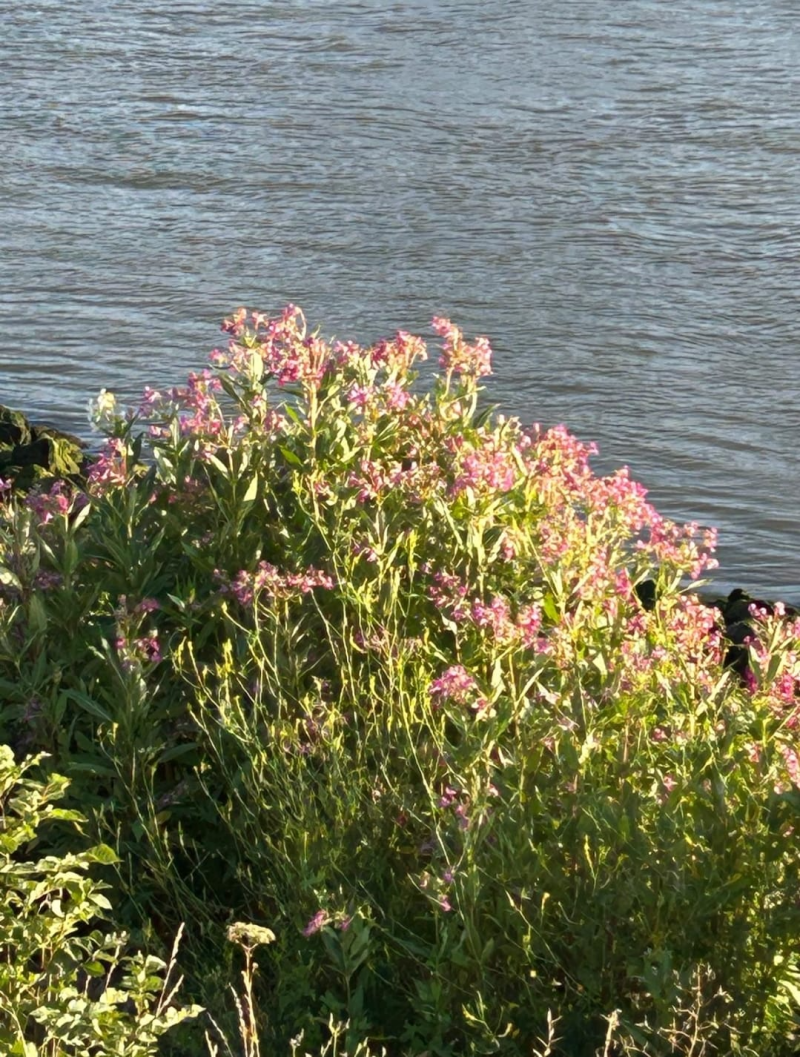
July 12, 2026
It is ten o'clock in the evening. Around this time I usually write my daily blog. As I type today's date, I suddenly realize that it is my mother's birthday. She was born on July 12, 1931, and passed away a few years ago from COVID. Nothing has been mentioned in the family group chat with my brothers and sisters. Her birthday has probably slipped their minds, just as it did mine. Still, for a brief moment, I think back to the birthday celebrations we used to have. They are warm memories, traditions that I later continued when I had a family of my own. Now that everyone has long since left home, I look back on those years with gratitude. At the same time, I realize that I wouldn't be able—or even want—to celebrate them in the same way anymore.
But back to today.
It was warm, so I stayed inside where it was cool and continued working on my painting until it seemed finished. Yet as I kept looking at it, I felt something was still missing. There is only one thing to do in moments like that: leave the painting on the easel until it tells me what that missing piece is.
We had seen on the weather forecast that it would gradually become cooler after six o'clock. Around seven, we set off on our bicycle ride. Very quickly we discovered how wonderfully gentle the evening had become, with a pleasant breeze. Such a lovely feeling—the cool air against my face, my blouse fluttering around me, and perhaps best of all... the silence. Hardly any traffic, almost no cyclists or walkers. It was astonishing that we seemed to be among the very few people enjoying this beautiful summer evening.
As we cycled through a village, I heard singing in the distance, growing louder as we approached. We passed the church, whose doors stood wide open. It was full of people singing with all their hearts. I said to Ton, "If I lived in a small community like this, I would probably go to church too. Simply to sing along and to be part of the village." He didn't really respond to that, but instead told me about a radio interview with a committed atheist that he had found fascinating. I smiled and simply replied, "I understand why you enjoyed listening to him."
We continued cycling, enjoying the temperature, the breeze and the silence. Then Ton suddenly said, "I don't know what to call the colour of the sky. It isn't a sunset. Do you notice how much greener everything looks?"
At that moment, I felt so happy that he was beginning to notice these things too.
I answered, "It's a very soft lilac. The sunset is still hidden behind the blue light. Do you also see how the light is beautifully diffused on one side, while on the other side the colours seem to glow?"
We stopped for a moment to enjoy the silence and the extraordinary light.
As I sat there, I heard these words in my mind:
"You are missing the paths of the heart."
My thoughts leapt from the singing in the church to my painting.
That is it.
Another step in the process.
My brush will know what it has to do.
And I will follow it.
We got back on our bicycles and continued along the river. This time I noticed completely different reddish-purple plants growing almost like shrubs along the bank. I stopped to take a photograph so I could look them up later and see whether they carried any symbolic meaning.
It was almost nine o'clock when we cycled back into town after twenty-five kilometres. Ton said, "You probably want an ice cream, but I'm afraid we'll be too late." I shrugged. If it works out, that's lovely. If not, that's fine too. As it turned out, we were the last customers of the evening. We each enjoyed a delicious scoop of forest fruit and lemon sorbet.
When I get home, I have a familiar ritual. The dogs receive a treat, I change into my nightshirt, climb onto the bed with my laptop, and look up whatever sparked my curiosity during the day.
Today it was the Hairy Willowherb (Epilobium hirsutum).
In the symbolism of plants, Hairy Willowherb is often associated with resilience, healing and a touch of magic. Because it flourishes abundantly along rough, sometimes disturbed riverbanks, it symbolizes perseverance and the ability to overcome adversity.
Perhaps my mind does not always know the way.
My heart—and my brush—seem to have known it all along.
Gentleness
July 11, 2026
I woke up feeling content, surprised that I had dreamed about a snake once again and had been completely at ease with it in my dream. My fear of snakes seems to have disappeared entirely in my dreams these days. I think it has something to do with healing, with old fears slowly fading away.
A good start to the day.
As we walk towards the car to go to the gym, Ton says, "Oh yes, yesterday I backed into a post when I was taking my son home." The moment I see the dent and the damage to my car, I completely lose it. Not because of the car itself, but because it frustrates me that Ton isn't focused. Whenever he has too many worries or tries to keep too many balls in the air at once, he loses his concentration. He is someone who is always there for everyone and hardly ever says no. That worries me. Instead of responding with kindness, I become angry and let my words run wild. If this happens, then that will happen, and if that happens, then something else will follow. I can go on like that without stopping. During our workout I barely look at him. I am busy processing my own frustration.
Once we get home, I apologize.
It's unfortunate.
Nothing more.
One of Ton's granddaughters has a dance performance, and around the same time my daughter arrives in Papendrecht with her husband and two daughters to say goodbye before leaving for their holiday. The performance is nearby, so Ton and I decide to go by bicycle. He takes the bikes out of the van while I have a shower. By the time I'm ready, he comes back upstairs. I find myself thinking, He's been gone for quite a while. Then I notice he is searching for something.
He has lost my bicycle keys.
Immediately I feel like crying.
What now?
I say, "I don't care. I'll break the lock open with a hammer if I have to, because I just want to leave on my bike." I feel so helpless that I can't even help him calm down. He decides to search the street first and cycles away. As I stand there, I suddenly realize how terribly I am behaving. My reactions only make his sense of being overwhelmed even worse. At that moment I decide not to continue reacting that way and instead simply look for a solution together, with kindness.
A little later I see him cycling back along the pavement. About thirty metres away, the sun catches a small shiny object lying on the ground. We both spot it at exactly the same moment.
My bicycle keys.
Fortunately, Grandma and Grandpa can still happily cycle to the dance performance.
Cycling is actually quite pleasant thanks to a gentle breeze. Sitting still in the blazing sun is another matter altogether. By breathing calmly and keeping my attention on the dancers, I manage reasonably well. Halfway through the performance, my daughter and her family arrive too. It feels good that our families are getting to know each other better and genuinely enjoy sharing moments like this together. Ton's granddaughter gives several wonderful performances but is overcome by the heat afterwards. Ton calmly stays with her and takes her home.
I return to our house with my daughter and her family, where the air conditioning has kept everything wonderfully cool. They mention that Ton looks rather worn out.
Well...
Apparently I'm not the only one who notices.
I cannot change who he is.
What I can change is my own response.
That is something I want to work on.
Finding a middle way.
My daughter smiles.
"Yes, Mum... that's all you can do."
My painting stands on the easel in the middle of the living room. My son-in-law studies it for a while and then says, "It reminds me of Aboriginal art." I smile, because years ago I created a ten-metre Aboriginal-inspired artwork together with a group of students. It was a landscape seen from above, built from traditional symbols that everyone had first researched. Working together with the person next to them, each participant became part of one continuous panorama. It was rather like a Panorama Mesdag in an Aboriginal style. It was wonderful to make.
Aboriginal art is deeply rooted in the spiritual concept of the Dreamtime. I recognise something of that in the way I paint. It feels as though the painting emerges through my brush and my paint. Only when I stop do I really see what has appeared on the canvas. Just as in a dream, the unconscious slowly becomes conscious. Sometimes I immediately sense or understand its meaning. Sometimes it needs time.
And time...
...chooses its own time.
This time, I think the painting is trying to teach me something about patience and gentleness.
My granddaughters ask if they may draw. They each receive a sketchbook and a set of coloured pencils, and quietly settle down at my worktable beside the painting. By now Ton has returned home. First he took care of his granddaughter, and now he immediately starts preparing dinner for my daughter, her family and me.
A little later he comes to sit beside me, his face warm and tired.
My heart melts.
Perhaps gentleness is not about never becoming angry.
Perhaps gentleness is about finding my way back to love a little sooner.
Nothingness
July 10, 2026
After a day of binge-watching and writing, I didn't go to bed until half past four in the morning. Even so, I woke up in time to go to the gym, but Ton needed the car for something else. To my own surprise, I was perfectly fine with skipping my workout for a day. Goodness, I am becoming so much easier about these things. Or is it secretly laziness? Perhaps resistance? In the end, it doesn't really matter. I know I am taking good care of myself, and I trust that I will continue doing everything I can to keep my body as fit as possible.
While Ton is away, I look outside. The sun is shining, and I can already feel that today will be warmer than yesterday. Yesterday I managed the heat quite well, although I could clearly feel how much energy it demanded from my body. So spending another day binge-watching in front of the air conditioner doesn't seem like such a bad idea. Mind switched off, the dogs lying beside me, completely at ease. Every now and then I spend an hour painting.
How wonderful this nothingness feels, stretching out into what seems like infinity.
Be honest with yourself. When you are caught up in your somethingness, isn't it always temporary? So why should we worry about those moments when we are doing nothing?
I no longer see my nothingness as emptiness, but as a creative space. A space where nothing has to take shape yet, and precisely because of that, everything is still able to emerge. Little by little, I am beginning to understand this. I am learning to listen to that quiet voice within me that occasionally chooses nothingness, without shame or guilt. Not out of laziness, but from the realization that this, too, is a gentle side of life that we as human beings need.
We do not always have to be doing something or being productive. That is the harder side of life. For now, I would simply say that there could be more balance between the two. Eventually, I hope I will no longer see them as two separate aspects, but as one quality of being, one layer of existence that embraces everything. Not thinking in duality, but in unity.
I realize that my language may sound a little unusual. Even so, these are the words that come closest to describing what I am trying to express. Perhaps there simply are no perfect words for this experience.
Words give shape. The moment I put something into words, it begins to come alive for me. Perhaps that is why nothingness is not an emptiness in which nothing exists, but a creative space in which new forms can emerge. I am human. I live through form, and it is only through form that I can express what lives within me. Perhaps nothingness is the space from which new forms are continually born.
Eventually, the way of words comes to an end.
Past, present, and future... disappear.
Perhaps nothingness is not the end of words.
Perhaps it is the space from which words are born again and again.
The Middle Way
July 9, 2026
It is usually in the evening that I continue working on my painting. This morning, in the soft daylight without bright sunshine, I noticed how much gentler it appeared to me. In the light it feels soft, while in the dark certain parts seem much harsher. Yet it is exactly the same painting. It feels like a metaphor for people. In the light and in positive circumstances, someone often appears softer and kinder. In the dark, or when life becomes difficult, that very same person may seem harsher or even unfriendly. How do you happen to meet someone? Cheerful or irritated? In the light or in the dark? It is becoming increasingly clear to me that every person has many different sides. The question is simply: which one do you happen to meet? And is that the image you continue to carry with you? I hope I will always remain aware of the countless changes every person goes through, every single day, simply because of the situations they encounter. Could that be the underlying theme of the painting I am creating?
After my workout, we loaded the bikes into the van and drove to a different area to go cycling. I was struck by how many tall purple flowers were growing along the waterways. They were everywhere, and beautiful to see.
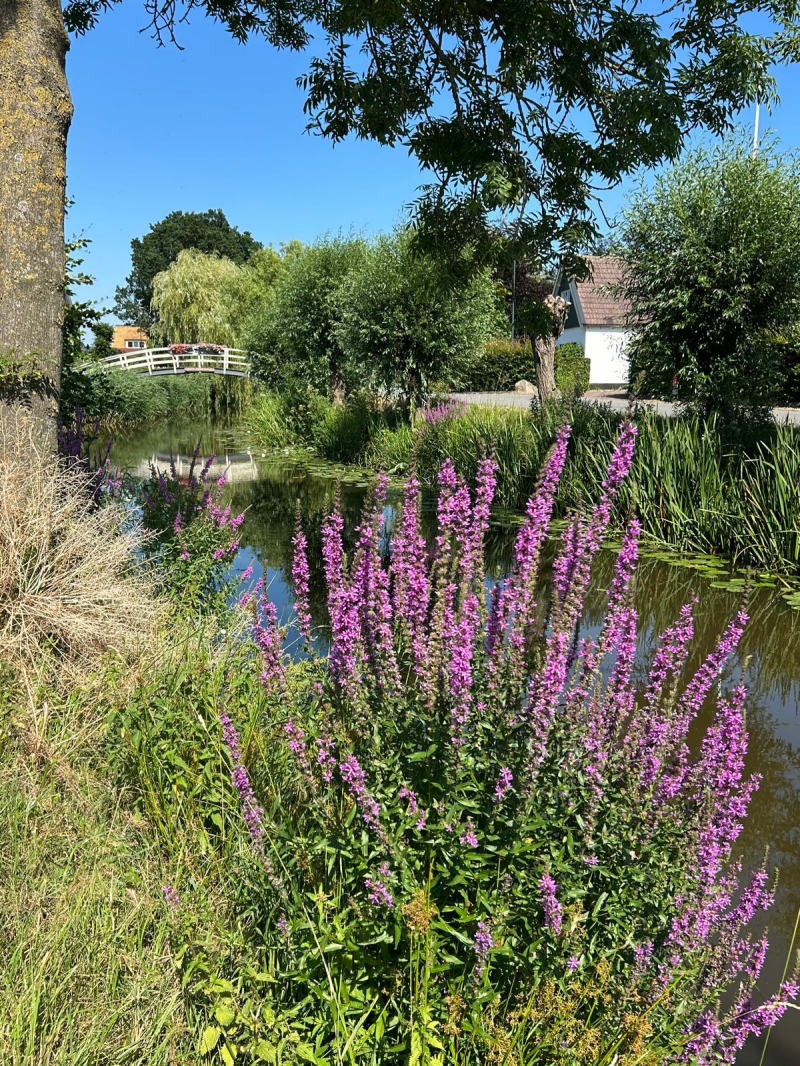
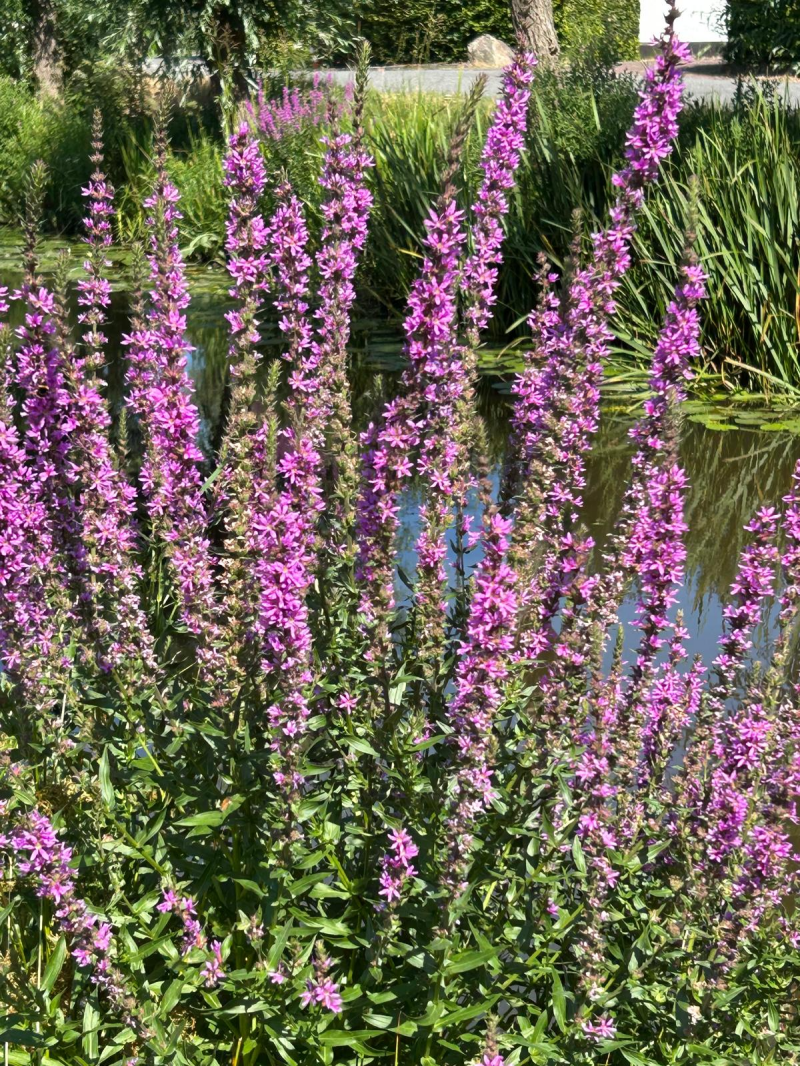
More than thirty years ago, someone who had devoted his life to herbs, plants, and making elixirs told me that the abundance of certain plants could sometimes say something about the people living there, or even about an entire area. The idea that we are not separate from the nature around us, and that nature is not separate from us, took root in me that day. Of course, once I got home, I looked up the name of the plant and whether it also carried a spiritual meaning. Not because I immediately accept such things as truth, but simply because I find them interesting. It turned out to be purple loosestrife. Spiritually, it is said to symbolize peace, protection, and physical continuity. It also represents sincerity, honesty, and the simplicity of life. That sounds beautiful. We cycled for more than two and a half hours, and almost the entire route was lined with these flourishing plants along the ditches. If this plant truly contributes, even in the smallest way, to love for our fellow human beings and to the vitality of life, then I would happily welcome even more of it.
It is remarkable how many roadworks are taking place at the moment. Motorways are closed, cars are being diverted through villages and across narrow country roads, and many cycling paths are under construction as well. There were traffic jams everywhere, yet when I look back on the day, I honestly cannot remember seeing any irritation. Haha... perhaps those purple loosestrife plants are doing their work after all.
It was even warmer than yesterday. Only after arriving home did I realize how much energy my body had needed simply to keep going. Off came my clothes, I lay down on the bed with the air conditioning on, my laptop on my lap, my head resting in the pillows, doing absolutely nothing. On television I was watching a programme about photography when I heard one of the photographers say, "I'm trying to find the balance between hard and soft." Someone replied, "Well, that's life." I smiled. That was exactly what I had been thinking this morning while looking at my painting.
A little later, Ton came to sit beside me on the bed. He told me about the stress he was experiencing because someone had entrusted him with a painful secret. Psychology often says that everyone carries secrets. I can understand that. Sometimes they are not even conscious secrets, but simply things we experience or feel without sharing them with anyone. But how do you deal with a heavy secret that someone has entrusted to you? They tell you because of shame, fear, or the fear of losing face. Naturally, you do not want to betray their trust. Yet at the same time, you may end up carrying sleepless nights and stress because of it. You also realize that keeping the secret may leave someone else feeling excluded.
I find that a difficult dilemma.
My first instinct has always been that you should never betray someone's trust. Yet I find myself wondering more and more whether such a rule should always be absolute, especially if the person keeping the secret begins to suffer physically or emotionally because of it. Is there a middle way? And if there is, what does it look like?
Or is it possible to truly listen to someone without taking over their burden? Perhaps they simply needed someone willing to listen so that they themselves could feel a little lighter. Is it really meant to become your burden as well, when in reality it does not belong to you?
Ton is naturally gentle and therefore easily carries the worries of other people with him. I, on the other hand, tend to respond more firmly and leave the responsibility where I believe it belongs.
For the first time, I notice another thought beginning to emerge.
Perhaps it does not have to be either hard or soft.
Perhaps there is also a middle way.
I don't yet know what that looks like.
But perhaps every middle way begins with the willingness to look for it.
Perhaps I am not only creating a painting.
Perhaps, little by little, the painting is showing me another way of looking at life.
Inner Freedom
July 8, 2026
I painted until well into the night. For a while, I ignored my own intention not to get completely carried away by the creative flow I sometimes find myself in. Going to bed on time, stopping what I am doing... It is actually quite pleasant to notice that I am becoming less strict with myself. Whenever I set myself a goal, I tend to do everything in my power to achieve it. So what happened? I wanted to continue painting, so I did. I decided I would simply see how tired I felt the next morning. And indeed, I woke up feeling rather groggy. No problem. I simply postponed my workout by an hour. Life can be surprisingly simple.
A good friend asked me through WhatsApp if I would read his latest blog. I thought, I have time for that now. It was beautifully written and dealt with themes that often appear in my own daily reflections. I complimented him on it, and a little later he called me back. We made plans to spend a day together soon. Something to look forward to. We always have wonderful conversations, and it simply feels good to be together. Ton is happy that I have such kind friends. Even though he hardly knows most of them, the fact that they care about me is enough for him. I truly feel blessed to have a man like that. No jealousy, no possessiveness, just the freedom to be exactly who I am.
Today, Ton and I had a conversation that once again showed me how a common thread sometimes only becomes visible after many years. We talked about my closest friend, my daughter, and about letting go. I told him that, in the end, I leave the ball in the other person's court. When someone chooses to distance themselves from me, it hurts at first. But after that, something else arises. Peace. Not indifference, not anger, not lingering sadness. It is as if something inside me quietly says, This is where things are now, and I no longer have to change it.
A kind of inner silence unfolds, a place where movement arises without me trying to force it. Not stillness, but a source. As if beneath all thoughts and emotions there is a deeper layer that is not dependent on what other people do. From that moment on, I can let go.
For me, this feels completely natural, although I know it is not for everyone.
During the same conversation, memories surfaced that seemed unrelated at first. After Michel died, my mother said, "What will become of her now? No normal man will ever want her again." I had to laugh. I wasn't looking for a man at all. It was obvious that those words reflected something within her, not within me. Years earlier, one of my daughters wondered whether her father might one day choose another woman because he was handsome and, according to her childhood logic, I was not. Then there was a friend who once innocently asked whether another girl was "just as disabled" as I was. She certainly didn't mean to hurt me, but the words simply slipped out.
I smiled about it then, and I smiled about it again today. Not because those words never hurt, but because I now see what lies beneath them.
Throughout my life, people have often seen my disability before they saw me. As if the way I walk automatically says something about my appearance, my attractiveness, my abilities, or even my worth as a human being.
I understand that mechanism now.
What many people don't understand is that it simply doesn't work that way for me.
I do not feel less valuable because someone sees me that way. Nor do I feel the need to prove otherwise. I don't have to convince anyone that I am worth knowing.
Whoever truly meets me, meets me.
Whoever only sees my disability is mostly meeting their own assumptions.
That may sound harsh, but I don't mean it that way. I judge no one. We all look at the world through our own lenses.
Myself included.
Perhaps there is only one thing I truly hope for. That every now and then we have the courage to ask ourselves whether what we think about someone else is really about that person, or whether it reveals something about the way we ourselves look at people.
What does it tell me about myself?
I think that may be the most interesting question of all.
Inner freedom reveals itself to me in different ways each day. Today differently than yesterday. Yet through all these movements, both literal and figurative, the same gentle ray of sunlight continues to shine.
Perhaps inner freedom does not arise because other people change, but because I feel less and less compelled to respond to what they think they see in me.
Freedom
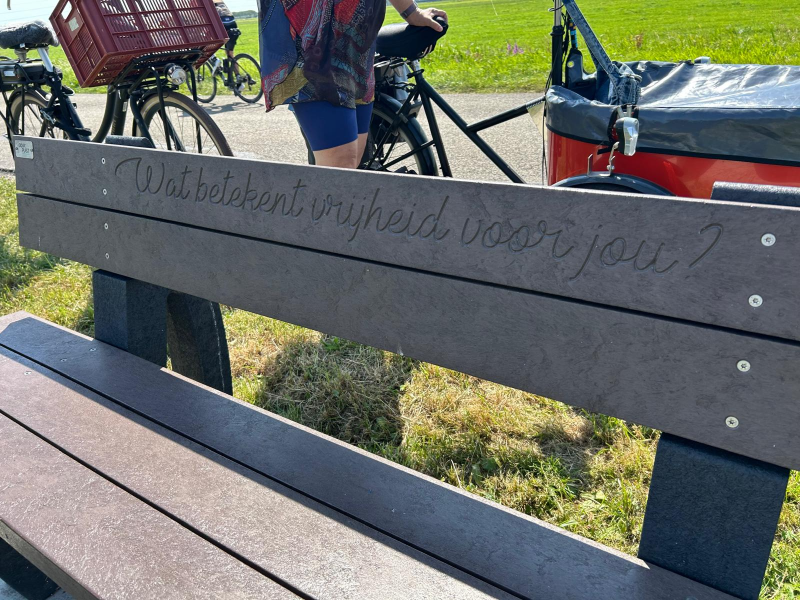
July 7, 2026
While drinking my coffee this morning, I listened through my earbuds to a psychiatrist talking about PTSD. She explained that people with PTSD can experience blackouts. Not because they lose consciousness, but because they enter a dissociative state. This can happen when they feel threatened or become highly agitated. They may become angry, sometimes even violent. Afterwards, they remember nothing of what happened. The interview stayed with me. I talked about it with Ton because it suddenly seemed to shed some light on both my daughter and myself. It brought a little understanding to a situation that began years ago and has since become a tangled ball of yarn, impossible to fully unravel. Perhaps it doesn't have to be untangled. Perhaps some threads simply need to be cut and tied together again in a different way. That thought alone brought me a sense of peace. After that, I let the subject go.
The gym was quiet. Nobody was talking. Everyone seemed absorbed in their own thoughts. It was there that an unexpected idea for my painting suddenly appeared. After two exercises, I let that thought go as well and focused only on my breathing.
As soon as I got home, I started working on my painting. Apparently, the idea had stayed with me without my being consciously aware of it. The result surprised me. I have no idea what it means yet. I only see the colours and feel that, somewhere in the future, they still have something to tell me.
After laying down the first new layer, I put my brushes away and went cycling. It was warm outside, but thankfully there was a gentle breeze. I am determined to help my body adjust to the heat so that I can spend time outdoors over the coming weeks without feeling unwell. I don't really know how I do it, but through my breathing and a certain posture I try to let my body surrender to the warmth. Strangely enough, it works. I feel the heat around me, but not inside me. As I cycle, I think to myself, "I'll get through the summer like this." We had planned a route, but along the way it turned out not to be possible. So we simply let our bicycles lead us, without thinking, through villages and across the Dutch countryside. It made me smile. Just as I become the brush while painting, today I became the bicycle.
Along a quiet country road we stopped at a bench to drink some water. Suddenly I noticed words engraved into the wood: "What does freedom mean to you?" Wonderful. Simply this: cycling, enjoying nature, feeling the elements, having to do nothing, knowing that everything is possible. That is freedom to me.
Then a memory surfaced from thirty years ago. I was giving a workshop with Freedom as its theme. After the yoga exercises, everyone was invited to draw what freedom meant to them. At the end, we sat together in a circle and shared our drawings. I always joined in myself. Back then, I didn't own a bicycle, nor was having one an option. I drew my car. When I showed my drawing, I never expected the amount of resistance that followed. Many people who practised yoga embraced an alternative lifestyle. The fact that their yoga teacher had drawn a car as a symbol of freedom struck them as materialistic. I simply let every reaction exist. Nobody even gave me the chance to explain why I had drawn my car. It fascinated me to watch how a group of thirty people gradually reinforced one another's judgments. Only after about half an hour was I finally able to explain why my car represented freedom to me. As long as I can move independently—whether by car, cargo bike, or mobility scooter—I feel free. Walking does not feel like freedom to me. It requires concentration and costs me a great deal of energy. Getting into my car and driving abroad—that is freedom. Today I experience that same feeling on our bike rides. Perhaps even more so, because I am outdoors, surrounded by nature.
Then I suddenly noticed that my odometer had reached 7,000 kilometres. Ton quickly took a picture because it felt like a special milestone. How wonderful that we have cycled this distance together in just three summers. Buying my cargo bike was probably the best purchase I have ever made.
When I got home, I found an email from the Efteling theme park. It said: "July 7th – Fairy Tale Day." "Did you know this day was first celebrated on 7-7-2007? Not just any date—the number seven plays a leading role in countless fairy tales."
Isn't that funny? 7,000 kilometres on July 7th... Fairy Tale Day.
My life feels beautiful, just like a fairy tale. Something painful or difficult always comes along eventually, yet somehow life always seems to give me something beautiful in return.
Perhaps freedom is not about living without difficulties.
Perhaps freedom is the ability to keep seeing the beauty of life despite them.
Context Changes Color
July 6, 2026
Last night I had a dream. I know it was an elaborate one, but only moments after waking up, I had already forgotten almost everything. The only thing that stayed with me was an enormous snake, at least six or seven meters long. Its skin was dark, a mixture of charcoal and grey. Some kind of python, I think.
I am terrified of snakes. It is a genuine phobia. Anything that even remotely resembles one, like an eel, I don't dare go near, let alone eat. Just the thought of it makes me uncomfortable.
In the past, snakes in my dreams were always part of nightmares. The strange thing is that last night I wasn't afraid at all. In fact, I helped catch it, put it into a kind of cage, and return it to its natural habitat. It simply appeared, and all I felt was: It's going to be okay. I'll take care of this.
The morning followed its usual routine. A protein shake, getting washed and dressed, and then off to the gym. My knee is no longer bandaged. It is still red, and a few scabs have formed. During my workout, I bumped my knee against a machine twice. Silly, of course. It wasn't until the third time that I remembered to watch out.
Apparently, I really am someone who can make the same mistake twice.
Each time it reminds me that I am not perfect. I am still careful by nature, but I have learned to accept my own clumsiness a little better. Years ago, I would have blamed myself for it. Now I simply smile to myself.
The weather turned warmer again today, so my body had to work a little harder. I came home feeling satisfied, but tired. After a cup of coffee and two crackers with egg and avocado, my energy slowly returned. Ton and I agreed that we would go for a bike ride as soon as I gave the signal.
But something inside me wanted to continue working on my painting, which had been standing untouched on the easel for several days.
Everything was already prepared. The right paints, the brushes, a stand for my laptop, my earbuds, a series to listen to. It felt as if I were making a bed that I could simply step back into.
I spent the entire day painting. Every now and then I stood up to stretch my legs before returning to the canvas. The signal to go cycling never came.
Instead, my painting became more and more alive.
I keep working with four colours. Each time I replace only one colour, causing all the others to appear different as well.
Suddenly I thought:
Context changes colour.
Now I can literally see it happening on my canvas.
A colour does not lose itself simply because another colour is placed beside it. It only appears different. Sometimes more intense, sometimes softer, warmer, or cooler.
The colour itself remains exactly the same paint.
Perhaps that is why this painting feels so alive.
Nothing exists on its own.
Everything influences everything else, without losing its own essential nature.
I believe the same is true for people.
Their circumstances change. Because of that, they behave differently, say different things, and sometimes even seem like different people.
Yet their deepest nature remains unchanged.
The colours in this painting were born during the bike rides of the past few weeks. The sense of wonder I experienced along the way is now finding its way back into my painting. It feels as though the colours of nature settled inside me like seeds and are now, through my hands, my brushes, and my paint, finding their own way of revealing something that has always lived within me.
I simply cannot see it yet.
That alone feels like a miracle.
At moments like these, my physical discomfort fades into the background and I step into another world that also belongs to me. Not a physical world, but one that is just as real and incredibly rich.
Now that my emotional pain is slowly receding into the background, another world is opening before me.
A renewed Annette...
...who, in her deepest nature, remains exactly the same.
Could that be why the snake no longer frightened me last night?
Perhaps not everything I encounter changes.
Perhaps it is the way I look at it that changes.
Transformation After Loss
July 5, 2026
July 5, 2015, is the day Michel transformed into the unknown. That is how I describe it, and how I experience it.
Some people say he died on that day. To me, dying is the process of moving from life to death. Others say that he is dead. To me, the word death suggests a definitive ending. Of course, it is true that all vital functions cease. You can say that someone has died or has passed away.
Now, eleven years have passed.
Every day, Michel crosses my mind. Not literally, of course, but in my memories. In many ways, I still have conversations with him in my heart.
He once said:
"A person is only truly dead when no one speaks of them or thinks about them anymore."
In that sense, he is still very much alive.
The word transformation, which literally means a change of form or a process of becoming something new, feels like the most fitting description for me. I no longer experience his physical presence, but I do experience his non-physical, spiritual presence. To me, that presence remains inseparably connected to life itself.
By now, I realize that Michel will remain alive within me for as long as I live. And afterwards, I imagine, he will continue to live on through our children.
This year, I noticed something new.
Every year, around the end of April, I would gradually begin the emotional journey toward July 5. It was never dramatic, but it was always unmistakably present. This is the first year in which an occasional cloud of memory drifted by, only to be carried away again by the wind. It seems that reliving those final days of his dying is slowly fading into the background.
Perhaps this is what healing looks like. Perhaps this is simply how it works. I honestly don't know.
What I do feel is a greater sense of peace.
A deeper sense of acceptance.
At the same time, I increasingly realize how sad it is when family members or friends no longer want to see one another, whatever the reason may be.
Life is meant for loving: our fellow human beings, nature, and the cosmos.
Every emotion and feeling I experience ultimately belongs to me. No one else is responsible for them. I am the only one who can choose how I respond to them.
The people I once struggled with have changed as well. Not only those who have already transformed into the unknown, but also those who are still alive.
Or perhaps it is I who have changed.
More and more, I can feel the love that has always been there, beneath everything else.
Perhaps I am the one who has undergone the greatest transformation during this lifetime—even more than those who have literally crossed into the unknown.
Today, I can finally say out loud:
I love my parents.
Accidents, setbacks, and painful experiences will always remain part of life. Yet I keep trying to notice the sunlight again, no matter how small the ray may be.
In the end, it does not matter where someone is.
When I love someone, that love is for now and forever.
Love remains.
Perhaps love is the only thing that is truly immortal.
Perhaps it is not only those who leave for the unknown who are transformed.
Perhaps the deepest transformation takes place within those who remain.
MICHEL
THE MUSIC OF THE WIND
July 4, 2026
My little dog bites my hand, then my arm. I gently push her away, but she immediately comes back to nip at my fingers and arm again. She refuses to give up. Slowly it dawns on me that it's Puck telling me it's time to wake up.
Tired, warm, and still half asleep, I pull myself out of bed, only to discover that I'm home alone with the dogs. I walk like a stiff old puppet before suddenly remembering that I fell yesterday. My knee is bandaged, and my nervous system was so unsettled that I didn't fall asleep until around five o'clock this morning.
My medication is already waiting for me in the living room. Ton laid it out before he left. Still only half awake, I dutifully take my pills. I notice that my mind is waking up very slowly today. Remarkably, I haven't felt any painful electric shocks running through my body yet. That feels like encouraging progress.
Once I'm fully awake, the nasty little stabbing sensations begin. No more sudden jolts like yesterday—just a constant, nagging pain. Pffft... this I can handle, I think.
A little later, Ton comes home. He wants to remove the bandage to see how the wound looks before dressing it again. The numbing ointment he picked up at the pharmacy yesterday really does seem to take the edge off.
While he's bent over treating my knee, I casually ask where we're going to cycle today.
Suddenly, I'm no longer talking to my husband.
I'm talking to Dr. Mijs.
"You're not cycling today, and you're not going walking either," he says firmly. "That wound needs rest. Your body has work to do."
Normally I'm a little stubborn, but this time I immediately know he's right.
I look around the living room. My painting is patiently waiting until I can continue working on it. It almost seems to be looking back at me. On the day of the fall, only the wounds hurt, but today I feel the impact throughout my entire body. Every muscle seems to have joined in. Painting requires focus and calm. Today, that's simply not possible.
With a touch of melancholy, I look at my painting one more time before returning to bed, propped up by a pile of pillows.
The moment I switch on the television, I fall asleep almost instantly.
A few hours later, I wake up again, surprised that I drifted off so quickly and slept for so long.
My thoughts wander back to yesterday.
We were cycling through the Dutch polder when the wind suddenly began to whistle. It wasn't just a sound—it was a pure melody, as though somewhere among the green fields an Indigenous musician was playing a pan flute. It was so beautiful that I stopped my bicycle just to listen. Ton couldn't hear it. I even looked around to see if someone was actually there, but there was no one.
Only the wind.
Nature makes music.
Not only frogs, crickets, or birds, but the elements themselves. Rain has its own rhythm. Wind has its own voice. Even warmth sometimes seems to have a sound.
The memory alone makes me smile all over again.
Then another image from yesterday returns.
We passed an antique shop. From the outside it looked like an elegant old manor house, the kind where distinguished families once lived. A sign invited visitors to come inside. Ton and I turned around and decided to have a look.
The moment I stepped through the front door, I felt as though I had entered another world alongside Alice in Wonderland or Dorothy from The Wizard of Oz. Behind that ordinary entrance lay an entire world of wonder.
The fact that I fell an hour later while walking toward those beautiful dahlias cannot erase that day.
When I think back on it now, the wound on my knee is not the first thing I remember.
I remember the music of the wind, the wonder hidden behind an old front door, and the beauty of a dahlia.
Perhaps that is what wonder does.
It refuses to be pushed aside by pain.
My knee will heal.
Wonder doesn't have to.
Thankfully, it was never injured.
THE HUMAN ENVIRONMENT IS OTHER PEOPLE
July 3, 2026
The human environment is other people.
At the gym, we're gradually beginning to recognize more and more familiar faces. Not that I know my fellow exercisers by name, but I certainly recognize them. We greet each other with a smile and occasionally exchange a few words. Precisely because I don't really know them, yet see them regularly, I notice that my body immediately responds to people. Sometimes I instantly feel warmth or sympathy, sometimes resistance. That first impression rarely changes; instead, it seems to deepen over time.
Can I really trust that first feeling?
That doesn't mean the people I instinctively feel resistance towards are bad people. They simply don't resonate with me. What fascinates me is that Ton usually experiences exactly the same thing. We think very differently about many subjects, yet when it comes to people, we often respond in remarkably similar ways. Could that have something to do with our own resonance? As if we were two violins, built by the same craftsman, sharing the same sounding board. Whenever I realize that, I feel as though Ton and I are carved from the same piece of wood. That thought makes me happy.
After exercising, we hurried home because my friend had arranged to visit early while her husband was at the eye hospital. Just before leaving for her holiday, she had asked whether she could choose one of my paintings as a birthday present. She had selected one from my website. Ton went into the storage room and found it in the very first box he opened. That felt almost like synchronicity. I hadn't seen the painting for years, and I found myself genuinely surprised by how beautiful I thought it was. Quite often I look at one of my own paintings and wonder how I ever managed to create it.
My friend was genuinely delighted with the painting, Landscape.
"Oh... it's even more beautiful in real life than in the photograph!" she exclaimed.
There is something very special about hearing that.
Originally, she had planned to hang it in a back room, but once she saw it in person, she decided it deserved a place in her living room instead. Later that day she sent me a message saying it was already hanging there.
She and her husband spend half of every year travelling through Europe in their campervan. They had just returned after three months away and won't leave again until September or October.
This time she surprised me in another way.
For the first time in fifty-three years of friendship, she called me while she was travelling. Simply to hear my voice and tell me about what she was experiencing in Spain. I never call people myself, nor do I expect others to call me, but I couldn't help smiling that this had suddenly happened.
She had also brought me no fewer than three presents. Everything was wrapped in a beautiful green silk bag with a little card attached:
"From your friend, who is never leaving again. Love, Cynthia."
Inside was a lovely little box with a hummingbird on it, an art trivia game, and a thick book containing poems accompanied by works of art.
It was such a lovely morning.
After she and her husband left, Ton and I decided to go for another bike ride. We wanted to see how far the blackberries had ripened so we could make jam again soon, and then cycle to the farm where we always buy our wildflowers. About twenty-five kilometres altogether.
The blackberries clearly needed another two weeks, so we continued to a nearby farm that also sells delicious homemade jam. Along a wide gravel path, one side displayed fresh vegetables, fruit, milk and preserves, while the other was filled with large pots of perennials and annuals.
At the very end of the path, my eyes were suddenly drawn to a row of dahlias.
Lush flowers from my childhood.
You hardly ever see them in gardens anymore. Perhaps people think they're old-fashioned. I thought they were magnificent—deep pink, burgundy and purple, edged with delicate yellow.
We don't have a garden ourselves, but Ton's ex-wife does. She lives just around the corner. I walked back to Ton to tell him I wanted to buy one of those plants for her.
I walked across the gravel… BAM. There I was. Flat on the ground. Between the stones and a grey garden rake. My knee was cut open. My ankle was bleeding. Little patches of skin everywhere. Getting up wasn't an option for a while.
Fortunately, it was a warm, pleasant day, so I simply stayed sitting among the stones. A lady immediately came over to help. The owner handed Ton a wet cloth to place on my knee. After a few minutes, the lady and Ton helped me back onto my feet. By then, the owner had already placed a chair behind me.
It seemed wiser to keep moving than to keep staring at the blood.
I asked Ton to put the dahlia into my cargo bike first, so I could cycle over to his ex-wife and give it to her.
She was absolutely delighted with it.
She immediately recognised the nostalgia those colourful dahlias carried with them.
A little later, Ton and I cycled home together.
A bleeding leg. But a contented heart.
Once home, the nerve in my knee became increasingly irritated. Every few minutes it felt as though an electric shock shot through my leg. I literally jumped up each time, shouting,
"OUCH!"
To distract myself, I picked up the book my friend had given me that morning. I opened it at page seventy.
There it was: "The human environment is other people."
Wonderful.
I closed the book again, started reading from page one, and had reached page seventy-five by the time Ton returned from the pharmacy with bandages and a numbing cream. After he dressed my knee, I gradually noticed the electric shocks becoming less frequent.
When I first read that sentence in the morning, I simply thought it was beautiful.
Only at the end of the day did I understand why that particular page had opened for me.
This day became beautiful because of the people around me... and because of the man who walks beside me.
Perhaps none of us ever truly travels alone.
We are constantly carried by the people who walk beside us
—sometimes for a few minutes, sometimes for a lifetime.
HOME
July 2, 2026
For the first time in years, I slept eight hours straight. My Fitbit showed no interruptions or moments of wakefulness. Quite remarkable, really. Do I feel any different because of it? I honestly can't say.
My little dogs usually stay with my eldest daughter whenever we go away. This time they stayed with one of my sons. We were only gone for two days, yet they were completely unsettled. A little out of balance. It always amazes me how a dog, without saying a single word, can communicate exactly what it needs.
Over time, you build routines together. The moment they behave differently from what I'm used to, I know they're trying to tell me something. Just before we went to bed, they had finally settled back into their normal rhythm. The vomiting had stopped, they had been outside a few extra times, and they eventually ate, even though it was hours later than usual.
I'm very much a creature of habit myself.
As long as I can remember, I can really only use the bathroom at home. Every holiday used to end with terrible constipation. I love being in nature, visiting new places and getting away for a while, but coming home always feels wonderful.
Whether it's after a few hours of cycling, visiting someone, a weekend away or a holiday, I'm always happy to come home again.
I'm not a little dog.
But I do understand feeling unsettled.
Ton finds it funny—almost endearing—that I always say out loud how happy I am to be home again. From his perspective, I understand why. For me, though, it's a physical sensation. The longer I'm away from my own familiar environment, the more my body quietly begins to protest. The discomfort gradually increases.
It makes a difference whether I've been in a busy social setting or out in nature. It also matters whether I can literally move around comfortably. My neurological condition requires a certain amount of physical space for me to feel at ease.
Even my clothes play a role. Can I wear something casual, or do I have to dress up?
That's one of the reasons I dislike weddings. Most people don't think it's appropriate if I show up in old jeans, an oversized T-shirt and Crocs. Then there are lots of people, conversations that require energy, and eventually I might want something to eat or drink.
Which means I'll have to use the bathroom...
And that's exactly where the problem begins.
Haha...
For me, it's a small disaster.
Perhaps that's why I understand my little dogs so well when I see them running eagerly towards the front door, desperate to be back on their own familiar ground.
After two wonderful days of sea, sand and salty sea air, I'm grateful to be home again. My laptop on my lap, one of my dogs at my feet, the television quietly playing in the background, and the cool air from the air conditioner drifting through the room.
"Home is where the heart is" may be a timeless saying—a place where you feel your deepest connection, no matter where you are in the world.
For me, that isn't only true in a figurative sense.
It is literally true.
Perhaps home is not simply the place where you live,
but the place where your body finally stops searching.
WHERE MEMORIES LIVE
June 30 & July 1, 2026
One of our granddaughters lives in North Holland and was performing in her Year 8 graduation musical. These performances usually last about an hour and a half, with sweet children moving awkwardly across the stage and singing cheerfully—often quite out of tune. They have worked on it for months and are excited, enthusiastic and, at the same time, incredibly nervous to perform for parents, grandparents and everyone they love. No one could really understand the dialogue or fully follow the story, but that hardly mattered. It was simply lovely to watch them.
At that age, most of the girls are already taller and more mature than the boys. The difference is striking.
I must have pinched Ton at least twenty times to keep him awake. In the end there was one very happy granddaughter, and it felt as though we had done our good deed for the day.
Being in a theatre like that costs me quite a bit of energy. Parents each carrying their own nervous excitement. Grandparents, like us, wanting to be there while quietly making their way through the afternoon. And then the teaching staff—around thirty of them—clearly emotional, wiping away tears as they watched their "little chicks" leave the school after so many years.
We had decided to stay overnight so we wouldn't have to drive home that same evening. The next day we had rented a tandem bicycle so we could explore the North Holland coastline.
Across from the theatre was a casino. We decided to spend an hour there to recharge a little. We were both feeling rather drained. An hour later we walked out twenty-five euros richer and headed to our hotel.
We arrived just after midnight. The very first thing I did was call my eldest daughter because it was her birthday. She told me I was late, as I normally call her one minute past midnight. After singing Happy Birthday, I wanted to write my daily blog. I entered the Wi-Fi password, but the connection was so poor that I simply closed my laptop again.
Paper is patient.
After a somewhat restless night, we were outside at nine o'clock to collect our tandem bike. Once we had received the technical instructions, we set off. I had planned a junction route from Schoorl to Callantsoog, about twenty-two kilometres.
I spent many of my childhood summers in this area.
On a tandem you sit side by side, which makes talking wonderfully easy. I told Ton how I remembered the Hondsbossche Sea Defence as a child. The dark basalt stones with the sea crashing violently against them. To me, that dike felt almost frightening, as though it alone had to hold back the North Sea, while the rest of the coastline was protected by wide dunes. I can still picture my eldest brother hopping across those stones while I stood terrified that he would fall into the rough sea.
That is how the sea felt to me there.
A little later I noticed a sign:
Hondsbossche Sea Defence Route.
"I wonder where the old stones are," I said.
We cycled through three rows of dunes with broad valleys in between. Warning signs were everywhere: Loose dune sand. Do not enter. Thick marram grass covered the landscape, while the rest of the vegetation was still young.
Then, about two hundred metres to our right, I suddenly spotted them.
The old basalt stones.
Grass and other plants had grown between them.
I pointed towards them.
"That's what I meant."
In more than fifty years, new dunes have been created on the seaward side. The sea defence is still there, but it has almost disappeared beneath a new landscape.
As we continued cycling, memories kept surfacing naturally, each one triggered by a familiar place. Every now and then Ton asked another question, allowing me to tell another story. While talking, I realised that some of those experiences had actually been quite unusual. At the time, they hadn't felt that way at all.
Now I can see them as they really were.
Fortunately, they no longer hurt.
We cycled past the flower fields where my brother and I used to peel flower bulbs during the summer holidays. We earned one guilder for every full crate. The colours were magnificent. We stopped to take photographs while debating what kind of flowers we were actually looking at.
A little farther on we reached the famous bend in the road.
As children we would all sit on the edge of our seats in the car. The moment we rounded the bend, everyone shouted that they had been the first to spot the church tower of Callantsoog. Every single year, that became the first argument of our summer holiday.
Ton burst out laughing.
We stopped there as well and took a photograph, which we sent to the brothers-and-sisters group chat with one simple question:
"Who spots it first?"
My youngest brother replied almost immediately. Then the others joined in.
For a brief moment, the distance I usually feel between my brothers, my sister and me completely disappeared.
For a little while, we were simply brother and sisters again.
In Callantsoog I showed Ton the places where we used to stay and told him the stories that belonged to them.
We decided to have lunch on a shaded terrace.
Despite our complicated family, most of my memories of this village are warm ones. This is the place where I really grew up. The place where I was free from the reality of everyday life at home. The place where I discovered another kind of freedom. The place where I connected with the world in my own way.
Today, that feeling quietly returned.
Eventually we cycled back along the same route.
Forty-eight kilometres were showing on the odometer.
Completely out of character, I ordered an alcoholic cocktail back at the hotel. Afterwards we looked online to see whether I would still be allowed to drive home.
The answer was no.
So... shoes off, windows open, the wind through my hair, and a wonderfully relaxed journey home.
This time, with Ton behind the wheel.
Perhaps landscapes don't only preserve our memories.
Perhaps they patiently wait until we are ready to meet them again.
And then we discover that it is not only the place that has changed, but also the person who is looking at it.
KNOW THYSELF
June 29, 2026
After a good night's sleep and five days spent indoors behind the air conditioning, I finally went back to the gym. It went well, although it was still extremely hot. Sweat poured down my body. While exercising, I don't really mind that. In fact, it almost feels liberating. Once I got home, however, I realized how much energy it had taken. Tired, but satisfied that I had set my body in motion again, I started painting. Headphones on, a series playing in the background. Most of the time I only listen. The story somehow enters my mind without demanding my attention. I don't really know how that works. I hear it, and at the same time I don't.
Ton placed a cup of coffee beside me with a broken biscuit, divided into three pieces.
While taking a break to enjoy my coffee, I told him about a childhood memory. When I was three or four years old, we visited my father's parents every Sunday. There were always ten to twenty grandchildren there. We would line up to receive a small glass of lemonade and a handful of broken biscuits from Grandpa.
Grandpa would collect a large bag of broken biscuits from the Victoria biscuit factory. These were biscuits that had broken during production and could no longer be sold. To all the grandchildren, they were a real treat.
Except for me. I always refused. I'd rather have nothing than broken biscuits. I honestly don't remember why.
I was so consistent that Grandpa eventually started saving one whole biscuit just for me. With a deep sigh, he would pull it from behind his back and hand it to me. It was always a Café Noir biscuit.
Ton laughed and asked,
"Did you feel you were too good for broken biscuits?"
I laughed too, but I don't believe that was the reason. I've never felt superior to anyone. Quite the opposite. Perhaps it had something to do with my strong sense of principle. Those invisible boundaries that already seemed to exist when I was a child—boundaries that no one could simply cross.
Remarkable how a broken biscuit can suddenly bring back a memory from sixty years ago.
As I continued painting, I suddenly heard someone in the series being offered ECT—electroconvulsive therapy.
I immediately stopped painting.
I turned off the sound and asked Ton whether he had any idea why I had undergone shock therapy myself more than fifty years ago.
I know doctors were experimenting with me in those days. The memory itself is horrifying. As I spoke about it, tears welled up in my eyes again. Strangely enough, I could no longer relive the experience itself. I could clearly see the room again. The equipment. I remembered the fear and the misery. But the overwhelming emotional pain that once accompanied those memories was no longer there.
While talking with Ton, I was able to connect several events from that period of my life. For the first time, I gained what may be a new piece of understanding in this dreadful puzzle.
I will write that insight in my shadow journal. It is still too vulnerable to share here.
Several times today, I unexpectedly found myself returning to the past. It brought tears to my eyes. Fortunately, not to my heart.
Perhaps another small piece of the puzzle has fallen into place. And that feels good.
To me, the ancient saying "Know thyself" is not about knowing who you are.
It is about gradually understanding how you became the person you are.
Perhaps knowing yourself is not a search for new memories, but for a new way of looking at the memories that have always been there.
Sometimes a single small insight doesn't change the past.
It changes the way you carry it with you.
THE LOST CHILD
June 28, 2026
In the year I had my stroke, I forgot my friend's birthday. It hurt her deeply. When I'm not feeling well, I tend to withdraw. Or when I feel like I'm too much, for whatever reason. The same happens when I know I can't participate in something. I rarely call people because I never quite know what I have to say. Of course, I can ask how they're doing, but eventually I'll have to say something about myself as well. My choice is simple: I don't reach out. It is never personal. It always has to do with me. I know that.
Why would I talk about my pain? My fatigue? They're always there. If I kept mentioning them, it would soon start to sound like complaining, wouldn't it? Healthy people often fill in the blanks in ways I don't need, with sympathy or advice, for example.
And what about my painting? I can't really talk about that either. It is so personal. It is a journey through my inner world that I am still discovering myself. It feels as though that journey is still speaking to me. If someone were to put words to it too soon, it would almost feel like interrupting something that isn't finished yet.
Withdrawing into silence is a movement in which I feel safe and comfortable.
Last week I came across an advertisement for a book by psychotherapist Kathleen Saxton called Child of a Narcissist. The peacock on the cover immediately caught my attention. Not because I wanted to stir up old pain, but out of curiosity. Could it still tell me something I don't know? Are there still blind spots? And... does it still hurt? When I look at my brothers and sister today, I can see that they too have been marked by the same past. What has it done to them?
I'm aware that once I start reading, I'll recognize many situations. That's why I decided to finish my painting first. The book can wait until then.
During a short break, I pick it up anyway. Just to open it at random.
Bam.
My eyes immediately fall on a heading:
Public Image Versus Private Reality
"Narcissistic families often present a polished and idealized image to the outside world in order to hide the dysfunction within the family. This duality creates a confusing and isolating experience for family members who are aware of the hidden toxic dynamics."
My sister and I were always very aware of that contrast—how the outside world saw our family, and what life was really like at home. My brothers still seem to resist that idea. I'm curious to see what the author writes about those who recognize the truth and those who live in denial, while carrying wounds of their own.
I open the book at random once more. Once again, it is so familiar.
The chapter is called:
The Lost Child.
Immediately I think of all the times people literally forgot I was there. It became something people laughed about later in life. As a child, though, it hurt me deeply.
I read:
"The lost child is often overlooked within the family dynamic. This child withdraws and becomes invisible in order to escape. They often develop a rich inner world and retreat into books, fantasy, and solitary activities to cope with feelings of neglect and isolation. This can later affect their ability to express emotions, form intimate relationships, and stand up for themselves."
The author also explains that in larger families there is often a scapegoat and a golden child. I can clearly recognize those roles within our own family. At times, those roles even shifted. I'll have to wait and see whether the book says something about that as well.
My closest friend felt rejected and is considering ending our friendship. I felt lost and withdrew. That response comes from somewhere too.
It is remarkable how, even in middle age, we can still be moved around like pawns by our own conditioning. How, without ever intending to, we can come close to losing something truly precious.
Perhaps old patterns never simply disappear.
Perhaps they patiently wait until life presents another situation in which they become visible once again.
Not to keep us trapped in the past, but to give us the opportunity to make a different choice.
Disappearing
June 27, 2026
Today I spent almost the entire day painting.
I slept in this morning. Perhaps my body needed it. Afterwards, I placed my easel back in its familiar spot in the living room, picked up my paints and brushes, and began.
From that moment on, something happened that is difficult to explain.
I don't paint.
At a certain point, I become the brush. I become the paint.
Thoughts disappear. Not because I push them away, but because they simply stop entering. It's as if one door quietly closes to the outside world while another opens to a place where words are no longer needed.
I disappear.
Sometimes I think of Alice in Wonderland. She falls through a rabbit hole into another reality. That's what painting feels like to me. Not as if I'm going somewhere, but as if I'm falling into a place where time no longer has any meaning.
I don't look at the clock. I forget to eat. I even forget myself.
Only the next line exists. The next colour. The next movement of the brush.
Perhaps that's also why I so rarely change anything once it has been placed on the canvas. The moment a line comes into being, it is true. It belongs to the journey the painting is making. Just as a step in life cannot be erased. You may regret it, but it remains part of the story.
At the end of the day, I looked up. It was already ten o'clock at night. Where the hours went, I honestly don't know.
Perhaps they don't even exist in the world where a painting is born.
Soon I'll step back into the ordinary world. Outside, thunder is rumbling, and I still have to drive to Schiphol Airport to pick up Ton's son.
I actually like that contrast. From the silence of paint...to rain against the windshield. From a world without thoughts… to a motorway filled with traffic. Both belong to the same day.
Yet somehow, I know that a part of me will stay behind for just a little while.
Among the colours.
Waiting until I disappear again tomorrow.
I'll open the window in a moment.
The warmth can drift outside.
The rain can come in.
And I...
I'll simply disappear into the colours again tomorrow.
A Friendship That Lost Its Way
June 26, 2026
We left the air conditioning running in the bedroom all night. I slept wearing my goats’ wool socks and a hat. The socks help regulate the burning sensation and the icy cold in my feet. The hat is there because I catch a terrible cold from having cool air blowing around me all night. Not exactly sexy, but Ton sleeps with his eyes closed anyway. All in all, I had a much better night.
While drinking my first cup of coffee, I noticed a message from the eldest son of my late friend. He asked how I was coping with the heat. He still remembered how difficult hot weather is for me. That unexpected kindness immediately brightened my morning. Shortly afterwards, my son called to ask me exactly the same question. How sweet that these boys worry about me, I thought. I could reassure them that everything was under control. It takes some adjusting and experimenting, but I manage. At the same time, I realise things would look very different if I were on my own. I am grateful that Ton is here.
While painting, I found myself thinking about my friend and decided to send her a message. Her reply felt distant. I had noticed that for some time. I asked whether something was wrong. She wrote that she had been pulling away because she no longer felt as welcome as she used to and was wondering whether she wanted to continue our friendship.
Shock.
This friend lives as deeply within me as my own children. I love her very much. Our lives have changed, and with those changes came a growing distance. We have both been adapting to new circumstances. I immediately tried to explain myself, but text messages are simply not enough, especially when emotions are involved.
Later, I read our conversation again, this time in silence and without reacting.
Then I saw what I had missed.
She shared her feelings.
And I immediately started explaining my own.
Mistake.
That could have waited.
I have done the same thing with my children and my family. First, I need to learn to listen to what someone is feeling. The way I respond can easily sound as if I am dismissing those feelings. That is never my intention.
She said,
"I suddenly didn't feel as welcome anymore as I used to."
Eventually I replied,
"I didn't feel welcome with you anymore either."
Almost a mirror.
The painful part is that we both started acting on those feelings without ever truly speaking about them. And once distance appears, it quietly starts inventing its own stories.
Reading everything back with more calm, I mainly saw her sadness.
Her life has changed completely. Because of that, I consciously created some distance. I thought, She has chosen a different life.
She probably thought, Annette doesn't want me close anymore.
Where did we lose each other?
I should have shared my feelings much earlier.
I know that about myself.
Perhaps the key lies in two different responses to the same story.
I felt disappointment and sadness.
She felt rejection.
And neither of us found the words soon enough.
This week I discovered something else about myself. When I feel humiliated, I immediately go into battle, in whatever form that takes. When I feel sadness, I quietly withdraw.
She undoubtedly has her own conditioning as well.
She responds in her own way.
We both feel love and connection. That is exactly why the distance hurts so much.
And perhaps that is also where hope for our friendship still lives.
If we are willing to face these sensitivities together.
Blaming each other only creates more distance.
You may still speak the same language, yet no longer give the same meaning to the words.
Once again, writing has done its work.
The knot in my stomach has disappeared.
Now I hope we can meet again soon, face to face.
Not to prove who was right.
But to quietly look together at the emotional paths we both wandered.
Getting lost does not necessarily mean there is no way back.
Sometimes it simply means that, for a while, we forgot how the other person experiences the road.
Perhaps finding each other again begins with learning to listen once more.
Life Is Movement
June 25, 2026
Today I stayed indoors.
Not because I had planned to, but because my body had a different agenda. I woke up with a headache, nausea, and dizziness. My feet were swollen, and my head felt overheated. Outside it was hot; inside, the air conditioner was running at full speed.
I spent the entire day in the living room, with my feet in a bucket of cold water, my paints and brushes beside me.
Every half hour I tried to walk for five minutes. Even that was barely possible. My body made it very clear: not today.
Years ago, a day like this would probably have frustrated me. The feeling of not being able to do anything, of achieving nothing. Now I notice that something has changed.
I sat looking at my painting.
Not to judge it, but to listen.
For years I've called this mopping. Sitting and looking until a painting speaks back. Sometimes it takes minutes, sometimes hours. And once it's finished, sometimes years. No... it keeps speaking for as long as I'm able to look at it. The beautiful thing is that I never have to force it. It tells me when it's time to continue.
Today it did the same.
I added a few lines. A flower. Part of the wreath around the head. Nothing more. And yet it felt as if the painting had grown far beyond the paint I had actually applied.
While painting, I found myself reflecting on something that came to me today. How insecure I can sometimes feel about my appearance, both literally and figuratively, while I have never been dissatisfied with a painting that has grown beneath my hands. Not even when, halfway through, I think I've ruined it.
Once something is on the canvas, it stays there.
Not because I'm stubborn, but because life doesn't come with an eraser either.
You can long for the way things used to be.
Or you can become curious about what wants to emerge from where you are now.
Perhaps that's why I love painting so much.
I'm not searching for perfect lines. They don't exist in nature either. No leaf is identical to the next. No flower grows with the precision of a ruler. It is those tiny imperfections that make them come alive.
Hundertwasser once said that the straight line does not belong in nature.
I understand exactly what he meant. I don't choose manufactured perfection.
I choose life. Life is movement.
As I write this, my feet are still resting in cold water. Outside, the heat continues. Inside, everything is quiet.
The painting stands opposite me. And somehow I have the feeling that today neither of us accomplished very much.
Yet somehow...we both grew a little.
Sometimes you walk for miles.
Sometimes you spend the entire day with your feet in a bucket of cold water.
And yet, it may be on a day like that that the greatest movement takes place.
FREEDOM
June 24, 2026
After my son called to tell me about his remarkable encounter, many memories resurfaced. Michel and I consciously tried to allow our children to be themselves. We wanted to encourage what they found beautiful, what they enjoyed, and what sparked their curiosity. It was important to us that they were allowed to be different from their parents. My son was a perfect example of that. From the day he was born, there was something special about him. How do you explain such a thing? Friends often said, “He’s a little Buddha.” Michel and I wanted to keep him as WHOLE as possible. Not shape him according to our ideas, but give him the space to discover who he was. The question that always guided us was: “Who are you, really?” It sounds beautiful. And often it is. But it is not always the easiest path for a child. Only now am I beginning to see that more clearly. No, actually, I am only now beginning to truly feel it.
Keeping him WHOLE meant that we did not break him to make him fit into school, tests, diplomas, and systems. But because of that, he had to learn for himself how to navigate a world that places great value on those very things. That is difficult. Not because we were wrong. Not because the system is wrong. But because freedom and authenticity do not automatically lead to an easy life. I see a strong inner compass in all of my children, and I still find that beautiful. At the same time, I can now feel how much it has sometimes asked of them. You can be a loving mother and still give your children something they will struggle with later in life. You can protect a child and, in doing so, leave them less protected against the expectations of the outside world. You can give a child freedom and also create uncertainty. I do not think these are mistakes. They are the consequences of choices Michel and I made.
The pain I feel these days regarding my children may come from the fact that I can now see both sides. In the past, I mostly looked from my own perspective. From my own pain, my own experiences, and the choices that grew out of them. Now I increasingly look through their eyes as well. Not only as a mother, but also as a fellow human being. It makes things more painful, but also more complete. The freedom to be yourself, to ask questions, and not simply follow the crowd is a precious gift. As a child, however, it can mean being different. It can mean being bullied. Being considered strange. Not always understanding why others seem to move so easily through life while you constantly have to discover what feels true for you. I believe, hope, and think that what is planted in childhood often only becomes visible much later in life.
Looking back at the upbringing we consciously chose, I can now feel in my body what it may have asked of my children. Am I only now free from my own dark clouds? Can I only now see clearly? Can I only now truly feel what my children may have missed in me at times? Ouch. That insight hurts.
But what does freedom actually mean? Can I say anything I want? Yes. Do I? No. Because words can hurt or wound another person. Even within freedom, we take each other into account. Adapting, attuning, being considerate—these are all part of living together. I have a body with limitations. One could say I am not free to move as I would like. Any attempt by others to hold on to me or tell me how I should think or be has always triggered resistance in me. Sometimes I became the clown. Sometimes the rebel. Sometimes I withdrew so deeply that people literally and figuratively stopped seeing me. And on a few memorable occasions, it even ended in a physical fight. From those experiences, I wanted to give my children something different. I wanted to spare them the pain I had known.
Now I can see that giving something from pain does not automatically lead to the freedom I hoped for. Perhaps true freedom only begins when pain no longer determines the direction. As I slowly begin to feel free within myself, there may also be space for my children to discover their own form of freedom. For me, freedom is ultimately an inner feeling. Something no one can take from you except yourself. Slowly I am beginning to grasp that feeling. And perhaps because of that, I can finally pass it on.
I think of Nelson Mandela’s words, which move through my mind like a quiet reminder: “To be free is not merely to cast off one’s chains, but to live in a way that respects and enhances the freedom of others.” Perhaps that is the freedom I am searching for these days. Not the freedom to do everything, but the freedom to be myself while giving others the same space. Perhaps that is the most beautiful freedom of all.
Perhaps freedom is not about needing no one.
Perhaps freedom is knowing that every person must walk their own path,
while you continue to wave from the sidelines with love.
Remaining Whole
June 22, 2026
The weather forecast issued a red warning, yet no severe weather was expected. I found that amusing. The sparrows are practically falling off the rooftops, the combination of heat and humidity makes it unhealthily hot here in the Netherlands, but somehow that is not considered severe weather.
Over the past few days, I have learned a few things that help me get through it. Air conditioning, staying calm, breathing steadily, and wearing my wool socks at night. Today I decided to try exercising again. At least, I decided to see how it would go. Ton and I had the gym entirely to ourselves, which was wonderful. No unnecessary stimuli, and thanks to the air conditioning it was pleasantly cool. My plan was simple: just move and don't make a big deal out of it.
To my surprise, I was actually a little stronger than I had been a week ago.
Back home, I returned to the same routine. Air conditioning on and five minutes of walking every half hour. Everything went perfectly.
When I got home, I found a voice message from my son. He had gone to Kookpunt to buy a saucepan and noticed two Indian men sitting on a bench. Men like Gandhi, as he described them. Not monks, but dressed in similar robes.
One of the men looked at him very intensely, stood up, walked over, took his hands and said:
"You have very good karma. You have so much love inside of you. You don't take care of yourself like you should. Don't work too hard. You are beautiful."
My son thanked him.
Then the man said:
"I love you, you know that. I love you."
And my son replied:
"I love you too, man."
"It was so strange, Mum," he told me. "But also very intense."
As I listened to the message, I found myself smiling. I was glad that he had heard those words from someone.
Ever since he was born, he has been a remarkable person. Sensitive, kind and gentle. When he was little, people often said to me:
"He's a little Buddha."
The message brought back a flood of memories. It touched me because his way of being is so authentic and at the same time so difficult to fit into systems. Unfortunately, society is built on systems and rules.
Michel and I always did everything we could to keep him whole.
Not perfect. Not successful.
Whole.
As a child, he was never rebellious. He simply genuinely questioned why he was expected to do certain things at school. And sometimes he refused. Always politely, but firmly.
Keeping him whole did not make life easier for him. He has no diplomas, no clearly defined goal, and perhaps he never will. But he lives in his own way. Like a young, gentle Buddha.
In the end, he always remained faithful to his own feelings.
Michel and I were called to school countless times. The schools often did not know what to do with us because I usually agreed with Max. Michel, being a mathematics teacher, was somewhat better equipped to discuss things with the teachers.
Max refused to take the national school tests. Politely. In secondary school, a teacher once told the class that people who commit suicide are cowards. Max stood up and challenged him. When the teacher refused to reconsider his words, Max walked out of the classroom, went straight to the headmaster and requested never to be taught by that teacher again.
Polite.
But resolute.
He has a strong inner compass. Courage. Self-respect. And at the same time, respect for others.
He often feels he has achieved very little. From the outside, that may appear to be true. But as a human being, he is rich. Rich in empathy, gentleness and wisdom. Whenever he is around, people naturally feel better.
The only thing he still lacks is self-worth. That is something different from self-respect.
Feeling nostalgic, I spent the afternoon looking through photographs of Max and my other children. It warmed my heart, and the afternoon passed with a smile on my face.
After dinner—a tuna salad—I decided to go for a bike ride. Just to see whether the evening air would be pleasant enough. And it was. A gentle breeze, comfortably warm, and above all wonderfully quiet.
We cycled twenty kilometres.
Along the way, my eldest daughter called. Ton and I had been planning to babysit later in the week. Since the day had gone so well, I was no longer worried about it. I had already devised my strategy: a spray bottle, a wet scarf, a bucket of cold water for my feet if necessary.
Then my daughter said:
"Mum, I have good news. The party has been cancelled, so you don't need to babysit after all."
I laughed.
"See?" I said. "The universe takes care of your mother."
"We'll come another time when the weather is cooler."
Relieved and happy after such a pleasant day, we cycled home.
Perhaps life is not about adapting yourself to systems, expectations or carefully made plans. Perhaps it is simply about staying true to what feels right inside. Remaining whole. In your own way. At your own pace.
Camping in My Own Body
June 21, 2026
It was supposed to be a little cooler today, so I wanted to try a short bike ride. Fortunately, I managed to sleep last night.
The heat had made my feet burn. A cold foot bath and the air conditioning seemed to help. My body feels better when the outside of my feet is cooled down. But as soon as I lie in bed, everything becomes quiet, and I relax, I suddenly feel a burning cold instead. Not pleasant either.
So I thought: why not try my wool socks? If they don't work, I can always take them off again.
That turned out to be the remedy.
Annette slept.
It is a constant process of experimenting. What works one day may stop working the next. Staying functional requires a great deal of creativity. Other people are thinking about going to the beach, sunbathing and getting a tan. I am occupied with figuring out how to best camp in my own body.
Perhaps it is because I no longer have obligations. No family that depends on me. No work that has to be finished. My time belongs to me. That makes my physical discomforts much easier to live with.
I also feel very little social pressure these days.
Today was Father's Day. Ton's sons still value those traditions, so they came to visit. I greeted them and then retreated to my cool bedroom. Simply being able to say that this is where I feel best at the moment, without shame or guilt.
In the end, it turned out to be thirty-three degrees again. We chose a route along the river where the wind could still provide some relief. It was actually quite pleasant.
I stayed with my breathing and tried not to create any tension. Just cycling from a place of relaxation. Surprisingly, it worked very well.
As we rode alongside the river, I could hear the water gently lapping against the embankment. It occurred to me that the sound of water may psychologically contribute to a feeling of coolness.
Later, as we cycled through the polder, I told Ton about the night before.
The rain had poured from the sky in sheets. The cycle path and the road had disappeared beneath the water. The drains could not cope. Our sunshade was still extended and seemed close to collapsing under the weight of the rain.
I had opened the windows to enjoy the drumming of the rain and the flashes of lightning illuminating the sky again and again. It was a spectacle that lasted at least an hour.
Ton slept through all of it.
Even talking about it brought back a sense of coolness.
Now he understood why we had encountered so many deep puddles despite the heat.
Even in the warm air, I could still smell the rain.
That helped too.
When we arrived home, I put my bicycle away and immediately felt the heat fall over me like a blanket. No wind. No breath. At least, that is how it felt.
I walked into the hallway towards the lift and began to feel dizzy. By the time I reached our floor, my legs could barely carry me.
Once inside, I staggered to my bed and literally collapsed onto it.
Clothes off. Air conditioning on. Water to drink.
Slowly, life returned.
The forecast says the heat will stay with us for another week.
I wonder what I will come up with next.
How do I stay active?
How do I keep my body temperature under control?
What still awaits me?
Hahaha.
My motto remains:
A day without a struggle is a day not fully lived.
Life as an Art Form
June 20, 2026
I was unable to sleep all night because of the burning nerve pain in the soles of my feet. Even after sitting with my feet in a cold foot bath for an hour, my body refused to fall asleep. So I started painting and listening to music instead. Eventually, I fell asleep at nine o’clock in the morning, only to wake up again two hours later.
There was nothing for it but to follow the same recipe as yesterday. Cancel my workout, switch on the air conditioning, walk around the house for five minutes every half hour, and take things easy. This time I alternated my walking sessions with painting and watching television in bed. In the end, it was all quite manageable.
I found myself confronted with someone who easily creates little secrets by saying, “Don’t tell anyone, but…” I have noticed that this person does it regularly. Not out of malice, more as a habit. What you don’t know won’t hurt you.
When someone has a pattern like that, I cannot change it. It only becomes uncomfortable when I am drawn into little lies or secrets. Because it seems to be such an unconscious system, I would like to dismantle it kindly but firmly. How do you tell someone, without hurting them, that you are not comfortable with that way of relating?
I do not like keeping secrets from Ton. It makes me uncomfortable.
Ironically, I had already told this person that once before. Because I did not respond, they apparently remembered it themselves and deleted the message.
Pffft, I thought. Well, good morning to you too, Annette.
Simply reading a message like that immediately puts my body on alert. My system slips into a stress response. Fortunately, it settles down just as quickly once the trigger is gone.
I think my emotions are still more open than they were before my stroke. Back then, I felt overwhelmed by them. Now I notice them happening and try not to immediately engage in a struggle. Instead, I ask myself: Do I need to act, or can I simply allow this to fade away?
I think that is where peace lives.
The emotion moving through my body is simply there. My body reacts. After that, I have a choice about whether I allow my thoughts to follow it.
Later, I heard someone say on television:
“How do you explain the colour gold to a blind person?”
Instantly, I was pulled out of my irritation. I love questions like that.
Gold—the colour, not the material.
A blind person can still hear, smell, feel and taste. So I would try to describe gold through those senses.
I would let them hear the song of blackbirds and nightingales.
I would combine smell and taste. The bubbles of champagne, representing sparkle and brilliance, while also tickling your nose. Or warm honey, its scent and flavour, as if a little angel were dancing across your tongue.
When you are outside and the sun breaks through the clouds, you feel its pleasant warmth on your face.
The touch of soft silk or flower petals.
Together, those experiences form the colour gold for me.
Perhaps that is why every day feels a little like gold.
Didn’t sleep? I painted.
Couldn’t go outside? I moved in my own way.
A difficult message? Another lesson about emotions.
A question about gold? A small piece of gold picked up and suddenly I find myself in an entirely different world.
Time and again, I realise that life itself is an art form.
Perhaps gold is not found in what happens, but in the way we look at it.
Even a sleepless night, an uncomfortable message or an unbearably hot day can contain something valuable.
Not because it is pleasant, but because life continually offers something to learn from, to wonder about, or simply to experience.
Perhaps that is the art.
Severe Weather
June 19, 2026
It was already 25 degrees Celsius when I woke up this morning. My entire body told me immediately: severe weather.
Today temperatures will reach around 35 degrees. For me, the decision is easy. I am not going out into this severe weather. Air conditioning on in both the living room and bedroom, breathe, and try to survive.
For most people, severe weather means torrential rain, thunderstorms, and strong winds. Here in the Netherlands, we rarely experience tornadoes or hurricanes. The kind of weather that is generally labelled as severe is exactly the kind of weather I enjoy. Rain, wind, thunderstorms—I love it. But as soon as the temperature rises above 25 degrees, my own warning signals begin. My body slows down, swells, retains fluid, feels clammy, and my resting heart rate gradually increases. I have experienced this my entire life. As I grow older, it only becomes more difficult.
The Dutch word for severe weather, noodweer, is also used in criminal law. It refers to acting in self-defence. In a way, I spent today defending myself against severe weather. Blinds down to keep out as much sunlight as possible, air conditioning on, and most importantly: doing nothing.
Doing nothing, however, presented a problem. How do I keep my body moving? Skipping the gym is fine, but spending an entire day watching television is not exactly healthy either. What if we have a long, hot summer? I may not be able to do much, but keeping my body reasonably fit is now essential.
I decided to start a new Korean series, set an alarm every thirty minutes, and spend five minutes actively walking around the house each time it went off.
Simple enough.
So that is exactly what I did.
Ton was away all day at a golf event. I had the house to myself. I stuck faithfully to my plan. I was proud of myself and now see this as a possible solution for excessively hot days.
My little dogs followed me during those active five minutes and then immediately collapsed back onto the bed beside me as soon as I returned to watching television. My sister called. We had not really spoken properly for a while, so we spent some time catching up. I had felt clammy all day, even while walking, but by the end of our conversation the sweat was literally running down my body and I could have wrung out my T-shirt.
For the first time, I became truly aware of how much energy a conversation can cost me. It could just as easily have been someone else on the phone. I do not think it had anything specifically to do with my sister. Any form of conscious communication costs me energy. That is probably true for everyone, but most people simply do not notice it. It makes me increasingly aware of what I can and cannot do in a single day.
As I write this, it is now evening. The wind has picked up, heavy rain is falling, and for the past hour lightning has been flashing across the sky. Ton came to tell me about it an hour ago because he knows how happy weather like this makes me.
Blinds up. Window open.
Listening to the thunder, the rain falling on the asphalt, the canal and the large plane trees in front of my window. Their voices perhaps even clearer than the distant sky, growling and throwing bolts of light in its fury.
For me, it is a wonderful ending to this day of severe weather.
Perhaps severe weather is not the same for everyone.
For one person it arrives in dark clouds.
For another, beneath a bright blue sky.
But in the end, everyone is searching for the same thing:
a place where they can breathe freely again.
Tonight, the rain brought that breath back to me, and I listened gratefully to the voice of the sky.
The Sky Writes
June 18, 2026
This morning I woke up with a lot of pain in my limbs. That can happen, and it is not something I worry about. There can be many reasons for it. So I decided to stay in bed a little longer, cancel my fitness session and start the day slowly. It seemed like a good idea to drive the van with our bicycles to the rehabilitation centre, park there, map out a cycling route and visit my brother on the way back. A nice plan. Half an hour's drive and we were there.
On the way, I became completely fascinated by the sky. Ton laughed when I told him it made me happy. Sometimes he thinks I am a rather peculiar creature. I saw such beautiful feather-like clouds that I took dozens of photographs from the car. To me it was immediately clear that tomorrow would bring exceptionally beautiful weather. There was an old-fashioned quill pen hanging in the sky. As if the heavens themselves were writing.
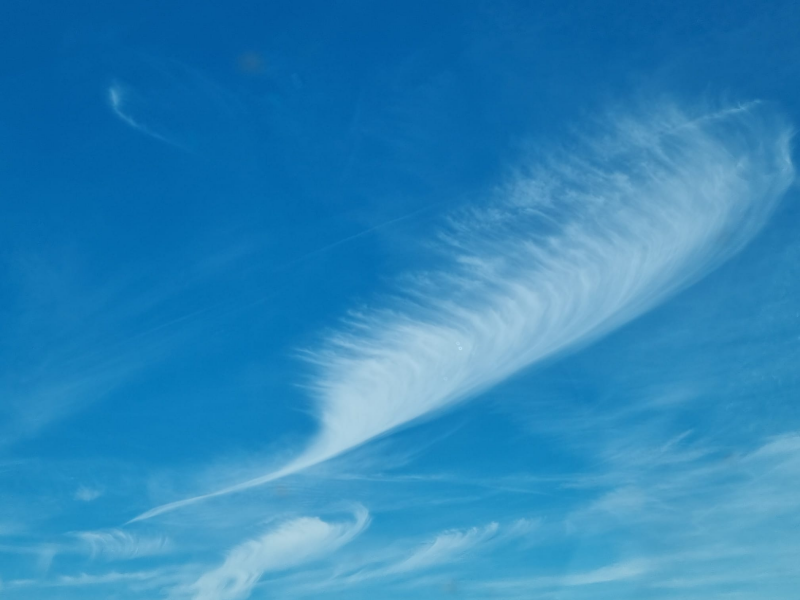
The sky writes.
Empty time.
Another thought that immediately opens many doors. What does air or sky actually stand for? Breath? Then it represents life itself. The air signs of the zodiac? Thinking, communication, freedom. Even the animated series Avatar came to mind, which my youngest children and I loved and still do.
In Avatar, air represents freedom. The Air Nomads try not to become entangled in worldly concerns. Inner peace and freedom form the foundation of their way of life. That is why they are pacifists who seek to value all life. Beautiful thoughts, associations and memories to carry with me as we began our cycling trip.
Once again, it was a joy to explore an area I did not know. This time it felt like a wealthier region in a very literal sense. The houses were perfectly maintained, the gardens immaculate and even the farmland looked carefully tended. What creates such a difference? A regional character? More wealth? Strong social cohesion? I do not know.
Along the way we came across an architecturally beautiful church. Despite its heavy brickwork, it seemed to dissolve into the sky. As if the building were being lifted by something invisible. Truly enchanting to see it standing there.
Then I saw another field filled with lilac and yellow flowers. The same image that had stayed in my mind since yesterday. As if it had been preserved somewhere in the sky and had appeared again today. The lilac seemed to spread across the land like a soft mist, while the yellow flowers shone through it like tiny points of light. As if someone had scattered stars
The sky on earth.
Breath is everywhere.
Freedom lives and moves within me.
And the sky writes.

Empty Time
June 17, 2026
Do you allow yourself empty time?
I saw that question on the cover of a magazine.
What is empty time?
I briefly skimmed through the article. What I gathered is that it is time that has not been planned or filled. No schedule. How do you deal with that?
Apparently, many people do not know what empty time is. When I think about it, I often hear people who no longer work and technically do not have to do anything say, “I have no time, I have so much to do.” That always surprises me because I have far more empty time than planned time.
In the article, the writer asks: How do you feel during empty time? What goes on inside you? Do you become bored? Do you feel uncomfortable?
Okay, so how do I deal with it when I do have plans? Standing in a traffic jam, for example?
I have never minded being stuck in traffic. It is simply beyond my control. In fact, it gives me a little moment of rest. Turn on some music, open the window and enjoy the scenery that you would normally rush past.
Standing in line at a checkout?
Usually, I am perfectly calm. I often even let people who seem to be in a hurry go ahead of me.
What happens when the car suddenly stalls in the middle of the road and refuses to start again? That is currently a regular occurrence with our car. I know it will eventually start, so I patiently wait while Ton works his magic.
Today we were on our way to spend the afternoon cycling. First, we needed to charge the car. People knew where the charging stations were, but due to construction work they were out of service. Bad luck. So I opened my app and we started looking for alternatives.
We drove through narrow streets trying to find our way back. At one point, Ton almost entered a one-way street. He noticed it in time and stopped to reverse. Then an older woman started shouting.
“No! No! You can’t go in there!”
She came marching towards our car, still shouting. Ton tried to explain that we understood. At that exact moment, the engine died again.
There we were, right in the middle of the street.
Cars coming from the one-way road could barely get around us.
The woman kept shouting.
Ton calmly got out of the car to explain what was happening. Meanwhile, I was getting increasingly irritated. Loudly, she informed her neighbour that we had tried to drive the wrong way down the street. Blah, blah, blah.
Is this a moment of peace?
Not exactly.
I knew everything would be fine. That was not the problem.
It was her relentless voice that got on my nerves.
Fortunately, the car eventually started again.
Pffft.
Off we went.
I began dramatically cursing about the woman and completely let myself go. Ton thought I was overreacting and tried to calm me down.
Secretly, I had to laugh.
Because I was doing something I had learned from Michel.
After an unpleasant encounter, Michel could express his frustration in great detail. I always thought it was exaggerated and sometimes even felt embarrassed by it.
He would say:
“You need to learn this too. Nobody gets hurt by it. Giving your frustration or anger a little room is healthy, Netje.”
While he was alive, I never did that. I was always the one telling him to calm down.
And now I do it myself.
In its own way, that is also a form of surrendering to the moment.
No, it is not exactly ZEN.
But it does feel good.
Eventually, we found a charging station that worked immediately. We have had very different experiences with that in the past. We unloaded the bicycles and the route I had prepared at home could finally begin.
The only sound was the navigation voice occasionally saying:
“You are approaching junction 63. Continue towards 60.”
Apart from that, there was silence.
We cycled past meadows, farmland, rivers, lakes and small villages. The atmosphere in this region feels warm and down-to-earth. There are few perfectly styled houses or farms. Just lots and lots of flowers.
This time, especially yellow and lilac.
The combination inspired me.
Yellow represents the intellectual and life-affirming energy of the sun. Lilac carries something calm and spiritual.
Yes, I could literally feel both the earth and the cosmos.
We took photographs of several flowers so I could look them up later. I am simply curious by nature.
For kilometres we cycled through open countryside without seeing a single house. I looked at Ton and noticed that he was enjoying the empty time too.
A magical moment of sharing empty time together.
In the distance we suddenly spotted enormous fields covered with what looked like white flowers or cotton balls. Curious, we cycled closer.
They turned out to be poppy fields.
Beautiful, of course.
I do not know exactly why they are cultivated on such a large scale.
Let us hope it is for medicine.
Eventually, we cycled back to the old fortified town where we had something to eat at the harbour.
It is funny how full empty time can become. Free from stress, yet filled with life.
Perhaps empty time is not the absence of something.
Perhaps it is the space in which life is allowed to fill itself.
With irritation, wonder, flowers, memories, love and an unexpectedly beautiful afternoon together.
Mother
June 16, 2026
I receive a message from one of my daughters. A personal story. I respond with a few open questions. All of my children are independent spirits who find their own way in life. I no longer feel the need to tell them what they should or should not do. Perhaps if they asked me directly. Although, even then, probably not.
My final sentence, after asking a few questions that I believe allow her to find her own direction, is:
"A question has the right to exist. It creates movement. Once there is an answer, things become fixed again."
Her simple "Thnx" makes me happy.
Those are the moments when I am grateful to be a mother.
A little later, my youngest son calls. He regularly phones just to hear my voice and have a chat. He is the only one of my five children who does that in this way.
There is something light about him that always makes the sun seem to shine. His name literally means enlightening, or one who brings the sun. He carries that quality within him. You simply feel happier in his presence.
The most beautiful thing is that he does not realise it himself.
My other son sends me a message asking whether I know of a certain medication that is now being used for people with MS. Could it perhaps be something for me?
He can be a little awkward when it comes to showing affection, but it touches me that these are the kinds of things he thinks about.
From my eldest daughter I receive a beautiful photo of my granddaughter.
Apparently, the theme of this day is my children giving and receiving a little attention with their mother.
These are special days for me, the days when I get to feel like a mother again.
My life exists separately from my children. They do not live nearby. I have always encouraged them to find their own path. I never expected them to stay close to me simply because I am their mother.
However, I did raise them with the idea that I will never move into a nursing home. I will remain independent for as long as possible, but eventually I expect to spend my final years with my children.
Perhaps one year with one child, the next year with another.
That would mean they only have their mother living with them once every five years.
Hahaha.
It sounds funny, but there is a serious undertone to it as well.
My youngest son recently told me that he has already prepared his girlfriend for that possibility.
He is adorably serious about things like that.
Somewhere in the conversation he also mentioned that he is thinking about moving to the South of France.
“Wonderful,” was my response.
He knows that ideas like that do not bother me at all.
My daughter added:
“Mum, there’s a house for sale across the street.”
Without many words, they still keep me close to their lives.
How beautiful is that?
Perhaps love is not always found in grand conversations or special occasions.
Sometimes it lives in a text message, a phone call, a photograph, or a casual remark about a house across the street.
Small things that quietly say: I’m thinking of you. And sometimes, that is more than enough.
As It Is
June 15, 2026
I notice that the subject that appeared in various forms throughout my day makes me somewhat reluctant to write. Not because I want to deny it. Not because I want to forget it. Rather because, despite how alive it felt today, it is important to me not to look at it with melancholy or sadness.
At the gym there was only one woman whom I had seen before. The centre was otherwise empty. There were no therapists or trainers around. We started talking about why we exercise and how it makes us feel.
She told me she was a widow and had chosen to keep moving forward. Not to deny her grief, but to continue living her own life.
I understood that all too well.
I also know someone who sits at home with the curtains closed and seems unable to move beyond the sadness. That was never my way. Fortunately, we do not all have to be the same. This fellow gym-goer seemed, like me, determined to actively embrace life again.
Back home I continued painting until I suddenly became very tired. I sat down on my bed and put on a romantic film. Usually I fall asleep when I watch television in bed, but this time I did not.
In the film, the father of two teenagers had died of cancer. Years later, the mother realised that she had not really been there for her children because she had been consumed by her own grief.
That hit me.
I am certain that I was not there for my children in the way they needed me to be. At the same time, I no longer remember exactly who I was or what I did, just like the mother in the film.
To see that the children had not only lost their father, but had also lost the attention and presence of their mother, was painful. It touched me because I feel that something similar happened in our family.
In the film, the mother eventually dies as well. The now-adult children can no longer share their anger and frustration with her. Fortunately, she had told her story to someone else, so her children could still hear it.
Either way, they will ultimately have to find their own way through it.
My youngest daughter wants no contact with me because I am a great disappointment to her.
Watching this film, I realised for perhaps the first time how deep that disappointment must have been for my children.
Unfortunately, you can only work through something like that together if both people continue to believe in the love that exists between them. Only then can there be room for communication.
I hope that one day she will understand that I was not a perfect mother, but that I love her to the very core of my being.
After dinner I thought, now I am going to watch a Dutch comedy with two actors I really enjoy.
And it was good.
Good enough to invite Ton to join me.
He watched the first twenty minutes that I had already seen, and then we continued together.
The story was once again about a father with cancer. His son wants to take one last trip with him. Along the way all kinds of funny and recognisable things happen.
Yet the father dies during the journey.
The son finishes the trip in a way his father would have wanted.
He feels the loss and realises how unfortunate it is that he never did something like this with his old man before.
That touched me too.
Children grow into lives of their own. Thankfully so. They become busy. Quality time with their parents is no longer something that happens naturally. That is unfortunate, but also understandable.
So, quite unintentionally, the entire day revolved around the theme of death.
Yet that is not what stays with me most.
What I want now is simply to enjoy life as it is.
Not as it could have been.
Perhaps life does not become lighter because sorrow, loss or disappointment disappear.
Perhaps it becomes lighter when we stop comparing the present to a past that can no longer be changed.
When we learn to see what is there, instead of what should have been. Life as it is.
Thunderclouds
June 14, 2026
I think the metaphor of seeing thoughts as clouds is probably the best way to look at them. There are beautiful light clouds filled with cheerful ideas and images. There are also dark clouds carrying sadness or even unpleasant thoughts. Clouds can simply drift by. Not every thought needs to be analysed or acted upon.
I think this is the next thing I really want to work on. Especially learning to let the darker thunderclouds pass.
Family remains one of my biggest triggers. Certain things can instantly bring me back to painful moments. It happened again today. I know exactly which thundercloud passed through. I do not want to dwell on it, but my body seems to have its own opinion.
What can I do differently? Fight the feeling? I do not think so. Letting my body grieve and allowing the feeling to slowly fade seems far more natural.
For years I kept asking myself the same questions: Why do they behave like that? Is there something I can do to make them change? Those questions never brought me peace. They only made the pain deeper.
So this is where I begin. Not asking those questions anymore. Accepting that things are as they are. Letting my body cry. Trusting that it will pass.
I went cycling and once again found joy in the waterways filled with yellow water lilies. There were far more flowers than last year. More poppies too. Not only hydrangeas and rosehip bushes, but all kinds of flowering shrubs and borders. I even looked up the name of one shrub I keep seeing everywhere: Japanese spirea. There seem to be many more of those planted this year as well.
The birds, the chicks, the croaking frogs trying to attract a mate—it was all there today. Cloudy skies, strong winds and hardly anyone on the roads.
It was wonderful.
When I came home, my body was apparently not finished crying. Painting seemed like a good distraction, but Ton wanted to watch the World Cup. Not exactly the atmosphere I needed for painting, so I chose a new romantic series instead.
When I say that my body is crying, I do not mean tears running down my cheeks. It feels more like a wave of shock or nausea. Neither description is entirely accurate, but both come close.
Around my heart something seems to tighten. A quiet pain.
I used to think my body was refusing to let me forget. Now I wonder if that is not true at all. Perhaps I am allowed to forget. Perhaps the pain simply never had the chance to move freely.
So I let my body feel what it feels, without giving it meaning. I breathe deeply in and out. That is what I can be for my pain.
No name. No explanation. Just breath.
Perhaps healing is not the disappearance of the thundercloud,
but learning that I do not have to chase it away.
I can simply watch it pass while I keep breathing, and life quietly continues.
Watching Clumsy Moments with Love
June 13, 2026
Today, after our workout, we drove to Veldhoven to attend my granddaughter’s dance performance at the theatre.
This always gives me mixed feelings.
I want to be present and show interest in my grandchildren’s hobbies. But honestly, I find it a complete ordeal.
Of course, I used to attend my own children’s tournaments and performances as well. It came with the territory. But it was never my hobby.
I especially disliked theatre performances. Children often speak too fast, do not articulate clearly, and when they finally speak loudly enough, they can still be difficult to understand.
Dance performances make me restless in a different way. I immediately notice who is a beat too early or too late. I see who is moving from within themselves and who is mainly trying to reproduce the learned steps while secretly checking whether the child next to them is doing the same thing.
I find that very tiring to watch.
Only when it is my own child or grandchild do I watch all that stumbling and fumbling with love in my heart.
That is rather hypocritical, isn’t it?
But honestly, sitting through three hours of other people’s children stumbling through a performance is quite a challenge for me.
Today I found myself thinking about my two youngest children when they were little and taking dance lessons together. They once performed as little gnomes carrying sticks with knapsacks tied to them.
My son stood on the far left of the stage and my daughter on the far right. There must have been twenty tiny gnomes running around.
While dancing, my daughter’s knapsack fell off her stick.
My son saw it happen. Without hesitation, he ran across the entire stage, picked it up and tried to return it to her.
The whole audience burst out laughing.
My daughter continued dancing without missing a beat, with a look on her face that clearly said: The show must go on.
I still remember how annoyed she looked while her brother chased after her with the knapsack.
During today's performance, I whispered to my eldest daughter:
“Do you remember that?”
“Yes,” she replied. “I was thinking about exactly the same thing.”
We watched three hours of performances by all the groups from the dance and theatre school my granddaughter attends. I found the theatre part exhausting and caught myself almost falling asleep a few times.
The youngest children, on the other hand, were absolutely delightful to watch. You could already see their personalities shining through. One was intensely serious, another clearly felt like a princess, and yet another was so enthusiastic that half the choreography disappeared along the way. They stepped left when they were supposed to go right, turned the wrong way and forgot half their moves.
But they were adorable.
Perhaps because everything still came from within.
As children grow older and become more concerned with doing things correctly, I find it much harder to watch.
I know.
I am being a grump.
They are children.
Just enjoy it.
I admit that is not always easy for me.
But when I see my granddaughter’s face, I am happy that I went. She is glad that Grandma and Grandpa came to watch.
For that, I am more than willing to sit through three hours.
And while I sat there, memories of my own children’s performances came flooding back. All four of them. Back then it felt just as mixed as it does now: pride combined with a small form of endurance.
But the memory that remains is mostly beautiful, loving and worth a smile.
While watching the children, I realised that I am not moved by technique or perfectly executed steps. It is the little ones, moving in every direction, who catch my attention. As if they are still dancing from something uniquely their own. From a sense of wonder.
Perhaps, if I were a dance teacher, I would spend an entire season helping children feel the music before ever teaching them a single step.
Because what moves from within stays alive.
What is only taught sometimes loses a little of its own voice.
Perhaps my way of looking has not changed, but my way of feeling has. The difference between being a mother and being a grandmother now.
The Roots We Share
June 12, 2026
This morning I saw a trailer for a romantic comedy. A young woman caught her boyfriend cheating. It lasted only a few seconds, but suddenly an old memory surfaced.
In the early days of Michel and me, something happened that now sounds almost unbelievable. In the middle of the night, I woke up because someone had entered our bedroom. It turned out to be his ex. Apparently, she still had a key to the front door.
What happened next was so absurd that at first I thought I was dreaming.
Lying next to Michel, I decided to do nothing. Not out of fear, but because I refused to be drawn into the chaos. This was my house. My bed. My life. I felt no desire whatsoever to fight over something that was already mine.
I stayed where I was and pretended to be asleep. In the end, that turned out to be far more effective than any argument could have been. The situation escalated not because of me, but because of her. She became increasingly angry because I was not reacting the way she expected. Eventually, she shouted that I had to leave.
I remember calmly replying:
“I think you are mistaken. This is my house. Perhaps you have the wrong address.”
More shouting followed. Then she left.
When everything had become quiet again, I turned towards Michel.
“I have to get up early tomorrow,” I said. “But this is the first and last time something like this happens. Tomorrow there will be a new lock on the front door.”
As far as I was concerned, that was the end of it. Not because what had happened was normal. Quite the opposite.
But some situations are so bizarre that only afterwards do you realise that the greatest victory is not found in what you say or do, but in refusing to be swept away by someone else's madness.
With a smile about this ridiculous memory, I returned to my painting.
I received a message from my sister-in-law telling me that my brother had been admitted to a rehabilitation centre. Ton and I decided to visit him after dinner so we would avoid the traffic.
My brother has Parkinson’s disease, diabetes, and recently underwent surgery on his foot after malignant cells were discovered there. The whole situation surrounding that foot has become complicated. He can do very little and lies there alone in his room. A small, vulnerable man. It hurts me to see him like that.
He has never been good at communicating or talking about his feelings. Now that hardly seems relevant anymore.
There were four children in our family. All four of us carry our own scars from the way we were raised. My sister and I became aware of that many years ago and have spent years working on it. My brothers have not.
The youngest at least talks. He likes to complain and in doing so releases some of his frustration. But this brother, the oldest, has always been quiet. Not good at making contact. Not good at expressing what lives inside him.
And there he lies. At an age when he should really be enjoying his later years.
The only thing I feel is that I love him. Even though we have never really been close. Even though we have never had real conversations.
We share the same roots.
That is enough.
When I get home, I call my sister to tell her how I found him. At least, how I see him. Because neither of us truly knows what is going on inside him.
Does he find this unbearable? Or not at all? Does he still enjoy life? Does he see a future? Does he want to rehabilitate? Or has he given up?
Are these questions he asks himself?
Or are they actually questions that I would ask myself?
Is it even necessary to give meaning to his way of being?
Perhaps I search for too much meaning sometimes.
I do not know.
But seeing such a fragile piece of humanity affects me deeply.
Perhaps love is not always found in conversations, understanding or closeness.
Sometimes love simply lives in recognising the same roots.
In knowing that someone belongs to your story, even when you never learned to speak each other’s language.
The Brush and the Paint
June 11, 2026
After doing absolutely nothing for a day, I continued working on my painting today.
It is difficult to explain, but I have no thoughts at all when I am painting. I am the brush, I am the paint. There is only that one small section of the canvas in which I have disappeared.
Whatever the brush is going to do, it takes an unknown path every second.
My body starts to feel hungry, creating a little distance. That distance allows me to see the larger whole rather than just the path of the brush. While I eat, my eyes remain fixed on what has emerged so far. It is as if I remain inside the body of the creation itself, moving from the cellular level to, briefly, the organ.
Once I have eaten and had something to drink, I stroke my little dog beside me and return to the cellular level.
I feel warmth, not cold. I hear nothing. As observant as I normally am, when I am painting, everything escapes my attention.
When I dream, I experience the emotions that pass through the dream. I can even take on different perspectives and communicate with them. But when I paint, even that disappears. I go deeper. I literally become the brush and the paint. It breathes me. It is me, with all my imperfections and with my inner voice.
After spending another eight hours working, I decided to stop after dinner.
Returning to the world.
Seeing that outside it is raining and windy. The leaves on the trees have taken on an almost luminous aura in this light. As if they are smiling, happy with the water that allows them to breathe again.
My little dog has been lying beside me all those hours like a silent shadow. He stretches himself as if to say:
“Okay, boss, are we done now? Are we going to do something else?”
My husband turns on the television to watch the opening of the Football World Cup in Mexico.
We watch a show with dancers, music and Shakira. I look at the colourful costumes of the dancers and think how fresh and beautiful they are. Bright colours that, to my eye, are remarkably tasteful. They represent a kind of passion that I deeply appreciate.
After watching part of the opening ceremony, I look for a film on my laptop to relax. Watching football is not really my thing.
I choose the Dutch film Adios Amigos.
The film follows three disabled friends: Lars, Philip and Joost. Every week they meet at the swimming pool, where they openly admire all the beautiful girls in bikinis. Together they plan a trip to sunny Salou in search of their first sexual experience.
Of course, things turn out differently.
What touches me most is the way each of them deals with disability in a different manner. The anger. The fear. The resignation.
I recognise something of myself in all three of them.
And then there are those golden moments when you no longer notice or are aware of your disability. Those moments are so healing. Almost restorative.
For me, that is creating.
Perhaps freedom is not the absence of limitations,
but those rare moments when they disappear from your awareness.
When there is only colour, movement, breath and presence.
As if life, for just a moment, stops resisting and simply happens.
Murphy’s Law
June 9, 2026
Once again there was a quiet and calm group of people at the gym today, allowing me to focus almost thoughtlessly on the machines I was working on.
At the Seated Row machine I sit with my chest against a soft support pad while only my arms pull the weight away from me and back again. Ever since I started, this has actually been the heaviest machine for me.
While paying attention to my breathing, a little cloud from more than thirty years ago suddenly drifts by.
I think about my foster daughter, who had only just moved into her own flat together with several students. Her group of friends consisted mostly of rather serious, somewhat dull young people. She invited me to her birthday party.
Of course I said yes, but honestly, I was not exactly looking forward to it. An evening of dullness.
That same week I had to run an errand in town. I no longer remember exactly what for. A very cheerful young man helped me there with enormous enthusiasm.
And suddenly an idea was born in my head.
I asked him how old he was and whether he had a girlfriend. He turned out to be two years older than my daughter and single.
I told him that I would actually love to give him to my daughter as a birthday present.
Hahaha… the boy thought it was a fantastic idea.
He gave me his address and fortunately still lived with his parents, who thankfully also saw the humour in it while I wrapped their son inside a duvet cover decorated with huge ribbons. Afterwards he had to hop half-blindly toward my car.
I laughed so much with that boy.
At the birthday party my daughter’s friends stood there looking completely serious. Honestly, there was barely even a smile to be seen. Luckily my daughter did laugh. She was used to my strange antics.
Now, all these years later, I suddenly start laughing again while the entire scene casually drifts back into my mind during my workout.
Funny, isn’t it, how something like that suddenly resurfaces? I had practically forgotten all about it.
I used to be mischievous. I loved doing challenging and unexpected things. Shaking up what was considered “normal.”
That was an Annette who formed a large part of me for many years.
And this morning I suddenly found myself smiling warmly at that memory.
Back home I continued painting. Ton was away, my little dog was lying on the chair beside me, and painting felt almost meditative.
Meanwhile my cardiologist called to say that my cholesterol values had improved, but not enough yet. She is now prescribing injections and we made another appointment for three months from now.
By now it has become clear to her that, apart from this cholesterol issue, I am actually very fit and healthy. Because of that, my weight is no longer really a concern for her either. There are no clear indications explaining why my cholesterol continues to behave this way.
There is honestly not much more I can do than what I am already doing.
Mostly I am relieved that this is now also clear to my cardiologist. Hopefully this endless medical fuss will calm down for a while after this.
Shortly afterwards a friend from the South of France called me. She and her husband spend about half the year travelling through Europe in a camper van.
She has already been away for almost two months and will return to the Netherlands in about three weeks. According to her, they had never experienced so much bad luck before. Problems with the camper, the dog, her own health… one story after another.
I said:
“But can you really still call that a holiday? It’s simply your life. You spend half the year living in that camper and constantly moving around. Of course things sometimes go wrong. Everybody experiences Murphy’s Law at home once in a while too.”
Yes… that did help pull her out of her “everything is going wrong” story for a moment.
It is unfortunate when things go wrong, but it is also simply part of life.
“And how are you feeling yourself?” she asked afterwards.
Well… honestly, I feel good.
I seem to have found a certain discipline for both body and mind. I listen to myself, do what needs to be done and then feel whether there is room for more or not.
No more guilt. No more shame when something does not work out or when I have to say “no.”
Perhaps that is exactly the beauty of growing older.
I must do nothing.
I need nothing.
I may, if I can.
Perhaps peace is not the same as a life without problems.
Perhaps peace only begins when you stop constantly pushing yourself beyond your own limits in order to meet expectations.
As if growing older slowly means you no longer have to prove yourself, but are finally allowed to simply inhabit yourself.
Four Colours
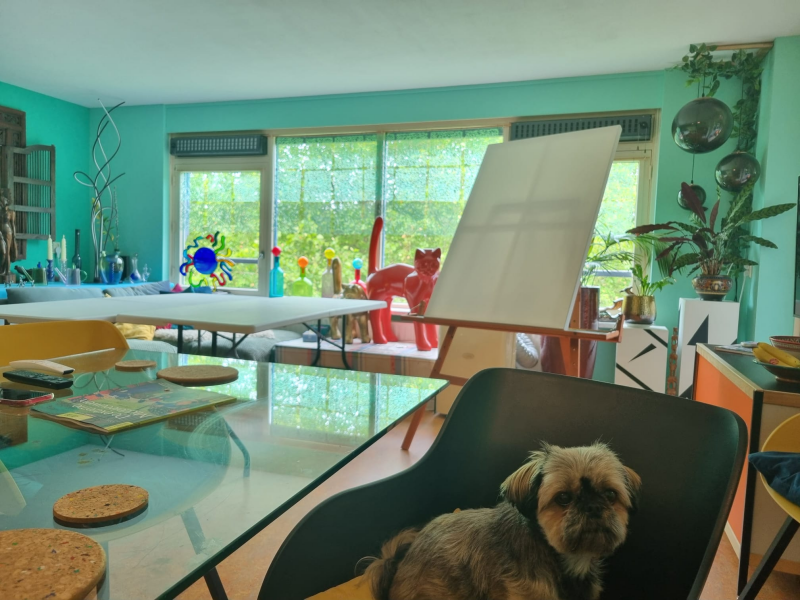
June 8, 2026
The living room has once again been transformed into a studio. The colours and the doodle have been placed onto the canvas and now it is simply a matter of watching what my hands will create.
For weeks I have been seeing four colours in my mind’s eye, and the number four keeps presenting itself as well. That is what is currently alive inside me, and that is what I will work with.
This colour combination is not something I normally associate with myself. It had to become a 3D canvas measuring 80 cm x 120 cm, which fortunately I already had at home.
The colours burgundy, cream, baby blue and apple green open up a new perspective, a new feeling. The moment the doodle appears on the canvas in these four colours, I suddenly understand why this combination satisfies me so deeply. It makes me happy.
The baby blue brings air and softness. The green shows vitality and growth. The cream brings rest, breath and the silence that connects. And that burgundy-pink keeps everything grounded, physical and warm.
During these first steps I suddenly realise why the number four feels so important for this painting.
The Angel Number is 4.
According to angel numerology, repeatedly seeing the sequence 444 is a sign that your guardian angels are close to you. A confirmation that you are on the right path and that your efforts will be rewarded.
As I have mentioned before, I talk to my angels. Perhaps it is imaginary or even nonsense, but it feels good to me and gives me a sense of trust.
Whenever I paint, I always feel that the colours and whatever appears on the canvas are trying to tell me something. Just like my dreams do. Of course I do not always know exactly what it means, but I do take seriously the thoughts that enter during the process.
The number four could also have represented the elements, the cardinal directions or the seasons. But that was not what quietly slipped in. It was the angels.
Apparently that is the atmosphere I am moving through right now.
Sometimes a painting can speak to me in a completely different way years later. It almost moves along with who I am and with the phase of life I am in.
It remains an adventure to see what appears. Which symbols slowly find their way inside. What they mean to me now.
Not only is the use of colour new, but my entire approach is changing as well.
Today I painted for about eight hours, but around ten o’clock tonight I consciously stopped. No more obsessively continuing day and night in a creative flow, only to end up with a beautiful creation and a completely exhausted body.
From now on, Annette will handle this more wisely.
Perhaps growing older is not about losing the fire,
but learning how to carry it without burning yourself up.
As if creativity slowly stops demanding exhaustion,
and instead asks for rhythm, breath and trust that it will still be waiting for me tomorrow.
Wonderfully Lazy
June 7, 2026
How wonderful it can be to be unapologetically lazy, simply because I feel like it.
Today I truly did absolutely nothing. Instead of watching series, I spent the entire day doing crossword puzzles. Fifty-nine in total. I think I’ve had enough now.
In between, I did spend a little time preparing for a new painting. I already found the canvas, and I have cleared some space in the living room for a workspace.
Colours and the beginning of an idea are moving around inside my head. I still have no idea what it will become exactly. Usually it starts as nothing more than a small point somewhere quietly present in my mind. Gradually it reveals itself to me what it actually wants to become.
Ton already knows how that process works. During those periods I am more or less absent. Physically present, of course, but completely absorbed in my own world.
“Oh, that works out perfectly,” he said happily. “Because the Football World Cup starts at the end of this week.”
Hahaha… he genuinely looked relieved. A few weeks of disappearing into his own football bubble without guilt, while I dissolve into paint, colours and thoughts.
Of course, I will keep training and cycling every day whenever the weather is reasonable to good. I also promised myself to go to bed on time and not work day and night without stopping. Trusting that the flow remains there and can simply be picked up again whenever I sit back down in front of my canvas.
Like today, there is actually not much to tell. Solving crossword puzzles did not leave my thoughts enough room to wander off into all kinds of associations.
Still, I already feel that this will become a large project.
So it remains to be seen whether enough thoughts will emerge during the creative process to keep writing about them here.
But usually my mind eventually finds another hidden doorway somewhere.
Perhaps creativity does not begin with knowing, but with making space. An empty canvas. A table moved aside. An afternoon without guilt. As if something deep inside first needs silence before it dares to become visible.
Masks and Hidden Rooms
June 6, 2026
When the gym is quiet, I usually work out in full focus while all kinds of thoughts drift through my mind. Just like my dream from last night.
In the past there were people I would immediately avoid. It could be for all sorts of reasons: too sloppy, too neat, too conventional… you name it. But at a young age I discovered that what you see on the outside can be completely different on the inside. So I learned not to judge a book by its cover.
People who appeared to be free spirits sometimes turned out to be extremely conservative, while very settled families — house, tree, pet and all — could possess a depth and level of self-reflection that genuinely surprised me.
Those were the clouds drifting through my mind while training.
Interesting… that dream opened memories again, but also a message: first get to know someone before rejecting them. Every human being carries hidden sides, talents and visions. That became the conclusion of my wandering thoughts.
At home the television was on in the background. I was not really listening because I was busy doing other things. Then suddenly I heard someone say:
“A person’s true nature lies in the light of their secrets.”
Well… apparently the theme was hanging in the air.
And perhaps there is some truth in that. Don’t we all wear different masks? A mask to be loved? To be approved of? To be socially accepted?
So many reasons why people behave the way they do.
For me it is obvious that with Ton, family, my children, friends or the cashier at the supermarket, I am always Annette — but each time in a slightly different role. A different social approach, you could say.
I do not even think it happens consciously. Only when you start observing and analysing yourself do you realise that human beings naturally do this.
So if I want to come closer to my true nature, perhaps looking at my secrets is not such a strange idea after all. The things you do not share with the outside world, but which quietly stir inside you, are often the most sensitive and vulnerable parts.
Hmmm… there may actually be something in that sentence.
Or maybe it is complete nonsense, who knows. Still, interesting enough to pause and think about.
An hour later I heard another quote on television:
“He should look forward, not backward.”
Well… that sounds wise. But is it really?
First of all, I believe this very moment already contains enough movement and emotion. And what that eternal NOW truly means remains difficult to explain.
But alright, if we think in a more horizontal way for a moment: is looking ahead really better than looking back?
Personally, I think knowing where you come from is incredibly important. Knowing where your roots lie. From experience I know that not truly understanding your origins can create a kind of missing link inside your identity.
After my stroke, many emotions from the past resurfaced. In the end, they gave me insight.
Who do I want to be now?
What can I let go of?
The past is like a puzzle that partly shapes who you have become. If pieces are missing, perhaps you carry something inside you that you cannot name, but still deeply feel.
And looking ahead? Is that better? Does it mean setting goals?
Isn’t the real goal perhaps the journey itself? Seeing what crosses your path? Not fixing everything in place? Allowing yourself wishes, but remaining flexible?
Maybe that is the healthiest way to look ahead.
“What serious thoughts all day long,” I suddenly realise.
I put my earbuds in and go watch comedians on YouTube. Time to laugh for a while.
And then it happens again.
A world-famous comedian tells an up-and-coming performer:
“Of all the comedians I know, I’ve learned that humour often comes from a dark place. You turned a black page into something positive by making humour out of it.”
Wow… that really hit me.
Michel used to say that he had never laughed as much with anyone as he did with me. According to him, I said something funny or absurd almost every single day.
Looking back now, I suddenly realise that I often used humour to break through the tension he constantly carried inside himself.
Now that I am with Ton, I am nowhere near as humorous as I used to be. Some time ago I even wondered whether I had become duller or more serious.
But perhaps it is something entirely different.
Perhaps I simply no longer need the clown mask.
The jokes I make now are just because something is genuinely funny — not because I need to mask tension anymore.
OOOOh wow.
Perhaps some masks disappear not because we become worse,
but because we finally begin to feel safer.
As if the body slowly understands that it no longer has to protect,
entertain or laugh away tension all the time.
Maybe beneath all those roles, something very simple remains:
a human being who is finally allowed to just be.
The Absurdity of Life
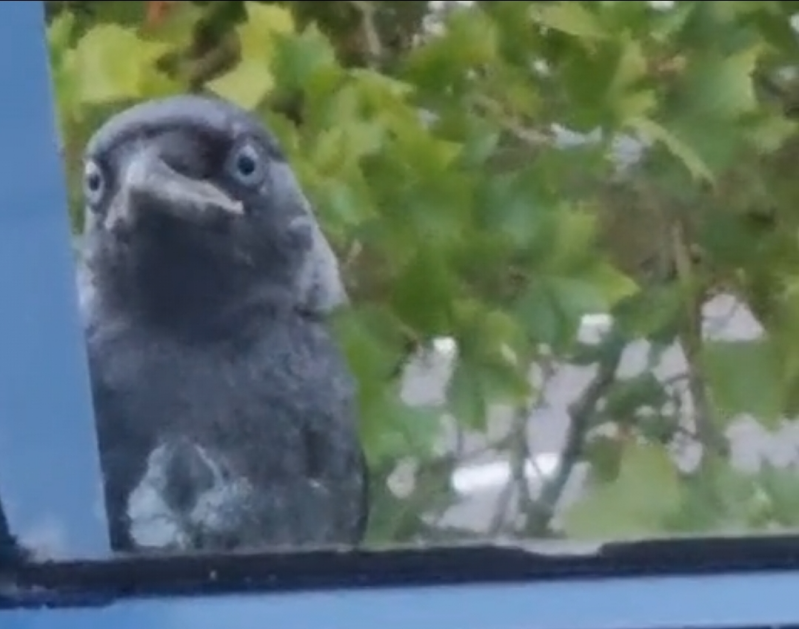
June 5, 2026
Last night I was sitting on my bed watching television when I suddenly heard an enormous commotion. My bed is less than fifty centimeters away from a large window. Directly below my window is a canal, and on the other side stands a row of enormous plane trees. I can almost touch the tops of the leaves.
About five crows were fighting and nearly flew straight into the window. One even tapped the glass before shooting back into the crown of the tree at full speed. They were trying to chase away a jackdaw that then remained sitting in front of my window, making sounds as if he were calling me. My little dog Puck started barking furiously at him, but he did not seem afraid at all. He kept looking at me as though he felt safe there.
Some time ago those same crows were behaving just as unpleasantly toward a jackdaw, and back then I interfered. Could this be the same one I rescued then?
I actually wanted to let him inside, but Ton was not too enthusiastic about that idea. So he sat in front of my window for at least half an hour, chatting away while continuing to look at me. I hope he comes to visit again someday.
I woke up after a dream about blood cells. Human beings can have such strange dreams. While writing it down on my dreams page, a story Michel once told me suddenly came back to mind. He once told me that in his younger years he had used LSD and driven from Dordrecht to Amsterdam with friends. That experience had always stayed vivid in his memory.
Behind the wheel, the LSD suddenly kicked in. Slowly the highways transformed into veins. The cars became white and red blood cells. Everything moved and breathed. The car itself seemed to be pumped toward the heart. The aqueduct near Schiphol felt like a heart valve.
Michel could describe his trips in such a vivid, painterly way. He said that during the drive he no longer saw roads, cars or surroundings, only veins, blood vessels, cells and the heart. And yet… when he came back to himself, he had somehow arrived safely in Amsterdam.
I myself have never used drugs. Maybe I am too responsible or too well-behaved for that. Or perhaps I already live enough inside a world of imagination by nature. I do not need drugs to associate — my brain practically invented it on its own.
Then my youngest son called. He had been having a discussion with his girlfriend about babies.
“Oh dear,” I immediately thought. “Am I becoming a grandmother?”
No, fortunately not. Pfffft.
He wanted to know whether we ever used to go next door or run errands while taking a baby monitor with us.
First of all, we did not even own a baby monitor. The babies slept beside me in our bedroom and I never left them alone. Not even for a second. The first time they ever slept somewhere else overnight was when they were around five years old and stayed with my sister.
My son had also called his oldest sister to ask how things used to be in our family. She told him exactly the same thing: we always took the children with us everywhere.
“Okay,” he said, satisfied. “That’s what I wanted to know.”
Then he hung up to call his girlfriend back.
Of course, that conversation brought back all kinds of memories. When my oldest daughter was only a few months old, my grandparents celebrated their fiftieth wedding anniversary with a dinner party. An aunt and uncle were supposed to babysit her for the evening.
I found it horrible.
Once we were seated in the restaurant, I started crying thick tears within minutes because I wanted to return to my baby as quickly as possible. No, especially when they were that small, leaving them was simply not an option for me.
Just remembering it made tears fill my eyes again. As down-to-earth as I can sometimes be, I am apparently equally capable of being a complete softie.
After the phone call we checked the weather radar, planned a cycling route and went for a ride. It was wonderful.
Everything has suddenly become so lush and overgrown. You can barely see the canals anymore because of the abundance of waterside plants. The flower borders are full of wildflowers, noticeably more than last year. You can tell there is a more conscious environmental policy now.
No rain, just a blue sky filled with white, grey and nearly black clouds. Beautiful.
Halfway through, we always sit down on a bench for a while to enjoy everything around us.
Then I heard nearby:
“Coo-roo, coo-roo.”
I started laughing and told Ton that I once had a pigeon I named Roekie.
When I once went on holiday, my mother was supposed to take care of her. After a week I called home to ask how things were going and of course immediately asked about my little pigeon.
My mother answered somewhat hesitantly:
“Well… she’s not doing too well.”
I panicked immediately.
“What’s wrong with her, Mum?”
“Well… she died.”
I instantly felt that shock and pain in my heart.
“How did that happen?”
And then my mother said completely seriously:
“Well… she fell off her little perch.”
She literally said that.
It was so absurd and slapstick-like that instead of crying, I burst out laughing.
Ton looked at me in disbelief and then started laughing too.
Dreams can be absurd. Drug trips can be absurd. Human behaviour can be absurd. Encounters with animals can be absurd. Life itself can be absurd.
And perhaps it is exactly that absurdity that creates a feeling of freedom. As if anything remains possible. As if life refuses to be completely trapped inside logic or rules.
Maybe that is precisely why life remains worth living.
Perhaps freedom does not lie in understanding life, but in daring to move along with its strange twists and turns. In laughing through tears. In a jackdaw at the window, a memory along the road, a sentence from a mother that is both painful and hilarious at the same time. As if life keeps whispering over and over again: look… everything moves, everything lives.
Songs That Keep Returning
June 4, 2026
Songs. Yesterday I wrote about songs that keep returning throughout my entire life. There are also songs that were part of my active mind for many years. Through life experience I have come to realize that certain things are said that simply stay with you and often only gain meaning years later. Or I see something that remains fixed in my mind’s eye. Usually it disappears only once it has revealed its meaning.
When I was younger, I always tried to search immediately for that meaning. By now I know it does not work that way. Time takes its own time. Sometimes hours, sometimes days, sometimes years.
During my yoga period I learned that patience and discipline may be among the most difficult virtues for human beings. Shuni mudra: the thumb touching the tip of the middle finger, the hands resting on the legs with the palms facing upward in a receiving position. In philosophy, that finger is connected to the planet Saturn. My zodiac sign is Capricorn, so you could say I am a Saturnian person. A great deal of patience, endurance and perseverance.
But often the other side comes with it as well. When I do not feel well within myself, I can suddenly become extremely impatient and give up very abruptly. For example, ending a relationship from one second to the next. In the past this caused major sudden changes, with all the misery that came with them.
My medal simply carries -1000 opposite +1000.
Actually, while writing this, I realize for the very first time that my sudden actions may simply be the other side of that same medal. I had never looked at it that way before. Writing down my feelings and experiences truly works in a healing way when it comes to understanding my conditioned character and behavior.
Hahaha… I am sitting here behind my laptop genuinely amazed. Really wonderful.
Back to a song.
I still catch myself singing at certain moments:
“Again and again I convince myself
That I will receive that heaven promised to me
Again and again all the blue turns gray
And disappointed I stand outside in the cold
Yet once again I think, ‘There will be someone…
The one I’ll live only for, to whom I’ll give my heart’
With whom I will find what I am missing now
Love forever, time and time again.”
For a long time I searched for unconditional love, recognition and acknowledgment. My disappointment in that search was enormous. Even now I still find it painful that this seems to be so difficult, even for people who say they love you.
But then came Whitney Houston’s song: The Greatest Love of All.
My children must have sat hundreds of times in the back seat of the car while I blasted that song at full volume and sang along even louder, tears streaming down my face. The realization that ultimately I would have to find true love within myself.
Something that is much easier said than done.
Still, from that moment onward it became a movement I slowly started setting into motion.
And only now do I begin to notice that for the very first time I am becoming truly loving and gentle toward myself.
And honestly?
There is still a long road ahead.
Perhaps some songs keep returning throughout an entire lifetime because they touch something that has not yet been fully understood or fully lived through.
Perhaps what a person keeps singing ultimately reveals more about their deepest longings than a thousand analyses ever could.
And perhaps real love begins not when someone else fully understands us, but when we slowly dare to become gentler toward ourselves.
Red and Black Balloons
June 3, 2026
One famous comedian once said to another:
“You basically do the same thing I do, only I do it with red balloons and you do it with black balloons.”
“Yes,” I thought, “one makes humor about love, passion, celebration and the simple things that make life beautiful. The other makes humor about grief, sadness, struggle and the simple things that make life difficult and complicated.”
Both can deeply appeal to me when done well. Because in the end, people laugh. And laughter is liberating.
There is a song that was written in 1966 which I already sang as a very small child, simply because it sparked my imagination. Later in life it just kept returning to my mind over and over again. I do not want to exaggerate, but I think I silently sing it to myself at least once every two weeks. Or, when nobody is around, simply out loud.
It is a tragicomic story. With red and black balloons, but also with red and black flags. A story about love, sorrow, grief, betrayal, compassion, judgment, innocence and completely different perceptions.
The song was written and sung by a man who himself struggled with alcoholism and eventually died because of that addiction.
I want to place the song here as part of my story and my fascination with it that has now lasted almost sixty years. Perhaps it has touched me for so long because it is essentially a universal theme, told in a small, almost comical way.
Nobody on earth knows how it all began
The sorrowful story of the rebel and the nun
Of the rebel and the nun
One spring morning they happened to meet
They looked at each other and love became complete
Yes, love became complete
Passion is powerful, though often only brief
The nun forgot her duties and her rosary beads
She forgot her rosary beads
It’s understandable, it happens every day
The rebel was completely lost when he looked into her gaze
When he looked into her gaze
They walked through the park in the early springtime sun
And a hundred thousand kisses the rebel got from the nun
Got from the nun
A certain Miss Jansen was peeking through the pane
She could not believe her eyes, nearly driven insane
Nearly driven insane
A certain Mister Pieterman sat upon his balcony
Amazed beyond all reason at the nun’s spontaneity
At the nun’s spontaneity
“Long live love,” said Mister Pieterman gallantly
But Miss Jansen quickly phoned the local news agency
Yes, she phoned the local news agency
Everyone assumed that she had made it all up
So they called the chaplain and reported the nun
Yes, they reported the nun
“Look,” said the chaplain, “this is clearly devil’s play
The moment I’m not watching, he leads the church astray
He leads the church astray”
“In matters such as these,” he said, “I’m hard as stone
I’ll send the police right to the roof of the nun”
Of the rebel and the nun
Thanks to Miss Jansen and the chaplain’s holy plan
The police eventually put an end to their romance
Yes, they put an end to their romance
The nun and the rebel both ended with a fine
The rebel got a kick, the nun lost her peace of mind
Yes, she lost her peace of mind
Because they simply dared to walk upon the grass
And the police declared that such behavior could not pass
That the grass was not to pass
Not for any reason, but simply because they could
The love between the rebel and the nun came to an end for good
Of the rebel and the nun
According to Aristotle, a kiss weighs almost none
According to the chaplain, that is completely wrong
If you ask me… it all sounds rather odd.
Whether it was written completely sober or with pink elephants floating around really does not matter to me. In a humorous way it tells us exactly how human beings are. Even in all their good intentions.
What feels right to one person feels wrong to another.
And vice versa.
We all move through life from within our own personal truth.
Perhaps this song fascinated me even as a child because intuitively I already sensed how complicated people truly are. How love, judgment, compassion, interference and morality constantly become entangled with one another.
Tomorrow I want to explore further why this particular song has kept returning to my mind for almost sixty years. Do I use it to put situations into perspective? Does it soften something inside me? Or do I simply recognize the absurdity of human existence within it?
And there is another song that I have hummed and sung throughout my entire life as well.
Writing every day and looking back at my own thoughts, memories and associations gives me remarkable peace and insight.
Those recurring songs probably tell a story too.
Perhaps some songs stay with a person for an entire lifetime because they touch something older than words.
Perhaps we sometimes recognize ourselves more deeply in rhythms, images and stories than in explanations.
And perhaps the songs a person keeps singing ultimately reveal what deep inside still longs to be heard.
Dancing in the Rain
June 2, 2026
This morning the sky was cloudy, even somewhat dark. A light rain was falling, yet the air felt warm outside. While walking to my car, I suddenly thought about the heavy summer rains in Yugoslavia, where as a child I happily danced through the downpour while everyone else preferred to stay dry indoors.
At the gym it was quiet. Still rather stuffy too. The air conditioning blew icy cold air into my neck, which I don’t particularly enjoy either. Earlier this week I heard on the radio that the global temperature rises on average by 0.2 degrees per year, and specifically in the Netherlands even by 0.4 degrees. While hanging onto the weights, my thoughts began to wander further.
Hmm… would that mean that summer rainstorms here will eventually become more intense as well? And that heavier storms will keep increasing? It’s not that I truly understand all of that scientifically, but somehow it seems logical to me.
On the drive home we see dark clouds approaching. The sound of the radio slowly reaches me. A conversation with a meteorologist. The entire Netherlands is under a yellow weather warning; heavy rainfall and strong wind gusts are expected. The interviewer asks whether this is connected to climate change. A long explanation follows about warmer air holding more moisture and therefore releasing far heavier rainfall in a shorter amount of time.
“Sounds logical enough,” I say to Ton. “I was just philosophizing about that a little while ago.”
And as always, my mind immediately starts wandering further.
Climate change also seems to go hand in hand with changes in human behavior. Less respect. Bigger differences that people no longer seem willing or able to bridge. Aging populations. There are still many people now, but in another generation the world will probably already look very different.
We often think in small, closed frameworks, but can’t we see our lives as part of something much larger? Existential. Universal. Perhaps my reflections are not merely metaphors, but maybe they also point toward a direction.
Back home I completely collapse again. That heavy atmosphere in the air exhausts me. I sleep for more than two hours and only wake up once the sky outside has literally turned dark gray. Rain is pouring from the heavens.
I love it.
I open the window and smell the fresh wet air. I hear the rain hammering against the asphalt. The large trees in front of my window swing their bright green branches wildly in the attack of wind and pouring rain.
My sister calls and tells me she fell with her mobility scooter. The only thing she thought about at that moment was whether her little dog might get hurt. She herself has a large wound on her leg and is covered in bruises. From now on she will probably drive a little slower uphill while taking corners.
Today she also attended the cremation of a friend. A man who had always loved dancing salsa with great joy. She had hoped that something of that spirit would be reflected during the funeral, but she experienced the whole thing as somewhat alienating.
During such a conversation, all kinds of different funerals pass through my mind.
How does someone actually want to be mourned?
With tears?
With laughter?
Or perhaps with both, because maybe they are part of the same coin?
Do you mainly want to share the intense sadness?
Or rather celebrate someone’s life?
All of it is possible.
For me, dancing in the rain comes closest to my feeling about life, love, grief and death.
Perhaps nature constantly tries to show us that everything moves, changes, disappears and begins again.
Perhaps rain, grief, love and relief are far less separated from each other than we often think.
And perhaps dancing in the rain resembles life itself for that very reason — vulnerable, temporary, wet, uncontrolled… and yet wonderfully alive.
Names in the Landscape
June 1, 2026
After another terribly painful night, I still wake up feeling surprisingly cheerful. Somehow I am really looking forward to the day. On my cycling junction app I created a thirty-kilometer route through the forests around Ede. The weather is lovely — not too warm, not too cold. Perfect cycling weather, you could say.
We cycle almost entirely through forests, heathlands, barley fields and onion fields. What especially stands out are the purple rhododendrons we see absolutely everywhere. In gardens they are neatly trimmed, but in the wild they grow into enormous shrubs three or four meters high. The houses we pass are gigantic, and remarkably large parts of the land and forests are privately owned.
The only village we really cycle through is Lunteren. Ah… Lunteren. That name feels very familiar to me. But why? A school camp perhaps? Or that psychiatric clinic in the middle of the woods where my brother once stayed? I honestly do not know exactly, but Lunteren feels strangely familiar.
I notice a car company called Koudijs with a huge electronic sign displaying the date and temperature: 27 degrees. Those kinds of details never escape me.
We stop at a terrace with an enormous Statue of Liberty in front as an attraction. Inside we are welcomed by two life-sized Blues Brothers statues. Instantly I am taken back to my dating years with Michel. We danced to their music so many times together. The whole place is decorated in American 1950s and 1960s style. My thoughts drift again to my time with the father of my oldest daughter. We used to wander around everywhere looking for authentic items from that era.
All of it passes through me quietly.
I do not talk about it.
After a wonderful ride we eventually return to the van to load the bicycles. But then… the van refuses to start. Calmly I wait while Ton tries to get the thing running again. After about fifteen minutes it finally works. Miraculously, I manage to hold on to the pleasant atmosphere of the morning ride.
We decide to drive home with the TomTom set to “avoid highways.” It is wonderful how you slowly travel from the Veluwe into the Betuwe through back roads, watching the landscape gradually change.
We talk for a while about the piece I wrote about Hans Dorrestijn. Ton keeps being amazed by how literally I still remember so many things.
“Well,” I say, “I connect associations to many words, which gives them multiple layers of meaning and therefore makes them easier to remember. I do not do that consciously by the way — it simply happens automatically in my brain.”
Ton says he knows that already, yet he still finds it astonishing every single time.
By now it is almost half past two and my stomach starts growling loudly. I check Google Maps on my phone, search for restaurants and see that we need to turn right in three hundred meters. Ton immediately listens. At moments like that, that is really nice. Within minutes we arrive at a lovely place beside water, a beach and nature all around it: Woody’s Beachclub. Friendly staff and the feeling of being at the seaside right in the middle of the Betuwe.
Afterwards we continue our route and end up on a dike. One of those high, steep dikes where you have to pass each other slowly while both vehicles slightly sink off the asphalt.
Terrible.
Normally I prefer driving myself, but with that van I cannot. I have to completely surrender to Ton’s driving skills. That is not easy for me at all. When I am on vacation I often cannot go to the toilet properly. These days are no exception. Slowly my chest tightens and eventually I literally have to clench my buttocks from fear.
Pfffft… thankfully we finally get off that dike.
To calm my screaming body again, I try to breathe slowly and deeply while focusing intensely on what I see outside. Then I notice a wind turbine named The Graceful Swan. Then another one: The White Lady. And another: The Red Deer.
That is unusual, I think.
Three turbines standing side by side named after a bird, a lady, and a deer. What is the connection? Why these names specifically? I decide I will look it up once I get home.
At home my first stop is the smallest room in the house — even before greeting the dogs. Although they do greet me enthusiastically in there. Afterwards all attention goes to the dogs, and then I begin my investigation.
It turns out these turbines are quite well known and have even appeared in the news. Two of them have stopped operating because of technical problems and aging. Only The White Lady is still functioning. But that information alone is not enough for me.
Why exactly those names?
The Graceful Swan refers to the elegant appearance of the turbine. The White Lady turns out to be both an old technical term and a reference to a young woman. And The Red Deer refers to nature and the strength of the surrounding landscape.
Alright… now I understand that they are seen as individuals rather than simply three wind turbines standing next to each other.
But that little white lady…
I keep stumbling over that one for a while.
My thoughts start wandering off on their own and eventually end up with white witches, old legends and female spirit apparitions. Suddenly I think of Clara, Bianca and Alba from The House of the Spirits by Isabel Allende. Three names that all refer to whiteness, light or purity.
Whatever eventually happens to those three turbines in Culemborg… in my mind they will simply be called Clara, Bianca and Alba from now on.
So there you have it once again — what a busy life I lead while practically doing nothing at all…..
Perhaps a landscape is never just a landscape, but also a collection of memories, associations and feelings that quietly begin moving along with us.
Perhaps my mind is not consciously searching for meaning at all, but meaning simply appears once something captures my attention.
And perhaps creativity begins exactly at the moment ordinary things suddenly start telling their own stories back to us.
After the Rain Comes Dorrestijn
May 31, 2026
“When you are dead, you miss nothing.”
That was Hans Dorrestijn’s opening line during the final performance we attended today. The title of the afternoon was: After the Rain Comes Dorrestijn.
The question that immediately came to mind for me was:
do I actually want to miss life?
His dark humor and that peculiar monotone, crackling voice make everything simultaneously absurd, funny, and somehow also true. In his songs and poems he describes how miserable life can sometimes be, only to suddenly add a humorous twist to it again. And it is not always about major tragedies either, but often about very ordinary things. Like standing in line at the supermarket.
He spoke about his very first confrontation with death. The little chicks he had received as a child had accidentally been poisoned. And the next day they were simply lying there dead. Yes… and once something is dead, it does not come back.
That finality.
That irreversible ending.
He mentioned countless colleagues and acquaintances — well-known Dutch people to us — who had all already passed away. How death has actually played a role throughout his entire life. His depressions and suicide attempts that ultimately remained only attempts because, in the end, he could never truly go through with them.
Now he is eighty-five years old and seems to accept life — including death — much more.
He visited a natural burial ground and found a place beside a small tree where, at that exact moment, a tree pipit landed. Never before had he been able to observe one from so close nearby. A little later a second tree pipit landed beside it, and at that moment he knew:
this is where I want to be buried.
The woman who organized this afternoon works as a funeral director. She hopes people will speak more openly about death and their wishes while they are still alive. So grief does not arrive as such a raw shock once the moment finally comes.
According to her, death belongs to life, yet it still exists far too much within a sphere of taboo.
Even humor should be allowed to be part of it.
He also spoke about his angry stepfather. A terrible man of whom he mainly carried bad memories. One day, on his deathbed, the man asked whether Hans and his brother would come visit him.
So they thought:
“Maybe he finally wants to make peace.”
So they went…
…and afterwards he still lived another fifteen years.
Hans Dorrestijn wrote a song about it that had the entire room bursting into laughter:
If only Uncle Jan would die
His stubbornness is far too great
Uncle Jan just keeps surviving
Even if he’s slaughtered like a chicken or a rooster
Even if we roast him in a frying pan
He only seems to come back more alive
If only Uncle Jan would die
If only Uncle Jan would die
That lazy fool will live to a hundred
Even if we cut him open with scissors
Even if we smash a hammer on his head
The old bastard only perks up from it
I love this kind of honesty. Feelings that are simply allowed to exist without becoming overly dramatic or heavy. To me, that is an art form in itself.
Not declaring yourself holy.
Not pretending dark feelings do not exist.
But daring to face them, laugh about them, and transform them into art.
Today I truly felt privileged to witness this final encounter with such a remarkable human being.
I wish him many more years.
Peace.
Nature.
And many more tree pipits.
Perhaps death only becomes truly unbearable when people pretend it does not exist.
Perhaps humor sometimes helps us deal with life better than seriousness ever can.
And perhaps the art of living is not about avoiding darkness, but about continuing to look at it with open eyes — and sometimes even with a smile.
Bruised
May 30, 2026
This morning I went back to training again. At first it felt heavier than I had expected. Meanwhile the house has become a bit messy because with all this heat I simply had no energy to do anything. But today I finally made a plan and actually carried it out.
For the first time in quite a while, I notice creative ideas beginning to move through my mind again. Nothing concrete yet, but something is clearly starting to come alive.
Tomorrow we are going away for two days and my son will stay here to look after the dogs. It will be the first time someone has stayed in our house to do that. My children never lived here, so the habits and routines we have are unfamiliar to them.
Miss Organization is not my nickname for nothing, so of course I made a clear list of what to do and what not to do.
He will probably not even look at it, but for my own peace of mind it works perfectly.
At the same time, I notice that I am getting better at letting go when the house does not look perfectly clean and organized the way I would ideally want it to. Especially during moments when things are simply too much physically, I am slowly learning not to complain so much, but instead to appreciate everything Ton does do.
Because honestly: when my body does not feel good, grumbling can sometimes feel strangely satisfying.
It is unbelievable, but every single day I am still turning bluer. The bruising is really starting to spread now and everything mostly feels sore and bruised.
That in itself is also something interesting.
Ton often finds my descriptions of pain strange or difficult to understand. I do not experience bruised areas as pain exactly, but more as if that specific part of my body feels nauseous. How can a leg, a back, or a buttock feel nauseous?
And yet that is exactly the right word for the unpleasant sensation limiting me there.
The spot that truly hurts is right in the middle of my buttock, exactly where I fell. There is barely anything visible there, except for a hard lump.
In that sense, a body actually resembles life itself.
The real cause lies deep inside. Encapsulated, hardened, and often barely visible.
Elsewhere, however, it starts showing itself.
Like Ton having to endure my grumbling even though he is not the cause of it at all. He has simply become an important part of my existence. Almost an extension of myself.
So I turn blue… and he gets the rough version of me.
Poor thing… luckily we both understand by now that cause and effect rarely appear in the same place.
Now we are looking forward to our little trip. Just the two of us getting away for a bit. Escaping the malaise of the past two weeks for a while. Literally changing environments also helps recovery.
And I am almost certain my brain will start picking up all kinds of things along the way to process creatively.
The itch is returning again.
I think I may soon begin a new project.
Perhaps creative impulses arise precisely when a person slowly begins to feel space opening up within themselves again.
Perhaps body and emotions rarely reveal themselves exactly where the real cause lies.
And perhaps recovery is not only the healing of pain, but also the moment curiosity and the desire for life slowly begin to return.
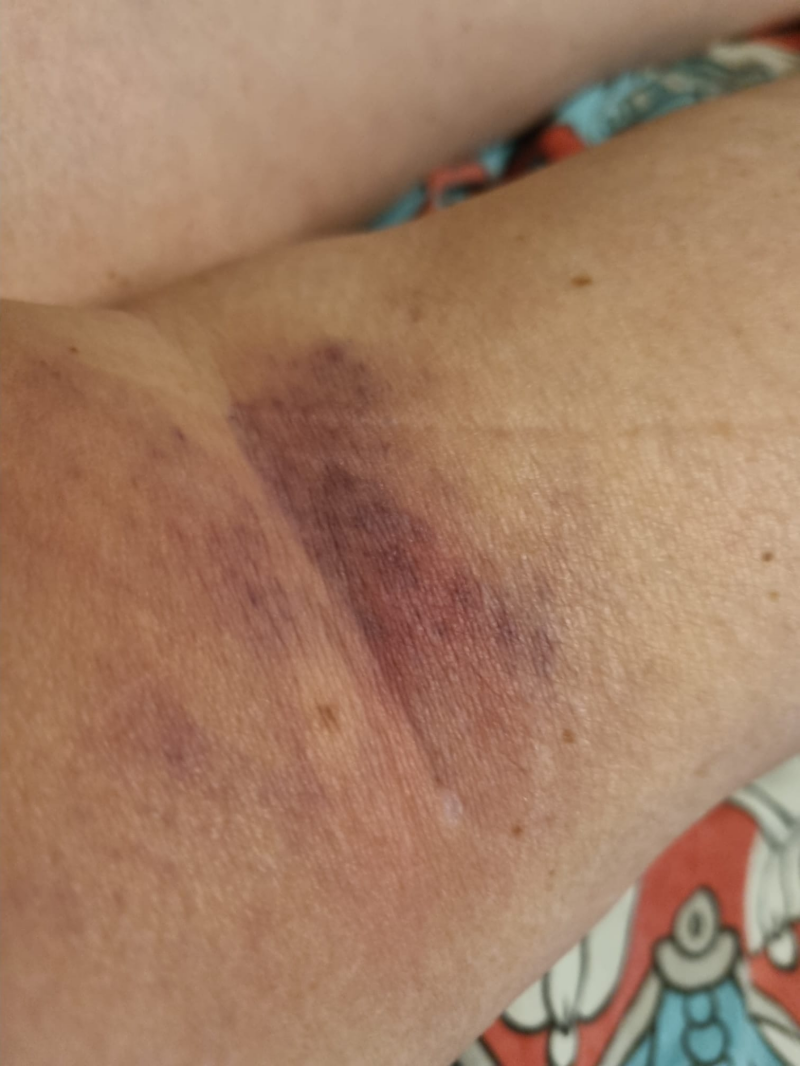
A Little Give and Take
May 29, 2026
Today I went to see my rehabilitation doctor. She was pleasantly surprised to see that I move more quickly now and that she only needed a small adjustment to realign my body again. My bruised back and leg will still need some time to heal, that is something the body simply has to resolve on its own. But overall she was very pleased with my condition and with the way I have been training.
She examined my entire body and was already finished after only a few corrections. In reality, that means my basic condition and muscle activation are better now than before I started this training process. Otherwise, such a hard fall would have disrupted my body far more deeply and for a much longer time.
And yes… she could clearly see that I have built more muscle.
As for my weight, according to her I should mainly read the book by Liesbeth van Rossum. She sees the whole lifestyle-clinic approach somewhat as a hype. In her opinion, my body is actually responding well to training and I am genuinely building functional strength. According to her, my body is clearly not only moving toward decline or compensation.
She had not seen me in half a year and was genuinely surprised by how much more smoothly and quickly I move now.
For me, that truly felt like the greatest encouragement of this week.
She is someone I deeply respect, both as a doctor and as a person.
She also explained how much influence stress, sleep, hormones, the nervous system, medication, temperature, chronic strain, and physical conditions can all have on weight and recovery. She made it very clear that, in her opinion, it is not simply caused by my lifestyle.
That gave me a strong feeling of recognition and validation.
The lifestyle clinic itself still has not contacted me, but I promised my cardiologist I would still try the program. And who knows, maybe I will indeed become wiser from it… though probably not lighter, hahaha.
As soon as I got home, I immediately ordered Liesbeth van Rossum’s book so I can already start reading it on my laptop.
What I perhaps felt most strongly today is that I am increasingly able to stay in control of myself while at the same time being open toward doctors and their ideas. That is actually an enormous shift within myself.
A little give and take improves the relationship with doctors, but ultimately also the relationship with myself, I think.
Because however I look at it: I do need doctors, especially now that I am getting older. After a lifetime without medication and without doctors, I now slowly have to accept that reality.
And honestly, that inner struggle about it may finally stop as well. That constant battle only makes everything more difficult.
Communication simply works better with kindness. People are also more willing to listen when I object to something or do not want something. Somewhere deep down, I always knew that already. But apparently there was also a thick layer of PTSD underneath it that immediately made me combative whenever I faced a doctor or specialist.
Am I now older and wiser?
Or did that stroke last year truly become a turning point in my life?
Today I am still covered in bruises and blue marks.
But at the same time, I am also a proud and satisfied human being.
Perhaps becoming stronger does not only mean physical recovery, but also learning to treat yourself and the people around you more gently.
Perhaps true strength is not found in constant resistance, but in the ability to remain open without losing yourself.
And perhaps trust does not arise because all fear disappears, but because a person slowly discovers that cooperation can sometimes feel safer than struggle.
Through Thick and Thin
May 28, 2026
A day of endurance.
It feels so strange that only now my body is becoming more blue, green, and purple. Only now do I truly feel as if I have been badly beaten up. Completely uncomfortable in my body, with a quiet sob lingering somewhere in the background, I decided once again to do absolutely nothing today.
My recovery score on my Fitbit also clearly showed that rest was probably the best solution.
Slowly the weather started getting warmer again and before I knew it, I had once more fallen into a deep sleep during the day. When I woke up, I was absolutely exhausted. I had to gather all my strength just to walk to the bathroom.
Meanwhile I see beautiful pictures passing by from friends and acquaintances. Lovely vacations, cozy outings, terraces, walks. And suddenly I realize that things like this will probably never again be completely effortless for me once the temperatures rise too much.
Although…
I have already asked a pharmacy about cooling vests.
And…
We even booked a little hotel for this weekend after seeing the weather would become cooler.
Hahaha… and now I see rain is being predicted after all, so that is just typical bad luck again.
Meanwhile Ton installed an air conditioner in my bedroom, which thankfully makes me feel a little better.
My little dog lies beside me all day long. She sleeps, occasionally reacts to a sound, and then peacefully falls asleep again. Every now and then she licks my feet for a moment before drifting back to sleep.
Whenever I get out of bed for a moment, she immediately walks along with me. And when I return, she quietly comes back too.
She is simply there.
Through thick and thin.
Once upon a time, I rescued her from a difficult living situation.
But sometimes I now wonder:
who is really rescuing whom?
Perhaps true loyalty is not found in grand words, but in quietly remaining beside someone.
Perhaps animals sometimes teach us better than people what unconditional presence truly means.
And perhaps love is ultimately not about solving things, but about simply staying when life becomes difficult.
Body Annette
May 27, 2026
Today I visited my brother in the hospital. He is lying there alone in a room. No view, except for a toilet bowl. An open wound on his foot, a catheter, a drain, and a body that has clearly become restless because of everything that is happening.
My brother has always been a healthy man. Athletic too. He did gymnastics, football, and badminton. Always agile, energetic, and balanced. And now he lies there with Parkinson’s disease and a condition in his foot that simply refuses to heal properly. His entire nervous system seems disturbed.
While he was lying there trembling, he suddenly said:
“I’m not nervous, you know.”
I had to laugh for a moment and immediately told him that I understood.
Then I asked him:
“Do you understand now why I always separated Annette from body Annette?”
And suddenly he could understand what I meant.
On the way home, that sentence kept circling through my mind. Once again I realized how strongly many people identify themselves with their bodies and appearance. Completely understandable, of course. Especially when your body has always functioned naturally and effortlessly. Then you are that strong body, that agility, that health.
For me, it has always been different.
Earlier in life, I truly experienced Annette and body Annette as two separate entities. Not because I rejected my body, but because my body never fully did what I internally felt or wanted. Because of that, a distinction developed early on between the one who observes, feels, thinks, and lives… and the body that had to carry all of that out.
And yet I have always taken body Annette very seriously. Not as an enemy, but as an instrument. A translator of what lives inside me. Through my body I sense atmosphere, tension, emotions, pain, love, authenticity, and unrest. My body often reacts before my thoughts do.
Perhaps that is also why I never fully identified with my physical functioning or appearance. Annette always felt larger than the body alone.
And yet I do live entirely through that body.
I find that rather remarkable myself now that I write it down.
Because perhaps I have always seen body Annette as a kind of life companion. Sometimes she cooperated, sometimes she did not. Sometimes I listened carefully, sometimes I became angry or frustrated. But there was always a form of collaboration between the two.
Now that I see my brother struggling with a body he no longer fully understands or trusts, I feel increasingly more empathy for people who have always been healthy and then suddenly become ill.
In the past I often thought:
“Well, then you simply adapt, don’t you?”
Or:
“Then you just find another way.”
I used to shrug my shoulders at it rather easily.
Now I am beginning to understand more and more how enormous the inner shock must be when a person suddenly realizes that their body no longer functions naturally.
Perhaps I am becoming softer.
Not only toward other people, but also toward myself.
Perhaps a human being does not consist only of a body, but also of the one who observes the body, tries to understand it, and learns to work together with it.
Perhaps true gentleness begins the moment we realize how vulnerable — and how extraordinary — that collaboration really is.
And perhaps wisdom does not begin by letting go of the body, but by learning to listen to what body and consciousness are trying to tell each other.
Severe Weather
May 26, 2026
Severe weather. When you look up the meaning of that phrase, it usually refers to extreme weather conditions such as storms, thunderstorms, and heavy rainfall. Well… I am actually someone who enjoys severe weather to a certain extent. Sitting safely indoors listening to the rain pouring down or the wind howling around the house. And afterwards that fresh air, as if life itself has become clear again.
Of course I am not talking about disasters like tornadoes or hurricanes, which can be truly frightening.
When I speak about severe weather, I mean heat.
As soon as the temperature rises above twenty-five degrees Celsius, my body starts struggling. At first I can still enjoy it a little, just like everyone else, but when the nights no longer cool down enough, my inner light slowly begins to fade. Today is already the third warm day in a row, even thirty-two degrees outside. The apartment is holding onto the heat from the previous days. Fortunately it is still cooler inside than outdoors, but my body noticeably slows down.
More than forty years ago I stopped going to specialists because I felt like a laboratory experiment. And honestly, back then that probably was partly true. At some point enough was enough. I became an expert on my own neurological condition and kept finding ways to deal with it myself.
Today it suddenly occurred to me that nowadays there may be much more knowledge available about CMT, and that perhaps useful information could be found online.
At the same time I thought:
“Well Netje… maybe this is actually another step toward acceptance.”
Perhaps all these years I believed I had fully accepted my condition, while my resistance toward outside expertise may have been telling a different story.
Apparently there is now even a CMT expertise center. Wow. On the website it says you can submit questions, except of course the required field refuses to work. Typical. Should I let something like that discourage me again? Or should I simply find another way to contact them?
I also read that there are cooling vests for people with MS. Maybe that could help me too.
A short explanation about heat and CMT unexpectedly comforts me. Recognition and confirmation apparently still feel reassuring.
High temperatures can worsen nerve signaling in people with CMT, resulting in increased muscle weakness, fatigue, and overheating. Because temperature regulation and sweating are often impaired as well, there is also a greater risk of heat exhaustion or unnoticed burns.
The explanation is much more extensive than this, but simply recognizing my own symptoms already reassures me.
Perhaps deep down I still sometimes feel like I am just complaining. That is what I actually mean by acceptance.
When Ton occasionally looks at me with a bit too much sympathy, I am usually not particularly pleasant, and he quickly retreats to the living room.
Summer has not even truly started yet, so hopefully I can prepare myself physically and mentally with a new spirit.
Who knows, maybe there are useful tips nowadays that can help me remain active without completely draining myself. Perhaps I can learn to regulate my mood better. That would be good. For myself, but also for the people closest to me — Ton in this case.
It just goes to show: a person is apparently never too old to learn.
I had to become sixty-three before actively searching for solutions that might help me get through summer without sitting indoors like a zombie.
Now that I write it all down like this, what I mainly feel is trust in myself.
Perhaps acceptance does not mean that a person stops searching, but rather that space begins to open for new help or insights.
Perhaps strength is not only found in continuing independently, but sometimes also in daring to acknowledge what remains difficult.
And perhaps trust is not the feeling that everything will become easy, but the realization that you are learning to understand yourself better and better along the way.
The Difference Between Life and Death
May 25, 2026
Hans Dorrestijn once said: “The difference between life and death is simply too great for me.”
Ton came across that quote in the newspaper. He found it so humorous that he immediately continued reading the entire article. Afterwards he asked how I would feel about going to a lecture and musical afternoon with Hans Dorrestijn next week.
Of course I would love that.
Hans Dorrestijn is a writer, cabaret performer, and also a birdwatcher. He has that wonderfully dark sense of humor which he delivers in his peculiar crackling voice, almost monotonously. It always makes me laugh. There is something wonderfully down-to-earth about him that I really appreciate. And the way he looks at birds is, in my opinion, absolutely beautiful.
“I used to be fun. Back then I wrote about alcohol and drunkenness, my unhappy marriage, sex and the lack of it,” Hans Dorrestijn writes in his Bird Guide. “Thank goodness all those horrors have now made way for something pleasant.”
That pleasant thing turned out to be birdwatching.
And luckily for us: writing about it too.
Dorrestijn’s Bird Guide is, as far as I am concerned, one of the funniest books about birds ever written. And educational as well.
I recognize that feeling somehow. That life once revolved around misery, sadness, depressive feelings, complications, and struggles. And that now, as I grow older, much of that slowly seems to lie behind me. That I can genuinely enjoy simple things: the dog looking at me with loyal eyes, nature, birds, and Ton surprising me with an outing like this.
Life is allowed to become simpler and simpler.
I often think about life and death myself. Both continue to fascinate me. I want to experience life in all its facets, yet at the same time I sometimes wonder why I am alive at all.
Death may be even more mysterious to me.
One moment you are still here. You worry about something or someone. You think, feel, move, speak, observe. And the next moment you are simply no longer here.
Where does life go then?
Somewhere I feel I am more than just this body. But what is it that makes me live inside this particular body? Is the moment of my passing already predetermined? Or is that nonsense? Am I actually afraid of death? Or not at all? Does the idea of dying become softer as a person grows older?
I honestly do not know.
Perhaps it is precisely that mystery that makes life so extraordinary.
For now, I am mostly curious about what the afternoon with Hans Dorrestijn next week will be like.
For me, there is ultimately only one thing in life that is truly certain: that we will die.
Perhaps it is precisely the finiteness of life that makes the small moments so valuable.
Perhaps growing older does not necessarily become lighter or easier, but it does become simpler in terms of what truly matters.
And perhaps a person does not need to fully understand the mystery of life and death in order to continue looking at it with wonder.
Fault Lines
May 24, 2026
It is a beautiful day, but after a night filled with discomfort in my body, I decided to stay home and do nothing today. Today I did not feel ninety years old, perhaps only eighty. An improvement, I would say. Rest after a day of cycling clearly does help.
My son called and told me he had met his in-laws. Born and raised in Marseille, they barely know what kind of country the Netherlands actually is. He noticed how little many French people know about other countries, let alone the rest of the world. I recognize that. All over the world, geography and history lessons often remain limited to a conditioned worldview shaped by one’s own country. In a way, everyone is formed — or perhaps even brainwashed — by the information absorbed through school, media, and culture.
Meanwhile, Ton was watching a program about the history of slavery and how deeply the Netherlands was involved in it. A horrifying history, of course. And yet I felt resistance to focusing on it in that moment. I am not entirely sure why. The strange thing is that my stomach literally turns when I think about it.
Apparently, I strongly want to live in the present. And right now, these kinds of terrible things are still happening in the world. Despite everything we see through the media, I am certain we only know a fraction of the inhuman things currently happening on this planet.
That is where I want to place my attention. Not on anger toward the past.
It is difficult to explain without hurting someone.
After that, I watched the documentary series Earth Storm. It explains natural disasters on both a geological and historical level. Fascinating how scientists show that an earthquake in America around the year 1700 affected a tsunami in Japan during that same period. How the fault lines of the earth’s tectonic plates are connected worldwide. They also recognize patterns and intervals between major earthquakes that can vary from four hundred and twenty to twelve hundred years.
It is virtually certain that major disasters will happen again. Perhaps tomorrow, perhaps in a hundred years, but the fact that they will happen is undeniable. The same applies to volcanoes and the six supervolcanoes on Earth, including Campi Flegrei in Italy.
Scientists say: as long as the Earth has existed, these forces have existed too.
So the question is not if it will happen again, but when.
I see human life as part of that same nature. As far as I can tell, people have hurt one another for as long as humanity has existed. Often simply because someone is different or unknown. I am not happy about that at all. In fact, in the times we are living in now, everything seems magnified on every level.
The conversation about this with Ton suddenly made me sad. I think in the end we meant the same thing, but we used different words, which caused us to misunderstand each other for a moment.
And that between two people who love each other.
Perhaps human beings carry invisible fault lines within themselves, just like the Earth does.
Perhaps many conflicts do not arise because people feel something entirely different, but because they give different language to the same fear, pain, or concern.
And perhaps understanding begins not with being right, but with realizing how fragile communication truly is — even between people who love each other.
A Thought on Pentecost
Perhaps humanity is not meant to transcend its nature entirely, but rather to become conscious of that nature.
For as long as the Earth has existed, there have been storms, fault lines, volcanoes, and collisions. And for as long as humanity has existed, there has been fear, love, struggle, connection, rejection, and longing.
Yet there also seems to be something within human beings that wants to observe itself. Something that does not only want to react from instinct, but wants to understand, to feel, and to choose consciously.
Perhaps that is what consciousness truly means.
Or — on a day like Pentecost — what is meant by the outpouring of the Holy Spirit.
Not as something supernatural outside of human beings, but as the moment a person becomes aware of their own inner world.
Of the fault lines.
Of love.
Of fear.
Of the connection with everything around them.
Perhaps true growth does not lie in denying our nature, but in learning to carry it consciously.
And perhaps real freedom only begins when a person no longer has to fight against themselves.
Invisible Threads
May 23, 2026
The first real summer day. Thirty degrees Celsius, shorts on, and apparently half of the Netherlands is out cycling during this Pentecost weekend. Naturally, so are we.
A blouse I bought a few years ago finally fits me for the first time. Back then I thought it was far too nice to return, and I was completely convinced I would not stay overweight forever. Wow… that really is an uplifting way to start the day.
Sun visor on, sunscreen applied, lightly dressed, we set off. Taking it easy. The breeze was just strong enough to keep the heat comfortable.
We cycle along the top of a dike where below us stands the tree stump with that enormous fungus I photographed yesterday. From a distance it suddenly looked like an octopus. An animal that symbolizes adaptability, transformation, emotional intelligence, and the subconscious. Because of its qualities, the octopus is often seen as a powerful spirit guide that helps you move resiliently through complex or changing situations.
I continue cycling with a smile because every now and then I really do think I am a slightly strange person with all these associative thoughts.
What stands out now are the fields full of buttercups mixed with purple clover everywhere. Also many wild daisies. The sheep are searching for shade beneath the trees. Everywhere there are groups of people walking with professional equipment: water bottles, sporty clothes, and probably healthy snack bars. Along the route I notice small red plastic signs and realize there is some kind of walking event taking place.
Naturally I ask the walkers about it while cycling past them. Indeed, people from various walking clubs are doing a twenty-five-kilometer route today. I wish them luck and happily continue cycling, enjoying all the greenery, flowers, sheep, birds, and the buzzing of insects.
Then I see a woman walking toward us with a dog. She looks angry or worried, at the very least tense. The moment I cycle past her, I suddenly feel a small shock.
This is a sister of mine.
I know her, but we have never really been introduced to one another. We simply recognize each other and know of each other’s existence.
It occupied my mind for at least ten minutes. Until I literally shook my head and suddenly realized I had stopped taking in my surroundings completely. I could only see her face in front of me.
I tell Ton that the woman with the dog we just passed is a sister of mine. Ton does not quite know how to react. Mostly, he finds it bizarre.
“Yes,” I say, “I still have four sisters and a brother.”
He looks at me as if he is seeing water burn. And suddenly I think: when I get home, I will look online and see if I can find anything about them.
After that we continue cycling along a route we have never taken before. My goodness… the Netherlands really does have such beautiful places.
Meanwhile my right buttock also starts hurting. I fell on my left side, so it is obvious that I have unconsciously been overloading the right side. Ouch… fortunately along the way we come across a café where we stop for a while so my legs and hips can rest a little. Afterwards I consciously try to sit evenly on my saddle again instead of protecting one side all the time.
Once home I am tired. I lie down comfortably on the bed with my laptop and some cold water. Then suddenly I remember that sister again and decide to search online after all.
I find all four of them.
One sister teaches yoga. One is involved in local politics. One participates in environmental protests. And one is extremely athletic and competes in cycling and triathlons.
Then I see a photo of one sister’s husband.
Oh my goodness…
That man once came to our house to buy one of my paintings.
Hahaha… what a small world this can be sometimes.
Through Facebook I also discover that all my sisters share mutual friends with me. I do not know whether they truly know who I am. I think they are aware of my existence, but not really of who I am as a person.
And yet I suddenly discover something remarkable: despite all the secrets in which I was raised, invisible threads had quietly been woven all along.
This is the first time I have ever actually searched for them online. It turned out to be surprisingly simple. Now I have names and faces.
What will I do with that?
Nothing.
Do I want to do anything with it?
No.
Life has simply unfolded differently until now. There is nothing wrong with that.
Perhaps today I simply saw a few extra puzzle pieces fall into place.
Perhaps there are far more invisible threads connecting people than we realize.
Perhaps lives continue touching each other, even when they never truly come together.
And perhaps understanding is not always about changing something, but sometimes simply about finally seeing how the puzzle truly fits together.
Life on Dead Wood
May 22, 2026
After another bad night, with lots of turning, groaning, and moaning from the pain, I decided to go cycling anyway. At least to run a few necessary errands and then see whether I wanted to continue. Suddenly you feel exactly how your buttocks move on a saddle when you turn a corner or have to cycle up a small slope. Oh my God… that was quite something, trying to keep moving as painlessly as possible. At first it was almost nauseating, but eventually it worked out. Only when getting off the bike was I reminded again and again of that intense injury to my buttock.
In the shop, my buttock started throbbing like crazy. I experience that as a local spasm. In the past I would have twisted myself into all kinds of positions out of fear that someone might see my buttocks moving. Now I was actually glad something was happening. It probably simply has to do with recovery. And really, what does it matter if someone were to notice?
The weather was beautifully sunny, twenty-five degrees, so I decided to continue cycling and enjoy movement, fresh air, and sunshine. Ton makes sure it does not turn into an enormous ride.
Because of the bad weather and illness, we had hardly cycled for a few weeks. Suddenly the yellow irises along the water, poppies, and marsh marigolds were in full bloom. It is surprising how quickly that happens. So cheerful too, seeing flowers appear everywhere again. Every summer we pass a farm that sells wild flowers from their own picking garden. We brought home the first bunches of the year again.
Along the way I saw a dead piece of tree by the roadside with an enormous shiny, almost living-looking fungus growing on it. So beautiful to see how nature cleans itself up and how new life literally emerges from something dead. The cycle of life, simply visible on a botanical level.
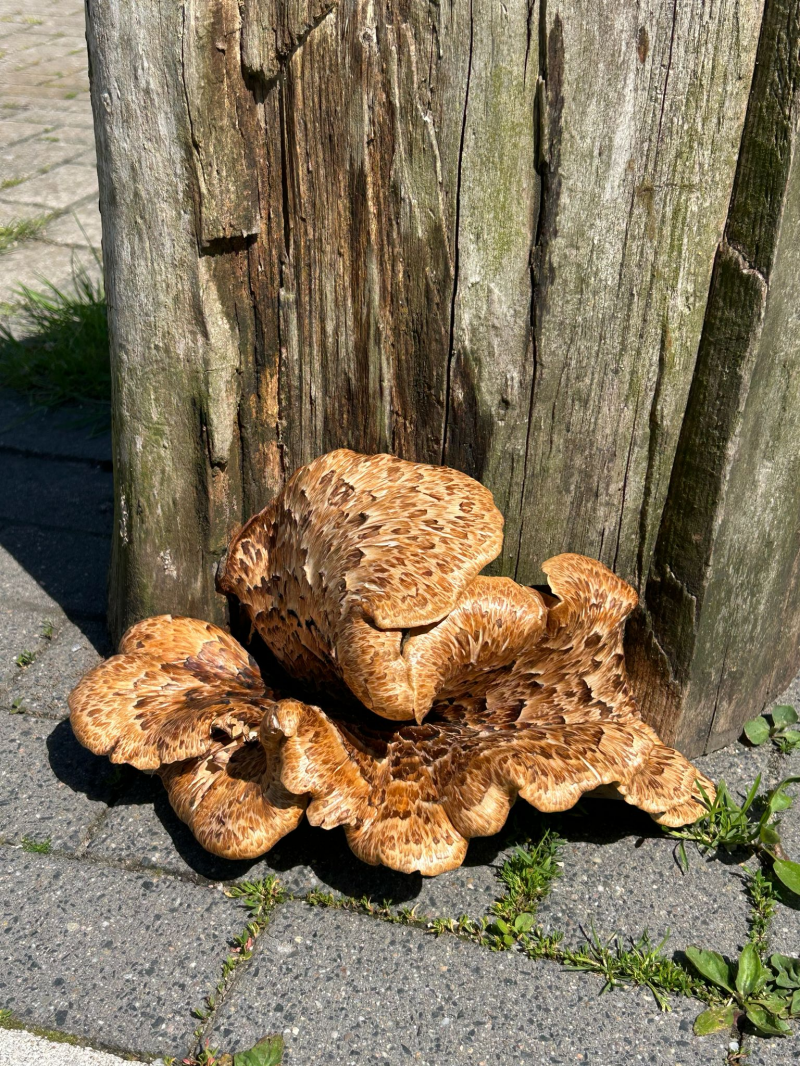
Yet I also immediately saw a bird of prey in it.
My thoughts then run off with me straight away. What might the spiritual meaning of a bird of prey be, I wonder. In spirituality, a bird of prey often symbolizes clairvoyance, freedom, and overview. Because of their sharp vision and high flight, they are seen as messengers that encourage you to look at situations from a distance and remain true to your own direction.
I simply cannot help seeing forms everywhere that immediately touch something in me. In plants, trees, clouds… you name it. When I instantly recognize something in a shape, it feels as though it is telling me something in that moment. In fact, I do the same with my surroundings as I do with my paintings: I let them speak to me. In nature, I constantly find associations. In numbers and figures too, by the way, but that is not relevant right now.
Once home, we wanted to put our bicycles back in their place. Then an unknown man, apparently visiting someone in our building, started acting quite unpleasantly because we were putting our bicycles there. I was upset about that for at least half an hour. Discomfort in my body makes me emotionally less steady, I notice. That has actually always been the case, only nowadays I am much more aware of it.
Let me put it this way: in the past, emotion would have completely taken control of me in such a moment. Now I am aware of both my body and my emotions, and I seem to be increasingly able to look at them as a kind of outsider and guide the emotion. That outsider is what I call “the self.”
Once I had returned to myself a little, I finally took my well-deserved rest. Still quite proud that, despite everything, I cycled for two and a half hours.
Perhaps nature constantly shows us that life and decay are not opposites, but part of the same movement.
Perhaps shapes, colors, and symbols mainly tell us something about what already wants to be touched inside us.
And perhaps recovery is not only found in becoming stronger, but also in learning to observe more consciously what happens within ourselves.
Softened
May 21, 2026
Probably because of the pain and discomfort today, I am not depressed, but I do find myself easily moved.
I wished my former daughter-in-law a happy birthday today. I have not seen her for years, yet she was part of a turbulent period in which we experienced both great love and great sadness within the family. There are former partners of my children I never think about anymore or feel any connection with, but even though we no longer see each other, she still has and keeps a place in my heart.
Yesterday my hip and leg felt like a stiff plank, fortunately that is no longer the case today. The pain is still quite intense though, and one side of my hip still feels as hard as stone. I woke up early this morning and carefully tried walking around the house a little. That worked. Sitting in my wheelchair on my right side also went reasonably well. After about an hour, I wanted to sit comfortably on the bed and watch a series for a while.
Then something happened that I do not really recognize in myself.
I wanted to open my laptop, but I completely collapsed, both literally and figuratively. Ton quickly helped me lie down as comfortably as possible again, and I was gone. Only a few hours later did I wake up.
Because I train daily, I notice that my body now reacts very differently to recovery. The stiffness disappearing this quickly is completely new to me. And then that sudden collapse into sleep — bam — simply impossible to resist, also new. It may sound unpleasant, but I actually see it as improvement. I will probably always get injured from time to time, that much is clear by now. But perhaps months of recovery are no longer necessary because of the fitness I have built up.
Eventually I feel well enough to watch a simple romcom in bed. Nothing too complicated, just not having to think too much for a while.
Then suddenly a poem by E. E. Cummings appears in the film:
“I carry your heart with me (I carry it in
my heart) I am never without it.
Anywhere I go, you go, my dear.
I fear no fate
(for you are my fate, my sweet) I want
no world
(for beautiful you are my world, my true)
And you are whatever a moon has always meant
and whatever a sun will always sing, you are.
Here is the deepest secret nobody knows.
(here is the root of the root and the bud of the bud
and the sky of the sky of a tree called life; which grows
higher than soul can hope or mind can hide)
And this is the wonder that keeps the stars apart.
I carry your heart
(I carry it in my heart).”
I find myself crying heavy tears while thinking about my children, Michel, and Ton. Impossible to stop once it begins, that is how deeply it suddenly touches me. Just crying my eyes out in solitude with my little dog beside me.
Perhaps physical pain sometimes makes a person softer and more open than usual.
Perhaps we carry certain people with us our entire lives, even when the form of the relationship changes.
And perhaps real love is not only found in holding on, but in remaining capable of being deeply moved.
A Messy Day
May 20, 2026
It is a strange day. Ton is still not well enough to come train with me, but he does drive me there while he runs some errands himself. His driving style is often stressful for me. The way he drives is very much the way he is. Perhaps that is true for everyone. With him, it means he does not worry too much and assumes things will work out in the end. One moment he waits far too long in my opinion, and today he sped toward a roundabout and almost drove into another car. Full force on the brakes. My heart practically shot out of my body.
At the gym I discover that I forgot my check-in wristband. Luckily they know me well enough by now, so the trainer gives me a spare one. I try to sit down on the first machine, my left ankle gives way, and I fall with my full weight onto my left hip. Shocked people around me. Intense pain and impossible to get back up immediately. After a few minutes I manage to climb back up anyway and decide to continue training. Just carefully feeling what is and is not possible.
Actually, everything went fairly well, except sitting hurt. During the exercises I tried to take some pressure off my hip. My muscles warmed up, my circulation got going again, and in the end I was satisfied with that. Once home, everything started throbbing and stinging. My ankle and hip turned blue and fluid started building up. As soon as I lay down on the bed, I fell asleep almost immediately. Eventually the entire left side of my hip and upper leg became completely stiff.
Later my son calls me. He asks what I would think if he got a Sahara desert with camels tattooed on his body. He knows I have never really liked tattoos and wants to know whether I feel differently about them now. Tears immediately fill my eyes. He is an adult and of course he has every right to decide that for himself. I do not even fully understand why I react so physically to the subject. Yet I always feel a certain resistance whenever tattoos are discussed. He says my opinion matters to him.
Well… what exactly does that mean?
Should I say:
“If you like it, then just do it?”
Or should I honestly say what I truly feel?
After that I suddenly start thinking about my daughter and I become sad. She no longer wants contact with me. As far as she is concerned, her parents are dead. It remains painful. Probably this literal physical injury causes emotions to rise to the surface more easily. There is a lot of pain within our family. She is someone who quite literally needs space in order to process things in her own way. My sister told me today that she looks good and that she is doing much better. That honestly makes me happy.
Perhaps one day she will see that love and hurt do not exclude one another. In fact, where there is deep love, the deepest wounds can also arise. Because expectations, dependency, longing for recognition, and old layers of pain all play a role there. For young people it can sometimes feel safer to divide everything into black and white: good or bad, safe or unsafe, loving or harmful, contact or no contact. It provides stability when emotions are too complicated or painful to hold all at once. Especially within parent-child relationships.
After all, I was once young too. I simply did not have the courage back then to separate myself from my parents in such a radical way. That took far too long for me. As painful as all of this can be, part of me is also proud of who she is.
People are not pure symbols. Not parents. Not children. Not partners. We clash, project, miss signals, speak from our own pain, say things at the wrong moment, and carry generations within us whose full weight we often do not even understand ourselves. And yet beneath all of that, a genuine layer of love can still remain.
It does not mean her feelings are wrong.
But neither does it mean my love therefore was not real.
All in all, it was a messy, painful, and reflective day.
Perhaps physical and emotional pain touch each other far more deeply than we realize.
Perhaps every human being is trying, in their own way, to make space for old pain and the longing for love.
And perhaps love does not always mean people can hold onto each other, but sometimes that they continue carrying one another despite everything.
Who Am I ?
May 19, 2026
Who am I? That question has been becoming clearer to me lately.
By writing down my thoughts instead of letting them endlessly circle around inside my head, I am beginning to see that I can actually be everything and anything. At the same time, I do believe we are born with a certain constitution. Not yet fully shaped by circumstances or conditioning, but already very close to who we essentially are.
Through situations, upbringing, conditioning, and change, I have sometimes adapted myself, while at other moments I resisted completely. Looking back at the themes I repeatedly return to, I can see how many different masks I have worn throughout my life. The moment you become aware of an outside world — school, friends, family — I think you continuously begin trying to fit yourself into it.
Age naturally plays a role in that as well. And often the environment you are in. Within family settings, for example, I am a completely different person than I am among friends. In one group I become a clown, somewhere else a quiet withdrawn woman, sometimes rebellious, or suddenly a wise, intelligent, sharp-tongued lady.
It is not a game, nor is it fake. It simply happens, almost unconsciously.
What I do notice is that after I have been somewhere, I can often feel again in the silence of my car how I behaved. As if only alone behind the wheel I slowly return to the Annette I truly am.
How did I even arrive at this reflection about who I am?
I came across a little Zen story that went something like this:
“Do you know the fastest way to disturb your inner peace?
It is not your work.
It is not your family.
It is not even your past.
It is reacting to everything.
In Zen there is a rule of silence:
You do not have to participate in every discussion you are invited into.
Not every remark deserves a response.
Not every insult deserves your energy.
Not every misunderstanding needs to be corrected.
The moment you stop reacting, you stop feeding the fire.
And without fuel, most conflicts die out on their own.
Three things to remember:
Pause. Breathe in and out.
Only respond if it protects your inner peace.
Silence is not weakness. It is awareness.”
When I read that, I suddenly thought about the little young Annette who mostly sat quietly alone in her room. I read books or was busy creating things. I preferred being alone, happy in my own world. My parents sometimes almost forgot I was even there. Understandable in a way, because there was a lot happening within the family, and I had almost literally withdrawn myself into my little tower room.
Perhaps that quiet Annette is still the closest to my essential constitution.
The problem was that not reacting was not exactly appreciated when I was younger. So as a child, you automatically begin searching for what is accepted or appreciated.
I increasingly hope to return to that Annette who does not react to everything. Who does not feel the need to participate in everything. Who dares to stand still, breathe, and simply observe.
Writing things down out loud already removes a layer of stress.
Perhaps that is how I am slowly finding my way toward inner peace.
Perhaps inner peace does not come from the disappearance of all stimuli, but from no longer feeling the need to react to everything that passes by.
Perhaps we all wear different masks without them necessarily being fake.
And perhaps that quiet young Annette is still the closest to who I truly am.
Light That Embraces Imperfection
May 18, 2026
A quiet day in which not much really happened. Training, Ton still not completely better. He has now been given antibiotics. It is rainy outside, so walking or cycling is not very appealing.
My friend is on holiday in Paris for two weeks. Lovely for her, of course. I have been going to Paris regularly since I was young. There were periods in my life when I spent a weekend there every single month. Walking endlessly through the city, enjoying the atmosphere, having breakfast on a terrace in the morning. Not necessarily acting like a tourist, but simply being there.
In the past, I could still sit inside a nearly empty Sacré-Cœur or Notre Dame. Nowadays, crowds flood these famous churches. Lying on the ground at night looking at the stars at Place du Trocadéro? Impossible now. The place is filled with people twenty-four hours a day.
I could sit inside the Sacré-Cœur for hours. That was where I discovered the many eclectic hidden symbols, the asymmetry, the deliberate imperfection. I understood it, and at the same time I was deeply moved by the light coming through the rose windows. It was the first time I did not feel distance inside a church, but connection.
I used to find the interior of Notre Dame less pleasant. Outside, however, I could lose myself in the endless number of sculptures attached in Gothic style to what is actually a fairly modern-shaped body. But inside, the cathedral always felt dark and heavy to me.
I always visit the place behind Notre Dame as well: the Mémorial des Martyrs de la Déportation. A quiet memorial space where relatively few people still go. Perhaps that is exactly why it touches me so deeply.
Shortly after the fire in 2019, I happened to be in Paris. It was truly shocking to see Notre Dame in that damaged state. It honestly hurt to witness it.
Last year, Ton and I visited the restored Notre Dame. And something remarkable happened there. My heart literally opened. It felt so light, so emotionally accessible. Suddenly you could clearly see the framework, the arches, the structure of the building because the light moved through everything. And especially the colors in the back of the cathedral… truly beautiful. The colors were bright yet soft, almost powder-like. Not heavy or overwhelming, but inviting. It almost pulled me into another dimension. So beautifully done in all its simplicity.
I have seen many churches full of grandeur and ornamentation, beautiful in their own way of course. But this felt different. For me, there is currently no more beautiful or kinder church than the Notre Dame as it is now. I would almost say: do not focus too much on the people around you, but feel. Let yourself be carried away.
To me, a church should be a place of silence and transcendence. I can only experience that when there is spaciousness and lightness. A kind of light in which you can move along as a human being. Perhaps that is why Notre Dame touched me so deeply now. The light did not fall upon perfection, but upon imperfection. As if imperfect humanity was not being judged there, but lovingly allowed to become visible.
I think I discovered something very simple there:
imperfection apparently belongs to life on earth. And precisely the light through the rose windows felt to me like something elevated, almost intangible, that literally places imperfection into the light. Not to condemn it, but to give it warmth, softness, and meaning.
That memorial behind Notre Dame works in a similar way. The space first surrounds you with a kind of moving silence. Then your vision slowly narrows toward a small window through which light is allowed to enter. It is difficult to explain, but for me this is not merely a visual experience. It is physical. As if architecture directly affects consciousness and emotion.
Later my friend sent a message:
“Beautiful cathedral (although we’ve seen more impressive ones), but the atmosphere makes up for a lot.”
Well… everyone has their own taste and their own way of experiencing things, of course. Still, I immediately felt a tightness around my heart and became unexpectedly sad. Strange, really.
Perhaps there is something much deeper there for me than I fully realize myself.
Perhaps some places move us not because of their grandeur, but because they open something inside us that we can barely put into words.
Perhaps human beings long not only for beauty, but for spaces where imperfection is gently allowed to exist in the light.
And perhaps true stillness is not the absence of movement, but a form of inner space where body, light, and consciousness briefly become one.
Freedom
May 17, 2026
Freedom… what is it really? And is it the same for everyone?
Lately I have been thinking a lot about freedom, being human, and duality. It began with the thought that absolute freedom may not truly exist for human beings. Unlike animals, we constantly attach memories, emotions, fears, shame, and meaning to everything we experience. Even animals do not seem completely free in the end, because they too form attachments and bonds.
From there came the question of what freedom actually is. Perhaps it is not about being completely detached from everything, but rather about being consciously present within the limitations of being human. Maybe there is a form of personal freedom, shaped by our own experiences and conditioning. In that sense, freedom means something different for every individual.
But besides that, there also seems to be something like an absolute or existential freedom. Then I think about the longing to dissolve, to return to some kind of source — something no one truly knows, but which many people seem to intuitively feel. When I continue following that thought, I naturally arrive at transformation and ultimately death. At the same time, these remain open questions to me, not absolute truths.
So I am beginning to see more and more that freedom perhaps does not really exist at all. Maybe animals come closer to it than humans do. We humans attach memories, emotions, and meaning to everything. The so-called peeling of the onion seems endless. Perhaps simplicity ultimately does not lie in becoming completely free, but in taking responsibility for everything you feel, think, and do, without constantly becoming trapped in fear, shame, conditioning, worries, or all the other layers we as humans add to life.
Yesterday I told Ton that writing about what I think and experience increasingly reveals how complex I myself — and perhaps human beings in general — make life.
The more I look at it, the more strongly I feel that the longing for freedom seems connected to the fear of death. An existential fear that may actually be very human, and perhaps even healthy. People search for freedom, for a feeling connected to something intangible.
Perhaps freedom lies precisely in embracing duality. In our personal lives, duality constantly manifests itself. We want to be both autonomous and connected, both receiving and giving, both restful and challenged. Recognizing our own inner contradictions may well be the first step toward a richer life.
I believe Nelson Mandela also spoke about this kind of inner freedom. How you can be imprisoned and still feel free at the same time. Again, that dualism between inner and outer worlds. The external circumstances can be imprisonment, while the thoughts, inner experience, and dignity of a person remain free.
Not because prison somehow becomes “not so bad” — quite the opposite — but because someone can imprison your body without fully possessing your spirit or inner attitude.
Yes… it is becoming increasingly clear to me that freedom may primarily have to do with my inner attitude toward the limitations I encounter in life. Whether those limitations are physical or mental ultimately makes little difference.
I honestly admit that I do not always succeed in this. Sometimes I feel sorry for myself, limited, or oppressed. Yet somehow I always find my way out again. Not because the situation changes, but because my perspective on the situation changes.
Perhaps I will keep working on that form of freedom until the day I truly transform.
And honestly, I expect that day to be very far away.
Perhaps freedom does not lie in the disappearance of all limitations, but in the way a person relates to them.
Perhaps it is precisely the tension between connection and autonomy, fear and longing, that makes life human.
And perhaps inner freedom begins the moment a person stops trying to be perfectly free.
When Pain Speaks
May 16, 2026
When is pain a signal to stop, and when is it actually a sign of life?
During my workout, two women started talking to me. They had noticed the difference between how I looked physically six months ago and how I look now. They also thought I was quite driven. After the trainer mentioned that I could skip a machine if I experienced pain, the women joined in with good intentions.
“Yes, learning to listen to your body is important too,” they said.
At first I smiled politely, but they kept — equally politely — explaining what listening to your body meant according to them.
So I told them that I have a form of MS — most people at least recognize that term — and that a year and a half ago I suffered a stroke, which was diagnosed rather late. I explained that I had first gone through a year of rehabilitation, but that in my experience it hardly seemed to help. Since I started fitness training, however, I have felt different from the very first day. The only thing is that I need to do it almost daily, because if I stop for too long, even because of something simple like the flu, I quickly decline again. And perhaps even more importantly: listening to my body has long been second nature to me. Just not always according to the textbook.
They understood that.
The woman sitting closest to me then told me that her mother had also suffered a stroke three years ago. At first she had been partially paralyzed on the right side of her body. She strongly resisted rehabilitation. Still, things initially seemed to improve. She regained some strength. Until she became ill again, something flu-like. From that moment on, she rapidly deteriorated. Now she is visibly disabled and can no longer even hold her newborn grandchild.
A sad story, of course.
I asked how old her mother was, expecting someone around eighty or older. It turned out she was exactly my age.
Wow.
Both of us were visibly shocked by that realization.
She said:
“It’s a shame she didn’t approach it the way you did.”
Immediately afterward she almost apologized, explaining that practicing and exercising had also caused her mother pain.
“Well,” I thought.
I had to pause for a moment to make sure I would not say something hurtful or offensive. Then I heard myself say:
“Pain can also be a sign of life. Feeling nothing at all in paralysis would frighten me much more.”
During rehabilitation I also met people for whom it sometimes seemed more like a social gathering where everyone talked about their physical problems. So what is the difference between me and those people? Perhaps the difference is that when you have always been healthy before a stroke, it feels as though your entire familiar world suddenly collapses.
Maybe, because of my disability, a lifetime of pain and constantly searching for ways to keep going has also given me something. Not because pain or hardship are beautiful, or make people better than others, but because I have never known anything other than searching for ways to live with limitations. Perhaps, without realizing it, you develop certain survival mechanisms or a form of resilience.
Later I told Ton about the conversation at the gym.
“What is it,” I asked, “that makes a relatively young woman slowly slide into living entirely as a disabled person?”
Ton answered immediately:
“Depression.”
Is that true?
Of course someone can become acutely depressed or emotionally overwhelmed after something as life-changing as a stroke. But permanently depressed? Were there perhaps already signs beforehand — dissatisfaction, sadness, emotional exhaustion?
Do physiotherapists automatically assume that pain means someone should stop? Is there also room for the thought that nerves recovering can create painful sensations — and that maybe careful movement should continue?
I still remember how uncontrollable my emotions were after my stroke. Why are people not followed more closely afterward? Not just through a phone call, but by someone physically checking in every few weeks. Someone who understands both the physical and psychological consequences of a stroke. Not to force people, but to slowly help them become resilient again after their entire life has suddenly changed.
It saddens me that this mother apparently no longer sees any possibility of living independently.
Perhaps it is a strange comparison, but it made me think of my father-in-law. He survived six concentration camps, including Auschwitz-Birkenau. He had grown up in a strict household with a father who easily resorted to violence. He once told me he had seen people literally turn white overnight from fear.
As strange as it may sound, the fact that he had already learned to survive as a child ultimately helped him in those extreme circumstances. That does not mean pain, abuse, or trauma are good things. But people sometimes develop a certain mental resilience under difficult circumstances. According to him, many people who had lived safe and protected lives mentally collapsed even before they were deported.
Later in life, my father-in-law even spoke with a certain gratitude about his childhood. And strangely enough, I understand that somewhere.
How can someone feel gratitude for pain and hardship?
These are the questions and thoughts that rise inside me after such an apparently simple, well-intended conversation.
Perhaps pain is not always only a warning, but sometimes also a sign that something is still alive, moving, or trying to return.
Perhaps it is not only what a person experiences that shapes how they continue living, but also the inner attitude that already existed before life changed.
And perhaps true resilience does not lie in glorifying pain, but in continuing to search for movement, even when life suddenly changes shape.
Shadows
May 15, 2026
In the bookstore I came across the book The Girl in the White Kimono by Ana Johns. It immediately fascinated me, both the image and the story on the cover. Once home, I decided to buy it as an e-book so I could read it on my laptop. Reading digitally also makes it easy to highlight passages that stand out to me.
The story takes place partly in postwar Japan and follows a young Japanese woman who falls in love with an American soldier, something that is culturally and socially almost unacceptable. The book is inspired by real events surrounding children born from Japanese-American relationships after the war, children who were often rejected or hidden away.
Even though it is a story about Japan, it touches so many themes that have also played a role in my own life. Hidden family histories, loss and loyalty, silence between people. Social masks and expectations. Love that does not fit within systems, the consequences of choices that echo through generations, and above all: the underlying layer of what was not allowed to be spoken.
I could empathize with the characters, but with a certain distance. Apparently the sting is no longer rooted in my upbringing and family history. I noticed a shift within myself there. At this moment, that sting lies much more in the medical world and my relationship with it.
There was one passage that immediately brought me back to a story Michel once told me about his childhood in Amsterdam. At the time, I thought perhaps he had described it a little too dramatically. Later, through my own experiences and observations, I realized it really must have been exactly as he told it. And now I almost literally encounter the same story again.
“With a sigh, I lean back and look at the mother and daughter across from me. Everyone is packed tightly together in the crowded train car, yet they have an entire bench to themselves. The other passengers pretend indifference, but their disgust is revealed by the distance they keep.”
Pffft… humanity has so often been cruel. Through tradition, honor, war, hatred. But above all through deeply rooted fear. I already knew about the Stolen Generation in Australia, child soldiers in Africa, the one-child policy in China and the suffering surrounding it. And now I read about mixed-race babies in Japan being killed at birth out of shame, honor, or fear of losing face. Historical stories and inherited patterns that, in truth, still exist today.
Fear, shame, group pressure, survival, honor, ideology, religion, obedience. “This is how it should be.” These are all things that can imprison a human being, emotions that rob people of freedom. That makes it even more confronting. Ordinary people, within such systems, can do things that individually might seem unthinkable.
While reading, I feel it. The loneliness of being human.
I walk into the room and Ton tells me he has been asked to keep quiet about a problem. To him it feels like betrayal, like lying. It eats away at him. How do you deal with that? On one hand, you do not want to betray someone’s trust, and on the other hand, a secret can make you feel almost complicit. I simply listen, because he handles these things differently than I do. But in the end, I think most people are not bad. Fear, status, shame and loyalty create behavior that ranges from light gray to black, so to speak.
I think it is almost inhuman to always be completely pure in what you do, say, or intend.
It was a beautiful and painful story. Recognizable, and easy to read. And in the end, only one thought really remained:
Maybe the world never changes all at once.
Maybe change only happens through small movements.
In the moment a person dares to look honestly at themselves.
And perhaps every form of peace begins there.
Witnesses
May 14, 2026
Once again, a line in a romantic comedy passes by that makes me rewind the scene for a moment.
“Why do you think people get married?”
“Passion?”
“No. Interesting, because I see you as a romantic. So why then?”
“We need a witness to our lives. What does one life matter among billions of people? But in a marriage you promise to be there for all of it. The good things, the bad things, the terrible things, the ordinary things. Everything, always, every day. You’re saying: ‘Your life will not go unnoticed because I see it. Your life will not go unseen because I am your witness.’”
Wow. Is that really true? I suppose you can look at it that way too.
To me, marriage has always seemed more like a traditional ritual. A ritual is a series of actions carried out carefully, attentively, and in a fixed order, often with symbolic meaning. It helps create structure, express emotions, mark transitions, and strengthen connection. Rituals can be religious, cultural, or personal. Apparently, people need something to hold onto.
Maybe letting go — or truly being free — is one of the hardest things for a human being. At least, that is what I am slowly beginning to think.
I have been married three times.
The first time, I did it out of conditioning. I was young and wanted to fit the image my parents had in mind for me. A celebration during which I felt deeply uncomfortable.
The second time, I married for my husband, to show that someone valued his existence. It was also practical because of the children. No celebration, just going to city hall. Afterward, a coffee gathering with our parents, who met each other there for the very first time.
The third time, once again, I married for my husband. It mattered to him. Sometimes, out of love, you do things for one another. A small celebration with only close family and friends already felt like hell to me. I hardly remember that day at all; I shut myself down in order to get through it.
Not exactly romantic, does it sound?
Do I need a witness to my life? I honestly do not know. Am I not already the witness to my own life?
Marriage also feels, in some way, like an economic system to me. The idea that you bind yourself to someone. That still feels suffocating to me somehow. Being married itself does not bother me. I barely feel it. But the actual day, standing there and saying “I do,” feels deeply confronting. That is probably why I never truly enjoyed it.
In court, witnesses can be called upon. They have seen or heard something. And if you belong to a religious community, I believe they also speak of witnesses.
To witness ultimately means to prove something, I think.
Today I received an email from the Dutch driving authority stating that the medical declaration from an independent neurologist had been received.
Immediately, I felt the tension rise inside me again. Being evaluated over and over. For this. For that. As if I am not capable myself of judging whether I can still drive safely or not. For forty years now, I have repeatedly had to take driving tests after medical evaluations. While honestly, I can drive better than I can walk. My car is my best companion.
In a way, the neurologist was also a witness.
After first throwing a snarl and a growl toward my dearest love, I discovered that for the very first time in exactly forty-five years, the driving authority has decided that after the specialist’s evaluation, I no longer have to take another driving test.
Pfffft…
Not that I am afraid of such a test. I actually enjoy driving. It is more the idea of rules, obligations, dependency, control, fear… all of it.
Rituals are beautiful, but often rigid with time. Witnessing begins to resemble proving, which can so easily turn into judgment.
The rebel inside me immediately feels those kinds of chains.
Perhaps human beings long for both connection and freedom at the same time. Perhaps that is exactly where the tension of existence lives:
wanting to be seen without being confined.
And perhaps love is at its most beautiful when someone dares to witness your life without trying to possess it.
Beyond words.
13 May 2026
Sometimes you come across a few lines that keep lingering in your mind. Not because you immediately agree with them, but precisely because something inside you begins to move. Today that happened when I read a text by Robert Anton Wilson.
“To eat, you must be hungry.
To learn, you must be ignorant.
Ignorance is part of learning.
Pain is part of health.
Passion is part of thinking.
Death is part of life.”
My first reaction felt strangely divided. Some sentences immediately felt true. Others made me think: no… wait a minute. And then again: maybe. It was as if my system was not reacting to the words themselves, but to the layers underneath them.
Especially the sentence “Passion is part of thinking” stayed with me. Is passion not more a form of intensity? And is thinking always conscious? At what point does thinking become feeling? Or processing? Or perceiving?
The conversation that followed carried me further and further away from the original text, while somehow bringing me closer to its core at the same time. Because what do we actually mean when we say that we are “thinking”?
Most people mean words. Reasoning. Analysing. Consciously drawing conclusions. But I increasingly wonder if that is only a very small part of what truly happens inside a human being.
Our bodies process too. Dreams process. Silence sometimes processes something. Art processes. Sometimes you only understand something months later, while it had already been moving through you long before words arrived.
And perhaps that is exactly where misunderstandings between people begin.
We use the same language, yet often understand completely different things. Two people can hear the exact same sentence and still experience an entirely different reality. One hears safety where another hears control. One hears freedom where another feels abandonment. And because the words are the same, we assume we understand each other.
Perhaps that is why the word “understanding” is so fascinating. We think it means sharing meaning, while often we are still standing far apart within the same sentence.
I notice that this can exhaust me quickly. Especially when I listen to conversations where many words are exchanged, yet at the same time I can feel that both people are actually having completely different conversations. Sometimes I think: they could just as well be speaking Chinese and Russian. Not because they are unintelligent, but because each person is listening from within a different inner world.
My youngest son taught me an enormous amount about this when he was younger. He understood language literally. Expressions or hidden meanings did not automatically work for him. Sometimes he could become deeply upset when something turned out to mean something different from what was literally said.
Later he would say:
“But Mom, that’s what you said.”
And when Michel and I went back through the conversation, we often discovered that technically he was right. We had meant something else, but we had not actually spoken those words. It made us much more aware of how imprecise ordinary communication can be. How often people expect others to automatically “read between the lines.”
Perhaps my son taught me to listen more carefully to language. Not only to words, but also to meaning, intention and interpretation.
And perhaps this entire insight today simply began with a small poem I happened to encounter online.
Perhaps words are not fixed forms,
but temporary bridges between inner worlds.
And perhaps we do not truly understand each other
when we use the same words,
but only in those rare moments
when two inner realities briefly touch.
Dancing to My Own Rhythm
May 12, 2026
Now Ton is sick. Even though there was nothing clearly noticeable with me besides fever and general malaise, he still managed to catch a virus. Sore throat, hoarse voice, swollen eyes, fiery red cheeks, and fever.
Today I did not go training until 12:30 p.m., after first going to the blood clinic. It felt a little unfamiliar, but actually I felt quite good. And the best part: there was absolutely nobody at the gym. No people training, not even trainers. IDEAL.
Instead of doing three rounds, I calmly did five. Not at full strength, not an enormous effort, but exactly enough. I felt better afterward than when I walked in. The loss of strength was manageable, although I did notice that I had to breathe more deeply to keep my heart rate stable.
That empty gym truly felt like a gift to my system. I am extremely sensitive to atmosphere, stimuli, and overall energetic load. For me, social and sensory input also costs energy, not just the physical training itself. Such a quiet space makes an enormous difference.
It truly feels like a dream to have a space of my own with this equipment. Training every day in silence, fully focused on my body. For a brief moment I was able to experience what that would feel like. An entire hour alone in the gym… at that point you almost start believing in providence.
Because it was so quiet, I could easily do five rounds instead of three. Very consciously without tension or pressure to perform. Just movement. Afterward I genuinely felt good, and that feeling stayed with me.
Apparently I have found a mode somewhere between building up, breaking down, and recovering.
It seems not to be about wanting, forcing, or proving, but about honestly tuning in and feeling.
I never truly realized how much pressure I always put on myself to function “normally.” Looking back, I can now see that I was constantly fighting my own body. Because of conditioning, because of self-image, and especially because of how I imagined the outside world would see me.
How much suffering a human being can cause themselves.
Being ill or having a disability simply means you are physically different from others. In essence, that is actually a very simple fact. You would think that would make it easy to accept. Unfortunately, people often react differently to those who are physically different. That is probably where the friction lies for me.
I am not pitiful. Quite the opposite, I would say.
Precisely because I lack certain things, I developed other parts of myself more strongly. It made me inventive, independent, and observant. I lost something, but because of that I was also given the opportunity to develop other parts of myself more deeply. That does not make me less human, but fully human.
Only… society often unconsciously disapproves of physical difference. And that is what rubs against me.
Ultimately it comes down to one question: how do I deal with all these different sides of myself?
I cannot change the world or the people around me. That is probably not the point either. Maybe I should learn to see life more as a rhythmic dance. With my possibilities, I will have to find the rhythm of the world and the people around me.
Not rigidly led like a ballroom dancer. More loosely. Moving along. In my own way.
Yes… I actually think that is a beautiful image.
Now that I feel better again, I am dancing once more to the rhythm of the world around me.
Maybe life does not always ask us to fight or overcome, but to learn how to listen to our own rhythm beneath all the noise.
Maybe true strength does not arise when a person constantly overrules themselves, but when body, feeling, and movement are finally allowed to move together.
And maybe freedom is sometimes nothing greater than daring to move through life without shame, exactly as you truly are.
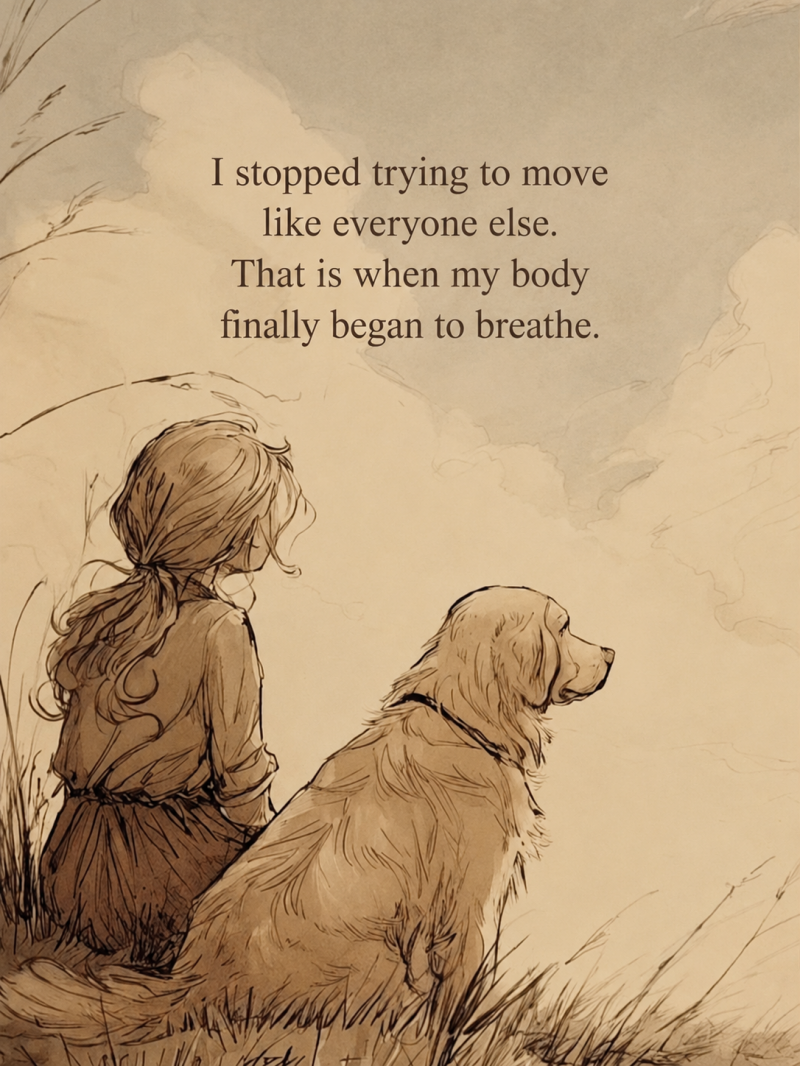
The Safe Place of Anger
May 11, 2026
I have two general practitioners, two women who I think both work part-time. Usually I get the same one, the one I do not completely connect with. This morning I had an appointment for several reasons. First of all, to figure out why I suddenly became so seriously ill this week. Besides that, after a difficult year, I want a very extensive blood test to see how things are really going inside my body.
At home I had already prepared myself. I would stay polite, but I was definitely going to tell her clearly how I experience her as my doctor. Of course I would not mention this to Ton, because he immediately starts relativizing things and telling me that maybe I should look at it differently.
So there I arrive, slightly worked up inside, and of course I get the nice one instead. For the first time in my life I consciously prepared myself to more or less lecture someone… and then it never happened. I really had to make an inner switch at that moment. At the same time I realized it might actually be better to enter a conversation normally instead of immediately throwing all my frustrations and grievances onto the table.
My doctor listened well. We laughed, and we were honest with each other. There are certain examinations I refuse because I already know that, whatever the results may be, I would not go through with treatment anyway. Ton would want to know everything, but for me that sometimes feels pointless. This time my doctor actually understood my reasoning. She only asked what I am still okay with. A fair question.
She understands my frustration and honestly admitted that she does not know anyone with CMT. She also understands that specialists often fail to properly take this disease into account in their treatment considerations simply because they have so little experience with it.
The preliminary conclusion:
tomorrow I will have blood drawn and undergo another, more extensive urine test.
Once I got home, the tension still came out anyway. I became incredibly stubborn and threw the most horrible remarks at Ton. Saying that I could shoot all those people who think they are so smart, and that if nobody takes me seriously, then I will simply survive on my own and become the last woman standing.
WELL, THIS IS GOING GREAT, ISN’T IT?
Of course it makes no sense at all. But apparently the frustration needed to come out somehow.
And maybe that says something important too:
at home, in a place where I feel safe, with someone who feels safe to me, I dare to completely release what I normally keep inside.
Because honestly?
After a stroke, a rare disease, years of adapting, doctors who often know very little about CMT, physical signals that I myself feel very clearly, and now once again such an intense physical experience… maybe it is not strange at all that anger rises to the surface.
Psychologically, people often say that when someone is ill for longer than two weeks, illness also begins to develop a psychological layer. So what does sixty-three years of living in a body that constantly demands attention do to a person?
I keep a lot inside. I often appear tough in my behavior. But especially since my stroke, I have felt less and less willing to compromise with my own feelings and frustrations about all of this.
I now give myself that space, with love.
Only… a little more balance would probably be better.
For me.
And for the people around me.
In this case:
Ton.
Maybe anger is not always the real problem,
but the place where grief, powerlessness,
and exhaustion are finally allowed to exist for a moment.
Maybe safety is exactly that: being able to be so completely yourself somewhere
that even your ugliest emotions do not destroy the connection.
And maybe balance does not begin by suppressing feelings,
but by learning how to let them move without tearing everything apart.
Being Free
May 10, 2026
Today is the third day that I’ve spent more or less in bed. I sleep a lot, yet strangely enough I still remain tired. Tomorrow I’ll visit my doctor for a moment. Maybe I’m actually coming down with something, or maybe I’m simply becoming tired from being too lazy right now. Tomorrow I’ll find out. There is probably something to be done about either option.
In between naps, I’ve had time to feel into what being relaxed actually means to me. Relaxation, for me, lies in not having to do anything, everything allowed. No pressure, obligation, direction, or anything at all.
Reading The Relaxed Woman. Why did that begin to rub me the wrong way ?
Modern ideas quickly seem to become new rules again. Even freedom can quietly become a new norm.
Today I wanted to look even deeper, more existentially. Because don’t we keep getting stuck if we continue to look at everything mainly from a societal perspective ? What happens if we let that go and look at the human being itself ?
Why keep focusing mainly on the forms in which ideas appear ? Self-care, relaxation, authenticity, femininity, performance culture. Beneath all of that, I sense a much larger existential question: why does humanity constantly keep building new systems ? Even around freedom ?
Maybe because human beings struggle to tolerate the absence of a fixed manual.
So we continuously create new frameworks. First religion, then discipline, now authenticity, self-care and conscious living. To me, they all seem like attempts to gain control over something that may not be controllable at all.
I don’t think it is really about who is right, but rather why human beings continuously need a movement, direction or new belief system.
Then the focus shifts from woman/man or relaxation/performance toward something far more fundamental: can a human being actually live without constantly defining themselves ? Without an ideal image ? Without new rules ? Without identity as a form of support ?
These are the kinds of questions that arise in me.
That is probably why the words “authentic living” begin to rub against something inside me. Authenticity can still become a performance. An identity. A moral ideal. While real existence may actually be far more fluid, contradictory and ungraspable.
The moment an ideology, however plausible it may sound, becomes too closed or complete, I feel space disappearing somewhere inside.
I think authenticity requires space as a condition. From quantum physics we know that everything moves. Even the densest and seemingly most solid matter is moving. A human being who is allowed to move in all directions lives in freedom.
So for me, authenticity is connected to freedom.
BEING FREE.
Maybe human beings are not meant to define themselves once and for all.
Maybe we live precisely in the movement in between.
Between knowing and not knowing.
Between form and freedom.
Between searching for certainty and daring to let it go again.
Maybe freedom only truly begins when nothing has to fully make sense anymore
— not even ourselves.
Having to Relax
May 9, 2026
Yesterday I started, inspired by psychologist Nicola Jane Hobbs, to look at how relaxed a woman I actually am in her eyes. I thought she had come up with twelve little cards meant to remind you to relax once in a while. Turns out there are only nine, so I’ll make up the last three myself. What actually relaxes me ?
The last suggestions from Hobbs.
Have you stared out of the window lately ?
I don’t really stare, I think. I can look outside and, in my case, watch the green tops of the trees, the birds flying in and out of the branches. But to me, staring feels more like looking without really noticing what you see. That rarely, if ever, happens to me. I’m almost always aware of what I’m looking at. Whether staring is actually relaxing, I honestly don’t know. Intuitively, I think probably not.
You are already good enough as you are.
That brings up a very ambivalent feeling in me. On one hand I feel insecure, unseen. On the other hand I feel very certain. I know what I can do, what I want and do not want. I absolutely do not let myself be guided by how people think life should be lived. I walk my own path, follow my own vision, even if the entire world disagrees. So there are two extremes living inside me.
One thing at a time.
Usually I do two, preferably three things at once. Hahaha. If I only do one thing, I often fall asleep. Which is probably the ultimate relaxation, of course. But is that the kind of relaxation they mean ? What exactly is relaxation ? Physical ? Mental ? Both ?
Those were Hobbs’ suggestions, but what do I do myself to relax ?
Have a pajama day.
Especially in winter I love pajama days, for myself and, in the past, with the children too. We would turn the living room into one big bed and camp out on the floor day and night. Watching television, playing games. Just being in my own space without having to do anything at all, if possible. Everything allowed.
Cycling through nature without a destination.
For me, pure relaxation. No sounds of traffic, but birds and rustling leaves. Buzzing insects, colours, weather and wind.
Being alone.
I love being alone. Nobody saying anything or asking anything. Phone off, communication reduced to almost nothing. Silence inside and around me. For me, perhaps the most relaxing moment of all.
It may all sound very logical, but I still wonder whether these are relaxing things for everyone.
Modern and trendy, a new book written by a beautiful woman. Modern ideas quickly seem to become new rules again. Relaxation versus performance. Softness versus strength. Woman versus man. How hip or new is that really ? I don’t know.
During my studies in clinical psychology, I already noticed that these ideas were beautiful to read, but eventually everything became a little too plausible. It sounds convincing, logical even, yet internally I still got tangled up somehow. Why ? I want to write about that tomorrow. It has to do with what Hobbs calls “authentic living.” Deep inside, something in me starts to rub the wrong way.
Maybe a person only truly relaxes when nothing is required anymore.
Not even relaxation itself.
Maybe authenticity does not begin with a new ideal image,
but with the moment something inside you quietly starts resisting.
Not out of rebellion,
but because something in you whispers:
wait a second… does this actually feel true for me ?
How Relaxed Am I, Really?
May 8, 2026
I’m reading a piece by Nicola Jane Hobbs, a psychologist who realized she hardly knew any truly relaxed women. Women take care of others, push themselves aside, and at the same time are still expected to be ambitious. So she started searching for ways to live more authentically.
That immediately interests me. What does “relaxed” actually mean? When does caring become a form of stress? What does self-sacrifice do to a person? And why does ambition still seem more acceptable for men than for women?
But perhaps the biggest question is:
when are you authentic?
She came up with small quote cards to keep in your bag or behind your phone. Little reminders in places you look often. How do you actually throw your internal to-do list out the door?
I do find it interesting to look at the twelve cards and notice how I respond to them myself.
“Being useful is overrated.”
Yes… I think most of us were raised that way. I certainly was. Quite strictly, compared to the people around me. Slowly, I’m learning to let go of that, simply because I realize rest is also important for my health.
And yet, I still feel proud when I’ve been useful. As if I’ve done something right.
“There’s nothing wrong with a messy house.”
Hahaha… this morning I was still yelling at Ton that the stains on the kitchen cabinets were absolutely not okay. It’s just dirt, you can clean it. “Yes, immediately!” my mind says.
Mess makes me restless. In the past, everything had to stand exactly right, down to the millimeter. When I came home, I would first put everything back in place. One of my foster daughters still talks about it.
I’ve let go of the extreme version of that, but it still isn’t easy. And when I do manage to let it go for a while, I feel proud of myself. Unfortunately, it usually doesn’t last very long.
“Have you gone for a walk yet?”
That one is easy. Yes. I try to go cycling every day. To be outside for a moment, to feel the air, the wind, the temperature. That’s something I consciously take care of.
“Be as lazy as you can.”
Coincidentally, I’m sick at the moment and spending the day in bed. I already feel much better, but out of respect for my body I’m still resting. Television on, a book nearby, laptop on my lap.
And maybe the most remarkable thing is that I no longer feel guilty about it.
I grew up with:
“Idleness is the devil’s pillow.”
The fact that this guilt is slowly disappearing actually makes me very happy.
“Take your time, it will be alright.”
That may actually be one of my strengths. Things I cannot immediately change, I can often eventually let go of. Then I trust that a solution, direction, or new possibility will appear in its own time.
And once I do move into action, I usually move quickly.
“Today you don’t have to do anything.”
Sometimes I consciously start my day like that now. Strangely enough, I often still end up doing quite a lot. It simply feels different when it isn’t an obligation.
No duty. No imposed schedule. No responsibility pressing on my shoulders.
Everything is allowed.
And that actually feels quite relaxing.
Since I’m staying home this weekend to recover properly, I’ll continue with the other six cards tomorrow.
I’m curious to discover how relaxed I really am.
When do you do something
because you have to—
and when because it feels right?
And how much peace appears
when nothing has to be proven anymore?
Perhaps relaxation is not about doing nothing,
but about holding yourself a little less tightly.
The Silence of Recovery
May 7, 2026
Yesterday it suddenly felt as if my body had decided it had had enough. Just one day earlier I was still training normally. Sweating, moving, using strength. Not perfectly, but steadily. Until that moment at the gym when a woman nearby kept coughing heavily in my direction. I remember thinking: this doesn’t feel right. After that, I forgot about it again.
Only later did it begin.
First the buzzing in my head. A strange feeling of instability. As if my system suddenly could no longer keep hold of itself. Within a few hours everything changed. Fever. Muscle pain. Pain in every single cell of my body. The feeling as if the light was literally going out. Not meant dramatically, but physically that is truly how it felt. I could do nothing anymore. No concentration, no clarity, only lying down.
Ton gave me paracetamol every few hours. Other than that, I mostly remember fragments. The strange thing is that later my Fitbit showed that I had barely slept, while emotionally it felt as though I had almost been unconscious the entire time. Maybe that is for the best. When a body becomes that ill, it apparently takes over temporarily. Thinking fades into the background. All that remains is surviving and recovering.
Today I woke up still slightly feverish, but the real sickness already seemed to be fading. As if the storm was already moving away again. Still, I stayed in bed the entire day. Not because someone else told me to, but because for the first time I truly felt that recovery is not the same as immediately carrying on again.
Maybe that is the greatest change of all.
In the past, the moment I started feeling a little better, I would start moving again. Push through. Don’t complain. Return to normal as quickly as possible. But more and more I begin to understand that health is not only about building strength, but also about preserving it. About allowing rest when the body asks for it.
Not tough. Not proving anything. Not fighting against a limit.
Just listening.
And perhaps that too is a form of strength.
Maybe recovery truly changes the moment you stop trying to overcome the body,
and slowly learn to work together with it instead.
Not every step forward has to be fought for.
Sometimes progress is born in simply daring to remain still
until life quietly returns to the body on its own.
Who Am I?
May 6, 2026
Who are you? Who am I? A question for an essay to be accepted into university. Or during a job interview. A question from someone at a party trying to sound genuinely interested.
In the past, I would have answered it at length. But even then, I would never have said: “I am Annette Groen and I am a doctor’s assistant, yoga teacher, or painter.” No, even back then I would have said: “My name is Annette Groen and these days I spend my time…”
Now my answer would probably be: I don’t know who I am.
What are people really asking when they ask that question?
I know who my parents are — although even that once felt uncertain. I know what I do and what I love. But those things change over the years too.
There have been so many versions of Annette. Withdrawn. The center of attention. Almost invisible. Impossible to overlook. Opinionated. Down-to-earth. Kind. Empathetic.
My partners were all completely different types as well. With each relationship, another side of me developed. Fears that once directed my life later disappeared again, allowing new directions to emerge.
Being born with a disability gave me an obvious visible characteristic — but so does the color of my eyes. Colored lenses can change that. Even the way I deal with my disability is not fixed.
Victim. Sometimes also the one causing pain. And so on.
Who am I?
Take your pick. I am all of it.
To the people you meet in life, you often remain the person they knew at one particular moment. If I was the carefree one, that is who I remain in their memory. If I was the serious philosopher, that image stays as well.
With family, it works differently. They connect my behavior to a part of themselves. I become their mirror, and everyone holds up a different one. Of course, it works the other way around too.
Still, I hope I can continue to see people — whoever they are — as human beings with endless faces and possibilities. Honestly, that is not always easy.
Putting a label on someone is simple. But perhaps then I miss something. Something I have not yet been able to see.
Who are you— without your roles, your past, your beliefs?
And how many faces does a person carry without even realizing it?
Perhaps we are not one fixed story,
but a movement that keeps revealing something new.
Where Light and Shadow Meet
May 5, 2026
Today is officially Liberation Day in the Netherlands. Yesterday was May 4th, Remembrance Day. Thankfully, this commemoration has gradually expanded beyond just the Second World War. Step by step, other groups and later military victims have been included. It is good that this is acknowledged, so people do not feel forgotten.
This year, I consciously chose not to watch television. Only around eight o’clock did I briefly watch the ceremony at Dam Square in Amsterdam. Nothing more. The confrontation makes me cry — and keep crying.
In a small chapel, somewhere along the way during yesterday’s bike ride, I wrote something. In memory of Michel, his family — and with that, also the family of my children.
When I think about the pain from back then, and how it continues through the generations, I sometimes wonder: are there still people without trauma? We all carry something. From our own lives, or from what has been passed down to us.
I now know that these kinds of experiences can even be stored and passed on in our DNA.
Perhaps no one is free from these shadow sides.
It is good to pause with that from time to time. To feel it. That Weltschmerz, that sense of world pain. As a country, it is also meaningful to find a moment of connection in this.
War cannot be justified. That feels very clear to me. And at the same time, I see it as a shadow side of humanity — something that exists as long as there are people.
When I see that someone has been hurt, I feel empathy. Of course. That is not a question.
But it becomes suffocating when someone believes they are the only one carrying that pain, as if it stands apart from everything and everyone. Because who does not carry something within them, in one way or another?
That doesn’t make it smaller.
It may make it more bearable.
I do not trivialize it. But I do see it as an inevitable shadow side of humanity.
Then I think of kintsugi, the Japanese technique I sometimes use in my paintings. The golden repairs emphasize the cracks as part of the object’s history — not something to hide, but something that makes it stronger and more unique.
Could that also apply to us as human beings?
Do all the things we go through — even war and loss — somehow make us stronger?
Today, after my morning training, I decided to take a day of rest. As usual, I sit on the bed with the television on, my laptop on my lap, and my phone in my hand.
In an Argentine series, I hear someone say:
“In Japan, they see shadow as beauty.”
Yes, I think. That’s true.
They call it komorebi — the interplay of light and shadow. Shadow is not seen as a lack of light, but as a space for rest and contemplation.
For me, it is important not to remain stuck in the pain, but to carry it along. As a shadow that is allowed to be there.
And when that shadow is allowed to dance with the light…
then perhaps something emerges that resembles healing.
How do you carry what is dark—
without disappearing into it?
And what happens
when you don’t try to remove it,
but allow it to move beside the light?
Is healing something you do—
or something that arises?
What Burns — and What Returns
May 4, 2026
Despite a strange dream — more like a single sentence that startled me — I slept well. The dogs behaved perfectly in the hotel. Our clothes were almost dry.
We pack up, load my car, and drive to the van to get the bikes. It’s warm, slightly oppressive. The sky dark, almost threatening.
At eleven, we set off on our bikes to explore the North Brabant area further, following ANWB cycling routes. So easy, my phone mounted on the handlebars. It makes me think that cycling paths are designed per region — depending on how much is invested.
Along the main roads, from village to village, there are wide bike paths for two directions. But once you enter the fields or the forest, they become narrow, semi-paved paths, maybe a meter wide. Official routes, but clearly with less attention.
In the forest, they sometimes feel like mountain bike trails: winding, uneven, too narrow for my cargo bike. And still two-way traffic — someone has to step into the bushes to pass.
I love it.
It makes it adventurous. Ton laughs that this is exactly what I enjoy. I find a solution for every challenge. It’s heavier than smooth paths, but I experience that as training.
I always look around. I notice every flower, every small detail. The trees here are remarkably old, the ground uneven. Not quite hills, but there are height differences of a few meters. Heathland, lakes, and ponds everywhere.
I cycle at about 18 kilometers per hour. Not fast, but I absorb everything — flowers to look up later, birds, small movements.
Then I notice something strange. A fire hose lies on the heath, about a hundred meters away. It feels out of place.
Moments later, I see dark patches stretching out before me.
I stop.


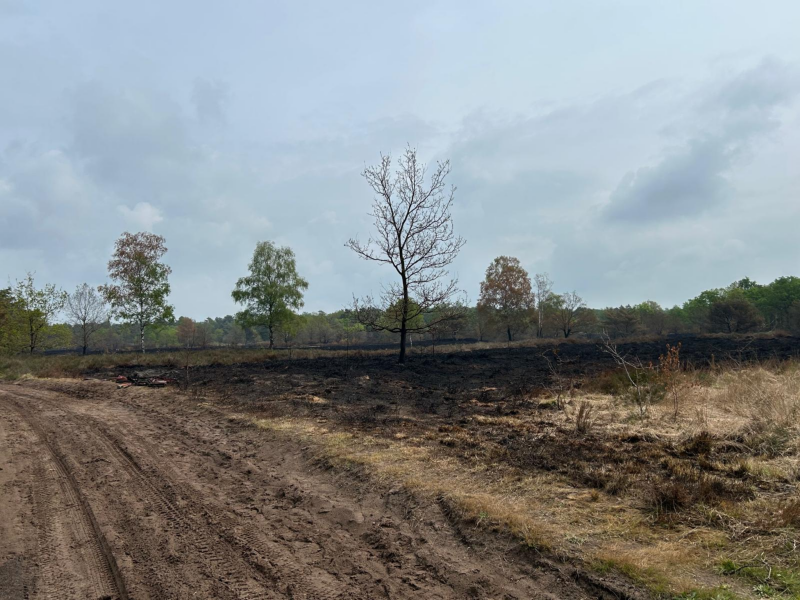
And suddenly I understand.
This is the heath that burned a few days ago. A military training ground — I had seen the signs. It was on the news.
I tell Ton and ask him to take a photo. Of the blackened land. And of the hose, as a silent witness.
He doesn’t understand how I spotted it so quickly, from such a distance. But he knows by now that I notice everything.
It reminds me of South Africa, where I once saw land still smoldering after a fire. Completely black. There, some plants ignite to release their seeds.
The atmosphere was eerie.
Two days later, I returned with my daughter to show her. To my surprise, there was already new green growth. Even flowers. It had begun to recover so quickly.
Here, I feel the same. Yes, the land is black. But I know it will recover.
Of course, one story belongs to nature, the other to human action.
The event looks the same. The circumstances differ. But the outcome… perhaps not.
And I find myself wondering:
how heavily should we judge it?
Or am I making it too simple?
What do you see—
when you look beyond the event?
Is destruction an ending,
or a beginning not yet visible?
And how much of what you feel
is shaped by what you know—
or by the way you look?
Between Tradition and Movement
May 3, 2026
Traditions. What do I think of them?
They are customs passed down through generations. King’s Day (formerly Queen’s Day), Sinterklaas, Luilakken in the north, Carnival in the south. Or gatherings around birth, death, and marriage. They bring people together, beyond what might otherwise divide them.
Today we stumbled right into one. In the village where we are staying, it was Guild Day. Forty-eight guilds took part in a procession. Around 1200 to 1500 members. Emperors, kings, standard bearers, flag throwers, drummers — everything passed by.
It’s striking how the entire village turns out for it, and how natural it all seems.
For me, it was the first time seeing this in such a way. All those people, seriously dressed in medieval clothing. Of course, I respect that. And at the same time, I feel a slight resistance.
How much do you tie your identity to an age-old tradition?
Is there room for change?
The day began with a church service. That’s where I notice a certain unease — a fear of rigidity. Just as Sinterklaas no longer feels fully of this time to me, I notice that I appreciate when things evolve.
Communities can also find other, perhaps more creative ways to connect and express themselves.
Ton wanted to go to the field where the guild ceremony would take place after the procession. For me, watching the procession was enough. So many people, and a certain atmosphere I wasn’t sure how I would experience.
Instead, we cycled for four hours through the forests and nearby villages. In pouring rain. Despite rain gear, we ended up soaked to the skin.
And still… I enjoyed it.
At home, I would never choose to go out cycling or walking in this kind of weather. But now that we’re away, we just do it. It feels active, refreshing, healthy.
The dogs sat in the cargo bike under the cover, cozy in their baskets. Every now and then a little head would pop out — so cute.
Finding a working charging station turns out not to be so easy. Clearly, we haven’t quite mastered that yet.
Back in the hotel room, we quickly change out of our wet clothes and relax. A few hours outside like this is surprisingly tiring.
I’m curious what tomorrow will look like.
It was another good day.
What do you hold on to—
and what is allowed to change?
And how do you move
between what remains
and what shifts?
GUILD DAY
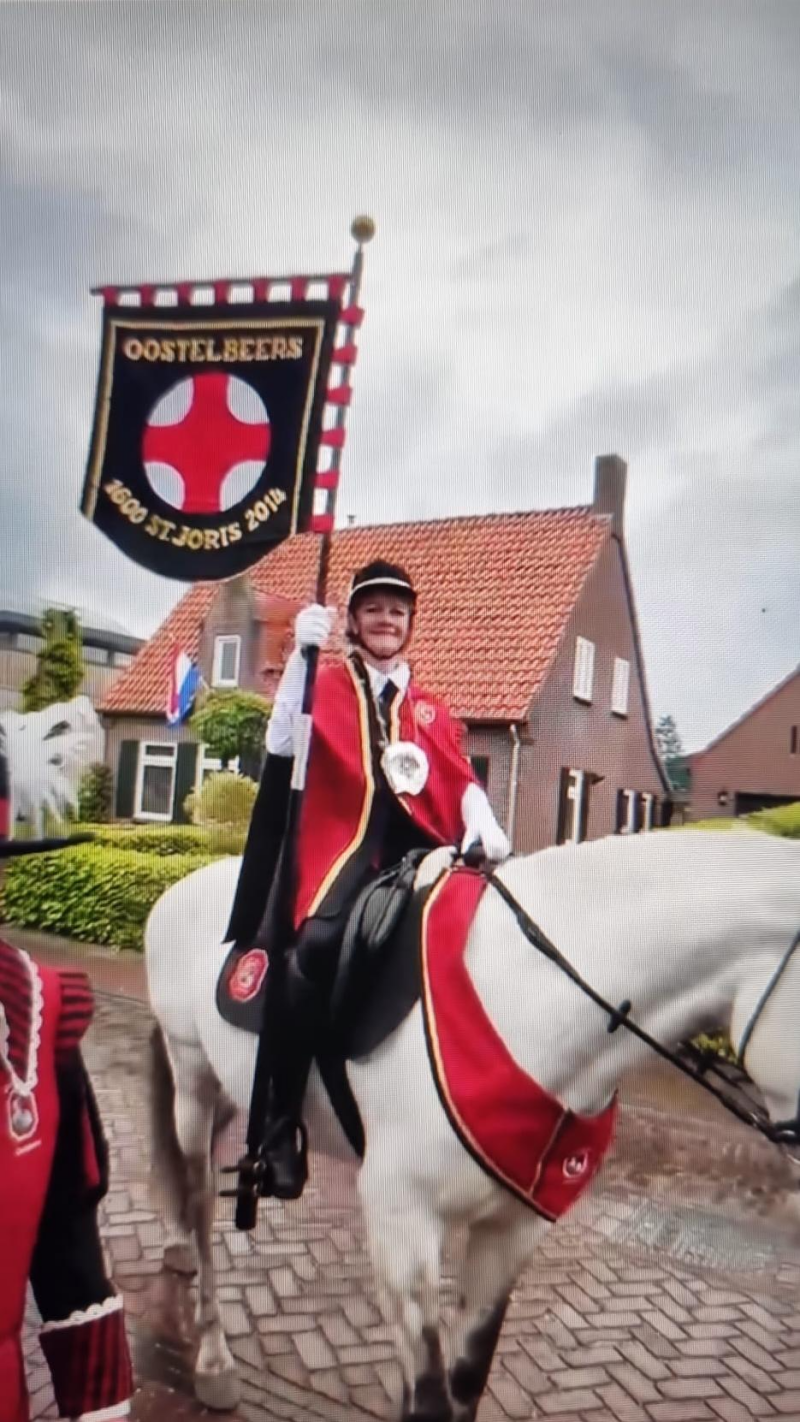
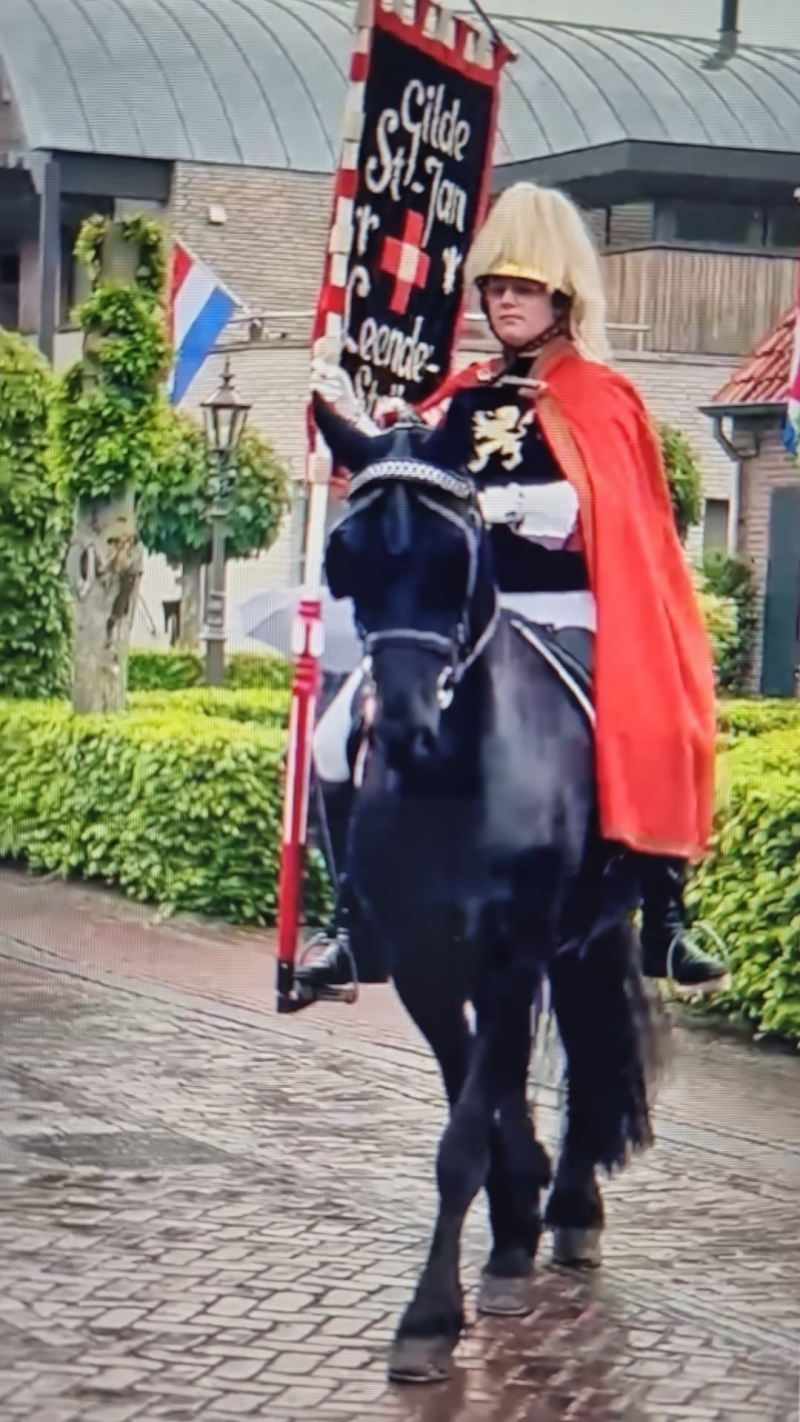
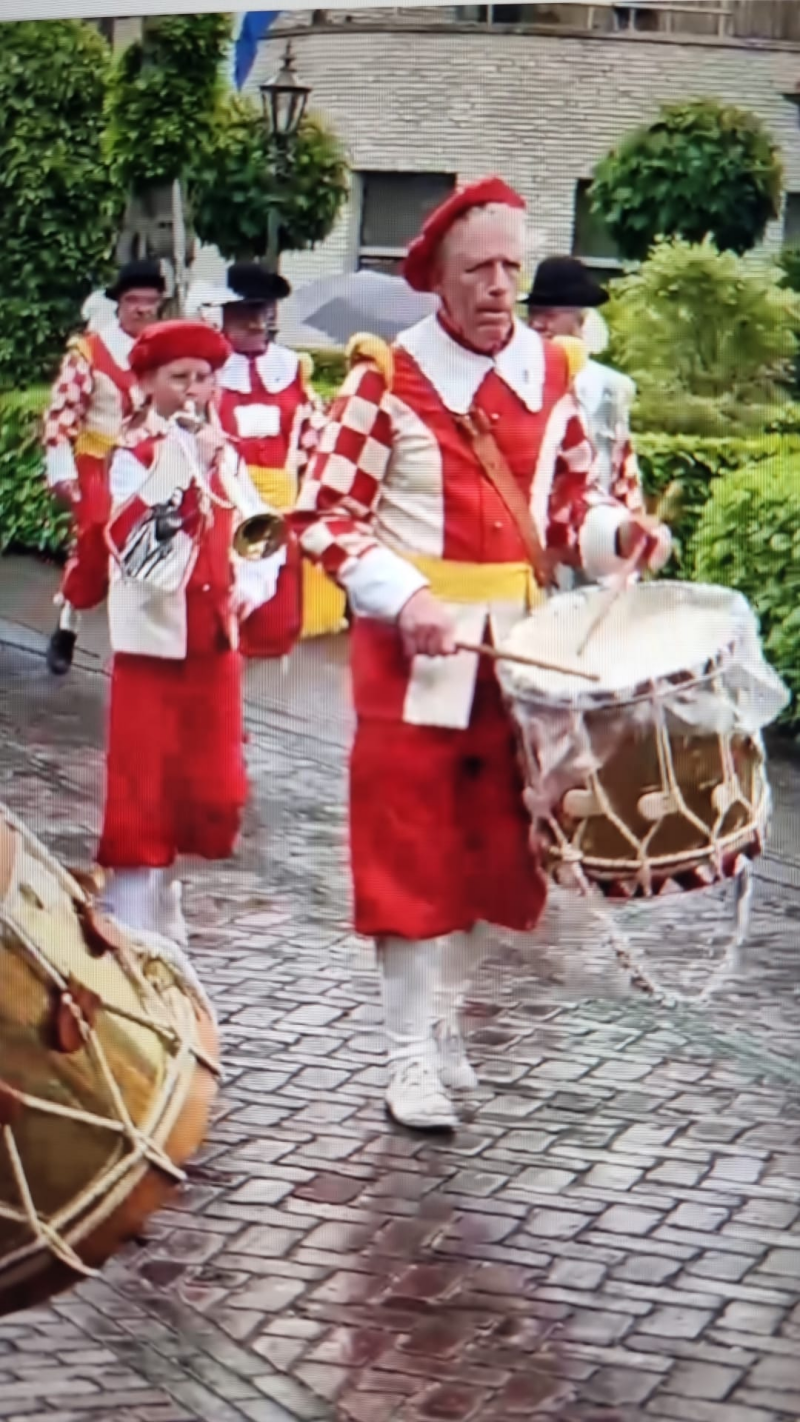
Outrunning the Rain
May 2, 2026
Weather forecasts. The whole week was supposed to be beautiful. Today we booked a hotel for two days, planning to go cycling from there. First to our granddaughter’s birthday, about an hour’s ride through a forested area. Sounds perfect.
But now the forecast suddenly predicts heavy showers and thunderstorms. From the afternoon on, all evening, and tomorrow as well. My daughter even texts to ask if we’re really coming by bike.
I tell Ton that we’ve had bad weather forecasts so many times before, and it always turns out fine. We decide to go with two cars. Ton takes the van with the bikes, and I drive my own car with the dogs. At the hotel, I check the weather radar again and we’ll decide what to do: cycle anyway or continue by car.
The forecast changes. Rain only expected around ten in the evening.
So we go by bike.
I usually just assume the weather will cooperate. And if not, we have rain gear.
Normally, I would drive straight to my daughter’s house. Now we cycle through the area where she lives. It immediately adds something to my sense of her life. That alone makes me glad we chose this. No regrets about this little getaway.
Visiting birthdays is not my favorite activity. Honestly, I don’t really enjoy it. In summer, when we can sit outside, it’s better. Inside, I tend to feel restless. Arriving by bike, though, I notice I feel fresher and more alive.
Luckily, we can sit outside in the garden. The dogs are calm — being close to us is enough.
The ride back to the hotel turns into an adventure. The bike navigation leads us onto forest paths, unpaved, through loose sand. With the cargo bike, it’s heavy. I have to get off and push several times. Sometimes Ton takes over. The sand is so soft and uneven that my ankles bend like matchsticks and I fall into the sand.
Sweat runs down my body.
All I can think is: I didn’t train this morning — this is my training.
I laugh and tell Ton I actually enjoy the effort.
We cycle toward the setting sun, a blue-red sky ahead. Behind us, dark clouds gather. A few drops fall, but we stay ahead of the rain.
An eventful day. Out with the van, the bikes, and the dogs.
Quite nice.
I’m looking forward to tomorrow.
How often do you let yourself be guided
by what might happen?
And what happens
when you simply go anyway—
and discover along the way
that it turns out just right?
What Remains — and What Fades
May 1, 2026
Memory… how does it really work?
I notice that mine is very selective. Things that made an impression — emotional, painful, or moments of joy — have stayed with me. Words, sentences, images. But interactions with people often have not.
Especially when I share a past with someone, I find that the other person has held on to very different memories. I notice this with my sister, my children, and today also with my foster daughter. She recalled moments that meant a lot to her. I could imagine the situation, but I couldn’t remember it.
Did I experience many things as neutral back then?
Is that why my memory let them go?
I notice many shifts within myself — in who I used to be and who I am now. Sometimes it even feels as if I have played with my character. Quiet, invisible, assertive, bold, playful, present, insecure, distant — I have been all of these, in different phases.
Many people have passed through my life. Others have always remained.
For a long time, I needed tension and stress to move forward. The calm I now experience is something I have to get used to. Sometimes confusing. Sometimes even a bit dull.
And yet, that calm also creates space. Space to move inwardly. I see it, I feel it, but it is still largely unexplored. And that makes it exciting again.
This afternoon, the conversation turned to a mutual friend from the past, whom I haven’t seen in fifteen years. She sent me an email with many attachments — almost like a book. The intensity I remembered from her was clearly present in that message.
My own attitude has changed. I prefer to leave existential questions open. My ideas are just that — ideas. Convictions I once held have softened into a “maybe.” The need to know, or to debate, no longer feels necessary.
My foster daughter spoke about her life and asked how I now see and experience things. I think it gave her some peace to hear that I don’t need to explain everything.
That I really only have one question left:
How do I deal with it?
Or… how do I respond?
What do you remember—
and what do you let go?
And how much of who you were
truly remains?
Perhaps the answer is not in knowing,
but in how you move
with what arises.
Giving Help, Asking for Help
April 30, 2026
We’re going away for a long weekend. A hotel booked in North Brabant. From there, we’ll spend three days cycling through the forests. On Saturday, we’ll cycle to my granddaughter’s birthday.
Today we bought bicycle bags at the ANWB and took suitcases out of storage. On the way, we stopped at a terrace for lunch. The anticipation of a trip, short or long, is always enjoyable.
Maybe it sounds strange, but I can feel so happy with a sunny day, running errands, and making preparations.
Back home, everything is clean. I take care of the plants.
A friend, who lost her husband last year, asks if I can help her with her tax return. The funny thing is, I really dislike doing this kind of thing myself. Yet I do it for her.
I once handled my sister-in-law’s estate. For this friend, I have also taken on the role of executor.
What is that?
That I feel almost blocked when it comes to these things for myself, but I take them on for others?
Do I want to be liked?
Can I simply not bear to see someone struggle with it?
I know the ropes by now, so in reality, it’s not that difficult for me.
In daily life, I’m not necessarily the most friendly or charming person, but where I can, I offer help.
Would I be someone who wished to receive help myself?
I would never ask.
Is it still a kind act if there is a psychological explanation behind it?
Am I still authentic?
I don’t know.
It remains a question.
And yet… it gives me a good feeling.
And I’m glad it’s taken care of for her.
When do you truly give—
without reason, without intention?
Is there such a thing as pure help,
or is there always something of yourself within it?
And does that make it less real…
or simply human?
From Strength to Trust
April 29, 2026
Today began with a strength assessment. Always a little tense, because it reveals what has been built in silence. Then followed the heaviest session so far. No long build-up, but short, powerful, direct. A warm-up, a pause, and then the pillars. Again and again. A quick, forceful push or pull, ten seconds of rest, and repeat. Three rounds.
I felt it immediately. This was different. Not “just training,” but truly engaging my body. Not beyond the limit, but right up against it. My muscles had to switch, my breath had to follow, my entire system organized itself around those brief bursts of strength.
And there is something special in that. A year ago, my body was mostly tired. Heavy. Unpredictable. Now it has become a conversation. I ask something, my body responds. Sometimes hesitant, sometimes surprisingly strong — but it responds.
What touches me most is that it’s not just about strength. It’s about trust. Trust that my body can learn. That it adapts. That it remembers.
I see it in the numbers. In steps that accumulate without forcing them. In weights that slowly increase. In connecting my Fitbit, turning my day into one continuous whole. No longer separate moments of effort, but an ongoing movement. Closer to who I am now, closer to my rhythm. Not obsessive, but supportive. As if, after all the medical interventions, I decided: I take this back into my own hands.
And yet it doesn’t feel like forcing. More like moving along with something already unfolding.
Maybe I’m on a plateau. Or, as it feels to me: a resting point. A place where everything reorganizes. Where muscles, nerves, and trust find each other. Where my body says: wait, I need to integrate this.
And so I do. I wait. Not standing still, but deepening. Beneath the surface, it continues to move.
After training, I have lunch with a friend. In the sun, against the strong wind. A soulmate. Someone with a similar background, similar layers. We speak the same language. About taking responsibility for what you feel. About how everything that happens outside touches something within. But what is touched belongs to me, not to the situation. The world happens outside of me, but my experience arises within. In everything, I come to know myself.
He works as a coach and counselor and guides people step by step toward a broader awareness:
-
Participation
-
Perception
-
Observation
-
Compassion
-
Transformation
It is always good to see him. Recognition matters.
Back home, my youngest son is there. It’s striking how a grown man becomes a small boy again with his mother. Sitting next to me, playing with the dogs, taking something from the kitchen.
Later, I receive a call from the company where I bought my colorful walking sticks. A cheerful conversation with the owner, who loves that I want them all and buy a new one each month. I choose one each day to match my outfit. To me, they feel like accessories rather than aids.
He asks me to write something about them and maybe send a photo. Because of my story, I now receive a discount.
I end my review with:
I prefer to turn necessity into opportunity.
When does strength become trust—
not because it is proven,
but because it is felt?
And how much grows in silence
while you think you are standing still?
A Generation Further, A Feeling Closer
April 28, 2026
My granddaughter is celebrating her birthday. She was born four days after we discovered that Michel was ill. He had arranged a “grandfather day” at school, planning to take care of her every Wednesday in Maastricht. He never got to experience that. But he was there for her birth. He even read to her — something he found very important.
I was allowed to be in the operating room. I was there for her very first breath. Becoming a grandmother for the first time is something special. A different kind of presence. More aware.
I love my children deeply. I went through a divorce, and later we became a blended family: one daughter of mine and one of Michel’s. It was complicated. We made mistakes, and they left their mark. Later, we had two more children together, and after Michel passed away, I took in a teenager. My heart was always large enough to welcome people and let them become part of our family.
As a parent, you want to be perfect. But you’re not. My five children each carry their own memories — good, difficult, and everything in between. They are all adults now, living their own lives. They don’t live nearby. We mainly call each other when there’s something to share.
We gave our car to my second daughter. She came to pick it up with her ex-wife. It was nice to see them both. The next day, Ton's eldest son visited my youngest son at the restaurant where he works, together with his daughter. We received a photo on WhatsApp. A small moment, but it means a lot.
Today I see a photo of my granddaughter having lunch with her divorced parents. It’s so good to see that this is possible.
One of my daughters has taken distance from me almost a year ago. Since then, I haven’t heard or seen anything. We are not all the same. She needs this space — far away from me. Rigorous, but necessary for her.
Ton shows me a photo on Instagram where she is standing with two friends. I am happy to see her smiling. She looks well. After a long time, this is a small crumb of life.
My adopted son is almost always the first to respond in the family group chat. He is there. Always connected.
And my grandchild… I can love her fully. I am the silly, loving grandmother, always happy to see her. She is a light in my heart.
A generation further,
yet a feeling closer.
How does love move
when distance appears?
Does it disappear—
or does it change its form?
And how much remains present
in the small moments that still exist?
Leaving the Crowd to Itself
April 27, 2026
King’s Day. There’s always something special about watching the royal family visit a city. Am I that devoted to the monarchy? Do I believe in fairy tales? Am I a dreamer? Or is it simply my nationality? Either way, the romantic in me awakens.
All my life I’ve watched this day on television. First the parades, later the visits to cities. A wedding, a coronation — I watch. With my family, we used to wander through the flea markets. Sometimes we even had our own stall. In recent years, we would cycle past it all.
Today, it was incredibly crowded in the center of our town and in the city across the river. From stage to stage, noise everywhere, people packed tightly together. No space, only the sky above me.
Almost automatically, something in me switches off. Where I usually take everything in, now nothing enters. There is only one focus: finding a way out of the crowd.
Fortunately, we manage. Outside the center, it is suddenly quiet. The streets are empty. Still, it takes time for my body to settle, to come out of that inner flight mode.
We cycle past friends, sitting quietly in their garden with a drink. There, I slowly open up again.
On the way home, we ride through a large nature reserve.
Back home, I feel how tired I am. I fall asleep, completely drained.
It may sound like a firm conclusion, but for me it is clear:
I won’t do this again.
I’ve seen it, experienced it, even enjoyed it in my own way in the past. But I no longer need it.
From next year on, we will choose the quiet places
and leave the crowd to itself.
When do you know something no longer belongs to you—
not because it is wrong,
but because you have changed?
And how much peace appears
when you no longer have to join in?
The Nature of the Beast
April 26, 2026
As long as I can remember, I have done things almost obsessively.
As a child, I would take entire book series with me on holiday. I preferred sitting outside on the grass, reading for days on end, until every book was finished. If I discovered there was another part missing, I would do everything I could to get hold of it as quickly as possible. My mother would sometimes get angry — I had to come to the beach. I would find a shaded corner and continue reading, completely unaware of everything around me.
Later, as a young adult, I collected romance pocket books. Waiting, in a way, for a kind of surge. And then suddenly it would begin: reading dozens of books in a row. And just as abruptly as it started, it would stop again.
When the video recorder became popular, I started renting films. Preferably a whole stack at once. Series like The West Wing, all seasons, all episodes. Michel loved it too. In the end, we watched almost everything the video store had to offer.
At home, we would turn the living room into one big bed by placing mattresses next to each other. We would rent all the Harry Potter films or The Lord of the Rings, and spend entire weekends in our pajamas, lying on the floor watching films together. The children loved it.
These days, I sit on my bed in the evening with the TV on, my laptop on my lap to write, and I play games on my phone. I still watch series — episode after episode. It even has a name now: binge-watching.
Probably unhealthy. Probably with all kinds of consequences. I believe that. But binge reading, binge watching, binge painting… I think it’s simply the nature of this creature.
Whenever something captures my interest, I dive into it. Fully. And just as easily, I step out again.
Was I a pioneer?
Or simply a bit obsessive?
Does it fit the way my mind works?
These days there are so many psychological theories about everything. About what is good and what isn’t. About how much we consume, both mentally and physically. Maybe it’s stubborn of me, but as long as it feels right, it is right. As long as it doesn’t stop me from functioning.
After Michel passed away, and the children had left home, I didn’t turn on the TV at all for years. Not until Ton came back into my life. Apparently, I can do without it too.
This lady has done her share of binging in life.
I’m no longer ashamed of it.
I simply move with the flow I live in.
When does something become “too much”…
and when is it simply who you are?
And how much really needs to change
when it carries you
instead of holding you back?
Is it enough?
April 25, 2026
Last night I couldn’t sleep. I’m not exactly sure why—usually it has to do with too much pain. This time it was different, no tangible stress. Just no sleep, I suppose. I finally drifted off around six in the morning. So I skipped training today—my body clearly wasn’t rested.
I got a message from my sister that my brother had been operated on his foot. Quite painful, and another procedure still to come. Practical. Factual. The way it often goes in our family.
And yet… underneath those words, something else is happening.
I notice myself reacting. Quite directly too. Not even angry, more tired. I hear myself saying that it all comes from one side, and I wonder why I even keep making the effort. It’s not a new thought, but it keeps returning more often, and more clearly. My brothers never ask how I’m doing, not even when they know I’ve been in the hospital. And still I cycle by, have a cup of coffee, keep things moving. As if I’m trying to maintain something that I’m starting to question whether it truly exists.
My sister says she doesn’t get that either, that she’s the one who asks. That this is just how it is with us. And she also says that there is love, it just doesn’t come out. I believe that too. I really do. And when we’re together, it’s often actually quite pleasant. We laugh, there is contact. But still… it remains somewhere on the surface. Their lives are different, their interests too. I understand that, but I find myself wondering whether trying to hold on to this contact is actually becoming a disillusionment.
And then I come back to myself. Because in the end, that’s where it is. Not with them.
Is it enough?
I notice that I’m already loosening my grip. I expect less, leave more to them, no longer force anything. And yet… there is still something. Because if it truly didn’t affect me anymore, I wouldn’t be asking this question. Apparently it’s not completely free yet.
My sister says I should listen to my feelings, but that they can shift again. And that’s true. Today I see the world a bit more somber. I didn’t sleep well, and that colors everything. I recognize that in myself, how things can shift, how tomorrow might feel different again. But somewhere I also know this isn’t just about today.
It’s no longer a sharp pain. No anger. More something soft that keeps returning. A quiet knowing that the movement comes from one side. And the question underneath it is becoming simpler, though not necessarily easier:
How long do I want to keep this like this?
Not out of anger or rejection, but because I wonder what still feels true. What is real… and what might only be an idea I’m holding onto.
Maybe this is one of those phases where nothing has to be decided yet. Where it is enough to simply see things as they are. That love can exist without being visible. That contact can exist without a real meeting. And that within that, I slowly begin to feel my own boundary.
It’s becoming clear to me that when I’m not feeling at my best, the family I come from always brings up a sense of loneliness.
So there’s really only one thing to do, and that is to go out cycling in this beautiful weather. Into nature, filling myself with sun, light, and the love of life itself.
Back home, I think for a moment about the conversation with my sister. I turn on the TV and hear exactly what I already knew:
“Hope comes when you least expect it. You will find it, or it will find you.”
Maybe love is not always visible in what is shared,
but felt in what is missing.
And maybe the question is not whether it is there,
but whether I can live with the form in which it shows itself.
When does acceptance become freedom…
and when does life ask me to gently let go?
What Moves Me Without Reason
April 24, 2026
Moved. Why does something touch me so deeply? I cannot find a clear mechanism within myself. There are times when serious things happen or are told, and I remain completely calm. And then, at other moments, I see or hear something — on television or elsewhere — and suddenly, tears well up in my eyes.
Over time, I have come to understand that it always relates to me in some way. Sometimes through past experience, sometimes through something I may only encounter later in life. That last part fascinates me the most: as if, somewhere deep inside, you already know what lies ahead.
When it touches me like that, I recognize it now. With Soldaat van Oranje, it was clear — it had to do with my own family and their experiences during the war. But when it isn’t clear, I no longer search for explanations. I trust that, at some point, it will reveal itself.
Perhaps it is through these experiences that I have come to feel that time is not horizontal, but vertical. Not something that unfolds in a straight line, but something that can be present all at once. There is no predicting the future — it can already be felt now.
It is difficult to explain.
I watch a documentary about the return of temple guardians. Artist Jikke van Loon is dedicated to the symbolic return of two Japanese temple guardians, Agyo and Ungyo. Imposing wooden figures from the fourteenth century, now part of the Rijksmuseum collection.
They once guarded the entrance gate of a temple near Hiroshima. Now they stand against a wall. Their function lost. Displaced.
Jikke felt that. That sense of displacement. It led to her project Issho-ni / Tomo-ni — together. An attempt to restore connection, not by physically returning the statues, but by opening a dialogue about their meaning, their origin, their place.
You see what the temple once meant to the villagers. How distance has grown. And how, through this project, something begins to open again. Not only physically, but emotionally.
They are “just” statues. And yet, they move me deeply. Tears run down my cheeks. It is about cultural heritage, about meaning, about connection to a place. And I feel that throughout my whole body.
In the end, Jikke van Loon does not return the statues physically. She creates artistic interpretations — including versions in Delft blue — symbolizing the connection between the Netherlands and Japan. The entire village participates.
I cannot fully explain how.
But it reaches me.
So beautiful to witness how connection can work.
What truly moves me
when I do not know why?
Is it memory—
or something yet to come?
And how much already lives within me,
without needing to be understood?
Coming into Motion
April 23, 2026
Last Tuesday, the chain of my cargo bike broke. Luckily, it happened fairly close to home, so Ton could continue cycling. He came back to pick me up with the van, and we drove straight to the bike repair shop. I had already called to say I was having trouble and asked if I could bring it in.
When we arrived, the mechanic rushed toward me, clearly stressed. He was extremely busy, he said, and had no time left. He was leaving for vacation on Saturday and didn’t know how he was going to finish everything. Maybe a colleague could take a look, but it would probably not be ready until Monday. He apologized repeatedly.
I reassured him. It’s inconvenient not to be able to cycle, but it’s not a disaster.
Yesterday, during the intermission of Soldaat van Oranje, Ton checked his phone. A message: my bike was already finished.
After training, we went to pick it up. The mechanic was much calmer now and apologized again. He had been so overwhelmed that he had lost track of everything. On Tuesday and Wednesday, he had even worked until four in the morning.
“Really,” I said, “I didn’t expect you to do this. Let alone give it a full service.”
New tires, brakes… everything had been done.
While applying a bit of oil to the new chain, he said:
“You look like a queen on that bike, so happy. I love seeing someone get so much joy out of cycling. You’ve already done 6,500 kilometers—amazing. That’s why I wanted to return it to you in perfect condition for these beautiful days.”
Maybe it sounds strange, but now that I feel better mentally and physically, it seems as if more positivity is coming toward me. In a quiet, natural way.
After a beautiful ride along the river Lek, we return home. I am so aware of how good I feel, and I compare it to a year ago. I decide to look up my blog from April 24, 2025.
As I read it, I feel how big the difference really is. Not so much in what is happening, but in how I experience it.
A year ago, I was much more in my head. I tried to understand what was happening to me. Why I was so tired. Why things affected me so deeply. As if I were observing myself from a distance, trying to put it into words. Vulnerability felt like something I still had to learn.
Now it is different.
Not because everything has been resolved, but because I am in the middle of it. I need to understand less, and I feel more. Things are allowed to be there without me having to explain them. Where I used to be strict with myself, I now notice softness. Less “I shouldn’t complain,” more simply: this is how it is.
My body feels different too. Back then, it was heavy, tired, limited. Now it moves. Sometimes still searching, sometimes with small interruptions, but it moves. I work with it instead of against it. I listen, adjust, continue. Not at full force, but in alignment with what is possible.
And that brings a sense of calm I didn’t know before.
It’s as if, over the past year, something has shifted from outside to inside. Less focused on how things should be, more on what is already there. And because of that, it seems as if something outside responds as well. Or perhaps I simply see it differently now.
I read my old text with understanding. Without judgment. It was exactly where I was.
But I also feel that I am no longer there.
That I have arrived somewhere else.
Without being able to point to the exact moment it happened.
And maybe I don’t need to.
When do you realize you’ve moved forward…
not because everything changed,
but because you did?
And how much really needs to shift
for everything to feel different?
What Cannot Be Done — And Yet We Do It
April 22, 2026
On television, viewers are constantly reminded that the musical Soldaat van Oranje is finally coming to an end. I’m not a fan of musicals, so I had no real interest. Still, a few million people have seen this production and speak very highly of it. So, at the last moment and out of curiosity, Ton and I decided to go anyway.
And honestly? The whole concept is remarkable. The entire auditorium continuously rotates from one set to another. We were seated in the front row, almost with our noses on the stage. We could practically smell the actors — at the very least, we could clearly see the emotions on their faces. The half-singing, half-speaking — something we normally both dislike — faded into the background because of the way the entire production was designed.
A few times I was so moved that tears ran down my cheeks. I’m not entirely sure what caused it. The theme? War, friendship? Or the honesty with which it was performed? Something touched me.
During the intermission, Ton and I both realized we had become a bit seasick from all the rotating. After the break, I was more prepared, and fortunately it got better.
On the wall of the restaurant, a quote is written:
“In every person’s life there are moments when they say to themselves: ‘Well, that’s not possible.’ And then they do it. The quality of your life does not depend on what happens to you, but on how you respond to it. There is little you can do about the first, but everything about the second.”
I sit facing it and think: yes, that’s true. It’s not so much about preventing or curing, but about how you deal with it. Perhaps that is the key.
In the entrance hall there is a bar with hundreds of small bottles of orange liqueur. Unfortunately not for sale, otherwise we would have taken one as a souvenir. On the way back, we drive through Wassenaar, inching forward in traffic. A moment where nothing is required. Letting go of concentration.
And suddenly I think back to Queen’s Day at my eldest daughter’s school. Drinking countless orange liqueurs with a group of mothers I was friendly with at the time. One of them, a little tipsy, looked at my blouse and asked, “Are those real?”
“Hahaha, of course they’re real,” I said.
“I want them too. I’m going to have them made.”
Later she divorced, remarried, and moved to Wassenaar. I smile at the memory as we sit in traffic.
It’s also a way of changing your situation. Sometimes literally, sometimes figuratively.
I tell Ton a few anecdotes about those Queen’s Days. Meanwhile, more memories surface. I keep those to myself. I don’t need to name them. It’s a familiar road, layered with the past.
In that moment, I choose to let it pass.
And it works.
Even now, as I write it down, it feels like something that once was —
and no longer is.
What makes something feel impossible…
and yet we do it anyway?
And when does the past become something
that no longer pulls—
but simply passes by for a moment?
Living in Layers
21 April 2026
Over the past few months, I have painted a lot. Not even to finish something, but to observe. To shift. To feel what resonates and what does not yet. Sometimes I place something down and leave it for weeks. Then I pass by, look again, and suddenly see it differently. Something shifts. Not only in the painting, but also within me. I sometimes call this “mopping.” Looking until it looks back.
And suddenly I see that I have begun to do the same with my body. Where I once wanted to correct, solve, improve, I now observe. Feel. Adjust. No longer moving from everything to nothing, but moving within a margin. In the past few weeks, many things happened. A fall, a painful foot, a knee that temporarily refused to cooperate. In the past, that meant stagnation, setback, frustration. Not anymore. Now it is part of the whole. A disturbance in the layer, not a break.
Today I connected my Fitbit to the EGYM app. A small technical moment, but it felt like something larger. Not because I need numbers to know how I am doing, but because I suddenly see a broader picture. Not just that one moment of training, but the entire day. My heart rate, my movement, my recovery. Perhaps less flattering, closer to my actual age, but therefore more workable. After all the medical consultations, all the advice and protocols, I have, somewhere, decided to take this part back into my own hands. Not obsessively, not controlling, but as an additional layer of observing. Close to myself, and increasingly distant from what does not feel right for me.
I still train, but no longer to prove that I am stronger. I train to keep moving. Sometimes I halve it, sometimes I continue. Sometimes it feels heavy, and sometimes… suddenly light. As if my body is beginning to recognize something. Not consciously, but somewhere deeper. As if muscles and nerves are learning to understand each other again.
For a moment, I thought I had reached a ceiling. But that is not true. It feels more like a plateau. A place where nothing seems to grow visibly, but beneath the surface everything is organizing itself. Muscles. Nerves. Trust. According to some, what I am doing is not possible, but my body seems not to care. It searches, learns, and recovers. Not because I force it, but because I give it space.
Just like in my paintings. I place something down, look, shift, wait. And one day, it feels right. Perhaps that is what life is. Not creating something perfect, but allowing something true to emerge.
What is asking for movement today,
and what may simply rest until it reveals itself?
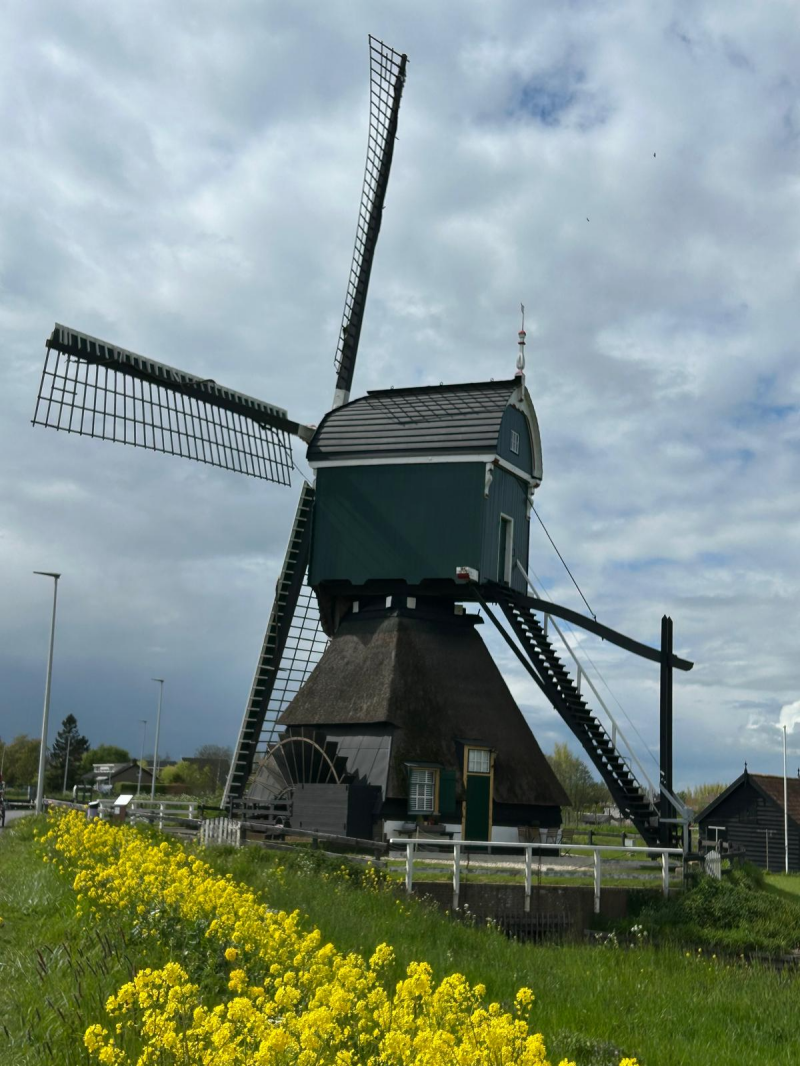
The Light and a Word That Lingers
April 20, 2026
The weather forecast had promised us slightly better weather. The temperature felt fine, so we decided to go cycling — toward the part of the sky where the clouds looked somewhat white. Leaving the dark clouds — literally and figuratively — behind us.
We set off while it was still lightly raining. The black sky behind us and the white cloud cover ahead created an almost fairy-like atmosphere. The yellow of the rapeseed fields became almost fluorescent. Ton and I kept talking about how the yellow, purple, and pink of the flowers seemed to come alive in this light. In that sense of wonder, I barely noticed the drizzle or the cold wind anymore.
We see swans, geese, coots, and moorhens sitting on their nests. Soon we’ll start seeing chicks again. It makes me so happy!
So many cycling paths — through the countryside, along small waterways and rivers, through villages. Beautiful houses, farms, villas with large gardens and wide open views. Farm shops, B&Bs, home-based beauty salons — perfect ways for women to work from home.
At the edge of a farm, I notice a sleek, modern sign: Epicurean coaching. It stands out. The way my mind works, I mentally stumble over a word like that.
At some point my calves start to feel stiff, and I tell Ton we should stop at the first bench we see, to rest and enjoy the view. It takes a while, but eventually we find a table with two benches by the water. A man is already sitting there. We ask if we can join him. He says yes and immediately starts talking about how beautiful and peaceful it is here. He tells us about other places in Europe he finds beautiful, and that he would actually like to live in Luxembourg.
“But,” he says, “my wife is buried here, so I can’t leave anymore.”
Ton and I listen politely and smile. Neither of us really feels the need to continue the conversation. We greet him kindly and leave him with his thoughts. When we cycle, we don’t talk much — we mostly just look.
After about ten minutes, I say:
“‘I can’t leave because my wife is buried here.’”
Ton laughs. He knows I’ll get stuck on a sentence like that.
I continue:
“It’s interesting how differently a sentence like that can live. One person locks themselves in with it, while another might feel free to move in a different direction.”
I leave it at that. It felt good that Ton heard it too.
Back home, I sit down at my laptop. An ad appears in the sidebar: Epicurean cutting board.
What…?! That word again. I need to look it up.
Epicurean refers, on the one hand, to Epicureanism — a philosophy focused on moderate pleasure and inner peace — and on the other hand to a brand of durable cutting boards and kitchenware made from compressed wood fiber.
I laugh.
It’s basically that saying:
“Everything that’s ‘too much’ is no good — except being content.”
My father used to say that so often.
It probably originates from Epicurus’ philosophy and has lived on that way over time. And now, apparently, it has resurfaced — in the form of Epicurean cutting boards and Epicurean coaching.
What makes something linger—
a sentence, a word, a moment in the light?
Is it coincidence that it returns,
or does it begin to speak
only when I am ready to hear it?
Life in Motion — What Love Has Taught Me
April 19, 2026
In my life, I have known two very different relationships.
And both were real.
One relationship was intense.
Everything went deep.
Feeling, searching, touching — nothing stayed on the surface.
It was a connection that carried me, that opened me, that showed me things I might never have faced otherwise.
The other relationship is calmer.
More rooted in everyday life.
Sharing meals, talking, making plans.
Less grand, less overwhelming perhaps — but present, stable.
In the past, I would have thought that one was better than the other.
That depth lived in intensity.
Now I see it differently.
Both relationships have touched something different within me.
In one, I was confronted with my depth, my surrender, my ability to feel everything.
In the other, I am learning something else.
To stay. To be present. Not to disappear into the grand, but to remain in the ordinary.
And honestly… I sometimes find that more difficult.
Because life is not always intense.
More often, it is simply ordinary.
Conversations that lead nowhere, days that repeat themselves.
And yet, something happens there.
I notice that I no longer have to leave.
That I no longer have to search for something greater in order to feel that things are right.
The depth is still there, but it no longer needs to prove itself.
When I was still teaching, I often said:
in principle, you can have a relationship with anyone.
Not because everyone is the same, but because every relationship touches something different within you.
Only now do I truly see that reflected in my own life.
One relationship showed me how deep I can go.
The other is teaching me how to stay.
And maybe that is what it’s all about.
Not choosing which one is better,
but seeing what they allow you to develop.
Perhaps love is not one single form.
But a path where you keep meeting different parts of yourself.
Heaven
April 18, 2026
“What is heaven?” a child asks his mother. Grandpa is no longer here, but he has gone to heaven.
It’s quite remarkable, really. That we explain things to children while not even knowing for certain if they are true ourselves.
Saint Nicholas, Santa Claus, the Easter Bunny, angels, Jesus, Mohammed, God, Arjuna, fairies, gnomes, heaven, hell… it’s only the beginning of a long list of things we believe in, or feel something about. Belief, legends, myths, fairy tales — or perhaps truths. To me, they are all allowed to exist. I don’t feel the need to exclude anything.
Everything we see, hear, smell, feel, taste or believe — everything that is — has the right to exist. Each person takes from it what they need to understand the world and themselves. And in that, everyone is unique.
The question of what heaven is brings me back to my youngest son.
My father was laid out in our living room. On a kind of stretcher with cooling underneath, surrounded by a curtain. On the day of the cremation, all the children and grandchildren were there. My son was three years old.
Years later, during a group conversation at school, that same question came up: what is heaven?
He told the class, with full conviction, that when you go to heaven, you go on wheels. Not driving, but lying down.
Someone had said that grandpa had gone to heaven. And he had seen how the undertakers removed the curtain, rolled the stretcher out, and took my father away.
That image had stayed with him.
I have always been quite direct with my children. When they asked what had happened to grandpa, I said: he was ill and he died.
“What is that?”
That’s difficult to explain. Someone no longer lives, only the body remains.
“Where does that person go?”
I don’t know exactly. It’s a mystery. There are many ideas about it.
If he imagined that grandpa had gone to heaven on wheels…
then I thought that was a beautiful image.
And even years later, he still remembered it that way.
For me, heaven is literally the sky. The clouds, the blue vastness, the atmosphere, the stars. But figuratively, it is something else. A feeling of freedom and happiness that lives within me.
For me, heaven begins here, on earth.
I experience it when I create. In nature. In moments of stillness and space.
And if I am ever gone…
you might find me again in my paintings.
Or outside, in nature.
Then you are visiting my heaven.
Does heaven exist somewhere far away…
or is it already within us?
And when an image stays with us,
who decides…
what is true?
Young on the Inside
April 17, 2026
Today we met up with friends of mine. They are both eighty years old. It’s remarkable to have a conversation with them just as we always have. Nothing seems to have changed.
They recently bought another large camper and spent two months traveling through Spain. Soon they’ll be heading to Sweden to visit their daughter. They laugh about it themselves — such a massive vehicle, at their age. They know people might think they’re crazy. But what does it matter? As long as they enjoy it together, as long as it gives them freedom.
I’ve known them for a long time. Nearly twenty years ago, they bought a house in Spain. He still rides his motorcycle. Ton was surprised to see how active and adventurous they still are.
The older I get, the more my ideas begin to shift. Also about age. About what is possible, what is not. What fits, what doesn’t.
To me, they are an example. Simply continuing to live, to do, to explore — for as long as it is possible. And when the body eventually says, “it’s time to slow down,” then you can always decide what comes next.
I’m beginning to see how little age really says. One person is old at seventy, another remains vibrant well into their nineties. It’s so individual. Perhaps it’s genetics, or the way you live. Staying active, eating well, remaining socially connected, continuing to challenge yourself. Or maybe it’s simply a matter of luck… or chance.
For me, one thing is clear.
I may grow older in years, but inside, I remain young.
My opinions are fading. They seem to dissolve over time. It makes me softer. Kinder. Perhaps wiser — though I don’t fool myself. Every day I still learn. From what I see, hear and feel.
I enjoy getting older more than I ever enjoyed my younger years.
I feel like a blessed person.
Do we grow older in years…
or younger within?
And what remains
when everything that once felt certain…
softens over time?
Meaning
April 16, 2026
Yes… there it is again. A sentence I hear, and it stays with me.
There is no motive, so there is no meaning. You only think that because you are looking for meaning. But meaning is not something you find — it is something you give.
Today I had to go to an independent neurologist for my driving license evaluation. Because of my disability, I drive an adapted car. In the past, I had to be assessed every two years. It caused a lot of stress and was also expensive. The word evaluation alone already brings resistance. Why do I have to be assessed again and again? As if having a disability automatically means being incompetent.
Five years ago, I said this out loud. How humiliating it felt. That you constantly have to prove that you are capable of participating. The neurologist understood my frustration and arranged for the next evaluation to be five years later.
Today was that day.
This morning, Ton asked me something, and I snapped at him immediately. That says enough. For me, evaluation equals stress. And stress means a short fuse.
That’s not who I want to be. So I paused, took a few deep breaths, and consciously tried to go to the hospital without prejudice.
We went by van so we could go straight to the forest afterward and enjoy a bike ride. The sun was shining. That alone already brought a sense of ease.
The neurologist turned out to be a young, approachable woman. Her questions felt genuine, not procedural. The examination confirmed what I already know: my core functions well, and my limbs respond through visual control. Because I take good care of my body, it remains strong. My speech is limited, but I don’t need that to drive a car.
Everything went smoothly.
And I walked out of the hospital feeling light.
Had I given this evaluation less meaning?
Is not assigning meaning a form of letting go?
My driving license itself matters to me. But the tension wasn’t in driving — it was in the meaning I had attached to the evaluation. By letting that go, something simple remained. A formality. A meeting between two people.
And suddenly… there was ease.
A little later, I was cycling, completely free of stress.
Back home, with a healthy glow on my cheeks, I turned on the television.
And right at that moment, I heard that same sentence about meaning again.
Am I searching for meaning,
or am I placing it everywhere myself?
And what remains
when I stop doing that…
The Drop
April 15, 2026
My husband reads the newspaper and watches the news. He worries about what is happening in the world. I used to do the same. I kept myself well informed about both national and international events — a way of maintaining general knowledge, you could say. Since Michel passed away, I have consciously turned off the television and cancelled the newspaper. I have taken distance from all the suffering that reaches us through the media. That doesn’t mean I know nothing about the world — enough still reaches me.
I used to have opinions. About politics, wars, injustice. Now I try to stay away from that. I have the feeling that nothing is quite what it seems, that there are always more perspectives than the ones we are shown. If you look at history, nothing develops in a straight line. On every level — micro, meso and macro — the lines of peace, war and awareness move up and down.
I hold on to a simple cliché: change the world, begin with yourself. I believe that is the only place where I can truly make a difference. I believe in the single drop in the ocean.
In the car, Ton asks me what I think the king and his wife should do. Whether they should go to President Trump or not. I laugh. I don’t know, of course. I see it as a diplomatic role. So I simply say:
“Keep your friends close, but your enemies closer.”
Ton looks at me, surprised. Sometimes it’s not about having an opinion, but about communication. Maybe it works that way too.
My heart aches when I see what is happening in Gaza, in Iran, in that entire region. I think of Mesopotamia, of Sumer — the oldest civilizations. I was already fascinated by them as a teenager. So much of our origin lies there. And now… people destroying themselves and their surroundings in the name of power. It is hard to comprehend. And yet, it seems to be a law of human nature that we keep returning to it.
What can I do? Who can I change? Who can I hold accountable?
Only myself.
I think of a story from the Mahabharata. A small bird lays her eggs on the shore. A wave takes them into the ocean. The bird begins to empty the ocean, drop by drop, to retrieve her eggs. It seems impossible. But the bird believes she will succeed, as long as she continues.
Arjuna sees her and asks what she is doing. He points out the impossibility. But the bird continues. Patient. Loving. Determined.
In the end, after a long time, Arjuna decides to empty the ocean in one single act. The bird finds her eggs.
I believe in that quiet miracle of simplicity.
Myself… as one drop in that ocean.
Is the world too vast to change,
or am I too small to try?
And what happens
when one single drop…
simply keeps moving?
The Word
April 14, 2026
There are words, sentences, and moments that are etched into my memory like images. At first glance, they may seem ordinary. But the fact that they continue to evoke something within me tells me they carry meaning. At least for me. I’m very aware that this meaning may not be the same for someone else. It reflects the way I move through life: curious, but not searching. I let things come to me. There is no need to hold on — they return on their own, when the moment calls for it.
I am not particularly religious, though I was raised within a Christian tradition. I would describe myself as eclectically spiritual. Whatever resonates is welcome and helps me give meaning to life.
As a child, I was fascinated by the Bible. I would lose myself in the stories. Even then, I saw more metaphor in them than literal truth.
“In the beginning was the Word.”
That sentence has resonated within me my entire life. Whatever its meaning may be, the Word holds weight for me. I listen closely to what people say — and how they say it. Sometimes something sounds kind, yet I hear something entirely different beneath it.
Maybe that’s paranoia… it could be. But that is how it works for me.
Today we took the van — bikes and dogs with us — and drove to the Betuwe. It was a sunny day, with fields glowing yellow from rapeseed, dandelions, and buttercups. Trees in full bloom, red, pink, and white. A soft, sweet scent in the air — it felt like a dream.
We cycled along paths without traffic, surrounded only by nature. Then through small villages, where time seemed to stand still. Well cared for, clearly loved. We found ourselves amazed by how much there is to discover in our own country. We’ve made a plan to explore the Netherlands by bike.
It felt as if I had stepped back in time. This afternoon I cycled through a village celebrating 1,025 years of existence. The upcoming festivities were already being announced.
Riding over the cobblestones, I caught something in the corner of my eye — a line of text on the wall of a small church.
Bam.
A hundred meters further, I said to Ton, “Can you go back and take a photo of that church?”
It read:
“Your Word is a lamp for my feet and a light on my path.”
Beautiful.
I understand that it refers to the Word of God. That may be so. But I read something slightly different:
“The Word is a lamp for my feet and a light on my path.”
A small difference…
but for me, it goes deep.
I don’t go looking.
It simply enters, through the corner of my eye.
Am I searching for meaning…
or does meaning find me?
And how much of what moves me
was already there…
long before I noticed it?
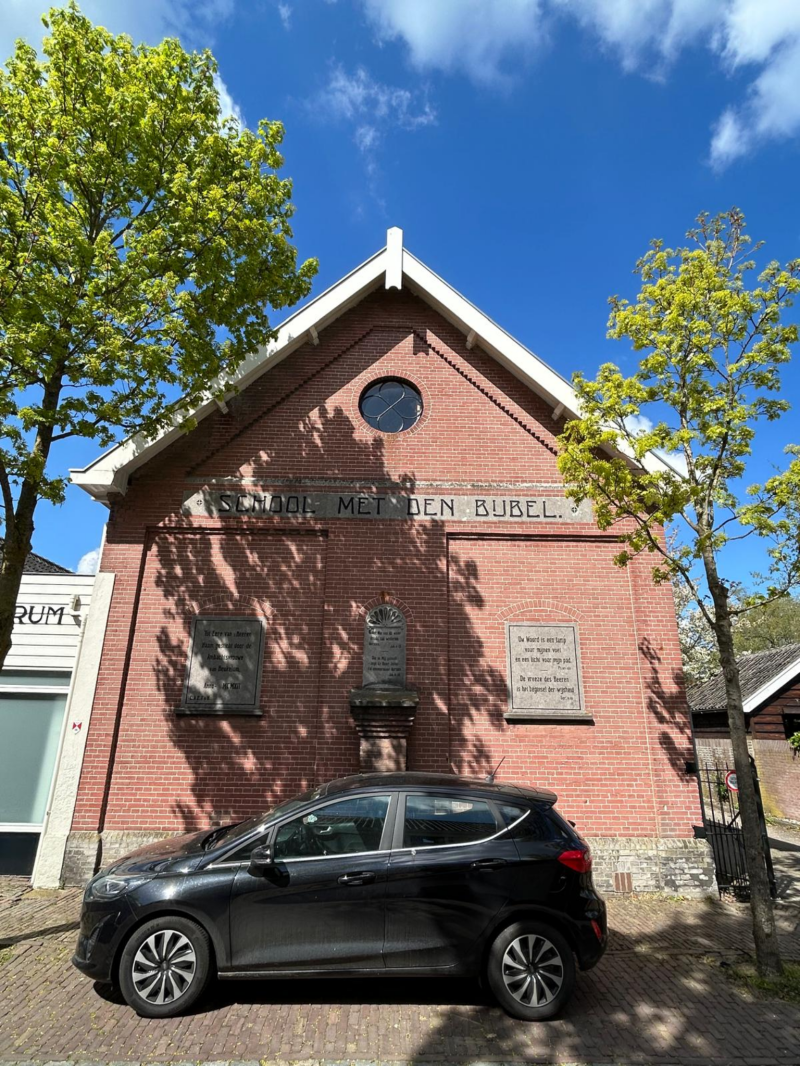
The Red Thread
April 13, 2026
History repeats itself. It sounds like a cliché, but within families you see it happening again and again. I think of it as a red thread that runs through different situations — sometimes clearly visible, sometimes more subtle.
We all want to be unique. At least, I felt that very strongly when I was younger. Being compared to someone else felt like a direct insult. When I had children of my own, I started to see it differently. They are unique, and yet they carry traits that are so clearly mine.
They are grown now, and every now and then I see them walking paths that I once walked.
At the birthday of my oldest granddaughter, who just turned sixteen, I spoke with her other grandmother. She looks so much like her mother — you can clearly see the family resemblance. I told her how, years ago, I was shopping in the city when a man stood next to me and kept looking at me very intently. I asked him why. He told me I looked exactly like one of his students. It turned out to be my daughter. You don’t always see that resemblance yourself, but to someone else it can be obvious.
My daughter now has a blended family of her own, just like I once did. Nowadays that’s not unusual, but the dynamics can still be complex. I recognize certain things in what she is going through.
She calls me for advice.
Even though she was young at the time, she still remembers how difficult things could be. It makes me happy to see how carefully she considers her responses now, how she tries not to lose herself the way I sometimes did.
Her first instinct is still to give and to adapt. But she also sees that this isn’t always recognized or appreciated. So why take on responsibility that isn’t truly yours?
With the calm and perspective I have now, I can tell her honestly that I would make different choices today. She doesn’t have to follow my advice. She will walk her own path, with her own lessons. Maybe she will take something from it, maybe not. Time will tell.
When she was younger, she used to ask:
“Mom, should I wear the red, the blue, or the green sweater?”
If I said, “the red one,” she would reply, “No, it’s between the blue and the green.”
“Okay, then the green.”
And in the end, she would come downstairs wearing the blue one.
Inside, I always had to laugh.
The apple doesn’t fall far from the tree…
I am proud of my children. They are navigating their own uneven paths, and sometimes it seems they learn faster than I did.
Maybe that’s how it works across generations.
The red thread remains…
but slowly changes its color.
Do we repeat the past,
or slowly rewrite it?
And how much of what is passed on
changes…
without us even noticing?
A Place Without a Name
April 12, 2026
This time, I want to share something sensitive. It brings up a lot within me.
It started last night. A friend I hadn’t seen in a while came over. It was nice, and I was happy to see her again. She has had a difficult year after the passing of her mother. For a long time, she didn’t have the energy to stay in contact with friends. I understand that — grief can bring everything to a halt.
And yet… something happens within me.
I listen to her story, and to others who have lost their mothers. How heavy it is. How deep the sense of loss. And I notice that I don’t recognize it. Not a little… but not at all.
When I say out loud that I haven’t felt grief, people often respond that I must be suppressing it. But that doesn’t feel true to me. It isn’t suppression. It feels more like an emptiness. Or perhaps better said: a missing connection. I don’t miss anything, because there is nothing to miss. And that is difficult to explain.
When others speak about their feelings, I sense that something in me cannot connect. As if a link is missing. It isn’t a problem. But it is there.
This morning I wake up early and stay in bed for a while. I turn on Netflix and start watching Trust Me: The False Prophet. The story affects me. I see how people grow up in a world where truth and lies become intertwined. How beliefs slowly shift, and how morality is influenced.
In the final episode, a woman says: “My whole life, I was raised with lies.”
That sentence hits me like a knife.
It’s not the same, but it touches something I recognize. Growing up with lies. Not as a specific event, but as an underlying layer. Something that shapes you, without you fully knowing where it lives.
I tell Ton about it. And while I’m speaking, something becomes clear. A family, a system, a place where something fundamental is off… may never fully heal. You can understand it with your mind, but there remains a place you can feel — and cannot find.
Perhaps that is the place where my sense of loss could have been.
And perhaps it touches something else as well.
That I sometimes wonder if, in my own role in life, there is something I have missed. Something I may not have been able to pass on. The difficult part is that I feel something… but I don’t know what it is.
Today, this insight doesn’t bring confusion.
It brings me closer to myself.
Is it only possible to miss something
if it was truly there to begin with?
And what happens to a feeling
that never had the chance to exist…
yet still makes itself known?
Nothing Has To
April 11, 2026
Yesterday I didn’t write. Why not? Very simple: I didn’t feel like it. I spent the whole day on the road picking up our new van, driving the scenic route behind Ton. All in all, it was quite an eventful day. Tired but satisfied, I just wanted to relax afterward.
Skipping my blog is literally stepping out of my comfort zone. When I decide to do something, I normally don’t deviate from it. Certainly not out of laziness. Because that’s what it was… right?
This morning my body still felt tired. I decided not to go train. Yesterday I had already done one round less. Today, I simply cancel it.
What is going on with me?
I’m someone who keeps going even with a high fever. Someone who continues despite pain or setbacks. Someone who, after a severe stroke, went out for dinner with friends just a few days later, as if nothing had happened.
Have I become wiser? Where does this shift come from? Was it habit? My way of being? My comfort zone? Or was there something underneath — insecurity, fear, the need for reassurance? Afraid that everything I build might disappear again?
Honestly? I don’t know exactly. Maybe a bit of everything.
What I do see now is that I’m listening to how I feel. That I’m less strict with myself. Nothing has to, everything is allowed. Who knows, in a while I might be able to say that many self-imposed stress factors have disappeared.
I’m curious to see whether I will notice that, both inside and out.
Looking at yesterday and today, I can only say that — for me — I’m doing something quite new.
Is this slowly becoming wiser?
Or am I secretly just turning grey?
Making Plans Together
April 9, 2026
It wasn’t very busy at the gym this morning, but the people who were there were clearly enjoying themselves. There was laughter. The sunshine and the beautiful weather seem to make everyone a little playful. Yes, that’s the right word. People appear full of energy, lively and light.
Ton and I had decided to cycle to our storage unit. During the winter months, he moved some things there, and I hadn’t seen it yet. A ride with a purpose always feels good. On the way, we stop for brunch at a café-restaurant we used to visit regularly last year. There’s only one table left on the terrace. It almost feels as if it’s waiting for us.
The waitress greets us warmly. She’s happy to see us again. That feels good. Sitting in the sun, Ton and I start talking about what we might do once we have the van.
This time, Ton begins.
I love that… it almost makes me feel emotional. And at the same time, it surprises me. Why does this touch me so much?
I’m used to being the one with the plans and ideas. Michel would follow me in that, almost without question. Ton needs time. His first response is often more reserved, as if he wants to feel into it before stepping forward.
For sixty-three years, I have followed my own ideas. But making plans together, letting ideas grow through conversation… that is so much more enjoyable.
More enjoyable than leading and being followed.
More enjoyable than having to fight for something.
This is what makes me happy: dreaming together, making plans together.
With Michel, we had a busy life with family and work. I remember sometimes speaking out loud about how it would be when we could be together more after his retirement. He didn’t want to think about it. As if he couldn’t imagine it. I could feel that the idea didn’t sit well with him. We never got to experience that together.
Now, with Ton, we live together — and yet also each in our own way. That’s how it feels to me. I realize that coming together later in life and building something shared takes time. We love each other, we share a life, but it grows gradually.
Cycling together started as my initiative. We’ve been doing it for three years now whenever the weather allows. And we truly enjoy it.
But the fact that Ton is now the one speaking about plans…
that adds something new.
It may seem small, but for me, something shifts.
Something deepens.
And on a day like today, I realize how important that is to me.
Is being together the same as moving together,
or does it begin when you start looking ahead as one?
And what begins to form,
when two lives don’t just meet…
but slowly grow into each other?
A Dream That Shifts
April 8, 2026
What is it about getting older? A sad film or a touching story makes me feel sentimental and tearful much more quickly these days.
Today was warm outside, the kind of day that invites you to go out for a bike ride. Ton and I have been talking for a while about how wonderful it would be to have a van — one where my cargo bike, Ton’s bike and the dogs could all fit. It would greatly expand our range. We dream about it, but don’t really see it as something within our reach.
And still… that old feeling of limitation, caused by my condition, always rises for a moment. Not being able to ride a regular bike also means that a simple bike rack is not an option.
After my training, I’m home and, as I often do, I start searching online for a van. Just like I often look at houses. Am I fooling myself? Maybe. Do I get frustrated? No. I’ve been doing this for as long as I can remember. What is wrong with having a dream? What is wrong with continuing to look, even if it doesn’t seem realistically attainable?
Today I come across an advertisement for an electric van. I show it to Ton and ask if we could go and take a look. Normally, he wouldn’t want to, especially if he thinks something is out of reach. But this time, he calls. We’re welcome to come by. It’s somewhere in Utrecht.
We decide to take the scenic route. Every time again, I enjoy the meadows, the trees, the nature and the villages in the Netherlands. We really do live in a beautiful country.
We’re allowed to take the van for a drive. Soon we find ourselves on a very narrow road, running alongside a winding stream. I think to myself: this feels more like a bike path than a road. And there we go… zigzagging in that van, with no end in sight. Hahaha, that was quite something.
Back at the garage, we make a decision.
We buy the van.
In the car, it’s quiet. To avoid traffic, we take the scenic route back again. I feel strange. Almost as if I’m startled. Even a little emotional. You would expect me to feel excited, maybe even elated.
I say it out loud to Ton.
He looks at me and feels exactly the same. He is usually more emotional than I am, but now we both feel it. Strongly. Connected.
Something has shifted.
We have made a dream real.
And as we drive, we can already see the possibilities ahead of us.
It makes us quiet…
and at the same time, we feel a deep anticipation for what is to come.
Is it the fulfillment of a dream that moves us,
or the moment something suddenly becomes possible?
And what happens inside,
when what once felt far away…
comes close?
The Same, in a Different Light
April 7, 2026
Every morning I check my email. Most of the time I can delete messages without opening them, almost without thinking. This time I notice an unusual first name. My eye lingers and my finger stops. I read the message. I’ve won a DIY Award with my latest creation Power of Stillness. They only have my email address, not my home address. What luck that the sender has such a distinctive name.
I immediately send messages to everyone I know who voted for me. A stream of kind responses follows. A wonderful way to start the day.
We cycle through part of the Biesbosch and decide to see if family is home. For that, we head back toward the inhabited world. In the avenue we’re cycling through, the sun shines straight into my face. The tightly pruned trees stand out as dark shapes against a bright blue sky. It feels as if I’m cycling straight into a fairytale. I stop. I want to take this in. This is an unintended form of art. I take two photos: one against the sunlight — because that’s what makes the image so striking — and one with the light, to help remember what I actually saw.
My cousin and his family are home. Mother and daughter sit behind the sewing machine, my cousin is ironing, his son is outside reading a book in the sun. Warm and homely. As always, welcoming. Beyond the initial conversations, real conversations emerge.
How do you deal with dark thoughts?
Do you fight them?
Can you? Should you?
The son is religious and struggles with this question. I tell him that I sometimes have very violent images in my mind. That I speak them out loud to Ton, but that I don’t fight them. I let them pass. I know I am a good person, not capable of acting on such thoughts. To me, everything exists within a human being — from light to dark and everything in between. We live in a world of opposites, from beginning to end. Perhaps we first learn, and later only deepen what we already carry within us. That thought gives me peace.
We cycle back home. I see the trees again, now in a different light. The image is completely different. And yet they stand there the same. Perfect. Unchanged.
Does what I see change,
or does the light in which I see it change?
And if everything remains the same,
what is it that truly moves?
When Color Appears
April 6, 2026
Easter Monday. A sunny day to go out for a bike ride. We were clearly not the only ones — it seemed as if all of the Netherlands had set itself in motion, on bicycles or in cars, heading out to enjoy something.
I notice every blade of grass, every flower, every change in nature. We cycled this same route two weeks ago. We like to ride the same path regularly, so we can follow the growth and blooming.
But today, something else caught my attention.
A car. In a beautiful khaki green metallic color.
It stood out to me because I almost never see that color on cars. I often tell Ton that black and all dark colors should be banned. If there have to be so many cars, then let them at least be colorful. The streets would immediately feel lighter and more cheerful.
But what happens, to my great surprise?
We come across six different cars in exactly that color.
Of course, once home, I look it up — curiosity being what it is.
And it turns out: green is currently a trend in car colors.
Who knows… maybe in darker times, people unconsciously choose more color. To make their surroundings feel a little lighter, a little more alive.
For me, it was striking.
At home, Ton was apparently reading my website. On the homepage it says:
Widow, Empty Nest, and Grandmother — together they formed the word AWAY.
A word that carries both absence and movement.
He noticed that the name of my website, Colours in eMotion, actually carries the same message.
Colours in eMotion — colors in motion through emotion.
Or…
colour sine motion — color without movement.
Sine being the Latin word for without.
WOW!!!
First of all, I love that Ton, like me, starts to associate and connect. We know of each other that we count planks, notice lines, follow tiles. He spots language errors everywhere — but this is new. It shows how, as a couple, you always end up coloring each other a little.
Secondly, a memory surfaces.
The website was created after Michel passed away, but that feeling of absence in motion was already very present. The name Colours in eMotion came to me purely intuitively.
Just like with my paintings, where I often only come to understand the meaning or depth later on. My paintings speak to me — I call that dweilen.
And now I notice that while writing, I find myself in the same kind of bubble or flow as when I paint.
Perhaps the words will also tell me more…
than I initially intend.
Is it coincidence that something suddenly catches your eye,
or does it only begin to exist the moment you see it?
Is the world moving…
or is something within me moving along with it?
Easter
April 5, 2026
Today is Easter Sunday. It is quiet in the house.
Once, this was an important day for my family, often together with the family of my friend. We would prepare an elaborate Easter brunch and hide eggs in the garden for the children.
Times change. My friend has passed away, my children have grown up and have let go of the family tradition, probably to give it their own meaning.
To be honest, it does feel a bit empty.
The days that were once filled with people, food and togetherness have come to an end within my family. No Easter celebration, no Ascension weekend, no Christmas, no New Year’s celebration. I haven’t celebrated my birthday for years either. On the one hand, I truly feel my children should not have obligations. The pressure of “having to” from my childhood — and later on as well — is something I do not want to pass on to them. And I myself am not drawn to the busyness in our apartment. That I sometimes miss it at the same time… is therefore understandable.
It creates space to give these days my own meaning.
The sense of freedom I wish for my children is something I may also embrace for myself.
Today I found myself exploring what Easter actually means. In a typically Annette way, I started to reflect on it. The Christian Easter story speaks of the resurrection of Jesus.
Well… rising from the dead. Is that even possible?
Does this story literally tell that the son of God dies and comes back to life?
Or is the Bible — and this story — a metaphor?
I then think of pivotal moments in life that suddenly make you see things differently. A radical shift. That can take many forms. When I think of death and resurrection, I also think of nature. The constant cycle of life. Plants die, yet leave behind seeds and spores. Animals and humans die, yet leave new generations behind. As long as something is not extinct, it remains part of this cycle.
Hahaha… it also makes me think of the children’s song “On one tree a cuckoo, simsalabim sala doe saladim.” That cuckoo returning every year — I already heard it in the air last week.
Looking purely at the word “resurrection”…
Re: again, anew, back.
Surrection: to rise.
It can mean so many things: to arise, to emerge, to appear, to recover — but also to rebel. All of these meanings are part of not only my life, but of everyone’s life, I think. Perhaps we all experience one or more figurative deaths — and rise again.
My thoughts then move to fairy tales. It appears there as well. Think of Snow White, Sleeping Beauty and The Frog Prince — always symbolic of a transformation for the better.
But then… the Easter Bunny and egg hunting.
I really had to look that up, because what does that have to do with Easter?
Originally, a hare or rabbit symbolized fertility in pagan cultures — a symbol of spring and new life. The Easter Bunny only appears in writing in the late 17th century. Of German origin, where the Easter Bunny would bring eggs to children, somewhat comparable to the Saint Nicholas tradition. In Greek mythology, the hare also appears. In one legend, the spring goddess Ostara transforms a bird into a hare, which does not forget its origin and therefore lays eggs. Germanic tribes would offer eggs to this goddess at the beginning of spring.
All in all, from various traditions — religious, spiritual and narrative — customs have emerged around this time of year, which we now call Easter. Everyone celebrates it from their own perspective.
While standing in my studio to print something, my eye falls on the title of a book: The Illusion of Life.
Yes, I think… that is exactly what it is for me.
Who am I to know what it is all supposed to mean?
Is emptiness the end of what was,
or the beginning of what has yet to take shape?
Is rising something that happens after a fall,
or something that continuously presents itself — without beginning or end?
And if everything keeps moving,
what does it mean… to be?
Seeing Light
April 4, 2026
I’m happy that it’s finally cycling weather again. Spring, the awakening of nature. Experiencing and observing this has truly become a shared hobby for Ton and me.
What stands out most right now is how the grass, the dandelions, and the rapeseed almost seem phosphorescent. As if there is light within them. The colors are young and fresh, and that makes them appear to glow.
The only time I have seen colors this intense before was while diving in the Maldives. Back then, I thought such colors could never be matched above water. Today, it dawns on me that when nature awakens, that same vibration can indeed be seen here as well.
Apparently, an assumption from the past can simply shift. Is it because I have started to look differently? Or because my experience has changed? Or because I give words to my days, my observations, and my thoughts?
This evening, Ton and I were watching Who is the Mole?, filmed this year in Tanzania. We were lying on the bed, the dogs beside us, something to drink within reach. On the screen, the savannas and animals appeared. Elephants, giraffes, antelopes.
Just last week, I told Ton that animals in the wild look different from those in a zoo. Not only freer, but as if they carry light.
I experienced that very strongly in South Africa. Animals in their natural habitat have a presence I have never seen anywhere else. It is difficult to put into words, but it is there. A kind of light, a presence that can be felt.
As I watch, I recognize it immediately. The same light I saw outside today. Perhaps it lies within me. What I see is not only in the world around me, but also shaped by how I look, how I feel, how present I am in that moment.
By seeing nature this way — luminous, alive, almost vibrating — something shifts within me. And we… we are simply part of that.
How close can a person come to happiness…
just by seeing this?
Perhaps not something great happens every day,
but I can choose to see greatly every day.
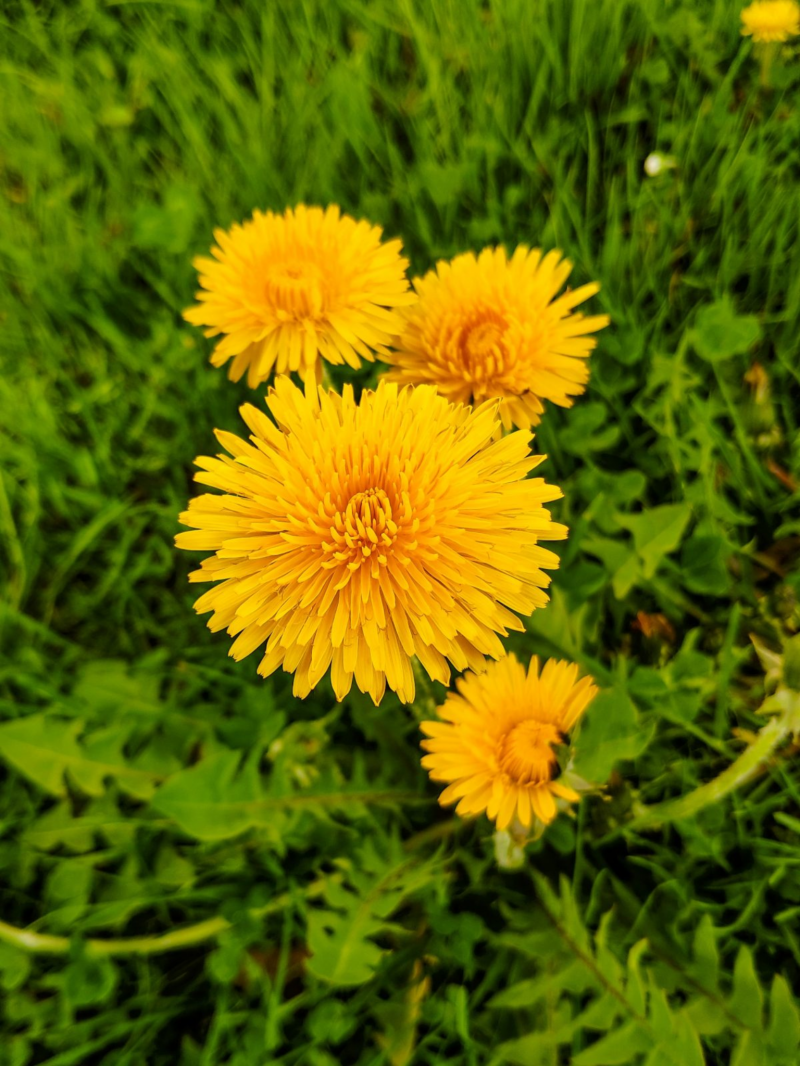
A New Perspective
April 3, 2026
On a tree, a cuckoo, sim sala dim, bam bas, sala doe, sala dim… That is the first thing that comes to mind when I hear someone talk about the cuckoo.
The cuckoo that lays its eggs in another bird’s nest. A master deceiver. Its eggs adapt to the color of the nest, and once the chick hatches, the other eggs are pushed out. So small, and already so driven by survival.
Then One Flew Over the Cuckoo's Nest crosses my mind. The cuckoo as a symbol of madness.
And suddenly, I think of my mother.
I have written before that she had a narcissistic personality disorder. Growing up in such a family leaves its mark. Unbelievable things happened. Painful, heavy, but sometimes also absurd and almost laughable.
I can still hear her say, in that mysterious, suspicious tone:
“Well… that’s what they call stealing a child.”
She meant that women would become pregnant without their partner’s knowledge, to bind him to them. Only much later did I realize that the saying people judge others by their own nature might have been more appropriate here.
Today, for the first time, I see a different metaphor. Not Narcissus, but the cuckoo.
We children… from different nests, but of the same mother.
As I follow that image, I become curious. How is the cuckoo actually seen? In Europe, it is associated with spring, but also with infidelity. That does seem to fit.
But what does the cuckoo do in nature?
It eats hairy caterpillars that other birds avoid, even poisonous ones. Through its breeding behavior, it forces other birds to become more alert, to develop stronger defenses. As a migratory bird, it connects different ecosystems. It is even considered an indicator of a healthy environment.
That surprises me.
Just as in nature every disadvantage also has a function, perhaps the same is true for human beings.
I have lived through and felt the darker sides of my mother. But there were other sides as well.
And perhaps this is the moment.
To turn my gaze, in the final trimester of my life, toward the light. Not to deny the darkness, but to be able to see the whole.
Because ultimately, that is what it is…
My story.
Perhaps I did not come from one nest,
but from one story.
What I saw does not change,
but how I look does.
And in that, everything shifts.
A Different Moral
April 2, 2026
At the moment, I’m reading Mongolian folktales. It’s interesting to notice how it physically affects me. Shock. Even a sense of being disturbed by the brutality of the stories. A lot of killing and violence.
When I take a bit more distance, I begin to see something else. Standing up for the common people, for the underdog. Respect for nature, and an alertness to the behavior of animals. They are, in essence, fables — short stories in which animals display human traits. A tribute to ordinary people, and at the same time a subtle satire on those in power. After each story, something lingers. A life lesson, without being spelled out.
“And they lived happily ever after” is something I have not yet come across. Nor a shepherd boy or a frog turning into a prince.
By reading folktales from other cultures, you begin to understand their world. Their environment, their way of living. Where hunting has long disappeared from our daily reality, it may still be close to life for nomadic people.
And then, suddenly, a moment. In one story, a man beats his loyal dog to death with a stick. My heart skips a beat. Truly. Is this a folktale?
That’s when I notice something in myself. To be able to read and understand these stories, I have to let go of my own sense of morality for a moment.
Perhaps that is what reading asks of us. To step into the world of the storyteller without immediately judging it. And it works the other way around as well. When I write, I enter a kind of magic myself. Words appear, and afterwards I often think: did I really write that? As if I discover my own world through them.
Reading has never really been my natural inclination, but perhaps this is how I learn to enter the worlds of others. I absorb what resonates with me. The rest simply fades away.
What remains,
remains on its own.
A Lost Day?
April 1, 2026
In the morning, I usually check my WhatsApp quite quickly. This time, someone sent me a cartoon. She: “Darling, I cheated.” He: “So did I.” She: “April 1st.” He: “June 12th.” My first reaction is neutral. Okay, funny. While brushing my teeth, I suddenly realize: oh right, April Fool’s Day. Something I haven’t really paid attention to since I was young.
We feel a bit slow and decide to go to the gym later. It’s almost empty — luckily not a joke, we can just train. Back home, we look at each other. “I’m going to take a nap,” Ton says. “Good idea, me too.” The weather is actually nice, so I still think: I’ll go for a bike ride later.
We lie down… and fall asleep immediately.
I wake up at six in the evening. We look at each other and start laughing. What just happened today? Was I really that tired? I didn’t feel it that way at all. I thought I would rest for an hour and then continue the day.
What I do notice is that I dreamed the same dream as during the night. As if the night simply continued into the day. A repetition, but more conscious.
Is this what they call a lost day? Does that even exist? Or is it simply rest presenting itself? I assume it was needed. My body gave itself what it needed, without me thinking about it or directing it. Normally, I would say I don’t take naps during the day. That’s something older people do, not me. But this time, I didn’t even feel that resistance.
Maybe that says something. That I no longer have to label it as lost, but as given.
Rest.
Nothing was lost today,
the night simply continued for a while.
Becoming Visible
March 31, 2026
For my painting Power of Stillness, I ordered plexiglass from a plastic sheet supplier. I had a clear idea in mind, but I found it quite intimidating since I had never worked with it before. I watched videos on YouTube to learn how to drill and handle the material without damaging it. Well prepared, I started working. With every circle, I was sweating — so focused, so careful not to cause cracks. But it worked. And I’m really happy with the result.
Then I received an email from the company asking if I wanted to participate in a DIY Award. It felt strange. For me, creating is not a competition. It is a way of getting to know myself, of understanding and growing. Everything I make is a part of me, and that doesn’t align with winning or losing. But when I looked into it, I realized it’s not about the most beautiful project, but about how you use the material. What you do with it, how you approach it, what choices you make. A sharing of ideas that can inspire others. That felt different.
The next step was that people could vote. Which meant sharing it. With family, friends, and acquaintances. I sent it through WhatsApp, Facebook, and Instagram. With hesitation, with tension, and also with a sense of embarrassment that I know isn’t necessary, but is still there. And then the responses started coming in. So positive. So warm. A relief. Why do I still make it so difficult for myself?
Looking back, I can see the steps. Through Ton, I started my website — step one. Participating in a few exhibitions, but hanging my work and then leaving quickly, no physical presence of myself — step two. After my stroke, I began writing consistently on my website — step three. And now this — asking people to vote — step four. They even asked for a photo of the project with me in it. That felt uncomfortable. Being visible is still a challenge.
And suddenly I see it reflected in my work. The plexiglass I use is sometimes clear, sometimes colored, sometimes frosted. Everything is visible, but each in a different way. Sometimes completely transparent, sometimes filtered through color, sometimes softened and diffused.
Perhaps that is my path as well.
Not everything has to be clear all at once.
Not everything has to be visible without a filter.
But step by step, layer by layer,
it may come into view.
And today, something else is present. Gratitude. For the responses, for the steps I am taking, and perhaps also for the fact that, very gently, I am becoming a little more visible.
Not all at once,
but exactly in the way that fits me.
Fifty Years Later
March 30, 2026
We have been friends for fifty years. We have been through highs and lows together, both literally and figuratively. Close at times, distant at others, and sometimes completely apart. Sharing that kind of history is something special. We both feel a bit startled by how long it has been, because we don’t really feel those years. Maybe only when we look in the mirror.
We have both had several relationships. Both divorced. And now we are both with men who are fourteen years older than we are. Synchronicity?
Ton has gone out to do some groceries. She asks if I can make coffee myself now. No, that is still a challenge. Laughing, she rolls up her sleeves to do it herself. And at that exact moment, Ton walks in. We both burst out laughing — the maestro immediately takes over.
She pauses in front of my painting Power of Stillness. It touches me how people respond to it, and now she does too.
The atmosphere is relaxed. We talk about one of her children, who has now changed his first name for the fourth time. She tells how this time it affected her a bit more, and she exaggerates her reaction while telling the story. We laugh. At the same time, I briefly think about how our children often hold on to our first reaction. What lies underneath is not always seen.
She gives me a small book with quotes from Paulo Coelho. It opens to a page:
Laugh at your worries and insecurities.
View your anxiety with humor.
It will be difficult at first,
but you’ll gradually get used to it.
While we are still laughing, I feel how fitting this is. I don’t say it out loud, but I take it in.
A little later, her husband arrives. I tell them about a tune that has been playing in my head:
“And he disappeared to nowhere, it was on a Monday, the northern sun was shining.”
Ton looks it up and plays it for us. After two verses, we’ve heard enough, but when we start talking again, he suddenly says: “Shhh!”
We burst into laughter. We picture ourselves sitting in a nursing home, being entertained with old Dutch songs.
Then her husband asks why one dog still has her leash on and the other doesn’t.
“So you can tell them apart,” my friend says.
“Yes,” I reply, “I’ve taken off my glasses — otherwise you wouldn’t be able to tell the difference between us either.”
We laugh until we can’t breathe.
So wonderfully silly.
And maybe exactly right.
Fifty years later,
we are still laughing about nothing.
And in that… is everything.
What I Finally Saw
March 29, 2026
I don’t often talk with people around me about my preferences for films and series. Even with my closest friends, I don’t really have that connection. Sometimes I don’t even understand myself why certain films or series stay with me. I’ve mentioned before that I enjoy anime and Asian series, but also films that people often say women don’t watch. As if it somehow doesn’t belong.
Apparently, I’m not a “typical” woman in that sense, because The Deer Hunter made a deep impression on me. Not so much because of the war itself, but because of the strong sense of community and what trauma does to a person. That Russian roulette scene… the madness of it, and at the same time the question: where is your breaking point? Do you even know? I don’t think anyone does, until they find themselves in such an inhuman situation. That kind of psychological intensity keeps me captivated.
I notice that I go through phases in what I watch. Sometimes romantic comedies, sometimes documentaries, then animated films or historical dramas. And now, war films. A need arises suddenly, and it is complete. And just as suddenly, it disappears again.
In the early nineties, I watched the series China Beach. Every episode. Later I watched it again online a few times. And over the past weeks, it kept coming back to me. I couldn’t find it anywhere anymore, so I ordered the complete series. Yesterday it arrived. Today it’s still raining. Ton is out, and I start watching again.
Every episode begins with Reflections by The Supremes: Through the mirror of my mind, time after time… Just that first line alone.
And then, after one episode, suddenly that moment. Eureka. After thirty-six years, I know what it is that touches me here.
This series is written from a female perspective. Not as a victim, but as strength. Women who carry, connect, and remain standing within the environment of war. Nurses, entertainers, but also the women often judged — the so-called “public women” — who are shown here in their humanity and their significance. They too carry, they too give, each in their own way.
They are not at the edge, but right in the center of the story.
That is what resonates with me.
And only now do I truly see it.
What touches me
has been there all along.
I just hadn’t seen it yet.
Language That Moves Me
March 28, 2026
When I was young, I had Asian drawings in my room. Minimalist, with flowers, bamboo, and birds. A world I could drift into. At an early age, I would go to The Hague, to a large Asian shop, to buy a kimono. I always chose a red one, with an embroidered scene on the back. I hung it upside down on a hanger on my wardrobe so I could always see it. I wore it daily. At the time, I never thought much about it, but looking back, it has been a thread running through my life. Art, clothing, objects, TV series, yoga, an interest in spiritual traditions.
By nature, I am not much of a reader. A text has to take me in immediately, otherwise I can’t continue. Writing, however, I have done all my life. First in diaries, and since last year almost daily on my blog. Because I missed a lot of school when I was young, I never really developed a strong foundation in grammar. My writing is not literary in that sense, but I do feel something in it — a rhythm, an attunement.
It has also become clear to me that proverbs and sayings are deeply rooted in culture. They carry the history and values of a society. That is why they are often difficult to translate literally — and why they are so interesting. By nature, I am a down-to-earth Dutch person, but the poetic language often found in Asian cultures touches me deeply. Today, in a Chinese series, I came across a few expressions that stayed with me.
“Adding a dog’s tail to a sable coat.”
A strange image, yet immediately clear. In Dutch, you might say something like putting a flag on a mud barge.
“If you won’t feed the wolf, you won’t catch the cub.”
An image that says: without investment, there is no result.
Maybe it’s exaggerated, but these kinds of phrases make something in me warm. As if more is being said than the words themselves. One more, simply to share:
“When storms darken the sky, the rooster still crows. Having seen the graceful one, how could I not rejoice?”
Do not be discouraged by hardship. Keep seeing the light. That is what I hear in it. And somewhere it feels familiar, as if it has always been there within me.
Words carry worlds,
and sometimes I recognize myself in them.
If you know a phrase that touches you, feel free to share it with me.
The Tree That Found Me
March 27, 2026
Last year, my friend got married. I gave her a painting of a tree, along with a written piece about growth, strength, and connection. I also included a well-known image: a circle in which the crown is equal in size to the roots. The Tree of Life. A symbol of balance between heaven and earth, the conscious and the unconscious.
I love forests. Trees that have been standing there for a hundred years or more. It feels as if they have something to tell me. I taught my children to respect nature — not to break branches, not to damage bark or leaves. Let the trees be, and allow them to give you their energy.
When I look closely, I sometimes see a kind of glow. It may be imagination, but to me it feels like energy. Healthy trees seem to radiate something. It brings me calm and joy.
In the late nineties, scientists discovered that trees are connected through an underground network of fungi — the so-called Wood Wide Web. They can send warning signals to each other about insect attacks or drought. It’s remarkable that science has only recently discovered this, while for me it has always felt present. That connecting energy. Sometimes even a sense of sadness within it.
While watching a Chinese series, I notice trees that resemble the Tree of Life. Their roots rise above the ground, as present as their crowns. The image stays with me. So, as I tend to do, I start searching.
They turn out to be banyan trees.
A tree without a single clear trunk, but formed by a network of roots that also become branches. Supporting, growing, extending. In Asia, this tree carries deep spiritual meaning.
And then I read:
Buddha reached enlightenment under a banyan tree.
A symbol of awakening. Of gathered energy. Of inner transformation.
And I recognize it — this is what drew me to it.
Banyan — Tree of Life, Tree of Wisdom.
Since I have given myself the task to write almost every day, I begin to notice more and more. Thoughts and images that linger are not random. They connect to something.
I follow them.
And each time, something opens.
As if I am not searching,
but being found.
Trigger Words
March 26, 2026
When people are interviewed about the state of the world, you often hear the phrase: “It’s complicated.”
In the car, Ton tells me how much it bothers him. To him, it doesn’t feel sincere, not kind, not authentic. He hears a clear opinion hidden inside it. He has no problem with the opinion itself, but with the denial of it.
He recently heard an expert speak about Gaza. The word genocide was used, yet she still called it “complicated.”
Ton wonders: how can you have an opinion about a fact? Why use that word? It feels like something is being wrapped up, softened, or avoided.
I hear him stumble over that word more often. Complicated seems to have become a safe place — a way of not expressing what you truly think or feel. Perhaps that is exactly what the word does: it wraps something in, instead of laying it out.
I recognize this. I once had that with the word sadness. To me, it didn’t say much. It felt like a cover for something else — anger, fear, disappointment. When those feelings are not acknowledged, what remains is this vague “sadness.”
I call them trigger words. Words that touch something, because there is always more underneath.
It is actually quite interesting to see that Ton now has his own trigger words. I wonder if I have influenced him with my sensitivity to language.
Why do we stumble over certain words? Maybe because they are so general that everyone can interpret them differently. The speaker means one thing, the listener hears another — and brings their own perspective into it.
I know that the word diplomacy does not exist in my own vocabulary. Ton, on the other hand, can be very diplomatic. But slowly, I see him moving a little in my direction.
And then I suddenly see it.
Two trees, firmly rooted.
One with yellow blossoms, the other with pink.
They stand side by side, their crowns touching.
And where the light falls on them,
the overlapping part
turns softly orange.
Perhaps something new is created there,
not by becoming the same,
but by touching one another.
The Garlands of My Body
March 25, 2026
A day with little resonance. Outside, one downpour after another. At training, everything was quiet and calm. Ton was out, busy with his own activities.
Silence. Stillness.
Normally I would read something or watch a series, but I simply didn’t feel like it. That state of not wanting, not doing, not engaging — for me, it is not boredom. It is a kind of light, open space.
This afternoon I went to the dental hygienist and then to the dentist. There too, everything felt calm. I was helped almost immediately. It always strikes me how strong my teeth are. It makes me smile. At least there is one thing in me that is simply good and healthy: my teeth.
That sense of nothingness… it is a familiar place. Not emptiness, but more like a crossing point. The place where, as I see it, the movement of life — like a lemniscate — turns. Things happen there without me having to do anything.
And then suddenly: teeth.
The mouth as a gateway to…
From that still point, something begins to move.
As a child, I was a biter. I showed my teeth. I was known as someone with “hair on her teeth” — strong-willed, determined. When I did something, I went all in. I could really sink my teeth into it. And often, I would push just a little further.
But that also came at a cost. I would overextend myself, run on empty.
Time has softened that part of me. More rest. More listening to my body. Less forcing.
And still… those teeth remain.
Strong. Present.
They say you have to hang your own garlands in life.
Perhaps my teeth are mine.
They carry what I show,
without me needing to do anything.
Simply there,
like a quiet smile from within.
The Air Is Empty
March 24, 2026
Ton always reads the newspaper in the morning. Today he tells me about an article written by a natural scientist.
“The air is empty.”
What a sentence. Almost poetic.
She explains that in the past, around this time of year, your car would be covered in dead insects after a drive. Black on the windshield, stuck to the license plate. I recognize that image immediately. Nowadays, that hardly happens anymore. In thirty years, about seventy-five percent of insects have disappeared. Essential for biodiversity and our entire ecosystem. Concerning.
And yet… it is mainly that sentence that stays with me.
The air is empty.
While cycling, I repeat it to myself. Sometimes I softly mumble it. Apart from its scientific meaning, it touches something else in me. What else could it mean? What does it mean to me?
Empty… perhaps absence, bare, open, unwritten.
Air… something fleeting, intangible. Breath, space, the sky above us.
Together, those words suddenly say much more than expected.
Playing with language is fascinating. Perhaps it is an art form in itself.
In spring, I like to cycle the same routes again and again. Watching nature slowly awaken feels like a healing process. I look, I take it in, I photograph flowers and animals I don’t immediately recognize. At home, I look them up. That’s just how I am. Curious. Learning.
Like a child, I can feel happy when I see Canadian geese, or a lapwing in a field. The willows have been pollarded, branches neatly tied along the path. Cuckooflowers appear everywhere, softly lilac in the wind. I’m almost wagging my tail on my bike.
And then I suddenly notice them everywhere: tiny light-blue flowers close to the ground. Soft and modest. I take a picture and look them up at home. Veronica persica, common field-speedwell. Funny, because despite the name “large,” the flowers are actually quite small.
And the more closely I look, the more I see them.
At home, while searching, I come across a quote from Winnie the Pooh:
“Weeds are flowers too, once you get to know them.”
My day is already complete.
I think of something I once wrote:
the meaning of nonsense versus the nonsense of meaning.
And somewhere in between…
everything begins to make sense.
What seems empty,
turns out to be full,
once I truly look.

Before Words
March 23, 2026
I often say that my body is my instrument. My eyes, ears, nose, tongue, and skin take everything in. Not only seeing, hearing, smelling, tasting, and touching, but also intention, color, atmosphere, authenticity.
My body, in a way, thinks before my thoughts. Only afterwards do the words come.
There is a continuous movement from bodily knowing to thinking.
I respond first to what my body has already picked up, and only then does understanding follow.
My body works differently from that of most people. My muscles do not respond as they should, and the feeling in my body is gradually fading. By now, it is mainly my torso that is still truly sensitive.
And yet… it is precisely this body that takes everything in. Intensely.
I do not know what it is like to have a ‘normally’ functioning body. You could compare it to someone who is born blind or deaf. To others, that may seem like a great limitation, but to the person themselves, it is simply what is.
To me, it is not a problem, more a characteristic. Like the color of my eyes or my hair.
I have, however, become fascinated by the body. How it can function. How people relate to it.
And rarely do I meet people who are truly in contact with their body in the way I experience it.
I do not necessarily see it in yoga or sports. There I often see technique and endurance — impressive, absolutely.
But what I am looking for is something else.
When is someone in sync with their body?
Perhaps when someone can move from a place of ease. When nothing is done in excess. When only what is needed happens — no more, no less.
A kind of letting go, right in the middle of movement.
When I see that, it touches me deeply.
Lately, I have been watching a lot of dance. So You Think You Can Dance.
You see dancers who move perfectly, yet it seems to come from the mind.
And you see dancers whose bodies speak.
I feel that difference immediately.
With that last group, something happens. Tears roll down my cheeks. It reaches me that deeply.
As if the body is no longer moving, but telling a story.
Perhaps dance is the place where this becomes most visible.
Where the body becomes language.
Because my own experience of life runs so much through my body, that is what I listen to first — not only in myself, but also in others.
Before words.
There are moments when a body says something
without a single word being spoken.
A subtle shift,
a breath that changes,
a movement that is not made, but arises.
Perhaps we have been speaking this language all our lives.
Perhaps we have simply forgotten
how to listen.
Spring Light with an Edge
March 22, 2026
After my day of rest, I couldn’t resist going out for a bike ride in the spring sunshine, despite still feeling a bit off. No regrets at all — it was wonderful.
Pink and white blossom in the trees, magnolias. Forsythias everywhere, and this year noticeably more daffodils than usual, strong and full. The colors lift my mood. In the polders it feels barer than I’m used to. The reeds have been removed, the banks neatly trimmed. The little rivers, ditches, and streams lie completely open now.
Tourism around Kinderdijk is slowly picking up again. Under the Noord bridge, a large parking area has been built. We saw the construction last year, and it turned out exactly as I expected. A logical place, where no one is really disturbed by it.
And then… speaking of disturbance.
In Nieuw-Lekkerland we see Dutch flags hanging at half-mast everywhere. We wonder why. I approach a woman, clearly a local resident, and ask her.
A large industrial building stands empty, and the municipality plans to convert it into a refugee center, where two hundred young men can temporarily stay. On the other side of the dike there is a nursing home. The flags are hanging as a form of protest. People don’t want it.
She tells it as if it is completely self-evident.
I thank her and continue cycling, with a heavy heart. Fortunately, Ton feels the same way I do. But for a moment, I no longer see the blossom.
Where does that fear come from? These are refugees, not criminals. Young men, far from their families and their homeland. I know these cultures from close by. In my life, people from these worlds are present. What I see and experience there is often respect for the elderly and the vulnerable.
Why do we isolate them, without allowing them to work or contribute in any way to the place where they arrive? Why don’t we bring them into contact with the people who live here?
The hardness of it. The us-versus-them thinking. It makes me feel sick.
It was only a moment,
but it gave a rough edge to an otherwise sunny, flower-filled day.
The sun kept shining,
the blossom was still in bloom,
but something inside me had shifted.
The Invisible Outer World Within Me
March 21, 2026
By writing down my dreams, as I also collect them on my dreams page, my daily experience is changing. I have, in a way, started to catch them. Sometimes it is a whole story, sometimes just an image or a feeling. Today it was only a quote that stayed with me.
At first, I often find what I dream strange. When I wake up, I am aware of a long dream, but once I sit behind my laptop, much of it has already faded. Without thinking about it, I write down what I remember, no matter how strange it may seem. I try not to give it meaning. While typing, or later during the day, an insight quietly finds its way in on its own.
Today one sentence lingered: napalming is aftersmoking. It felt sinister at first. Napalm brings up images of war and destruction. I didn’t even want to write it down. Yet it stayed. While translating, I did not look for a literal meaning, but for what was behind it. In a split second, it became clear. In Dutch it almost has something poetic. Burning and smoke.
Suddenly I realized that my reaction to that one wrong pill is the burning — the napalming. And what I am experiencing now — the nerve pain — is the aftersmoke. The smoke that still lingers. As I am used to, I continue quite matter-of-factly. But somewhere deep inside there is also concern about the intensity. The words from my dream reflect that intensity exactly. A kind of recognition of what is truly there. And that already brings me peace. It is still smoldering, and so it may also fade.
Staying at home and taking as much rest as possible feels like the only right response. In the living room my eye catches a book: Brave New World. I pick it up and leaf through it. I bought it two years ago at Museum de Fundatie in Zwolle, during an exhibition by Neo Matloga. Two sentences stay with me: Home is where you create your world. and Lives are shaped by the invisible outside world.
Yes, home is my world. My colors, my paintings — as in Power of Stillness — everything breathes who I am. The place where I feel best. Perhaps even the only place where I can truly recover. And that invisible outside world… is it the world outside of me? Or the place where my consciousness moves when I sleep? That image suddenly appears. My dreams have become part of my life. They color my days, without me searching for them.
I do not catch my dreams to understand them,
but to give them space.
And somewhere in between,
my life begins to move along.
A Tribute to My Little Dogs
March 20, 2026
At the moment I have two little dogs. Kiba is a mix between a Bolognese and a Chihuahua. Puck is a Shih Tzu. I’ve had Kiba since she was a puppy. She has a few spots in the house that she has claimed as her own. She is independent, almost cat-like. The world — and we — belong to her. She is always calm, hardly ever barks, and I have never seen her growl. She is simply a sweetheart.
I call Puck a “corona dog.” She was bought as a puppy by young people during the pandemic. Afterwards, they stopped paying attention to her. A baby came along and took all the focus. Through our dog groomer we heard about Puck. She knew Fluffy had passed away and thought Puck would have a better home with Ton and me.
From the very beginning, Puck has stayed close to me. She follows me around all day and prefers to lie right against me. Thankfully, she and Kiba can stay home alone together without any problems. No barking, no howling. She feels safe and clearly seeks warmth and protection.
I have had dogs all my life, usually two. There are very few photos of me as a child, but when there are, I am almost always cuddling a dog. When I was young, a singer named Heintje — still a child himself — sang the song “My Faithful Dog.” I would sing along at the top of my voice, with tears running down my face. That deep feeling of love for a dog has always stayed with me.
“Dogs are not our whole life, but they make our lives whole.” – Roger Caras.
My life truly does not feel complete without a dog.
“A dog is the only thing on earth that loves you more than it loves itself.” – Josh Billings.
Perhaps there is something a bit selfish in enjoying that so much. But when I think of that love — and of what I feel in return — tears come to my eyes.
“The more I get to know people, the more I find myself loving dogs.” – Charles de Gaulle.
I have often described the distrust I used to feel toward people. I can now place that in perspective. And still… I understand this quote.
A dog’s loyalty is something I never doubt. In a dog I experience a kind of unconditionality that I rarely encounter in people. Not a judgment — simply my experience.
Dogs have short lives. Far too short. But you know that from the start. I know the pain will come, that I will lose my dog and that there will be deep sorrow. And that is exactly why I enjoy every moment fully — her joy, her presence, her innocence.
There is something beautiful in that honesty. Giving and receiving love while knowing the cost.
“Dogs live short lives because they are born already knowing how to love.”
That sentence touches me. Maybe I romanticize it, but when I look at my little dog lying close to me now, asleep, I feel my heart soften. There is a warmth that literally flows through my body.
Today it felt right to write this down. A tribute to my dogs, and to the love they carry so naturally.
They ask for nothing,
they are simply there.
And in that simplicity,
I recognize something that always feels true.
Pain and Frame of Reference
March 19, 2026
Some time ago, I came across a text about pain. It intrigued me. Not so much because I recognized myself in it, but because of the way it described how one might relate to pain.
Pain is proof of life.
Pain lives within us.
Our lives end with pain.
Having someone beside you to share your pain reduces it and gives you the courage to embrace it.
Recognizing and sharing another’s pain — that may be the most essential part.
I do experience my pains as proof of being alive. To me, pain — physical or emotional — is part of life. It has a function. It helps you deal with situations, it helps you put things into perspective.
Having someone beside me to share it with is still unfamiliar territory. I do believe it could bring relief, as long as it is not based on pity. The feeling of being a victim does not suit me. Whether it would give me more courage to embrace pain, I don’t know — I already tend to do that.
That last line stays with me: recognizing and sharing another’s pain.
Today I met with two friends I have known all my life. For a few months now, we have been seeing each other regularly again. It is good to reconnect, to revisit old memories and create new ones.
Our conversation turned to physical discomfort. Each of us, in our own way, has experience with long-term illness. One of my friends spoke about her healthy sister-in-law, who often complains about minor aches. Frequent visits to the doctor, yet nothing is ever found. And then frustration when nothing shows up.
My friend finds that difficult. After forty years of cancer, surgeries, and a body marked by scars, her question has become: what is still good? Complaining hardly exists in her vocabulary.
I understand that. I have felt that way too. But I have come to see that when you are, in a sense, conditioned by illness, your resilience develops differently from someone who has always been healthy. For someone who has never been ill, even a simple flu can feel overwhelming.
It is not about more or less.
It is about frame of reference.
In that sense, recognizing and sharing is not always easy.
And as I sit there, I notice something else. I still do not easily accept support. My husband cares for me, but in a way that does not feel heavy. Without words, without making me feel small. That is the kind of support I can receive — support that allows my dignity to remain intact.
At the same time, I have become milder toward people who complain about small physical discomforts.
It is interesting to see how a sentence you once read finds its way back into your life. And how a conversation, seemingly by chance, arrives at exactly the same place.
Pain does not connect us because it is the same,
but because it is recognized within each person’s own world.
From Patient to Player
March 18, 2026
It feels almost strange to see how much endurance I’ve had. Over the past years, my physical setbacks never knocked me down. Difficult, heavy, but acceptable.
And then, after all those years, I get my wings back. Vitality. The freedom I feel in that is almost otherworldly, blissful. And then one pill… and everything collapses again. Vitality gone, and with it, my resilience.
Of course I stop this medication immediately. Now, six days later, my system still hasn’t recovered from this. Unlike what I’m used to from myself, I find myself crying heavily, with deep sobs and thick tears. The loss of that regained vitality hits like a hammer.
Deep down I understand that it is physical, pure biology. But I had finally felt what it is like to live freely instead of just carrying on. Things hadn’t been going well for over seven years. And then, three months of real progress… and this setback seems to break me for a moment. How strange is that? It’s not pleasant, but it’s not a disaster either.
Because of substances my body cannot tolerate, my system becomes overloaded. I experience it now as weakness, but of course it isn’t. It needs to recover, to clear itself again. And I notice something: the crying, with deep sobs and heavy tears, releases tension that had apparently built up. Slowly, a sense of calm returns.
Then my phone rings. My cardiologist. I had been given rosuvastatin, and before that I had already tried two other statins that I also reacted badly to. There are cholesterol-lowering medications that are given by injection, but the insurance only covers them if you have first tried all statins and also ezetimibe.
It is clear that she believes me. Gently she tells me to give my body another week to recover from this blow, and then to try ezetimibe once. If I stop after one pill, that is fine. She will then arrange blood tests to prove that everything has been tried, so that the injections will be reimbursed.
Suddenly, that sounds a lot better. At the same time, I see how it works. My cardiologist is also bound by protocols. The insurance company looks at checkboxes, not at what my body has been through all this time.
Yesterday I spoke about a living chess game. In a way, she is now saying: we play this game for a moment, so that you can get what you need. And suddenly something shifts. My doctor and I are no longer on opposite sides, but standing next to each other. Not to make these medications succeed, but to find a path towards something that truly fits.
I am no longer lying on the board.
I see the game and move with it.
Not to win or to lose,
but to stay with what feels true.
Living Chess Game
March 17, 2026
What am I doing today? Nothing special. Training and then back home. Because of a new medication I’ve had muscle pain again for a few days. It started as if my legs had turned to stone, so stiff, and by the third day everything started to ache again. My head feels filled with cotton, heavy and slow. A mild headache and slightly blurred vision.
The euphoria of the past three months disappeared these days like snow in the sun. After a long period of physical discomfort, I finally felt full of energy again. That made me happy. Those months truly felt like a liberation. And now, after just one pill, it all fades away again. Don’t get me wrong, I’m not really ill, but just drained enough to carry myself through the day. No energy to do anything, just lying in bed watching a series and drifting off to sleep now and then.
The conclusion for me is actually very clear: stop these medications. The question of trying it a bit longer, as some kind of experiment, is a clear no. My willingness to surrender to the medical system, to examinations and pills, feels like it has snapped somewhere along the way.
Slightly frustrated, I lie on my bed with the TV on and hear someone say: “I don’t care about wealth, I care about health. When the game is over, both the king and the pawn go back into the same box.” I can attach many meanings to that. The duality of life, rich and poor, and ultimately the equality of every human being. I usually say it more simply: “When a king passes gas, it smells just as bad as mine.” It makes me smile. And still… when I wake up from dozing off, that sentence is still lingering in my system.
For three months I felt so good and vital again. Nothing can compete with that. For me, wealth is simply feeling at home in my body, a body that can generate energy. I have an inner acceptance of my congenital condition, and I also accept the changes that come with aging. But getting worse because of medication — that is a line I’m not willing to cross.
Now I’m waiting for a phone call from my specialist. And honestly, I’m curious how I will respond to what she has to say. Is it wise to turn my back on the medical system? Can I take the risk of staying healthy without further help? I’m not fully sure yet. It feels as if I’ve placed myself in a game where I have to decide which move is truly mine.
A game of chess is often compared to life. Every move has consequences, sometimes irreversible. You have to choose, weigh, let go, move forward. But in my game, it’s not about winning. It’s about my vitality.
How do I stand in this game?
Not attacking, not defending, not sacrificing — but trusting.
And yes, I trust that I will find my way through this. How, I don’t know yet. I will share that in time.
Maybe the move is not in the system, but in me.
Maybe I am not a chess piece,
but the board on which everything remains possible.
Letting Go of Knowledge
16 March 2026
Michel always gathered a great deal of knowledge. He read everything he could get his hands on, sometimes to a point that felt almost embarrassing to me. Through his strong communication skills and, here and there, a bit of bluff, he was able to hold conversations about the most diverse subjects. You would easily get the feeling that he truly knew what he was talking about.
Secretly I admired him for that. In the twenty-five years we were together we talked a lot. That was really our thing, you could say. I also felt that he kept me sharp.
After his death that part disappeared. Slowly it began to feel as if I was becoming more and more stupid. It was as if he had been able to keep a certain mental fire burning in me. I don’t read newspapers, I don’t watch television, I don’t have a social life. In a way he brought the knowledge into the house. And he knew how to stimulate my thoughts, question them, test them. Debating with him made me wiser. I needed that dialogue to discover what I myself know and how I think about things.
Outside of Michel I have never met anyone who could do this with me — someone who gave me the feeling that I could grow and learn.
Maybe it was part of the grieving process, I don’t know. But only this week I suddenly realized that I have actually found that person.
That person is myself.
By writing every day, asking myself why I do something, testing my own thoughts again and again. One day the theme is deeper than the next, but every day I look at myself. I discovered that the part I missed in him was already present within me.
That feeling of becoming “stupid” of course makes no sense at all. Being intimidated by knowledge — knowledge that actually never meant that much to me — may even have kept me away from the path I truly want to walk. Please understand: this is not an accusation. It was a phase in my life that I needed, I am convinced of that.
At the same time I realize that those years with Michel enriched me enormously. All those conversations, all that searching, all that testing of thoughts — it shaped me. That way of looking at the world I will carry with me for the rest of my life.
And perhaps the fact that I no longer have a sparring partner in that way is, as I see it now, even a blessing.
Now I can dig up for myself how I look at life. At knowledge. At wisdom. At truth.
For me, truth has to be experienced. I have to see it myself. The moment I tell you my truth, it already changes and can no longer be that same truth. My truth was meant only for my own eyes, to give me insight.
Everything I am told or everything I read is therefore not truth, but literally an assumption. It becomes a piece of information, an opinion, but not deeper inner knowing. I have heard it, and if I attach value to it, it is still something outside of myself.
It only gains impact and insight when I have experienced it myself, when I have seen it with my own eyes.
Only this week did I realize that because the material relationship with Michel has closed, a door to my inner truths has opened.
I am grateful for all those beautiful years with him, even grateful for the emptiness he left behind in me.
And so happy that I have found this newly opened door.
Perhaps we gather knowledge together,
but wisdom reveals itself in solitude.
And sometimes the emptiness someone leaves behind
opens a door to something that was already waiting inside you.
Comfort
15 March 2026
An acquaintance sends me a small piece from the newspaper.
Little story — Comfort —
I pick up my four-year-old niece Yara from the after-school care. She does not see me, because all her attention is with a crying little boy she wants to comfort. I hear her say: “If you are sad you should think about nice things. Just think that next week I am going to the Efteling.”
This is a story taken straight from life. It touches me as well. I feel a lump in my throat while reading the piece.
Children often have no filters. It is also funny. At the age of four the development of the ego begins: I want this and I want that. They recognise the emotion of another child, but immediately mirror it through themselves.
This child has apparently already learned comfort by pointing to a bright spot. Then she does the same with her little friend.
That is where it becomes interesting to me.
Because the way this child approaches it already shows a small piece of conditioning within her own development. She approaches it by relativising the situation. Not necessarily protective or warm in the sense of: I am here with you, you are not alone.
It brings me back to how I raised my children.
Also by relativising. Not with an arm around them, not cuddling them on my lap to protect them. Rather: letting them cry, letting them be afraid, explaining what was happening.
Why do I only see now that perhaps it could have been a little warmer?
I love my children deeply, but I have never been the warm, comforting mother. Relativising, a somewhat clinical explanation of the situation — that was how I approached things.
Whenever I explain something, I always approach it from myself. Everything I bring back to I. Not out of selfishness, but because that is the only place from which I can truly speak. Everything outside the first person is not directly from my own experience and therefore quickly feels like an assumption.
Looking now at how I dealt with my children, I think I could sometimes have been more loving. I hoped and believed that my love — which for me was clearly overwhelming — would be felt and would be enough.
Now I read that small piece in the newspaper.
It looks funny, but I sense a deeper layer behind it.
And suddenly I think: what a pity that at that time I was not a little softer and gentler.
At the same time I notice that I have already found a great deal of peace. Painful pieces from my past are still there, but they are no longer felt in the same way. What remains now may be something else: forgiveness for my own behaviour back then.
That too may still be liberated.
The first step is that I can now see it so clearly.
Perhaps insight is not about changing the past,
but about the moment you can look at it with softer eyes.
And sometimes forgiveness simply begins with seeing.
Manifesting or Attuning
14 March 2026
At the Wereldmuseum, a friendly young woman guides us through the building because some of the lifts are out of service due to renovations. She tells us she is very happy to work at the museum. She graduated in that field, especially the organisational side of it. For now, she is sitting behind the desk and helping visitors like me.
Of course this is not what she dreams of, being a kind of cashier in a museum. She wants to organise exhibitions. She smiles sweetly as she tells me this. Her shoulders are slightly bent forward, shy and hesitant.
“I don’t know what I should do,” she says.
Suddenly, I remember an interview with a young woman of twenty-five. I tell this girl about it. This young woman is the youngest museum director in the Netherlands, at Villa Mondriaan in Winterswijk. This museum is known for training young talent, where interns — often with an art background — take on the role of junior director. Although specialised experience is important, it turned out here that passion and dedication can also play a leading role in organisations like this.
“I understand that you might earn more behind the checkout at Albert Heijn, but you are in the right place here. If this is your true passion, then try to stay in an environment like this. You will become happier living your passion than by looking at what you earn.”
It is always special to have such a meaningful conversation in such a brief encounter. It feels fulfilling.
On the drive home, I suddenly thought of a magazine I had seen lying in the waiting room of the Heart Clinic. Funny — that had stayed with me and now, four days later, I used it in a conversation with this girl.
Manifesting in Flow – create the life that truly suits you.
Could it really be true that you manifest your own thoughts? That in that sense you can create your own life? How does that work then? If you turn it around, could you then also say that you have created your own misery? That sounds rather too simplistic, doesn’t it?
Manifesting almost sounds like a promise.
If only you visualise hard enough, if only your intention is strong enough, then everything you wish for will naturally come to you.
I personally think it has less to do with wanting and more with attunement.
Have the courage to feel what, deep down, is your path, your passion.
That is of course easier said than done. How do you do that if, for example, you are an artist and still want food on the table? Not everyone becomes famous or can earn enough from their art to make a living. So how do you manifest your passion, that which truly moves you deep within?
To be able to manifest something, I think you must be able to let go. Not pushing, pulling, wanting, having or having to, but more a gentle intention. A kind of invitation. Trusting that life will pave that road for you.
I know that road has bumps, holes, turnings where you can lose your way. But it is about trust and learning to know yourself. What makes me happiest?
Write it down, say it out loud, use the right words. I do not know exactly how it works, but I do believe that the word is very important in manifesting that which makes you happy.
I am not religious, but I have adopted a great deal of thought from the Bible. Or rather, I have given it my own meaning.
“In the beginning was the Word.”
This sentence has always gripped me, because I feel how important this is. So I do think that this is indeed where manifestation begins.
Perhaps it is true that you can manifest a path for yourself, and that what is meant for you reveals itself naturally. Because that path shows you what truly fits you and what does not.
As I see it for myself, I walk that path with trust, in my own way, with fits and starts. More and more insight comes into who I am and where my honest passion lies.
I could say that with every step further in my life, a little more revelation lies waiting.
Perhaps manifesting is not forcing what you want,
but the slow becoming visible of what already belongs to you.
Step by step, word by word,
the path reveals itself.
In Conversation with My Dream
March 13, 2026
This morning I wrote down my dream. I do that often. Writing a dream down is a way for me to capture the images before they fade.
But today something else happened.
The dream did not remain on paper. It stayed with me throughout the entire day. As I thought about it and asked questions about it, more details slowly began to appear. Not because I was looking for an explanation, but because I noticed that the dream contained more structure than I had first seen.
What struck me, and is only now really sinking in, is that the large, remarkable building by the water is a building I have seen in my dreams before. It does not exist in real life, at least not as far as I know. In the dream I had arranged for our whole group to be able to visit the inside of it.
One of the first things that caught my attention was how the movement through the building began.
In my memory everyone first walked through one narrow, dark corridor. Only after that did side passages appear. People started choosing different directions, as if the space were slowly unfolding.
The building itself turned out not to be a regular building. It felt more like a cave. There were no straight floors, but slopes and spaces that flowed into each other. Corridors crossed constantly, levels intertwined. Exactly like in a real cave where water once found its own way.
And then something else became noticeable.
The light did not suddenly appear in the large hall. It began earlier. Here and there organically shaped windows appeared. Through these windows light entered that passed through transparent colors. That light projected moving colors onto the white walls, ceilings, and floors.
I realized that in the dream I was actually walking through a painting made of light. I had no idea where I was going. It was exciting, but above all I was curious and drawn forward by the beauty I was experiencing.
In the great hall something remarkable happened. In this softly welcoming cave, with an enormous wall of colored glass, the light seemed to flow through the space like music. The only thing I could do was lie down gently against a small hill. The people in the room followed my example. Not because anyone said so, but because the space itself almost asked for it. Everyone looked up at the light that streamed through the immense glass wall.
The light was not bright like sunlight coming through a window. It had something soft, almost alive. The colors moved slowly across the walls and ceiling as if they were breathing. For a moment it felt as if the space itself had become light.
Looking back, I noticed that my attention first went to the light, then to the artworks, and only afterwards to the people lying there. I suddenly thought of the line: “Heaven opens for me; these are the angels making music.” Perhaps this is what that phrase means.
Maybe that says something about the way I look.
Later another memory surfaced that I found beautiful to notice. In the dream the corridors kept crossing each other. Crossings have always meant something special to me. They are not endpoints of a line, but passages.
In crossings I often feel what I call moving stillness.
A place where movement gathers for a moment before everything flows onward again.
Perhaps that is also why the great hall made such an impression. Everyone arrived from a different corridor and had taken their own route. Yet in the end they all entered the same space.
Later, when we were outside again and everyone started exploring the area, I remained by the water for a moment.
Nearby stood a steel climbing structure. Two young people started climbing it: a boy and a girl.
While I was watching them something strange happened. I suddenly realized that the girl was myself.
She was wearing jeans and a T-shirt, with a hairstyle I used to have. I saw her move the way I once moved—young, light, carefree.
As can happen in dreams, I became the girl, Annette standing there by the water with Ton, and at the same time the observer watching the film of my dream.
At that moment I was simultaneously the one watching, the one climbing, and the one seeing the whole.
I waited and kept watching until she had come down safely, out of care for the young Annette. I took her and her friend aboard the cruise ship.
And then the journey simply continued in my dream, and I was able to return again to the here and now.
Later that day I walked through the Wereldmuseum and saw a line from a poem:
To live like a tree, alone and free —
and like a forest in brotherhood, this is our longing.
That sentence stayed with me.
Perhaps dreams sometimes show something that I also recognize during the day: that every person walks their own path, but that occasionally there are moments when all those different paths touch.
And perhaps such a hall of light is exactly such a moment.
A place where different corridors come together,
where movement becomes still for a moment,
and where, just briefly, you can experience the whole.
And then everyone continues on their way again.
The dream remained in my system all day, and in the museum—especially in the hall of The Art of Poetry—the story and my understanding of it seemed to become a little more complete.
The dream did not speak in words.
The words only came later.
It is the language of my knowing — not the truth, but how it sounds to me.
A Dream That Seems to Make No Sense -
How Symbolism Appears in Dreams
March 12, 2026
This morning I woke up from a dream that, at first, I hardly dared to write down.
One of those dreams where your first thought is: what a ridiculous dream again.
It seems to make no sense at all.
No logical story, no neat sequence, just strange images following one another.
Still, I started writing it down.
And that is always a special moment. Because as soon as I begin to write, something happens. The loose images — which at first seem strange and disconnected — slowly begin to arrange themselves. As if the dream only really reveals itself once it enters language.
In my dream a large painting lies flat on a table. About one by two meters. Over the painting there is a kind of grid fence about ten centimeters high. This creates ten by twenty compartments — two hundred little squares in total. In each square there is a small figure. When you remove such a figure, a shape remains behind.
I show a boy a tiny piece of hardened bodily fluid, about half a centimeter in size. Based on that fragment he must remove a figure from the grid so that a shape becomes visible that is about twenty times larger.
And somewhere in the dream I suddenly think:
of course — when you remove the figure, the form remains.
That sentence stays with me.
Because in fact that is exactly how I explain self-realization to participants in my courses. A form, for example, could be jealousy. But jealousy never appears in only one way. Sometimes it is obvious and rough, sometimes subtle, sometimes almost invisible. It comes to you in countless colors. One moment as envy, another as criticism, withdrawal, undermining, or disguised innocence. The expressions differ, but the underlying tone remains the same.
In my dream those expressions are not stories or behaviors, but little figures. Almost like small statues. Separate from each other. As if they have nothing in common. But once you remove them, the form underneath becomes visible.
Looking back, that may be what strikes me most about this dream: it shows something that I have long recognized in daily life and in my work, but now it presents it in an almost tangible image.
What also stands out to me is how strongly the dream contains elements of working with forms, proportions and almost mathematical logic. There is something measurable in it. A grid. Compartments. Numbers. Heights. Ratios. A tiny fragment that becomes enlarged into something much bigger. As if the dream is playing with the idea that within the small there is already a blueprint of the large.
The numbers also catch my attention.
For me, one refers to unity.
Two refers to duality.
The painting is one whole, yet it consists of ten by twenty squares. Ten and twenty do not feel like random numbers in the experience of such a dream. Ten has something of completeness, a finished sequence. Twenty is doubling, expansion, a movement toward more. Together they become two hundred compartments: a multitude of separate forms within one whole.
So on the one hand there is unity — the single painting, the single surface.
On the other hand there is differentiation — the many compartments, figures and variations.
That too fits with how I often look at human beings. The colors, the expressions, the stories and behaviors are endlessly different. Yet beneath those differences recognizable basic forms often appear.
Then the dream shifts again. First I work on a format of one by two meters. Then we go outside and essentially do the same thing again, but now on a work of ten by twenty meters.
That also strikes me. The dream moves from small to large. From something almost microscopic to something monumental. From a fragment of half a centimeter to forms that become twenty times larger. From a work on a table to a work outside, in open space.
It is as if the dream suggests that what you learn to see in the small also applies to the large. What becomes visible in a detail may also say something about the whole. What reveals itself in a tiny fragment may contain a larger principle or underlying pattern.
This connects for me to painting, to observation, to art — but just as much to human behavior. A small detail can sometimes be the key to a larger pattern.
In my work I sometimes call this looking on micro, meso and macro levels.
The micro level is the detail: a small piece of behavior, a remark, a reaction, a fragment of a situation. The meso level shows how that detail repeats itself in relationships and patterns between people. And on the macro level you can see how the same form may appear within larger structures, in groups, organizations or even in society.
In this dream that principle seems almost literally visible. A tiny fragment becomes enlarged into a form. A form in a painting becomes a pattern in a much larger work outside. What first appears small and insignificant turns out to be part of a larger whole.
And then the dream does what dreams often do: suddenly everything changes.
Suddenly I am standing in a historic city center near a harbor. Friends appear — people who have been divorced for twenty years, yet whom I still care about deeply. They have come to surprise me. They are carrying a baby. The moment I truly realize that it is Mats and Moni, I begin to cry. They embrace me. Then I wake up.
That part of the dream also has its own beautiful logic.
After all the work with form, grids, proportions and structure, something deeply human suddenly enters the scene. No schema anymore, no almost mathematical image, but meeting. Recognition. Love. Emotion.
It also reminds me that letting go does not necessarily mean an ending, but sometimes a new beginning. If I look at the symbolism of two separated people appearing together with a baby.
As the saying goes: when one door closes, another opens.
And then there is the baby.
Even without assigning a fixed meaning to it, it is striking that after all this looking at forms and patterns, an image of new life suddenly appears. Something new. Something vulnerable. Something not yet defined, but carried and protected. That this appears at the end of the dream, together with people I care about, gives the dream a surprisingly warm closing.
Perhaps that is also what touches me in this dream: that it begins with something almost abstract — form, pattern, proportion — and ends with something deeply human: crying, embracing, being surprised, seeing new life.
Apparently the two do not exclude each other.
On the contrary.
The longer I look at this dream, the more I see how it allows different layers to exist side by side. Something technical and something emotional. Something almost mathematical and something very human. Something artistic and something relational. Something small and something large. Unity and multiplicity. Structure and tenderness.
Perhaps that is exactly why I find dreams so interesting.
When I wake up, my first thought is often: what nonsense.
But once I begin to write, I see that symbolism and coherence can indeed appear. Not because I force it, but because the dream itself offers images that I would not have consciously invented in this way.
For me dreams are sometimes almost like fairy tales that you do not invent yourself, but that arrive.
Perhaps that is why so many ancient stories have their origin in dream images. A dream does not speak in tidy reasoning, but in images that touch something older than logic. Images that first appear absurd, yet later reveal a kind of inner order.
And perhaps that is why I keep writing them down.
Because again and again I see that what first seems to make no sense eventually reveals a form when given attention.
And perhaps that does not only apply to dreams.
Perhaps it also applies to life itself:
the colors are endlessly different, the figures seem unrelated, yet beneath them a form sometimes appears that is surprisingly familiar.
Perhaps this does not only happen in dreams.
Perhaps it also happens when we look at life itself.
First we see separate figures, events, people, colors.
Only later does something of the underlying form begin to appear.
And sometimes — just for a moment — we see how the small and the large, the thinking and the feeling,
the pattern and the human meet.
Perhaps that is the moment when a dream slowly begins to wake.
A Book That Writes Itself
March 11, 2026
Today I spent almost the entire day in conversation. The kind of conversation that doesn’t really begin anywhere and doesn’t really end either. One subject leads to another, like when you are walking and occasionally stop because something catches your attention.
It started with a simple idea. Perhaps I will use this chat for fairy tales. Not because I already know what kind of fairy tales they will be. Maybe old stories from different cultures, maybe something that simply emerges along the way. I truly don’t know yet. And perhaps that is exactly the right way to begin: not knowing.
During the conversation an image suddenly appeared in my mind. The image of a book. Not a book that you write, but a book that is already there. You open it and discover that the story continues to write itself while you read. Perhaps life is like that too. Sometimes you think you are writing it, but perhaps you are simply living, page by page, what unfolds.
The conversation moved through many subjects today. About how people often try so desperately to prevent chaos. When you watch talk shows and politics you see it constantly. There is something almost anxious about it, something forced. Yet history shows that change often arises after a period of chaos. It is as if humanity occasionally has to stumble before something new can grow. Personally, I cannot worry too much about it. I live now. And I continue living as long as life is there, within the circumstances that present themselves.
The conversation also touched on death. Just yesterday I told my cardiologist that I am not afraid to die. Of course, as long as I live I want the quality of my life to be as good as possible. But for me that quality is not only determined by what you can physically do. I see many people who are physically healthy and whose lives I would not want to exchange with my own. For me, the quality of life lies somewhere else. It is almost always there. Only when I am truly lazy and not engaged with anything does it feel like less quality. Otherwise I always experience a certain inner intensity. I may not move quickly, but inwardly a great deal is always happening.
I also spoke about yoga. For me yoga has never been an exercise that you do for an hour on a mat. For me yoga is Life, with a capital L. It is a way of learning to know your body as an instrument. By learning to know your body, you learn to know yourself. You listen to what is happening, to why you do the things you do. Yoga, for me, is not about unlearning things or throwing parts of yourself away. You need everything you possess as a human being. Including the ego. The ego is not some dirty thing that needs to be destroyed. It is better to get to know it, sometimes embrace it, and occasionally simply laugh at it.
At a certain point I was asked what the most difficult thing is for people to learn about themselves. I did not need even a second to think about it.
Patience.
Almost everything that truly grows needs time. You cannot force it. Not in the body, not in life, and not within yourself.
I also spoke about a few moments in my life when I sat somewhere in nature and watched and listened so completely that I lost all sense of time. Frogs in the water, light on the grass, a bird of prey circling above the trees, the warmth of the sun on my face. I sit there and suddenly hours have passed. Not because I was somewhere else, but because I was completely there.
At the end of the day another thought appeared, one that is actually very simple. People often speak about spirituality as if it is something special that some people have and others do not. But in my view all people are spiritual. Everyone tries to understand life, everyone searches for meaning in their own way.
And so I returned to the image that had appeared earlier today. The book. Perhaps somewhere there is a book that slowly opens. Page by page. Perhaps I am not writing it. Perhaps I am simply living it.
And perhaps,
somewhere between the lines of today,
the first fairy tale quietly began.
Michel, 73
10 March 2026
March tenth is a special day for me.
Just as several days throughout the year have gained a deeper meaning over time.
Today I had an appointment at the heart clinic. A new cardiologist had proposed a few things that didn’t sit well with me. She gave both herself and me six weeks to think carefully about her proposals.
I noticed I was becoming rebellious.
That tends to make me dig my heels in.
For the past few days I had already been arguing with my cardiologist in my head.
Hahaha.
Michel used to do that at home too. He could already have an argument in his head with someone before actually confronting them.
I always thought that was ridiculous.
He would say:
“All the poison is out before I speak to them, and then everything goes smoothly.”
Maybe there was something to that after all.
And then something funny happened.
The appointment turned out to be exactly on his birthday.
That gave me an idea.
I allowed myself to argue in my head all weekend, hoping that today I could approach the conversation calmly. Perhaps Michel is looking down from a cloud somewhere with a smile, thinking: See Netje… it works.
And indeed.
It worked.
Both the cardiologist and I were in good spirits during the conversation. We reached agreements in a very reasonable way. A bit of give and take on both sides.
With clear explanations, people who know what they are doing, who work scientifically and show genuine curiosity, I am willing to cooperate.
You might think:
you simply do what a specialist tells you.
No.
That is not how it works for me.
But today I am content.
And then back to Michel.
Today he would have turned seventy-three.
He only lived to be sixty-two.
Michel was a mathematics teacher, so today I want to write something about the number 73.
Seventy-three is a special number.
It is the 21st prime number.
Its mirror image, 37, is the 12th prime number.
And the mirror of that, 21, is the product of seven and three.
In binary, 73 is a palindrome:
1001001.
The same forwards and backwards.
In Biblical numerology, 73 symbolizes divine insight and spiritual wisdom, pointing toward personal growth and inner clarity.
Psalm 73 is a prayer of gratitude. Not in response to physical danger, but to the resolution of a personal crisis.
Michel was not religious, but he was spiritually inclined, and he loved knowledge.
He would have loved this little piece about the number 73 — and undoubtedly would have had much more to say about it.
I smile when I think about how he could recite Biblical texts and connect mathematical facts with tarot or other symbolic systems.
Today it feels good, after eleven years, to remember him in this way.
Grateful that he was part of my life.
Grateful for this day.
Memories do not disappear.
They slowly transform
from pain into a quiet smile.
Those who wish to read more about the period after his passing can find it in
Recovery
9 March 2026
Today I believe I experienced a turning point.
A real shift.
And I cannot explain to anyone how happy that makes me.
After a fall in the shower on January 1st, 2019, I injured my hip — actually my sacrum — so badly that sitting, lying down and walking were almost impossible. I will never forget the pain from that time. Painkillers, semi-opiates… it turned out I couldn’t tolerate them. It took months before I could move again without severe pain.
Because of my condition I live with pain 24 hours a day anyway. I have become used to that. It may sound strange, but that is simply how it is.
After about half a year things became more normal again, but a serious instability remained. One wrong movement or uncontrolled turn could throw me back for weeks or even months. Because of that immobility my weight slowly began to increase, which only pushed everything further into a downward spiral.
Last Friday I fell again.
While working on my painting I suddenly fell flat on my back. A hard fall. Immediate sharp pain in my knee, the back of my knee, and my ankle. There was also a deeper kind of paralysis that made walking almost impossible again.
I had to cancel my training.
And I have to admit, I was really disappointed about that.
The next two days I mostly spent in bed. Reading, writing, watching television. Mentally I was actually quite active.
After the first night I already felt reasonably well. My leg was stiff and bending it was still impossible, but what struck me most was something else: I had not fallen into the kind of overall malaise that usually followed an incident like this.
After the second night I could walk again. Carefully, and bending only worked step by step up to the point of pain. But it worked.
Today I decided to go to the E-Gym.
A little nervous, of course.
I had already decided that I would not put any pressure on myself. If it was too heavy or too painful, I would simply do what was possible and slowly build up again.
That attitude felt real.
Today there was also another strength measurement scheduled. I had prepared myself for many things, but not for what actually happened.
It went incredibly well.
Without pain.
This is one of the biggest breakthroughs since that fall in 2019. Normally a fall like this would have thrown me back for months. Now two days of rest seemed to be enough.
And that’s when I realized something.
My biggest victory is not that the kilos are still there.
My biggest victory is that my body’s ability to recover has changed.
My body recovers.
That is the real answer to my wellbeing.
And I don’t say this easily, but today I will say it:
I am incredibly proud of myself.
Perhaps this is what recovery really means.
Not that the body will never fall again,
but that it learns how to rise again.
God’s Fool
March 8, 2026
Once there was a clown.
That clown was me.
I painted her: colorful, transparent, playful — but with a large tear on her face. I gave that painting away forty years ago. It was who I was. An image of myself as I saw myself.
It was a coping mechanism: seeing the humor in everything. Hiding my pain behind jokes and laughter. It was a deeply inner and very vulnerable part of myself.
In trust, I told this to someone. I literally exposed my soul.
Then this person told it publicly to a whole group of people, as if she herself saw me that way. Perhaps sharing it with her had given her a kind of permission to speak openly about it.
The shock of hearing my own words coming from someone else’s mouth — as if they were her words — is something I have never forgotten.
Did I feel betrayed?
Did I feel shame?
How is a clown actually seen?
Today I was reading a story about Francis of Assisi. In earlier times there was often a court jester at royal courts. Why, you might wonder?
Because there are things the so-called wise people do not understand. Their cleverness and sharpness can close their minds. A fool or jester could say anything and dare to speak freely, because he was not afraid of the consequences.
Within the fool lives a wise person.
And within the wise person lives a fool.
I do not know whether people at that time already thought about it in such psychological ways, but it did bring balance.
After his enlightenment, Francis of Assisi became Saint Francis, and he called himself “God’s Fool.”
That brings me to the thought that when a person is serious and carries responsibility, that is beautiful. But only when that same person can also laugh at themselves, can put things into perspective, and can preserve a childlike freedom and sense of wonder.
When these can exist side by side within you, perhaps that is the path toward consciousness.
Looking back at that shock around the clown within me, I now see a very vulnerable child. I was deeply hurt when that child was exposed by someone else.
But now the uninhibited child — the fool who fears nothing — can finally find a place in my life.
Bold.
Uninhibited.
Frank and free.
Becoming a master of life.
Perhaps the fool is not the one who understands nothing.
Perhaps it is the one who finally dares to be who they truly are.
Power of Stillness 2
March 7, 2026
This work came into being after my stroke. Not as a plan, but as a process.
I began with gold.
Simply because it had to be the first layer. Gold that carries everything within it — light, life force, something that remains and is always there. Sometimes you know it is there, and sometimes — perhaps even often — you seem to forget.
Over it I let colour flow: light blue, lilac, magenta and white. For me these are the colours of awareness. The paint found its own path. Sometimes clusters formed, almost like cells. Sometimes the surface opened. The gold began to push through the layers, revealing fracture lines I had never planned.
I do not try to control that.
I simply watch what happens.
In those lines I recognised something of my own life. The cracks that appear when life breaks or shifts direction. It reminds me of the Japanese idea of Kintsugi: not repairing something in order to hide the break, but showing where it happened — because that is often where a new kind of beauty emerges.
Then another layer of thinking and feeling appeared.
Circles.
A form that, for me, represents wholeness, unity and equality — something natural and honest.
They are not painted, but placed above the work as a new dimension. Transparent plexiglass that catches the light and changes with the angle from which it is seen. As if you are looking through a different lens. The same reality, but deepened.
At the bottom something earthly appeared.
Raw wool. From the sheep. Dyed in the same colours as the painting. The soft, the tangible — life that also needs ground beneath it.
And then the question arose: can the canvas carry this?
Just as a person sometimes needs a stronger spine to move forward, the work itself needed reinforcement. The back of the panel was strengthened. Then the building began: drilling, fixing, creating space between the layers. Wooden beads became small carriers of that space, like planets in a galaxy — part of the universe, just like you and me.
The process was technical.
But it was also a metaphor.
About how a human being grows. Not by adding something new, but by deepening into what was already there. The form remains the same, but the colours change.
For me this work is about gentleness.
First towards myself.
And from there, towards the world.
In that stillness, there is strength.
Power of Stillness
The form had always been there.
Only the light changed.
And in that new light
it became visible
what had been whole
all along.

Power of Stillness
March 6, 2026
They say the last stretch is the hardest. Unfortunately, that was certainly the case today. My painting is finally finished, but it did cause quite a stir.
Through a moment of inattention I fell very hard. I twisted my left knee, and my ankle is now swollen, deep purple and painful. I also fell flat on my back. Let’s knock on wood — strangely enough I don’t feel my hips yet, even though that has been a weak spot for me for years. It really was a heavy fall.
Now I am sitting on my bed writing this little piece, in quite a bit of pain.
Still, I may be mistaken, but I have the feeling that I won’t be as badly off as I would have been in past years. Because of my daily training I think I have gained more strength in my body to recover from this — like a healthy person would. At least, that’s how it feels. Maybe it is wishful thinking. But something in me is different.
A moment ago my husband asked if I would like to have a glass of wine to toast the completion of my work.
After two glasses of wine I am now a little tipsy. I’m not used to drinking alcohol. So it is also a bit exciting to see how I will finish writing this blog piece. If something goes wrong, it will be because I allow myself to be carried away by my mood instead of paying attention to my own actions. My clarity seems somewhat blurred at the moment.
My painting, my work, is finished. It is my own creation. It is the result of years of being myself, up to this moment. There are many things I have done, and many things I think could have been done better. But I cannot and do not want to keep control over that. I have to let it go.
My mind is creative. Creative with thoughts.
By observing myself and my work I see light blue and lilac light — the colors of my spiritual awakening. I see transparent and frost-like circles that refine or soften. I see stillness, silence and movement. The gold rising through the cracks. It symbolizes the beauty of loss, failure and pain.
Life sometimes feels like chaos, but in reality it is almost a mathematical pattern in which we move and in which we may place our trust. I think of quantum physics, and I am convinced that even that goes another dimension further.
All I can do is translate a cosmic movement with earthly precision and sensitivity.
Working on Power of Stillness brings out all the aspects of who I am at this moment.
And in the final stretch I crossed my own boundary once more — by falling, shouting at my husband, and now, after two glasses of wine, feeling a little drunk.
What am I drunk on?
On releasing my deepest movements?
On the flow that took over for more than a week?
On exposing transparency?
Or simply on exhaustion?
Perhaps completion is always a little dizzying.
Because something that lived inside you for a long time
is finally allowed to enter the world.
Maintenance and Liberating
March 4, 2026
This morning I woke up with a word that had remained from a night full of dreams: liberating. Not liberation, but liberating. The difference was even corrected in the dream. “No,” was said when I thought the word liberation. Not an end point, but a movement. Not something that is achieved, but something that creates space while life simply continues.
The night before, another word had lingered: maintenance. I hadn’t written it down. I was tired and went to bed early. But when I thought about it this morning, it seemed as if those two words followed each other. First maintenance, then something liberating. As if a system first asks for care and attention before movement can arise again.
It did not feel grand or spectacular. More like gentle sobriety. Calm. Moving stillness.
Moving stillness — that is actually the best way to describe it. Not stagnation, but not restlessness either. A current that moves without making noise.
And somewhere in that quiet the word ether appeared. Not as a thought that needed reflection, but as a clear knowing. Space and connection at the same time. Because space is connection. Without space, connection suffocates. Without connection, space becomes empty.
Perhaps that is also why my dreams lately seem to need fewer and fewer images. Sometimes only a word remains. And that is enough.
I woke up fully alert, took my beads apart, and began the day.
Perhaps that is what liberating means. Not that everything is solved, but that enough space appears to start moving again.
And that is exactly what happened: movement.
First training, and then continuing with my painting. At least that was the plan. Ton had taken the car to a garage, and I started pre-drilling the beads I had made. Outside it was bright and sunny. I realized I still needed screws and thought I could pick them up by bicycle at a hardware store ten kilometers away. Being outside — fresh air, wind, sun — perfect.
It seemed like a healthy way to take some distance from my creation.
After cycling twenty-six kilometers we returned home, with screws, but also quite tired. After resting for an hour I continued working on the painting. It is fun and exciting, but also an intensive task.
When I began to feel my muscles again, I decided that tomorrow is another day. I can simply stop.
A liberating thought.
And better maintenance of myself than I have been used to giving.
Am I finally going to learn it?
This responsibility, freedom, and love for myself?
Seeing Is Enough
March 3, 2026
“Hello, we were unable to deliver your package to your address.
New delivery location: THE LORD SERVICE 2 OUDE VEER PAPENDRECHT, 3353 GS.”
I am simply at home. No one rings the doorbell. And then I receive this email. This happens so often. In the past, I would truly get angry about it. Filed complaints and so on. They don’t feel like coming by, so they prefer to take it straight to a pickup point. That way the driver gets off work earlier. Understandable — it’s nice weather.
The pickup point, if I’m unlucky, has the same issue: not processing it right away because people want to sit on a terrace as soon as possible. So with a bit of luck, tomorrow.
Sa Ta Na Ma. Breathe in, breathe out.
I feel irritation — practical irritation, because it simply isn’t true.
But also an old charge. In the past, this would really make me angry. Not anymore. I see the mechanism. I even relativize it now, because I can also see the human side.
In the past, this was one of those moments when my sense of justice would fully switch on. The invisibility. Not being taken seriously. Not ringing the doorbell.
That touches something old in me.
My nervous system now remains calm.
In my self-realization course, I always tried to help people find the form — not the color, but that one container concept that more or less determines their life. Once they find that one word, they begin to recognize the thousands of colors in which it appears.
What lies underneath for me is that I am allergic to any form of manipulation.
What UPS is doing now is also a form of manipulation.
The form is called manipulation.
The color can have thousands of different expressions.
In the end, the container concept is: MANIPULATION.
My childhood was full of it.
My body recognizes it immediately. This is not about the package that wasn’t properly delivered. The words in the email do not match the behavior. The truth is shifted, responsibility is denied. And with that, my intuition is undermined.
That is what I am allergic to.
My nervous system recognizes the pattern before my mind analyzes it. That touches me — I notice it again and again. A reality is being created that does not align with what is true. And that is exactly what manipulation does.
What is remarkable is that I still register it physically right away, but I no longer become angry. I can now better distinguish between their behavior and my reality. Seeing is enough. That already brings peace.
Through these small events — which nevertheless contain the container concept that has shaped much of my life — I can observe a shift in my response.
The form will always remain a theme.
I will continue to recognize and acknowledge more colors.
My reaction will move more and more toward calm and acceptance.
That is where my inner growth lies.
What does not align, I recognize.
What I recognize, I no longer need to fight.
Seeing is sometimes already liberation.
Millimeter Work
March 2, 2026
After spending two days mostly in bed again, I was able to go train early this morning. Hours of painting in a row had been just a bit too much. Less than usual, because I had gone to bed on time. Still, I need to take more rest breaks — even if it simply means setting my timer to go off every hour so I take a fifteen-minute pause.
My slow rehabilitation after the stroke succeeded, so holding onto this agreement with myself while working is something I can — and simply must — do.
For my creation I needed wooden slats, screws, new drill bits, and a work plank.
Ton came up with the idea of asking the sawmill about leftover scrap wood. I would not have thought of that myself — but why not? At the sawmill he is given a plank from the waste bin. They do mention that it is actually not allowed.
At the checkout, Ton honestly explains how he got the plank. The woman in question, rather large in stature, stands in front of him with her legs apart, hands on her hips, chest and chin thrust forward, and says in a curt, harsh tone:
“That’s not allowed! Take that plank back.”
Ton tries to say something in a friendly way. She does not listen, remains in her confrontational posture, and repeats relentlessly:
“It’s not allowed!”
Ton calmly walks back to the sawmill. I step aside and wait around a corner, somewhere I can no longer see this woman. Still, I continue to feel this unkind behavior in my body. Even later, in the car, the feeling has not disappeared.
“Why do I always keep feeling these kinds of things for so long?” I say to Ton.
I don’t understand why people act like that. I don’t like it.
Is that really what I’m asking myself? Or am I simply angry?
Well… I don’t know.
With a restless feeling, we drive to another hardware store. As soon as we enter, I hear a cashier speaking cheerfully. We walk to the saw section at the back of the store. An employee says:
“Oh yes, there’s a large bin in the back. Just have a look and see if there’s something you can use.”
So friendly.
The woman at the checkout is happy for us that we found a suitable plank. I tell her that her cheerful mood and customer friendliness have made my day better again.
We stop by the supermarket on the way home. In front of it Ton says, “Just park the car here for a moment, I’ll be right back.”
While I’m standing there, a huge truck approaches. He drives straight toward me and deliberately blocks me in. A young driver turns on his high beams and calmly sits there waiting. I have to make strange maneuvers to get out. Millimeter work. Half over a high curb.
I drive around and find another spot. Then I see him simply reverse his truck. So yes — deliberate teasing.
Fortunately, the cheerfulness of the cashier was still lingering, and I was able to smile at this petty behavior.
Once home, I immediately started sawing and drilling. One hour — and then I wisely stopped.
My plan to visit my sister in the hospital, I let go. Tomorrow is another day.
Normally, once I am up, I immediately carry out everything I have in mind. Now I have to make choices and distribute my energy more wisely.
It worked today.
But… still much to learn in that regard.
What touches me may be there.
What exhausts me may wait.
What Emerges Is Allowed to Be
March 1, 2026
I never know exactly what I am going to make.
I begin.
A first layer of gold and silver. I know it “eats” the acrylic. How exactly, I don’t know. I once discovered that by accident. Almost everything I can do, I have learned this way — by doing. Not through manuals, but through curiosity.
If something turns out differently than I expected, I don’t call it a failure. I continue with it. I have never thrown anything away because it “wasn’t good.” Sometimes I store a work in my studio. Years later, it suddenly reappears. As if it has been waiting for me.
This painting began to eat. The gold crept into the cracks, the top layer pulled open. I could keep watching it as it dried. That moment always feels magical to me. I do nothing, and yet everything happens. The material continues working.
It made me so happy. Truly happy. Not proud in the sense of “look at me.” But joyful. Content. Every step felt right. As if I were listening to something inside me that knew exactly what needed to happen.
I realize that in ordinary life I may not always have had enough self-respect. That I adapted, swallowed things, held myself back. But the moment I create, that disappears. There is no doubt. There is no negotiation. What emerges is allowed to be.
I never find anything I make ugly. Not even the wasp’s nest. Because it is always honest. It is a step in a process. And every step is right in that moment.
Now I already see what the next addition will be. It will gain an extra dimension. Light and shadow. I still need to call technicians to ask how to handle the material. In my mind, the image is complete. But from experience I know it will change during the making. It usually does. And it almost always becomes better than what I could have imagined beforehand.
That may be the most beautiful part of all.
I am simply happy and content with what I create.
And that is enough.
In the act of making, I am not smaller.
There is no doubt, no judgment, no negotiation.
There, I listen.
And what I hear takes form.
The Magic Wand Is Not Needed
February 28, 2026
Someone asked me:
“If you could instantly be healed by a magic spell, would you want that?”
I had never asked myself that question before. It is interesting. Because in moments when things feel heavy, I often think about what it would be like to simply walk. Or how life would feel without pain. But to stand there — point blank — with the choice to suddenly be healthy?
When I thought about it more deeply, I wondered: what would I get in return?
Would I still be such a persevering person?
Would I still search for ways to make life more livable?
Would it benefit my creativity?
Would I still look at people the way I do?
Would the HALO effect begin to operate in a healthy Annette?
Is that something to be happy about?
Would I want to be like my healthy friends?
All those questions rushed through my mind.
Has my disability not shaped me into who I am now?
I strongly feel that I can — and may — be content with who I am.
Some people acquire scars during life. Some are born with them. A few seem to have some kind of free pass and encounter little pain or sorrow.
I am also blessed in that the storms I encountered were not immediately felt by me as insurmountable obstacles.
Because of the question, I suddenly felt light, like a butterfly.
I thought of a butterfly emerging from her cocoon. She must struggle to break free so that afterward she is strong enough to fly. If you help the butterfly out of her cocoon too quickly, she will not be strong enough. She may flutter briefly, then land and die.
In a way, this applies to people as well.
Perhaps this sounds dramatic, but in that sense I was born with fortune. No golden spoon, but a powerful beginning — with the possibility of becoming mentally strong enough to withstand all elements.
In short: the magic wand is not needed.
The magic lives within me.
No magic spell.
Just living.
Which turns out to be magic already.
Bruised Grass
February 27, 2026
“Where you place your attention, that is your life…” I read in a magazine.
Goodness. That is quite a statement. In my case, it means my life is far more colorful than one might think at first glance.
What people can see on the outside:
I get up, write down my dream if I still remember it. Wash, eat, train. Stay home when the weather is bad. Write, paint. When the weather is good, I cycle or walk with the little dogs. Every now and then, a visit to a museum.
On the inside:
I see and hear so much passing by. My associative memory is always in a kind of overdrive. I watch many films and series. Every day there is something I have seen or heard that stays with me.
It gives my life its color. Out of curiosity, I often look things up — to understand what something is really about, or simply to know more.
Since the age of twenty-four, I have been declared 100% disabled. And yet my days are always full, and I am truly never bored. Human behavior, nature, art, science — you name it. There is almost nothing that does not interest me.
Later that day I came across a poem by Jeong Ho-Seung. I would like to share it:
__
Grass, too, has its bruises.
Petals, too, have their bruises.
Walking across a field that I used to walk with you,
I sit to watch the changing evening colors
as leaves of grass speckled with bruises wave their hands.
It’s the petals with many bruises
that have the sweetest scent.
—
What a beautiful image to express the pain and vulnerability of life in this way. The beauty of nature — which I often use as a metaphor myself. The sweet fragrance released from bruised petals. The inner richness that can be found through hardship.
The blades of grass sway in the wind despite their bruised tips. How beautifully resilience and acceptance are described here. It also shows that we all carry pains and scars within us. In that, we can find connection through communication. Every blade of grass is unique, and at the same time, just a blade of grass like any other.
The peace of simply being a bruised blade of grass brings me closer to the essence.
For me, the essence is very small in its greatness.
What is bruised still breathes.
And sometimes, it even smells sweeter.
Friendship
february 26, 2026
On the radio I hear an interview with someone who is currently performing in the theater with a theme very much of our time.
He tells how, during the corona period, he was gaming online. There he met a boy in Norway with whom he later developed intensive online contact. He experiences this as a true friendship. That is why he wrote a theater piece around this theme.
He also has a friend with whom he plays squash once a week, followed by a beer and conversation. Personally, he does not consider one friendship to be inferior to the other. In both cases there is connection. In both cases there is an exchange of personal thoughts and experiences.
Interesting, I think.
It brings me back to my mother, who once wrote letters to my father in the Dutch East Indies. After his death, she destroyed those letters. They contained an intimacy meant only for the two of them, not for anyone else.
I also think of my sister, who for a long time communicated with her current husband only through letters. They fell in love without physical contact. She experienced those letters as deeply intimate.
Why should an online friendship not be placed within that same framework?
Can we really speak of online versus “real life”?
That would diminish online communication, as if it does not belong to real life.
Perhaps the theme of that theater piece is indeed: online versus in person.
What are the differences?
In person — you smell someone. You see someone, not only their appearance but how they move, how they are present.
Online — no optical noise. More focus. Perhaps, because of that, even more depth.
Could it be that when one sense falls away, another sense becomes stronger? Or perhaps even something like a sixth sense? As sometimes happens with people who have a disability, where the loss of one faculty deepens another.
I find this way of rethinking things, like Loesje, refreshing.
With the energy of my training still in my body and the conversation on the radio lingering in my mind, I can continue my day with good courage.
Perhaps true closeness is not about distance or proximity,
but about attention.
Whether you sit across from one another
or thousands of miles apart —
where words land
and silence is shared,
there friendship lives.
Liberating Self-Respect
February 25, 2026
My body reacts to a sentence I hear:
Men fight the hardest when they have been neglected by their mother.
This is how it works for me: I see something and can always recall that image. Or I hear something and it lingers close within my awareness. Sometimes I encounter the theme later in life. Sometimes it speaks immediately. The first thing I do is ask myself: why does this stay with me?
Do immediate clues arise? Can I do something with it right away? If not, it can be parked. It will present itself when the time is right. That can vary from a day to years. Eventually it falls into place like a puzzle piece.
This sentence immediately brings me to my brothers. To our family. What do I stumble over?
I experience the stereotyping as problematic because it links behavior to gender and points to a single cause. Human behavior is rarely mono-causal. Attachment, temperament, culture, parenting style, genetics, social position — everything plays a role. This quote is powerful because it is vivid, not because it is complete.
Neglect affects every child, doesn’t it? One may fight, dominate, compete. Another withdraws, adapts, or becomes a perfectionist. Yet another develops hyper-responsibility or empathic over-sensitivity.
What happens to people who receive too much love and protection? Could that not lead to fear of failure or strong dependency? Or to rebellion in order to feel autonomous? Is it not true that too much protection can be just as limiting as too little care? It is more subtle, I think.
Do the two extremes automatically create opposite characters? Or is it not as straightforward as a saying suggests?
Isn’t the core question for everyone simply:
Am I safe being myself?
Is there not always something contained within a quote, a proverb, a saying? And yet — isn’t it too short-sighted? Isn’t it more like looking through a lens than looking at the whole landscape?
Is a quote sometimes used as something to hide behind? To avoid taking responsibility?
My thoughts go to my father. He was almost glued together with proverbs and sayings. Perhaps that is where my resistance lies when I hear such interpretations.
My father did not take responsibility for the dysfunction of my mother. He saw it, even acknowledged it, but he was not willing to correct it, to stand up against it, or to help us as children.
I feel no sadness, but I do find it regrettable that he did not take more from his life. That he did not gather the courage. That belongs to him, not to me.
More and more I am beginning to recognize my subtle resistances. That is beautiful.
This morning I felt in a different way that I do not always have to be the one who steps toward others in order to generate interest in me. If someone wants to read my dreams or blog, they can save my website on their phone. I stop facilitating. I stop carrying. I stop adjusting.
It feels liberating. It has to do with priority. How much do I have or feel that for myself?
This is a small shift with enormous inner impact. Tears come to my eyes as I write this. Not out of sadness, but out of liberating self-respect.
What I no longer carry
does not fall apart.
It returns to where it belongs.
Nothing Has To. Everything Is Possible.
February 24, 2026
Over the past months I have been intensely focused on training, getting fitter, and writing my dreams and blog. Several times ideas flew through me to start painting or creating something. But I noticed there was no response or action within me to actually bring them into form.
Today something shifted. How shall I put it? It’s tingling. But the flow isn’t fully there yet.
In the past, when the flow came, I would shut myself away in my studio. I would work as if in a trance. I let whatever emerged from me unfold and would go on day and night if necessary. It was fine if someone brought me food or something to drink, but I became irritated if they wanted to talk to me.
When I finished, I usually collapsed completely and often needed weeks to recover from such a creative outburst.
Until now, my life consisted of either running or standing still. When I felt good, I extracted everything from it as if these were my last moments in this life. Afterwards came a total breakdown — sick in bed — in order to come to a halt again.
There has always been an acceptance that this was simply how I functioned. This is how I want to live, and the people around me must accept that. After all, I am already grateful to still be here.
After my stroke — which ultimately had more impact on me than the neurological condition I have lived with my entire life — something changed.
During the first six months of rehabilitation, I could not improve myself through brute force or endurance. This path required patience, careful pacing, and honest attunement. Not perseverance, but resilience. Not hardening, but softness. Not a destination, but alignment.
Never before had I felt the need to approach something slowly or in a reduced way. Now I had no choice. And it brought me to a new insight.
Do I want to grow old? YES.
Then I will have to distribute my energy calmly. Pushing my limits is no longer necessary. If it’s too heavy? Stop. Continue at another moment. Listen to my body — it quickly signals resistance.
I have been doing this for a year now. I feel calm. Freed from all the “shoulds.” From all the stress I imposed on myself.
These days I do it differently. I no longer work in my studio but in the living room. There is a lot of light there, and my work remains part of life itself. It can literally continue speaking to me. Now I simply try to go to bed and trust that the flow will not disappear. This way I no longer exhaust myself.
The tables are set up in the living room. The canvas, foam, wool, and paint are waiting for me.
Nothing has to. Everything is possible.
What a wonderfully peaceful feeling.
What grows slowly takes deeper root.
What is not forced, remains.
Showing Up in a Mysterious Life
February 23, 2026
On Netflix I watched The Last Words of Eric Dane. A handsome, athletic actor who passed away last Thursday, February 19, from ALS. He was fifty-three years old.
The mystery of life in its pure outward form. Why does something like this happen to a healthy, successful person? As everyone has experienced or witnessed in their own surroundings — a child, a vibrant person, suddenly ill, in an accident, gone. How is it possible? Why? Is there a purpose to it? Is there a purpose at all? In short, life is mysterious.
I am writing now from the memory of watching this interview. In doing so, it becomes clear to me what specifically stayed with me.
A few things stood out…
-
He spoke about the discrepancy between his inner world and his outer world. About being a sensitive, vulnerable person with many insecurities, feeling he had never been enough. The outside world saw him as this handsome, successful actor. That friction had always been there. He also reflected on a history of alcohol and drug abuse.
-
His father ended his own life when he was seven years old. His mother was young and could not fully sense or understand the impact on her son. He was raised by his grandmother, whom he loved deeply, but she passed away only a few months later. According to Dane, trauma never completely disappears because it becomes encapsulated at a cellular level. You can learn to live with it — that is all.
-
He had never truly been able to open himself to people, yet this illness made him softer, more open, more available.
-
All the outer layers and participation in life are slowly stripped away. What remains is simply the person he is.
The interviewer responded:
“So it has literally flipped — from inwardly closed and outwardly open, to inwardly open and outwardly closed.”
Beautifully said. Because that is how I see it too — a transformation within matter before the transformation into the immaterial presents itself.
When asked what makes a good father, or a good human being, Dane answered: “Showing up.”
Wow. That is so true. Being present at moments that matter to your loved ones. Being there for your friends simply by coming.
It briefly brought me back to my own parents, who never came to watch a sports game, a performance, or anything else we did as children. They did not even attend graduation ceremonies. Nothing at all.
If you ask me whether that was a trauma, I have to honestly say I did not experience it that way. It was simply normal for us children.
I do wonder whether I have done this enough for my own children. Being there when it is needed. I believe I attended performances and graduation ceremonies, yes. Visiting friends is something I do little of. But being there when it truly matters — that I do.
In any case, I found “Showing up” to be a striking answer.
After my stroke, much has changed within me as well. I am still here. And I hope to continue hopping around on this earth for a long time to come.
Why one person becomes ill and another does not — we do not know. Whether there is a purpose in it remains an open question. But I do see that illness can create a shift. That it can strip away layers. That it can bring someone closer to who they truly are.
Perhaps that is the only thing we can do in the time we are given — to appear.
To show up.
Simply come. Be present.
In this inexplicable, mysterious life.
What is taken away sometimes reveals what was already there.
A human being without decoration.
A heart that finally dares to appear.
My Inner Architecture
February 22, 2026
My inner architecture is not about walls and roofs, but about how space, color, and life take shape within me. Looking at houses is not an odd habit for me — it is a way of being.
For as long as I can remember, I have looked at houses with real estate agents. In the Netherlands, abroad, at the edge of forests, with large open spaces and deep gardens. Preferably with a piece of woodland of their own. I often know exactly what is for sale. Not because I am dissatisfied with where I live. On the contrary. I am always happy to be home. I often say it out loud: “What a lovely house we have.” Ton laughs at that. He knows how important my own space is to me. And he is part of that space.
Still, I look. Curious. Hopeful. Not to possess, but to feel. How does the light fall? Where would my work hang? How would the floor flow? What does this house want? I impose nothing; I attune. First the house, then the sofa. First the space, then the color. My current home is turquoise and green, with marmoleum Asian Tiger under my feet. Sheltered. Like a place in the forest in the middle of chaos. It carries me. It regulates me. I have learned to make every place I live my own, whether large or small. Tidy disorder. Everything has its place, yet you can see that life happens here.
And yet, slowly, another image is forming. Soft yellow walls. Light. An orangery. My paintings and texts together. A wall where visitors may write or paint if they wish. They don’t have to — they may. Solid stairways so people can choose their position. High, low, close, at a distance. Not a gallery, but a field. Welcome. Rest. Moving stillness.
I notice that my path does not change in form, only in color. From forest green to yellow. From shelter to openness. Not because my life now is lacking, but because it is ripening. I dream without rejecting my present existence. If it ever becomes reality, beautiful. If not, I will continue painting and writing as I eat and sleep. It is daily hygiene of body and mind.
Perhaps that is my inner architecture. I do not build walls to protect myself, but spaces in which I can breathe. And when I cycle past a house, my imagination immediately begins to arrange it. Not out of lack, but out of vitality. Some people walk into clothing stores. I walk into real estate agencies. They ask: what suits me? I ask: where do I belong?
Perhaps my dreams are neither deception nor literal truth, but direction. An organic image that forms without haste. I do not need to force anything. I listen. And when something is right, I know it. KLARO.
What color is your inner architecture? And do you already live in a sheltered place — or are you ready for light?
What am I truly building when I look at houses?
Is it a dream of stone — or of space within myself?
When does shelter become light?
And do I dare to trust that my inner architecture will always bring me home?
Trix, a Waterfall and a City Full of Animals – Naturalis and Zootropolis 2
21 February 2026
Yesterday we visited the Naturalis Biodiversity Center in Leiden with our granddaughters. In the great hall stood Trix, the nearly complete Tyrannosaurus rex who carries no complicated Latin name there, but is simply called Trix. The girls were a little restless at first, but the moment we stepped inside something shifted. High ceilings, bones larger than their entire bodies, time suddenly no longer a number but a space you could stand beneath.
“This is the most impressive,” they said without consulting each other.
I asked why.
Because she is almost entirely complete.
Because you can really see her.
And because she has a name.
That last part stayed with me. A skeleton is old, distant, millions of years gone. But give it a name and it becomes someone. Something you can relate to. Something that remains.
A City Full of Animals
Today we sat in the cinema watching Zootropolis 2. A city full of animals, all different. Big, small, predator, prey, fast, cautious. In the car I asked what the film was really about. They searched for words. I helped a little.
About differences.
About how being different does not mean being dangerous.
That you are not automatically right simply because you are you.
That another perspective can make your world larger instead of smaller.
They listened, looked out of the window, lost in thought. It wasn’t a grand conversation. Just a gentle back-and-forth movement of ideas.
A Jungle with a Waterfall
At home they began painting with my materials. Paint on their hands, brushes between their fingers, aprons that are actually too big.
One called her painting Mini Jungle. In the center a waterfall falls. Not a thin line, but a firm, light stream running from top to bottom. You can see the brushstrokes as water. Dark walls on either side, bright green grass below. A leopard sits at the front and watches. A monkey hangs, birds fly. Everything lives. The waterfall does not divide the jungle; it flows through it.
The other painted a Tropical Sunset. An enormous yellow sun half sinking into the water, a sky of purple and red that is not careful, birds in the distance, a palm tree silhouetted in black against the color. It is large, almost cinematic. They give their world a name, and in doing so it becomes theirs.
As I sit there and watch, I see the line between yesterday and today.
Trix received a name and became someone instead of a species.
In the film, animals learned not to reduce each other to boxes.
At my table, colors blend without fear.
And in the middle of a jungle, water falls.
Movement between dark and light.
I don’t have to make anything of it. It is enough simply to see it. Perhaps that is what I most want to pass on: space where differences are allowed to exist, where something receives a name and comes closer, where a waterfall may simply flow without someone insisting it divides the jungle in two.
If I am honest, I feel something warm there. No grand pride, no educational triumph. Just gratitude that I am allowed to sit there while their worlds come into being.
Trix received a name.
A jungle received a waterfall.
A sunset received color unafraid of purple next to red.
Perhaps that is all we do.
Not making each other smaller than we are.
Not reducing one another to species, role, or difference.
At my table, water flows through paint.
And I sit there.
And watch.
Balm
20 February 2026
Ton and I went to Naturalis Biodiversity Center in Leiden with two of our grandchildren. The building itself is already a pleasure to look at. Red-orange rough natural stone blocks, with an edge probably cast in concrete but shaped with molds reminiscent of the designs in the clothing of Iris van Herpen. Undulating, textured, almost fossil-like. Windows in evenly spaced organic forms like a honeycomb or an almond shape from Benoit Mandelbrot. The parking garage with two large half-spheres resembling the compound eye of an insect.
I was already happily surprised before even entering the museum. Inside, these windows form an enormous atrium that lets in abundant light. It was very busy — many parents with children. Clearly school holidays. And yet this museum breathes light and space.
In the first hall, “Life,” you encounter a great diversity of animals. From sea creatures to land animals, birds, insects — biodiversity. In this room I could immediately feel that I am part of this immense diversity. I am part of this organic system. It made me instantly humble.
The next hall, “The Earth,” makes you feel how small we actually are. The Earth is 4.6 billion years old and still in motion. Forces of volcanoes, earthquakes, tectonic plates. Yes, I genuinely felt immersed and carried along by this museum.
There were halls dedicated to the Ice Age, to seduction (how animals flirt and mate), and to early humans. This hall contained only one early human; the rest had once been excavated during the Dutch colonial period in Indonesia and have been returned to their country of origin. It did me good to see this stated so clearly and prominently. Also that, as a result, a dark black room had been created — almost as an equivalent of the dark period the colonized countries endured. I do not know whether everyone would interpret it this way, but that is how I felt it.
Then we entered the “Age of Dinosaurs.” Oh my God, how impressive it was. The famous T-Rex, the astonishingly large Triceratops and many more, 66 to 240 million years old. A turtle from 145 million years ago, still recognizable today. I said to my granddaughter, “As humans, we should have enormous respect for species that have been moving on this earth far longer than we have.” In this hall I felt awe and a kind of vicarious shame for the arrogance of humanity. The sense that we still know so little about the Earth and her universe.
The last hall we visited was “Death.” In the “labyrinth of death,” you discover how death and life ultimately come together. Beautifully expressed and, in my eyes, profoundly true — that death literally gives life. Because in the cycle of nature they both belong. How fitting that there is a hall about death in a museum about all of life.
Ton initially came along mainly to be a loving grandfather, not necessarily because he wanted to visit this museum. He too was pleasantly surprised and impressed by how beautiful, interesting, and thoughtfully composed it is.
It was like balm for my soul.
Amid bones, stones, and millions of years
I found no heaviness
but space.
I am small —
and precisely because of that
I belong.
Freedom in Love
February 19, 2026
Tonight a sentence from a Korean series lingered with me:
Pain is the proof of life.
Pain lives inside us.
Having someone next to you to share your pain with reduces your pain.
I immediately thought: life begins with pain. Birth is not a gentle entrance. The first breath is a shock. The first movement is separation. Perhaps pain does not only belong to the end of life, but also to the beginning.
In the series, it was about sharing pain. About having someone beside you. About recognizing each other’s pain. I noticed that this is not familiar territory for me. I do not easily accept being comforted. I find comforting someone else complicated. When it becomes too much — too intense, too close — it feels suffocating. Then resistance arises. Then I want space. I prefer to determine my own possibilities.
During dinner I told Ton that I sometimes miss my friend who passed away almost two years ago. I had two “besties”; now I have one. I also told him about my mother-in-law, who lost her three closest friends and then literally said she no longer wanted to live. A few months later, she was gone. Perhaps I am always preparing myself for being alone. That sounds harsh. But it does not feel that way. It feels more like autonomy. A way to remain standing, whatever happens.
In that same conversation it became clear to me what truly suffocates me: not love, but panic. When something happens to me and the other person becomes unsettled, I feel tension. I want to stand beside someone who remains standing. Not someone who collapses when I am vulnerable.
And then something remarkable happened. When the words Freedom in Love were spoken, a painting suddenly returned to me. Forty years old. I do not know where it is — perhaps in the storage downstairs. But the image was clear. A soft light-blue background, almost lilac. Like gentle rippling waves. Two thirds of the canvas showed a chalice, transparent like glass or crystal. From the chalice came golden rays like feathers, and also rays in all the colors of the rainbow. Inside the chalice three tears fell back — two small ones and one large tear. It was a soft painting. I remember that. No explosion. No drama. No wall. A chalice.
Perhaps I already knew then what I am rediscovering now: pain belongs to life. But pain does not have to lead to disintegration. The tears did not fall away. They did not disappear into the ground. They were received. Back into the chalice. Perhaps that is love for me. Not fusion. Not dependency. But freedom within connection. Being able to be soft without losing yourself. Being vulnerable without the other collapsing. Perhaps my knowing has always been clear. But knowing needs depth. And gentleness. And perhaps becoming softer is not a loss of freedom, but its deepest form.
Perhaps life begins with pain.
Perhaps it ends with it as well.
But in between
a chalice may exist
that receives everything —
without breaking.
Holding Ground
18 February 2026
There are no major events today. No dramas. Just ordinary life unfolding. And yet, there is a lot in it.
At the E-gym, a sixteen-year-old boy is doing his internship. Training to become a Sports and Exercise Coordinator. He is especially good at talking — loudly talking. Some people are annoyed by him. I mostly see a young person who still has to learn how to attune himself to a space that is not his alone.
Today he proclaims his political views in a firm voice. Climate goals are nonsense. China and America are the biggest polluters. Why should he change if others don’t? He calls the Party for the Animals “ridiculous.”
I calmly ask whether responsibility might begin with yourself. Not with what others fail to do. He immediately fires off new arguments. Working until you’re seventy — when are you supposed to enjoy your life?
“Maybe you shouldn’t wait for that,” I say, “but start enjoying it now.”
He looks at me. “You’re probably thinking: he’s still young.”
I laugh. “I do think that.”
He keeps following me around. Warns me not to overdo it. Says it’s bad for me. His voice grows louder. “I can assure you that what you’re doing is not good for you.”
At that moment a physiotherapist comes hurrying over. She looks at me anxiously, gauging my reaction. “I’m not going to explain this now,” I say kindly. She nods in relief.
What stays with me is how little it touches me. Not because I don’t hear it, but because I don’t have to carry it.
Later my son calls. Confusion about an insurance issue. France, the Netherlands, working online, demands from his girlfriend’s French employer. Irritation slips in between them. I ask questions. Try to clarify the core of it. It remains unclear. I give him the number of my own insurer. He calls back later — they don’t understand it either. We laugh. I cut the knot and tell him which insurance he needs to take out. Relief.
And Ton… for months now he has been in contact with the Tax Office on behalf of his son. Letters to different cities, phone calls with ever-changing outcomes. I hear his voice growing tighter while the woman on the other end of the line simply repeats what her screen tells her. Unwilling to look beyond the protocol.
After he hangs up, he looks at me, agitated. “Did you hear how that went?”
Yes. I heard it.
And what I especially hear is how differently I respond these days. The boy with his firm statements. My son in confusion. Ton in frustration. It comes in, but it no longer sticks.
Maybe that is what growing older does. Or what living through things does. I don’t have to correct. Not to convince. Not to win. I may simply be present.
What a blessed human being I am then. Not because life is easy — but because I no longer have to tilt with every movement around me.
Holding ground is not a wall.
It is space in which everything may move.
Without losing myself.
And that is enough.
Perception
February 17, 2026
The older I get, the more often I find myself wondering how real my memories actually are.
A conversation with my son about how he experienced my way of functioning in the past set something in motion. Not dramatic. But honest.
My sister and I have been close throughout our entire adult lives. Yet our memories sometimes turn out to be completely different. She remembers things that have disappeared from my mind. And the reverse is just as true.
My youngest daughter does not wish to have contact for now, because she does not feel seen in her pain.
Ton — whom I have known for almost fifty years — sees and experiences certain things differently than I do.
And yet I know one thing for certain: we are all people with the best intentions.
How, then, can memories diverge so widely?
I believe perception arises from an interplay of conscious and unconscious processes. The situations we find ourselves in. Conditioning — even within the same family, completely different. Experiences, opinions, media, the spirit of the times. No one lives through exactly the same reality.
Our unique perception determines how we see the world — and how we behave. Sometimes something cannot land because you are not ready for it. Sometimes it lands deeply in the other person and leaves a mark. That does not mean one is lying and the other is telling the truth. They are different truths, shaped from different inner worlds.
My underlying life philosophy has always remained the same. It has matured, but at its core it is constant.
My behavior has not always been. From physical and mental pain I could be sharp. Harsh in words. And in that sharpness I have hurt people — sometimes too deeply. I see that more clearly now. It was never my intention to cause pain. But intention and impact are not the same.
We are human. Conditioned, activated, reacting.
For me, the process unfolded in stages.
– First, understanding.
– Then, living through the pain — that took the longest.
– And now, integrating.
No longer as an image that defines me, but as knowledge that I carry. That is the phase I am living in now. And beneath everything, I still feel the same current: unconditional love for the people around me.
Not perfect.
Not without mistakes.
But real.
Perhaps truth is not a fixed image,
but a collection of inner worlds touching each other.
What we call memory is often a lens.
And love begins where we no longer try to break each other’s lens.
Movement
February 16, 2026
In a world fighting obesity, you see gyms popping up like mushrooms everywhere. Movement is healthy — not only physically, but mentally as well.
For me, movement has always been heavy. At the very least, laborious. My body is conditioned to conserve energy, so that at crucial moments — doing groceries, making an appointment — I can walk at all. As long as no additional condition interferes — flu, bruises, a torn meniscus, tachycardia, or a stroke — my health remains stable. But there was never energy left to truly move. The result: twenty extra kilos.
At the end of December 2025, for the first time, all additional complaints disappeared. There was space. Since then, I go to the E-gym every morning — except Sundays. I feel better, physically and mentally. The scale rises at first, because muscle develops before fat burns. My body tightens, my shape visibly changes. My overall well-being shifts from a 7 to a 9. The world feels calmer.
I work on my body without pushing myself over the edge. I recognize the process from forty years ago, when I began practicing kundalini yoga daily. Nerves tingling and vibrating throughout my body. For healthy people, that’s an alarm signal. For me, it’s a sign that something is trying to come alive. Not fear. Move through it.
Then comes the “elastic feeling.” As if you are a soft doll that could collapse like pudding. It doesn’t happen, but that’s how it feels. Unfamiliar. Unsafe. Muscles announcing themselves. Healthy people feel that quickly. For me, it takes months of daily training before I truly notice something has changed. Then the slack elastic disappears. Then the real work begins — training as if you have a healthy body. That is where I am now. So happy.
Ton is ill. Normally he does the groceries. Now there were a few things on the list, and I went to get them without any resistance. Outside, a sudden downpour breaks loose, hailstones crashing down. Within seconds I am soaked.
And I… I am completely happy.
The freedom in my body. The calm in my mind. It feels like heaven on earth. That the elements add an extra dimension only shows how deeply rooted this feeling has become.
At home, Ton, the dogs, and the cat are asleep. I sit in the silence. And I feel how all the cells in my body, and all the atoms around me, gently move along.
In life, silence exists.
But not stillness.
Movement is not speed.
It is permission to live.
Even in hail, even in effort.
And precisely there, I feel freedom.
A Day That Took Care of Itself
February 15, 2026
It felt like a day of days — though I only realized that afterward. I woke in silence. Comfortable. I looked at my watch: 10:00 a.m. Exactly ten on a Sunday morning. That alone felt like a small blessing. I got up immediately to write down my dream — because it had layers, many layers, I thought.
In the living room, Ton was taking his temperature. A slight fever. Shivery. His lip a bit swollen. We recognized it. Over the past week I’d also had mild fevers without really being ill. The news calls it flu. My husband doesn’t call this flu. That’s fine.
I sit down at my laptop to write my dream. Gone. Completely gone. Such a shame.
We cancel a visit with friends. My warm bed is still calling me, so I lie down again. Maybe the dream will return. It doesn’t. After an hour I get up anyway. I’ll just write what little I remember. I open my laptop. Black. Restart. Black. Check the charger. Unplug everything. Try again. Black. Oh my God. Crashed?
Ton sits across from me. He isn’t feeling well, but he’s watching my reaction closely. Understandable. After a year of intense emotions, he isn’t yet used to my calm. I call my daughter. She walks me through steps. I’ve already tried them. “Maybe it’s completely drained, Mom. Charge it and check again in an hour.” That sounds reasonable.
Back to bed. Dogs beside me. A series playing. No restlessness. No panic. No sense of being cut off. It’s striking how it simply drops out of my system. Ton crawls into bed too and falls asleep immediately. Hours later my daughter texts to ask if it’s working. I had forgotten about it. I check again. Still black.
“Then just use Ton’s laptop,” she says. In the past I would have done everything possible to get back online immediately. Now I think: it’s Sunday. Tomorrow I’ll train first. Outside, the world is turning whiter and whiter. It keeps snowing. Time chooses its own timing.
In the evening I try once more. And there it is. As if it needed a day away from me. Twelve hours of silence. And now it’s back.
Was this a day of days? Yes. Not because things went wrong, but because nothing had to be forced. Because nothing needed fixing. Because even malfunction was allowed to rest.
What falls away may simply fall away.
What returns does so in its own time.
I don’t have to cling to stay connected.
Even silence works for me — not against me.
Freedom
14 February 2026
Because of the assumptions I often hear about my condition, my thoughts naturally drift toward philosophical reflections. What does something actually mean? For me — and for someone else?
The word. How is a word used? What weight do you attach to it? Does that change its meaning — or does it make it heavier?
Today it is about one word: freedom.
When I think of it, my first association is: being able to move freely. Healthy people rarely think about that. For them, movement is self-evident. For me, it is not. So here already, meaning begins to differ.
For someone in prison, freedom means being outside. Going wherever you want. For a Westerner, freedom often means being able to say whatever you think. In other countries, that is impossible. Not having to go to school. Not having to work. No obligation. No compulsion. That can feel like freedom. Having money to buy what you want. Being able to act. To choose.
But then the reversal.
If you are disabled — can you not experience freedom? If you are imprisoned — does freedom not exist? If you are poor, limited, dependent — is freedom impossible? Or does it lie somewhere else?
I once heard an Arab man say:
“Freedom is forgiveness.”
That landed deeply.
In some languages and religious traditions, freedom is connected to letting go. To not holding on. To no longer carrying guilt, resentment, blame. Within my own life philosophy, that makes sense.
For me, freedom is not an external condition. It is an inner state. In the silence I always seek — and find — I encounter strength. Insight. Autonomy. That silence is not emptiness. It is the eye of the storm. Outside, it rages. Inside, something builds.
Especially in difficult moments, I return to that place. There, I feel freedom. Not because there are no limitations, but because I no longer resist what is.
After the silence, the storm may continue. I know I can face it.
This source — this silence — is my core. There I find freedom, regardless of circumstances. And perhaps — just perhaps — this is something every human being carries within. Especially when life on the outside is not cooperating.
Freedom is not the disappearance of limits.
It is the release of what binds me from within.
In silence, compulsion dissolves.
And what remains — moves freely.
The Nanosecond
13 February 2026
The heart clinic’s blood service called today to schedule an appointment for Monday. Unfortunately, they couldn’t set a specific time.
“Do you have anything planned that day?” she asked kindly.
“I train in the morning.”
“Oh, surely you can skip it just once.”
My response came in a nanosecond: “NO.”
A brief silence. “Oh… then I’ll make a note of that… but I can’t promise anything.”
“I’m not home between 10:15 and 11:15. I’ll be training. The rest of the day I’m available.”
“Thank you, I’ll note it. You’ll receive a text when they’re nearby.”
“Alright — have a nice weekend.”
I worked in healthcare myself for years. I remember how things could be arranged with pen and paper. Ten slots — but there was always room to squeeze one more in. A footnote, a human margin. Since automation, scheduling has become systematic and fixed. No space in between. Assistants can hide behind the system — full is full, not connected, not possible. Don’t get me wrong: I earned my automation diploma in the 1980s. I find progress interesting and like to move with technology. But sometimes you notice how systems make people impersonal — or relieve them of responsibility.
There was no space to explain that training is not a hobby for me. Not a luxury. It is recovery, stability, autonomy. It belongs in the same category as eating, sleeping, washing — self-preservation. That doesn’t fit neatly into a computer schedule. For me, the conversation was done. I let it go. Monday would unfold as it would.
That afternoon Ton and I drove to pick up a grandchild, an hour and a half away. Friday traffic — a day-long trip. Then my phone rang. A friendly woman. She had heard from her colleague that I train Monday morning and cannot skip it. Would it be alright if she scheduled me first, so I could train afterward and wouldn’t have to wait all day?
I laughed. “That’s perfect — thank you so much.”
Did my nanosecond shift something? I don’t know. But it’s reassuring to discover it’s still possible. Not a computer with a woman — but a woman with a computer. That call made my day.
Boundaries don’t have to be harsh to be clear.
Sometimes one honest moment opens space.
Humanity doesn’t disappear inside systems —
it simply waits to be seen. And today,
I saw it looking back at me.
Cheese Twists
11 February 2026
Oh my God — I can’t stop laughing.
My husband is a man of habits. Fixed lines, familiar frameworks. He played squash for years — with complete devotion — until his knees gave out, literally worn down by the sport. But letting go of squash never really happened. He stayed involved. Manager of a premier league team his sons played in. Referee. Always part of the structure. Alongside his demanding job, this was his world. There wasn’t much room left for other interests — and that simply is what it is, without judgment.
Then things began to close.
Three years ago he chose not to renew his registration as a general practitioner. That chapter ended.
Last year the premier league team dissolved. Another layer gone.
And last Sunday he said goodbye to refereeing.
Last night I woke up because he shouted, “Help! Help!”
I was upright in bed instantly — fully awake. Luckily nothing was wrong. He had been dreaming.
He was playing squash. Outside. In a heath-like landscape of sand and shrubs — colourless, without walls, without glass, without boundaries. When two opponents suddenly appeared, panic struck and he started shouting. In the dream — and in reality.
I told him it wasn’t strange at all. When frameworks disappear, it can feel disorienting. Overwhelming. Maybe even threatening. What now, when the familiar falls away and nothing new has yet taken its place?
With a smile I teased him:
“No problem — it will be fine once you start following your wife. The horizon is already there.”
He owns several reading glasses — funny ones — which he has repaired a few times a year because a temple broke off or he sat on them. He’s been going to the same optician for forty years.
Next door is a pastry shop. That’s where he buys his beloved cheese twists — in his eyes the best in the Netherlands.
Recently they had changed. Different shape. Different taste. A small tragedy.
So he asked the woman behind the counter. She explained they were now produced in The Hague and that most customers actually liked them better. Ton tried to clarify what he meant. She insisted he must have bought them elsewhere.
And then came the moment — that look on his face.
He said — visibly regulating his breath:
“I immediately think of you… don’t get angry… breathe in and out… try kindly once more… Ma’am, I’ve been coming here for forty years and I buy them only here.”
He came home with cheese twists that neither had the shape nor the divine taste he loved.
Ah well, I thought. Another shift.
He even called it a momentum of loss.
But what I saw was something else.
That childlike expression when he came home. The seriousness with which he told the story.
I laughed until tears came — not at him, but at the beauty of life in motion. Where something closes and something new quietly opens.
For now, I’m simply glad he can see the humour in it.
Where frameworks dissolve,
the soul searches for new lines.
Sometimes it begins with panic,
sometimes with cheese twists that taste different.
And somewhere between loss and laughter
a new space quietly appears.
Home as an Inner Space
February 10, 2026
Visiting museums, cycling, being in nature, going on holiday — I can deeply enjoy all of that. But the moment I get back into my car and its nose turns toward home, there is nothing I want more than to be there as quickly as possible. The very idea lightens me. Every cell in my body rejoices. They seem to dance. Wonderful — going home again.
My home is not a place where I merely stay or sleep.
For me, it is an inner space.
Cycling nourishes movement. Going to a museum nourishes inspiration. Nature recharges me. Travelling opens perspective. But returning home restores my system.
In my childhood home, this existed in the intimate domain of my little room. Later that feeling remained — in every house I lived in. I always created a place that breathed my world, that carried my vibrations.
I don’t like staying over at other people’s homes — not even with my closest friends or family. If I am within a radius of five or six hours from home, I would rather drive back — even in the middle of the night. Visiting feels similar. There always comes a moment when my system immediately wants to go home. If I ignore that, I become heavy, nauseous, unwell.
In a theatre or cinema I prefer sitting on the aisle. Not because of the people — but because of my sensitivity.
It has taken nearly sixty years before I stopped adapting myself to the expectations of others in this. For the first time in my life, I can meet this sensitivity with self-respect. Perhaps those expectations lived more inside me than they truly existed outside. I am not certain. But it might very well be so.
What does my world look like?
As soon as you step out of the lift onto my floor, my paintings are already there. The coming home begins there. Enter my home, and the first thing you notice is colour. Those deep green-turquoise walls — vivid yet calming. My paintings present in the space, not as decoration but as conversation partners. I “dwell” with my work.
Light from outside enters through the windows and is filtered through coloured glass objects — light gaining meaning through form and colour.
On the table: my laptop, coffee mug, coasters, patterned textiles — practical, domestic, inviting. A place where life unfolds while writing happens. Even the small details — plants, animal figurines — carry the layered symbolism that speaks through my work.
I do not sit behind a desk.
I sit in the middle of my story.
Among my paintings, my colours, my light.
My home is my world — with its own vibrations, my moving stillness.
There is no other place that can do this for me.
Home is not a place I go to,
but a space in which I come together again.
What moves outside may land here,
and what arises here may return to the world.
Thus my stillness remains in motion.
KLARO
February 9 , 2026
There are moments when thinking stops. Not because there is nothing left to think about, but because the answer is already present within me. For me, that is called KLARO. It cannot be translated. It is not a word that explains something. It is a state. Strength, calm, boundaries, and transparency converge, making discussion unnecessary. My body says no — and that is the end of it. Not closed off, not defensive, but clear. On every level I stop, and yet I remain open.
Today I realized again how strongly that same mechanism shapes my creative process. I do not make work from a plan I execute. I gather, feel, test, put things aside, return. Buying foam, laying down wool, placing colors next to one another, letting half-finished paintings wait. Sometimes for years. These are not preparations; they are seeds. They speak when they choose to. My task is to make space, not to direct.
I often feel materials absent-mindedly. Running a hand across wool. Touching wallpaper in a hotel. The bark of a tree. Fabrics before I buy them. That sensing speaks through me without words. Only when it becomes embodied — in an image, a movement, an action — does it become audible. Then a flow takes over. Not mystical — simply a state in which doing and knowing converge. Driven and carried at the same time.
I believe anyone can experience this when stillness arises within movement. Not standing still, but allowing quiet movement. In that space work emerges that I always find beautiful. Not because it is perfect, but because it is truthful. It is a moment of myself that took form. Why would I reject that?
My works continue to live for me. Years later I discover new layers, new meanings. They move along with who I become. Perhaps they are not objects, but dimensions in which different versions of me continue to exist side by side.
For me, KLARO ultimately means the same as creating: listening, recognizing, acting — and trusting that time chooses its own moment. Trusting that I may listen to my boundaries. Trusting that those boundaries can dissolve as well. It is a trust that does not need to be fought for — not with myself, nor with another.
Where does listening begin, and where does acting end?
Which boundary protects — and which one opens space?
What may remain waiting until its time speaks?
And when stillness moves through my hands — who, then, is creating?
The Moving Island
February 8, 2026
When you write every day the way I do here, words begin to live.
What does this word really mean? Does it match what I feel or what I am trying to express? One such word is: MISSING.
What does that mean to me?
I never miss anyone.
When I say this, I know there are people around me who might feel hurt. That is of course not my intention — but it is my honest answer.
So how does it work for me?
To miss someone implies dependency. Life and people are unique within movement and therefore changeable. That is something I accept. It does not take away my love for anything or anyone. I love licorice, but if I cannot get it abroad, I accept that. I might think once: “I feel like having a piece of licorice.”
If someone is no longer in my surroundings — literally through death, or because life has taken them onto a path outside my environment — nothing changes about that love. My life continues to move.
Would I not wound myself if I tried to hold on to what once was?
How can I move if I insist on holding?
Missing suggests I want to go back or keep something fixed. I don’t think that is the intention. I feel this deep in my fibers — not to hurt anyone, but because it is true for me. From there my thoughts made another leap toward a metaphor.
The metaphor that appears is clear: I am an island. Not a closed place. People may dock, stay, share in what grows and lives there. But at the end of the day I place everyone back onto a little boat or ship and let them go. Not out of distance, but because each follows their own current. Some return later — because they have moved within the same wave. Others do not. And that is fine. I also need moments of silence to absorb and release what may be released. Silence restores the island — gives it energy and growth. The island keeps moving on the water. It keeps feeding itself with what it encounters along the way. It changes shape, color, vegetation — without losing itself.
When this image appeared, I thought of Howl’s Moving Castle. Not because I see myself as magical or spectacular, but because that moving house shows so precisely how existence can feel: not fixed to one place, not bound to one form, but moving with what arises. Living matter. Traveling without a route map. Responding, transforming, rearranging itself while continuing onward.
That is how I experience it. Matter and I move together.
Not controlling. Not directing. Meeting. Following synchronicity. Using my tools — my color — where needed, and allowing them to change when growth asks for it.
I notice something essential has shifted within this. I no longer need to be understood in order to exist. I see myself more clearly now, and that is enough. Softer, even. My perception has not become less sharp — perhaps sharper — but where judgment once followed quickly, compassion now arises. Observation without hardening.
My body moves along with it. Fever that comes and goes. Muscles forming. Energy changing. Growth that cannot be followed linearly. Development is never a straight line. A branch grown outward looks different from the root — yet belongs to the same whole.
Today it feels simple.
I am here. Breathing. Moving.
Not arrived. Not completed.
Only present within another layer of experience.
What if belonging is not a place, but a movement?
What if letting go does not mean someone disappears, but that each follows their own current?
And what if, like that moving island — or that walking castle — I do not need to hold on to anything in order to remain fully connected?
Are These Daydreams?
7 February 2026
Sometimes something small happens that I don’t put into words, yet I notice it. Today, while I was simply moving about the house — tidying, walking, thoughtless — a sentence suddenly passed through me. Not as a thought I formed myself. Just present. Who’s Afraid of Virginia Woolf?
I know that kind of thing. For years, in exactly these kinds of moments, the same phrase would always appear: The Secret Life of Walter Mitty. I often laughed about it. It had no function, no assignment, no meaning I needed to find. It was just there. And now, another one. That caught my attention. Nothing more.
It took me back to earlier times. Saturday afternoons. Alone in the front room. Films on BRT 1. My brothers away, my father busy, my mother somewhere else in the house. I watched. With wide eyes. Feeling along. Sometimes crying, feeling tension, laughing — Danny Kaye, for instance. That was not passing time. That was my world.
I didn’t play. I didn’t know what to do with toys. Drawing and crafting — yes — alone in my room after school. Occasionally I invited girls over. They played with the dolls I never touched. They immersed themselves completely. I sat nearby and watched. Not sad. Not excluded. Curious. Why choose those clothes? Why that colour? Why argue over roles? I listened to their language and noticed my words were different from theirs. They didn’t even notice I wasn’t playing. I was simply there.
That is how I remember it. Factually. Not as a strategy. Not as protection. This is how I was. From very early on. And I never suffered from it.
For a long time, my youth simply felt good. Later, through the eyes of Michel and now Ton, I came to see other layers as well. Much happened — in my youth and afterwards. I don’t deny that. Yet it is good. Genuinely good. It has shaped me. Memories may still surface — sometimes as a brief sting — and then they dissolve again.
Closure is not something I believe truly exists. It continues to live through me and takes on new colour at each level I reach. What I can bring to completion is the way I relate to it. And in that, I feel peace.
And still, I lingered a moment with those phrases that simply arrive.
Walter Mitty — the inner journey, imagination, parallel worlds. That often felt like my life.
Virginia Woolf — observing people, behaviour, tensions between them. That has always fascinated me.
There was a time when I experimented with that, when I moved within those fields.
Around my twentieth year I decided not to do that anymore — and that decision still stands.
Observing remained. Quietly watching, seeing what unfolds — perhaps my second nature, perhaps my first.
Could it be that such phrases need not mean anything — and yet touch something that has long been there?
Standing in the Space
6 February 2026
Sometimes a day begins in the body. Fever that comes and goes. Sweating. Soles of the feet glowing. A head that feels dull yet clear. Not ill — but in motion. As if my system is restructuring itself, layer by layer, without me needing to understand what is happening. The body speaks first. Then comes movement. Only after that does language appear. Today it happened the other way around. Language brought movement, and movement touched the body.
In a long conversation — mirroring, questioning, searching — I arrived again at something I had always known, yet had never seen this clearly. That my life has never truly been carried by systems, educations, or methods. Not by medical worlds, not by alternative worlds, not by theory. My only constant has always been my own perception. My own sensing. My own movement. I tried to adapt. To fit in. To understand how things were supposed to be. What was expected. Sometimes I became a shadow of myself. Other times a rebel. Yet I always returned — like a boomerang — to what was truly mine. Not constructed. Not learned. Simply present.
Somewhere along the way something shifted. I see it more clearly now: pride once served as protection. A response to a world that dismissed, misunderstood, or simply failed to see. But beneath pride was struggle. And beneath that struggle was the longing to be seen. Today I felt something of that dissolve. Not disappear — but transform. What remains is not pride. It is contentment with who I am. Without the need to prove. Without defense. Self-respect. That word touched me deeply and unexpectedly. Tears without a story. Only recognition.
I notice that I look more gently now. Literally. As if there is less tension behind my eyes. Where my gaze was once experienced as piercing, it now feels quieter. Clear perception remains — perhaps even sharper — but without the old judgment that used to follow. Where my body once received signals and my mind confirmed them, compassion now arises. Observation instead of hardening. Perhaps that is what truly changed: not what I see, but how it lands.
In the world around me I move more freely. In the gym, among people, among conversations, among glances. I do not share my space — yet I do not close it either. I move like a free atom. Not distant, not cold, but autonomous. Friendship, for me, does not arise from proximity or repetition. Only from recognition — a bodily recognition I cannot ignore. It has always been that way. The difference is that I no longer try to correct it.
And in the midst of all this, something small — and immense — happened. I began to see that my longing to be understood may have come from looking from within my own perspective. Why don’t others see what I see? Why don’t they feel what I feel? Today something shifted. It felt as though I — existentially — stepped slightly aside. Not away from myself, but further into space. I sense that I already belong. That I am part of the whole without life needing to mirror my view. This insight does not feel like a conclusion, but like a discovery. Still tender. Still without form. Yet alive.
Life continues to deepen. No arrival. No completion. No enlightenment. Only moving from depth to depth. With curiosity. With patience. With humility toward all that has not yet been seen. And perhaps that is enough for today. That I sit here. Warm. Calm. Breathing. In the space — and part of it.
What if growth does not mean becoming someone else —
but simply allowing more light to fall on what has always been there?
Attuning
5 February 2026
This morning I woke up at half past six with a pounding headache — the kind that fills everything. I took paracetamol and went back under the covers. That worked. When I woke again the pressure had eased, but I had a slight fever of 37.9°C. For Ton that means a worried look. For me it means getting up and sensing first. Giving my body time to speak before deciding anything.
I went to train. Normally I do three or four rounds — today only two. It was also strength-measurement day, but I kept it gentle. No forcing. In the car I felt good — even content — that I had moved. What was different this time was not the rush of exertion, but the quiet joy of being home again. As if the movement had done its part and my body had taken over.
The fever disappeared. I had sweated heavily in the gym — my system regulating something. My ears felt muffled, so I put on my pajamas and allowed myself a day in bed. Laptop, a little sleep, some soup. No fighting. No analysing. Just giving space to whatever was happening.
And honestly — there was something beautiful in it. My dream had been about cleaning, maintaining, being rich from within… and afterwards my body seemed to move through its own cleansing process. Layers running in synchrony. It still amazes me how dreams and physical processes can touch each other. Not to explain it. Not to assign meaning. Just to recognise that they coexist.
I understand more and more why there are cultures where dreams are taken seriously as part of life. Not as prediction, but as another sensory layer. Another language.
What struck me most today was this: I didn’t push through stubbornly like I would have in the past. I wanted movement — yes — but without overruling myself. Less strength, more sweating — and that was enough signal to stop at two rounds. Back home I didn’t feel drained. On the contrary. My daily training nourishes me — as long as I keep listening.
I know fear plays a role too. Fear of sliding backward physically if I stop. But today I felt the difference between avoidance and attunement. Not crossing limits. Resting when asked. Letting go when appropriate.
Tomorrow I will see how I feel. Closing my eyes to listen.
What does my body ask?
I am not a loser if I don’t train.
I am not tough if I do.
It isn’t about behaviour. Not about how others see me.
My body is my measure — and my ally.
And the longer I live, the clearer it becomes:
when I give it trust,
it works with me.
Listening is sometimes movement,
and sometimes becoming still.
Not because I must choose,
but because the body already knows.
Today I followed — and that was enough.
Clear and Diffuse
4 January 2026
This morning The Logical Song by Supertramp was humming through my head.
It came from my dream. First I wrote it down. Posted it on my website. Then I looked it up on YouTube and listened again.
While I’m singing along, I notice the sun is shining. Thick beams of light fall into my living room. The light is different than usual. Clear and diffuse at the same time. Not like a sunrise, but as if the sun is already setting. It creates a strange, gentle atmosphere.
I ask Ton if he sees it too. He sees the sun, but not what I mean. When I try to explain what I’m perceiving, he tries to see it as well — but he can’t.
We go training together. The gym is almost empty. Quiet. It fits my sense of contentment, and it fits the light of this morning.
Back home, Ton reads my dream. He notices how calm it is. How the memories in it feel soft now. Yes, that’s true. All the memories are still there, but they’ve become light. Or at least: no longer heavy.
I tell him about the shift I feel.
In my younger years — until about thirty — I experienced my childhood as pleasant. Looking back, I see that this was mainly a way of making everything beautiful. A coping mechanism.
With Michel, my way of seeing changed. Then everything turned black. By the end of his life, the memories had become grey.
With Ton, I fell into a pitch-black hole again. His anger, his way of coloring things — that became mine too.
After the stroke, my emotions became completely deregulated. I entered a black tunnel, with only a pinprick of light at the end. I walked through that tunnel for a year. At the same time, that tiny point of light slowly grew larger. Less black. More light. And at the end of December, I suddenly emerged. Eureka.
The memories are still there, but they no longer stick. They pass through me, transparent.
Later that day I have lunch with a friend. We see each other a few times a year. He’s a coach, guiding people in self-knowledge and meaning, and teams in their internal dynamics. He asks how the children are doing. Also about my daughter, with whom I have no contact.
I tell him that I still send her money. That her photo is on my TV. That I send her love in my thoughts whenever I see her. And that I made mistakes. That I pointed out my own dissociation from the past instead of fully acknowledging her feelings. That I should have said: this was never my intention, and given her experience its rightful place. Now that’s no longer possible. What I can do is trust her — and trust the love I feel for her.
He tells me about a client with a similar story. He used the metaphor of an apple. Inside the apple there’s a bruised spot. That’s the pain. His client is still sitting entirely in that rotten, bruised place, cut off from the rest of the fresh, juicy apple. Only she can choose to cut that spot away, so the rest becomes visible again.
“You’ve done that with your past,” he says.
“Maybe you’re now, invisibly, giving her the space to heal.”
I’m grateful for a friend like that.
The light doesn’t have to explain anything.
It may be clear and gentle at the same time.
What can move through me doesn’t get stuck.
And sometimes that’s enough —
for today.
Momentum
2 February 2026
After training, Ton and I each do our own things for a bit. I ask him, “What shall we do later? Run an errand in Utrecht or walk the dogs in the Lingebos?”
Ton needs time to think about what he’s going to do. He almost never responds immediately. That sometimes rubs between us. With Ton it’s a slow response. With Michel, in the past, it was slowness. I react quickly, almost automatically. In a relationship, that requires attunement.
By nature I have a lot of patience. Life has also given me ample opportunity to practice it. As I’ve said before: every trait has two sides. If something is +10, the other side is −10. If it’s +1000, it’s also −1000.
After my stroke, my emotions were completely out of balance. There was no brake. It was a year of extreme impatience, of being overwhelmed. There were moments when I thought I wouldn’t make it in this relationship. Ton had a lot to endure. I can see that now. At the time, my focus was much more on what was happening inside me.
Now I notice that something new has emerged. Something I had always felt, but can now name more clearly.
I need momentum.
For me, almost everything feels like a project. Even small actions—brushing my teeth, getting dressed, stepping outside—are small projects that make up my day. This feeling slowly crept into my life because of my congenital illness, CMT. Because the progression is slow, it’s hardly noticeable unless you look far back. I prefer not to do that. Living with what is here now feels lighter. Freer.
When I ask a question, my mind goes into action. Movement starts. Start-up energy. If too much time passes, that energy drops away. The train comes to a stop. Restarting costs a lot of energy. But once I’m moving, the process flows more easily. That’s when flow arises. Small steps keep that movement going.
Ton doesn’t respond right away to my question. He makes a call, takes care of this, takes care of that. Time passes quickly. Suddenly it’s half past two. Then he asks, “Shall we still go for a walk with the dogs? We’d be back around five.”
Very calmly, I feel that my momentum has gone. And I say that this plan no longer works for me. Not angrily. Not sharply. Just clearly. I can see that this is difficult for Ton to accept at first. It takes some processing. Understanding doesn’t come immediately. But I stay with myself.
I don’t harden. I don’t close myself off. But I also no longer adapt in ways that cost me energy I don’t have. This isn’t unwillingness. It isn’t stubbornness. It’s listening—to my body, to the moment, to what is possible.
Now the movement is to see how we can attune to this together. Not by asking me to switch gears as if my energy were unlimited, but by making space for how my system works. That doesn’t feel hard. It feels honest.
Momentum doesn’t ask for speed,
but for timing.
Not pushing through,
but moving with what is.
I stay open,
and I stay with myself.
That isn’t a boundary,
it’s direction.
Integration of Noise
1 February 2026
Cohesion or adhesion?
Is it the same thing that connects, or are they different ways of connecting?
I actually know how I arrived at this. Last night I was lying on my bed, writing my blog piece for January 31, when I heard sirens. Not once, but several times within an hour. Something serious was happening, I thought.
Since I’ve lived here, I’ve had to get used to that sound. In the forest, I hardly ever heard it. Where many people are, many unfortunate things happen. In the beginning, it made me restless, easily overstimulated. Fortunately, a system adapts to that. Mine did too. Integration of noise. But last night it was more intense than usual. The restlessness briefly returned.
Two years ago, a company here burned down completely. Ton and I often cycled past it. It made an impression on me. I felt the impact — for the company, the owners, the employees, the surroundings. Some time later, the entire building was gone. A vast empty space. Then a large billboard appeared, showing what was to come. A new building. Prestigious. Shiny.
My mind immediately started moving. How can something like that happen? How do you survive that as a business? And later: they did survive. How do you pay for such a luxurious building? Is there really that much money?
Recently, the new building was completed. Exactly as glamorous as on the billboard. I saw flowers in the offices, people who seemed to be celebrating. Probably the reopening. Good for everyone, I thought — and let it go again.
Maybe it’s strange, but there is always a lot happening in my head just by looking around me. It’s busy, but not clinging. It also lets go again. Free. If something needs to be remembered, it resurfaces on its own. I trust that. And if it doesn’t come back, I think: apparently, I don’t need to remember this. That may sound superficial, but it gives my busy mind the rest it needs.
Ton reads the newspaper every morning. I never do — enough already comes in. This morning he read aloud: the same company burned down again last night.
Goosebumps.
Everything went through me at once. Was it arson? Was it bad luck? That last question suddenly brought to mind the book In the Name of All Mine, which was also made into a film. The true story of a man who loses his family twice: first in the Holocaust, later in a forest fire. Why did I think of that? I don’t know. It simply presented itself.
Today is Sunday. I’m not training. I keep my pajamas on. I stay home. Watching a series. With the animals. Cuddling. Listening to music. And yet, you could write a book about everything that moves through me on such an apparently quiet day.
Magical, really.
What comes in may leave again.
What remains finds its place naturally.
My mind doesn’t have to hold on to it,
my system knows what it’s doing.
This is how noise finds its place,
and silence gains meaning.
Staying in Motion
31 January 2026
Going to the E-gym every morning does more than make my body stronger. It also brings back something I had lost for a long time: a natural daily rhythm.
I go to bed on time — still late, but earlier than before. Instead of four or five hours of sleep, I now sleep seven to eight hours. Sometimes more. And then I get up. Around nine. Even on Sundays. Today I was out of bed at half past eight.
The first thing I do is write down my dream. That, too, is new. Becoming aware every morning of what I have dreamed. Sometimes it’s a detailed story, sometimes only a voice, a word, a feeling. There is always something that lingers — something that would otherwise sink back into the unconscious.
What is remarkable is how these dreams run in sync with my waking life. As if they walk alongside it. As if they comment without explanation.
It feels the same as painting or writing. I can only do that from what I call flow. It happens to me. I don’t know beforehand what I’m going to make. There is an urge. A movement that wants to come into being. While creating, it’s as if I’m walking behind Annette.
Oh… is this what it’s going to be?
Or maybe that?
And when it’s finished and I still don’t understand why I made it, I keep looking. Sometimes for days. Sometimes for weeks. I call that mopping — lingering until it speaks.
Over the past year, I discovered something new: works I made ten or twenty years ago are speaking to me again. With an added layer. As if they were waiting until I could hear them.
I already knew that life is full of mysteries. Maybe that’s why I find it so beautiful. It keeps me curious. Not about what I can learn from books or courses — but about myself.
What is happening now?
How do I respond to this?
Why does this feel familiar, yet different?
I find that exciting. In a good way.
Today I told Ton that over the years there are quite a few things I can no longer do. It’s been a slow process. Quiet. My range has gradually become smaller. But I never think: I can’t do that anymore.
I think: I did that.
And I enjoyed it.
And I’m grateful for the memory.
Something came in return. Time. Space. Painting. Writing.
As a child, I lived from the outside inward. Preferably alone.
As a teenager and young adult, I lived from the inside outward. Going out, dancing, traveling, exploring the world in motion. Yoga.
Over the past ten years, I returned to living from the outside inward. A period of intense painting.
And now — after the stroke — both movements are present at the same time. With added depth.
The dreams feel like the flow. They tell me something. They give color and meaning. From the outside inward.
The E-gym feels like a lifestyle I intend to keep. Not searching for friendships, but for pleasant daily connections. From the inside outward.
So I see that the small life I live — in which, at first glance, little seems to happen — is experienced by me as rich and vibrant.
For me, it’s a solid ten.
Perhaps richness is not what expands,
but what settles more deeply.
Perhaps movement is not always visible,
but felt.
And perhaps a life is truly large
when it aligns from within.
When experiences change place
30 January 2026
It is strange to write this, and at the same time it feels completely clear.
Twenty-five years ago, after a lifetime of denial, my mother came forward with her confession. What that meant, how it unfolded, what it did to me — that story does not need to be told again here. The trauma has been lived through. Literally and figuratively. That lies behind me.
What occupies me now is something else.
A sensation I had back then — and that is now presenting itself again.
At the time it happened at night. I felt my brain become scorching hot and start to rotate, as if there was literal movement inside my head. Not pain, but activity. As if something was seeking another place through burning heat. Cold showers didn’t help. I had no headache. Only this intense, physical experience.
My general practitioner — then my doctor, now my husband — didn’t know what to make of it and referred me on.
“Find someone good who suits you,” he said.
The psychologist put words to it that stayed with me. He used the metaphor of a library. Every experience has its place there. For years, through denial, this truth had ended up on the upper left shelf — where it did not belong. Now it had to move to the lower right. That reordering takes energy. Processing. And for me, it did not happen only mentally, but physically.
Not everyone experiences it this way, he said.
But my body has always been my first messenger.
Why am I writing this now? Because I feel it again. The heat. The turning. Not as intense as then. Slower. Gentle waves instead of fire. No panic. No fear. Only recognition.
Something has shifted again. Not only physically — perhaps even more so mentally. The past is still there. It was there. But it no longer touches me. Not as pain. Not as charge. It is integrated, without struggle.
This time I don’t have to do anything. I don’t have to understand it. My system knows the way. Back then it was overwhelming. Now it is familiar. And that difference says everything.
There are shifts that make no sound, that ask for no drama.
They announce themselves in silence, in warmth,
in movement beneath the skin.
Not because something must open again,
but because it finally finds rest.
My system is working. I allow it.
What Remains
29 January 2026
Color has always been important to me.
When I was younger, I followed fashion — or rather, I stayed just ahead of it. In clothing, in interiors, in my hair. It could be different, bold, visible. My hair went through all the colors of the rainbow. Creative hairdressers were free to do as they pleased: long, short, spikes, asymmetrical cuts, a mohawk — everything was possible.
My home moved along with me. First bamboo, then sleek gray with black, later rough wood and natural materials. Each phase had its own image, its own voice.
Through yoga, something began to shift.
Not abruptly, but slowly.
The question was no longer: how do I want to be seen?
But: what truly feels like mine?
Gradually, the pronounced hairstyles and bright colors disappeared. Large earrings, loud accessories — they fell away. My appearance grew quieter, sometimes almost unremarkable. My home changed along with it. Not according to trends, but according to what gave me a sense of calm. The colors remained, yet returned again and again in new shades. Always the same family, endlessly rearranged.
A few things never disappeared.
I wear only distinctive coats.
The colors in my home remain related.
And… I love glass.
Only now do I see that clearly. Glass has always been there. Glass spheres, vases, lamps, tables, carafes. Art made with glass. In Italy I never tire of Murano — the modern, the classical, the extravagant chandeliers. Last year I discovered the glass industry in the Czech Republic. That, too, made me curious and happy.
Why glass?
Perhaps because it is transparent.
Because it lets light pass through and yet holds it.
Because color in glass does not shout, but glows.
Glass is born of heat, of transformation. Natural glass can arise from lightning strikes, from volcanic force, from meteorites hitting the earth. From violence — and yet it remains clear. We humans have been making it for centuries: sand, soda, lime, fire. Something ordinary that becomes timeless.
What moves me is this:
glass is fragile, yet hardly susceptible to erosion.
It can last for thousands of years.
It withstands wind and weather.
It does not need to harden in order to endure.
Glass feels like how I would like to be. Transparent. Open.
Light moving from inside to outside, and from outside to inside. Always in connection.
Today Ton gave me four colored glass jars. They stand beside a glass artwork in the window frame. It is just matter. And yet it makes me happy. It makes something inside me sing.
Not because it is new.
But because it fits.
Perhaps it shows
how strength can shine,
how fragility remains,
and how light is ever changing.

Reliving
January 28, 2026
There was a time when I decided to grow old. Not as a wish, but as a choice. I was in my early twenties, confined to a wheelchair, using a mobility scooter, and the outlook was far from hopeful. Too much movement would lead to deterioration, they said. I did it anyway. Daily yoga, against medical advice. Not to prove anything, but because my body knew something else. Slowly, almost imperceptibly, I worked myself out of the wheelchair.
That choice — to grow old — I have never let go of.
In recent years, my body took blow after blow. A serious fall, inflammations, heart rhythm disturbances, a torn meniscus, and eventually a stroke. At times it felt as though life was growing louder, not to break me, but to draw my attention. As if my body wanted to remind me that holding on is not the same as carrying, and that continuing sometimes asks for something other than endurance.
In a dream, I heard the word reliving. Not becoming ill again, but examining it properly, this time without mistakes being made. The word stayed with me. Only later did I understand that it wasn’t about the hospital at all, but about my body. About inhabiting again what I had once overcome — now in a different way, with more gentleness and less struggle.
Back then, I went against the current, but also with myself. I only realized that in hindsight. I did not follow medical advice, but I did follow my body. That turned out not to be recklessness, but loyalty to something I already sensed at the time, even though I could not yet put it into words.
Now I am doing essentially the same thing again. The form is different, perhaps less dramatic, but the movement is unmistakably familiar. I go against expectations, against numbers and urgency, while at the same time moving with myself. During a conversation, my cardiologist said, “If I were in your shoes, I would definitely do it.” She meant medication. Ozempic. Intervention. I understood her — and at the same time, I knew immediately: these are not my shoes.
Gradually, I discovered that it was no longer about becoming stronger, but about daring to be softer. About no longer fixing emotional pain in place, but allowing it to pass through me. What I kept holding onto from the past was also holding onto me. My body had carried that for years, until it forced me to stop and listen.
Recovery turned out not to be a battle, but a process of letting go. Not speeding up, but slowing down. Not forcing, but trusting. I now train every morning — not to lose weight or to perform, but to be present in my body. Movement as a conversation, rhythm as a foundation, and the awareness that time, here, is not an enemy.
Growing old does not mean enduring at all costs. It means allowing what wants to unfold. And perhaps that is the deepest meaning of reliving.
I went against the current,
but always with myself.
I am doing that again now —
with more gentleness,
and the same trust.
A Day in Layers
27 January 2026
This morning we arrive at the gym. Before I even step out of the car, I see him: a black Labrador looking in through the window. Not on a leash. His owner is apparently training inside. We park the car, and as soon as I step out, he comes trotting toward me, tail wagging happily. I am just as happy as he is. While petting him, I guide him back to the window. He sits down neatly when I tell him to. At that moment I think: my day can’t really go wrong anymore.
There is a large, sturdy woman who often trains there. Her posture evokes something in me. Almost arrogant — an image my mother used to call a flagship. In my mind I see an old ship with a richly decorated bow, a mirror: impressive, polished, creating distance. No vanity, no judgment — more a form of presentation. A front that says: here I stand, this is my bow, this is how I wish to be seen.
On New Year’s Day she wore a silver-colored fake crown with Happy New Year on it. What struck me then was how that playful, cheerful gesture did not match her overall presence. Today she takes the machine ahead of me. She doesn’t look around; her posture is closed. In the past, I would have felt intimidated by this, or I would have searched for the cause within myself. Now I said to Ton in the car:
“I think someone who presents herself like this is probably very insecure.”
Next time, I will look at her with that thought in mind. I wonder whether that might change something — perhaps mainly in me.
It was also the day I had another appointment at the heart clinic. Since July 3rd of last year, we have been busy investigating my heart and its rhythm. The number of ECGs made is countless by now. This time the waiting ran forty minutes late. We were taken to a small room with the instruction that I could undress so an ECG could quickly be done before I went to see the cardiologist.
Ton and I said in unison: “I don’t think so.”
“But that’s protocol,” the assistant said.
“Unfortunately,” I replied, “I’m done with protocols.”
We then had a conversation with yet another new cardiologist. She offered gentler options for us to consider. We will return in six weeks, so we can think it all through calmly. That felt right.
For me, it was also a day of synchronicity. Not as an explanation, not as coincidence, but as a way of remembering. First, Ton had made an appointment for the dogs on March 3rd — the birthday of a good friend. Later, he made an appointment for himself with the practice nurse on July 21st — the birthday of my aunt, my mother’s only sister. And at the heart clinic, my follow-up appointment was scheduled for March 10th. The birthday of my late husband Michel.
I use dates like these as memory aids. Today, they were noticeably present.
On the way home, I felt sad. Without a clear reason. Perhaps Weltschmerz is the right word. Now, as I write this at the end of the day, that feeling has passed. It was allowed to be there for a moment. That was enough.
Perhaps some days are not a story,
but a collection of layers.
A dog that trusts.
A façade I learn to see differently.
A boundary I draw calmly.
A date that lingers.
And a feeling that comes and goes.
Today, nothing needed to be solved.
I was simply there.
My Sun Rises, I Saw His Freedom
26 January 2026
Yesterday was my father-in-law’s birthday. I was reminded of it by a post a nephew shared on Facebook.
Whenever I think of him, almost the same thing always happens: my sun rises from within. Not as a memory that hurts, but as something that is simply present. He was a remarkable man to me. I loved him. His presence touched me in a way very few people ever have. I am grateful that I came to know him through my husband Michel.
It is difficult to explain exactly what I feel. It is not missing. Not grief. It is a form of connection that I have never experienced with anyone else, to this day. There are no right words for it — and perhaps there do not need to be.
When I first met him, I was immediately struck by how much Michel resembled his father. In his voice, his face, his hands, his gestures. And yet there was a difference. In Max’s eyes there was depth, mischief, joie de vivre. In Michel’s eyes there was more closedness, more melancholy. As if each of them had found a different way of dealing with the same life.
What I could not yet put into words back then, but can now see clearly, is this:
Max did not live freedom as a luxury, but as a necessity. Not as something you allow yourself when life cooperates, but as something you choose because otherwise no real life remains. I recognized that immediately. Without words. Without hesitation. Perhaps that is why I saw him so clearly from the start.
Max was admired and judged by people alike. The admiration often came from the creative circles he moved in — artists, writers, dancers, singers — people he met in cafés such as Reijnders and Eijlders on Leidseplein. The judgment more often came from those close to him. After the war, Max decided that life was his. That no one would ever impose limitations on him again. Freedom was his guiding principle, in every sense. Not always easy for those around him, but for him unavoidable.
The first time we met, we went out to dinner together. When Michel briefly went to the restroom, Max took my hand and looked at me intently. In his deep, refined voice he asked whether I would consider including him as well. Immediately afterwards he added:
“I don’t think you’re shocked by this question.”
He was right. I wasn’t. I told him I preferred to keep it just between Michel and me — and that was that. That freedom of speaking, without drama or judgment, was characteristic of him.
Max survived the war — by his own account through sheer luck. He carried that history with him without using it as a weapon or a shield. He understood how vulnerable a human being is, and how necessary it sometimes is to wear armor. Armor protects. But when it comes off, what remains is the human being — vulnerable, open, alive.
Through him, I came to see that freedom is not given, but chosen. And that this choice sometimes comes at a cost: rejection, misunderstanding, loneliness. But also that remaining faithful to that choice yields something no one can ever take away from you.
This morning I watched again the episode of Achter het Nieuws entirely devoted to Max, presented by a young Paul Witteman. I see him then. I hear him. And immediately it happens again: my sun rises.
I feel no sadness that he is no longer here.
I feel gratitude that he was part of my life — and still is.
I do not miss him.
I carry him.
Not as a memory that hurts,
but as a presence that remains warm.
Perhaps that too is a form of freedom:
that what was truly connected
does not disappear,
but simply changes its place.
Loyal to You
25 January 2026
Sometimes something you’ve lived your entire life suddenly aligns with words from the outside.
Not as proof, but as recognition.
There are few photos of me as a child. And when there are, I’m almost always with my nose pressed against a dog. As if that simply belonged there. In my younger years, I left many tears in the fur of my dog Rakker. Silent tears. Seen by no one — except him. That was enough.
Do you recognise that feeling — that something you see or hear can give you a small sense of support?
Sometimes a single glimpse is enough to know you’re not the only one.
My dogs are my most loyal companions. They always seem to sense how I’m doing, as if they read me without asking questions. In return, they feel safe with me. It’s a natural understanding between us, not an agreement.
Once, I had a little dog named Donald. Not pretty, but incredibly loving and stubborn. She wasn’t allowed upstairs. She slept downstairs, in her basket. Yet sometimes she would lie upstairs, on the landing outside my bedroom. We could never get her to leave. She opened doors herself, even when we had turned the locks.
Later, I discovered the pattern: whenever she insisted on staying upstairs like that, I would fall ill. She sensed it before I did. At that time, I was young and consistently pushed beyond my limits, trying to function as normally as possible — as a woman, a partner, a mother. I managed for a while. Until I collapsed. My dog knew sooner.
When I saw her lying there, I would think: oh dear, I need to slow down. It was always too late. She stayed by my bed until I recovered.
The look in her eyes when we had her put to sleep, the trust she had — those are precious moments. A bond I have never known with any human being. That may be something about me, but that is how I experience it.
Much later, I had Pan. As a puppy, he became seriously ill. For weeks, I cared for him day and night. I set my alarm at night to give him his medication. He survived. He grew big, heavy, gentle, and loyal. Impressive to others — to me, whenever he got the chance, a lap dog.
When Michel became ill, Pan never left his side. On the couch, in bed, everywhere. After Michel passed away, Pan immediately shifted his focus to me. At that time, I was weak, mentally and physically. Pan sensed that he needed to protect me. That turned into dominance and dangerous behaviour toward anyone outside our immediate circle.
With me, he lay on the bed together with Kiba. Gentle, protective, attuned. But toward the outside world, he was no longer safe. I even brought in a dog trainer, but I literally couldn’t handle him. He was too strong. His pack consisted of me, Kiba, the cats, the children, and our grandchild.
For the first time in my life, I had to give up an animal. That was ten years ago. Even now, when I see a Bernese Mountain Dog, I feel a sharp pang in my heart.
At that time, Kiba had been a cheerful, athletic little dog. After the loss of Michel and Pan, she changed. She lay curled up in a corner for days, walked with her tail between her legs. The vet told me that animals grieve too. She had two losses to process. Only after half a year did life slowly return to her.
Once, a house near mine caught fire. The fire brigade used my home as a command post. A small dog was rescued from the house, and the trembling animal was placed on my lap. Her name was Fluffy. From that moment on, she never left my side. Sometimes I still hear her little steps in my mind, just behind my leg. She lived to be fifteen and was allowed to fall asleep in my arms at the vet’s.
During the pandemic, many people got a pet. Puck was bought as a puppy by young people. When life returned to normal, their attention faded. The mother of the couple felt sorry for the dog and looked for a new home. The owner of the grooming salon where my dogs go sent me a photo and asked if I had room for her.
I was sold.
Puck, like Fluffy, follows me around all day. She sleeps with me on the bed, wants to sit beside me or on my lap. She keeps an eye on me. I cuddle my dogs a lot.
Lately, I see more and more appearing about dogs and humans. Articles, conversations, reflections.
Your dog as a therapist.
What pets do for your mental health.
A monk wondering whether it’s unhygienic for a dog to sleep on the bed — and concluding that there are even benefits.
I don’t secretly take such a magazine from the waiting room. I write down the issue number and order it later. Not because I’m searching for something, but because I recognise what I’ve been living for a long time. It does me good to see that, from many different angles now, animals are being looked at differently. What they do for us — and what we do for them.
Loyal presence needs no explanation.
She is there.
She feels what I cannot yet carry myself.
She stays, without conditions.
That, for me, is loyalty.

Puck and Kiba
Missing as a Circular Form
24 January 2026
Loss is a large part of my life.
Of everyone’s life.
At a young age, I discovered that writing about it could be a gain for me.
In this place, I mainly write about how I experience loss and how I look at it. That does not make it the truth. It is true for me, perhaps not for someone else. What I now experience as true can shift through new insights.
New insights always announce themselves to me physically. As a kind of confirmation.
A little “light-bulb moment” switches on in my head. Or I get goosebumps. Sometimes even stronger, like a brief electric shock. I don’t consciously go looking for these moments. I believe time chooses its own time. That asks for calm and patience. Growing as a human being requires waiting. Strangely enough, insights I try to force are often not pure for me. They pull me away from what actually wants to be seen.
Life feels to me like a winding, wide path with side roads. In the end, I always return to that broad path. I have learned not to regret the side roads I took. Sometimes out of impatience. Sometimes guided by emotion. The falling and getting back up, the pain, the experiences — later they turn out to be gains.
For me, being born is the beginning of loss.
Having a body means limitation. It must be fed, maintained, protected.
Every change during growing up is the loss of what was and the gain of what newly emerges. This is true physically and mentally. Every day, something dies. And every day, something is added. Quite literally: yesterday is gone, tomorrow is not here yet.
So what is there?
NOW. This moment.
Ton and I visited an exhibition titled Missing as a Circular Form. Artists who have given shape to missing, to dealing with loss and grief. I was curious to see how they had done this.
— Every person will, sooner or later, be confronted with loss. Whether it is the loss of a loved one, a pet, or a homeland. How do you deal with missing, and how do you keep your loved ones close to you? —
These were the opening lines of the announcement. In the exhibition rooms, I mainly saw the grief of losing loved ones. The pain of missing was portrayed in many ways. Beautiful art, yet it also made me feel somewhat somber.
In a large room with a wide variety of works, there was a text on the wall that resonated with me:
— In this room, grief is not shown as a moment, but as a movement. As a slow wave that continues to come and go, even after death. How does the absence of the other take shape in everyday life? —
Something became clear to me there. For me, loss and continuing to live are not only about missing a loved one or a homeland. They are also present in the smallest, everyday things. Close by. For me, that is the essence of what we call life. It begins in the smallest atoms, in and around us. Dying off and renewal.
When you can see this as an uninterrupted cycle, it is always NOW.
For me, the only true experience of the present is letting go of expectations, fear, worries, unrest, and pain. By emptying my mind of the past and releasing control over the future, I can be in that true now.
The Annette who looks back at me from the mirror is who I am at the moment I am standing there.
Not a second earlier.
Not a second later.
What did I take with me from this exhibition?
The realisation that every person has a different frame of reference to give shape to something like — missing.
And that all of it is true.
Missing is not an emptiness that wants to be filled,
but a movement that keeps circling.
What disappears changes form.
What remains moves along with me.
And again and again
there is only this moment
in which everything comes together.
When Laughter Shifts
23 January 2026
OMG!!!
This time I really had to call myself to order.
At the beginning of the week, my two friends came to visit. Hilde and I share a mutual friend who has a certain serious naïveté that always makes us laugh. With her, you end up in Fawlty Towers–like situations. Because she herself is so serious, it sometimes feels to Hilde and me as if we’ve landed in a fairy-tale comedy. We allowed ourselves to talk about this together — perhaps gossip is the right word. In any case, these situations come up now and then, and we laugh until tears roll down our cheeks.
We told this to Carry. I could see from her face that she didn’t like the idea. Gossip — the word alone. And honestly, I agree with her completely. I have bad memories of gossip. It can be very unpleasant. Hilde and I don’t mean any harm. But where exactly is the line between gossiping and telling an anecdote about someone?
Carry’s disapproving look did reach me. I felt guilty. It wasn’t a mean story; it was mostly very funny. But maybe it’s not about what you tell, but why. Are we laughing at a situation — or are we laughing at someone?
Today I was in a museum with Ton. Ton reads all the texts next to the paintings and sculptures, moving slowly and attentively through the galleries. In the meantime, I went to sit in the museum café. The long tables there are joined together, so strangers often sit next to you. At first, I was sitting there alone, quietly reading.
Then a group of women sat down next to me — about six or seven of them. They were talking about a woman who wasn’t there. It was clearly gossip.
“Oh well, she always has something.”
“Well, if you knew what I’ve been through.”
“Why did she text you and not put it in the group chat?”
“Yes, she obviously doesn’t like me.”
“Doesn’t matter, I’ll just make sure I never sit next to her.”
“I got a message — shall I read it out?”
In a joking tone, one of them started reading the message. And at that moment, all my energy drained away. I just wanted to go outside. I’d rather wait in the cold.
Ooooh… how awful that is.
The conclusion made itself known almost physically: speaking badly about someone does something. To yourself. To the space. To the other — even when they’re not there.
Outside, standing in the winter cold, I took deep breaths and thought:
Annette, let this be a lesson.
Perhaps not never to talk about someone again — nicely or not —
but only to do so when you are willing to share your thoughts openly and honestly with that person as well.
Or perhaps that’s not a rule,
but an exercise.
One that became visible again today.
Maybe honesty doesn’t begin with what I say,
but with what I feel as I say it.
And maybe freedom sometimes asks for nothing grand,
only the courage to become quiet
at the moment something no longer feels right.
Today, I listened.
FREEDOM
22 January 2026
On 22 January 2025, I was admitted to the stroke unit of the hospital. Of course that was unpleasant. At the same time, it was a moment when my thoughts immediately moved forward: how to go on with these paralyses?
No fear. No — rather an acceptance of what was. Even in the worst scenarios, I could already see possibilities. Knowing that I will always find a way to feel happy, whatever my situation may be. That knowledge gives me a sense of freedom.
Today things are so much better, both mentally and physically. Much better than I could have imagined. A turning point in my life. You may not see it on the outside, but on the inside I feel calm. I feel free from the dark spirits of the past. They are part of who I am, without touching me anymore. They exist as experience — and that is what freedom feels like to me.
After training today, the sun seemed to shine inside my body. My face reflected it. That is freedom.
Since Ton and I started training on the EGYM, I have an app that records everything: what I’ve done, how heavy it was, how much, progress and/or setbacks. It’s pleasant and appealing not only to feel and experience this, but also to see it visually mapped out. Unfortunately, this app doesn’t work for Ton. So we made an appointment with the administration to go there in person. Said and done.
Ton also asked about my medical indication and how reimbursement works. First, you have to visit a physiotherapist, who enters it into the system, and then it runs through the health insurance. But… then you’re only allowed to come between 12:00 and 4:00 p.m. Only if you pay yourself can you choose when you want to train — from 8:00 a.m. to 9:00 p.m.
What works so well for me right now is this: getting up, washing, having breakfast (half of it), training, and then coming back to finish breakfast. The whole day still lies ahead of me. That would no longer be possible.
The moment this friendly woman tells us this, I feel fire shoot from my eyes and I say:
“So if you’re disabled, not only is your physical freedom limited, but this freedom too?”
The shock in her eyes immediately dissolves my rising anger. I feel understanding: she didn’t make these rules. I apologise right away for my quick, indignant reaction.
There are two options.
Pay for a subscription myself, without an indication.
Or call the health insurance company, hoping it can be arranged differently.
The health insurer sticks strictly to the rules. If I go at the designated times, they pay €50 per day. If I don’t, they pay nothing, and the subscription costs me €50 per month. The choice was simple. I prefer to decide for myself.
What’s funny is that as a teenager I devoured the books of Jean-Paul Sartre for a while. Existential humanism holds that human beings are radically free and must create their own lives and meaning in a world without inherent purpose. This entails total responsibility: human beings are “condemned to be free.” Freedom is not a gift, but a task. Every choice shapes not only yourself, but humanity as a whole.
Into that framework I fitted my own morality, as I had learned and interpreted it from the Bible. I thought more in terms of a SOURCE than of a God.
Years later, during my studies, I encountered Carl Rogers. Remarkably, this existential-humanist thinking received little attention at university. For me, Rogers aligned even more closely with how I experience life. His humanism emphasises freedom through self-actualisation: the innate drive of human beings to realise their full potential. This can only flourish in an environment of unconditional positive regard, empathy, and authenticity. From there, autonomy emerges — living from an internal frame of reference, free from external, often conditional demands.
Already during my studies, I felt an inner resistance to fixed definitions in this area. Much later, I began to embrace the eclectic and allowed myself to see it as an organically growing concept. Nothing fixed. Mobile. Changeable, even. Freedom is hardly definable. In fact, you already lose part of it the moment you are born. You suddenly have a body.
How free is that?
Freedom is not the absence of limits, but the way I relate to limits — ethically, embodied, and with regard for the other.
Because this theme of freedom was so strongly present, I also thought of my painting Colorful Equality.
“For to be free is not merely to cast off one’s chains, but to live in a way that respects and enhances the freedom of others.”
I made this painting years ago, inspired by that quote from Nelson Mandela.
Colorful Equality is an ode to equality, freedom, and respect. The many heads, each with their own colours and textures, symbolise the diversity of humanity. They are unique, yet connected — shaped by different stories, backgrounds, and perspectives. Freedom is not only the right to be yourself, but also the responsibility to create space for the other.
What I never understood was why I painted the background so fiercely. Today, for the first time, I understand why those faces stand in a sea of fire.
— Freedom that comes under threat feels like something you would instinctively want to defend with fire and sword. —
Here too, after many years, a meaning surfaces that I myself had not seen before.
Freedom is not a state I reach.
It is a movement I make again and again.
Not by ignoring boundaries,
but by consciously inhabiting them.
Today I do not choose less,
but truer.
And that turns out to be enough space.

Colorful Equality - Acryl - 3D - 100 cm x 100 cm
FLEETING LIFE
On time
This was it.
One full year.
A long year.
A slow year.
A short year.
A lightning-fast year.
Fleeting life.
We say: time flies.
And suddenly I see it clearly:
as human beings, we always live in two time zones at once.
There is time measured as time.
It is fleeting.
Almost nothing.
One year.
Ten years.
A hundred.
A thousand.
A human life
is a drop
in the ocean of time.
And at the same time,
time stands still.
You live.
So much happens.
So much still lies ahead.
In fifteen years then…
Back then…
That feels like an eternity.
And yet
time flies by.
Looking back at this diary,
I experience both.
Time is fleeting.
Time stands still.
And time passes me by.
Time does not end.
Time does not begin.
Time is.
The Voice Returned
21 January 2026
On 21 January 2025 I woke up and could no longer speak.
On 21 January 2026 I have my voice back — literally and figuratively.
What lies between those two sentences was not a straight line. Nor was it a recovery story made up of steps or goals. It began with disorientation.
My body asked for attention, but that was not where the greatest struggle lay. I took the physical setback seriously right away. Rehabilitation was simply part of it, almost self-evident. There was no drama there, no resistance. I had known my body for a long time as an idiosyncratic yet honest instrument. That part moved forward.
What did not move forward were my emotions.
They surfaced unfiltered. Raw, old, uncontrollable. Pain, memories, reactions I recognised but could no longer manage. As if doors that had been closed for years suddenly flew open — not one by one, but all at once. That surprised me, and it confronted me.
That is why I decided to write. Not to get rid of it, but to investigate it.
Why do I do what I do?
Why do I react the way I react?
Can I change that?
Do I want to change that?
Do I have choices?
And if I choose — are those choices allowed to change as well?
It did not become an analysis, but a process. With ups and downs. With moments of clarity and moments of confusion. No spectacular growth, but — as I realised later — an invisible upward line.
A confrontation with my son became a turning point. Not because of the scale of the conflict, but because of what it revealed. That this was not just my inner world. That what happened inside me had consequences. And that I did not have to go through this alone — and perhaps could not go through it alone.
I sought help. And there something became visible that I had long avoided facing: my heart was wearing armour. Not a small shield, but a hard layer, formed over many years. Protective, functional — and ultimately suffocating. The image that came with it was clear.
A bullet destroys. It strikes with force, tears through, leaves no doubt about what has been hit. That was how damage had always looked in my mind. But this was not a bullet. In my life it was a needle. A thin, almost invisible movement, slowly gliding through the pericardium. Not to destroy, but to make space. No impact, no drama — yet an unmistakable process. You hardly see it happening, but you feel it. Breath finds room again. The heart no longer has to brace itself.
Around 23 December I felt something I can only describe as relief. No euphoria. No great insight. But a bodily knowing: something has shifted here. This was, for me, the most tangible turning point of the year.
And then something else unexpected happened. The EGYM. No long build-up, no trajectory. One day. As if my body suddenly understood that it was allowed to participate again. Not fighting, not compensating, but joining in. It was not a performance. It was integration.
Now, a year later, I look back without heroics. This was not a victory march. It was an honest year. A year in which emotions could no longer be suppressed. In which old material surfaced and was allowed to be examined. In which I discovered that choices exist — and that they are allowed to change. In which my heart softened, my body was included again, and my voice slowly returned.
Not loud.
But mine.
Today I am not closing a chapter to seal it shut.
I am closing it to make space.
I am here.
I speak again.
There are breaks that bring you down,
and there are openings you do not see coming into being.
They make no sound,
they ask for no attention,
and suddenly something flows again that had long been still.
This is not an ending.
This is the moment life dares to move through me again.
Small Shifts
20 January 2026
On days when seemingly nothing happens, there are always small, quiet moments that make life glow just a little. I’ve given myself the task of seeing them—and capturing them. Not every day is spectacular. There are calm, almost boring stretches, and there are days that fizz with energy. Right now, I’m sailing through calm waters.
I woke up because Ton woke me. My dream had been intense. There was danger, but no fear. On the contrary: in every situation I dealt naturally and competently with whatever presented itself. To avoid losing my dreams, I always go straight to my laptop to write them down. This morning I did so with a striking sense of optimism.
The gym was quiet. I did a few extra exercises and sang softly along with the radio playing through the room. At home I saw via the app that my best friend Hilde had read yesterday’s blog and responded warmly. That did me good.
A little later Ton called to ask if I could pick him up at the garage. In my wardrobe hangs a colourful winter coat I had never worn. When I bought it, it was too tight around my arms and back. Because of a long period of limited mobility—already before my stroke—I had gained quite a bit of weight. Still, I kept that coat. For better times. Perhaps for slimmer ones.
Today I put it on again. It fit perfectly. Not tight—just right. In the lift I looked at myself in the mirror and thought: what a lovely woman is standing there. I felt genuinely content. The fact that I look in the mirror at all is new. That I see myself there with gentleness may be even more remarkable.
At the end of last year I completely cleared out my studio. For a long time it had been a thorn in my side, simply because I didn’t have the energy to begin. Eventually it worked. And then—almost carelessly—things were put back again. Boxes. Storage. Christmas items. Once more, no space.
I mentioned it, more than once. But Ton doesn’t feel that pressure the way I do. And this time I noticed I didn’t have to fight. I let it be. Today we cleared it out together. Calmly. Without tension. In a harmonious atmosphere.
There were no big events today. No milestones. But for me, they were little pearls.
Maybe this is what life sometimes does:
it doesn’t shift anything grand,
but sets everything just a fraction better.
And suddenly, it fits again.
Who Is Reading Whom?
January 19, 2026
Two friends came over today.
Carry — my friend since secondary school. Fifty years now. That remains a strange, almost unreal number.
And Hilde, my best friend. They know each other, but they are not friends themselves. That’s fine. It was a relaxed afternoon. We laughed — really laughed — like we used to.
Lately, I’ve been deeply engaged in writing my book. Over the past year, I’ve written an enormous amount of text, which I now use as source material. In my head, the structure is clear. I see how everything connects. But as soon as I try to fit it into the format of ChatGPT, interference appears. The material is large, layered, complex — and somewhere along the way the system keeps losing the thread.
At one point I said to Ton:
if this were a colleague instead of an AI assistant, we would have had a serious argument by now. I would have pinned him to the wall.
It drove me mad. I started sweating. I got too worked up.
Ton suggested measuring my blood pressure.
It turned out to be that of a young, healthy woman.
So it really wasn’t that bad.
Quite impressive, actually — getting into a fight with a computer.
The arrival of my friends was a welcome distraction.
Hilde asked several times how I was doing.
And the honest answer is: unusually well.
Since joining the new gym, a lot has changed. I have energy. I feel stable. There is an inner calm I don’t recognize from myself.
But she asked so insistently.
She told me that after reading my pieces, she had the impression that I was depressed.
That touched me. And it surprised me.
I experience clarity instead. Of course, many things are happening — but they don’t stick. They don’t sink in and drag me down. I feel that everything is allowed to be there, without it knocking me over. Not like before, when I dealt with things by wearing an impenetrable armor.
Now it’s different: seeing, feeling, and letting go again.
For me, a completely new way of being in life.
What does this say about the way I write?
What does it say about how my friend receives my texts?
What does it say about me?
About her?
I find that an interesting question.
Last year, I was clearly writing in a self-therapeutic way. Now I write more from existential curiosity. Less to save myself, more to look. Perhaps that touches something more universal — causing the themes to color themselves through the reader.
At least, that’s what I think.
But those are assumptions.
And who am I?
Who is she?
Who are you?
Perhaps writing is not a mirror of what is,
but a space in which everyone sees what they are able to carry.
Not because it stands there,
but because it begins to move —
between me, you,
and what does not yet have a name.
BETWEEN LOVE AND EMPTINESS
18 January 2026
I dreamed about Ton and me. I don’t remember what the dream itself was about, but when I woke up, something lingered: a conclusion, and a few questions that would not let themselves be pushed away.
Do I see and experience the same things as I did back then?
How do I deal with that now?
And how do I do this — without losing myself again?
I met my first husband, the father of my eldest daughter, on holiday. We fell deeply in love. We married young. We were blessed with a sweet little girl, Renée. Then came a major operation and two years of rehabilitation. At the end of that period, Renée was born. My physical condition deteriorated so much that I was declared fully disabled.
At the time, it didn’t seem to matter. I was happily married and had a child. Life was difficult, which meant my parents took over part of the care for my daughter. I was often left alone in my small apartment. My car was adapted, I was given a wheelchair and a mobility scooter, and my world became a little larger again.
It was during that time that yoga crossed my path. I immersed myself in it completely. My energy returned. I was able to walk much better again — literally and figuratively. Much more happened in those years that shaped my life, but that is not the point today.
Through the deepening I was going through, through the way I had always related to life but now more intensely, I gradually drifted away from my husband. Until there came a moment when, to me, there was nothing left. No communication. No shared purpose. No love. Emptiness.
I met Ton eight years ago, after Michel had died two and a half years earlier. We, too, fell deeply in love. We quickly became inseparable. Ton is someone who takes care — or rather, he provides care. He cooks, does the shopping, takes over the household. For me, it felt like heaven on earth. It gave me space. Space to paint again. To be creative.
Until he entered my life, living and surviving had been more than enough. That was all my body could manage. Nothing wrong with that. I had nothing to complain about. But that space also reawakened something that had been dormant for a long time. The energy I received from painting was immense.
We moved in together into a ground-floor apartment, with a small studio. Perfect. We bought bicycles so we could go out into nature and I could keep moving. And then came the stroke. The rehabilitation. The awareness. And the reborn feeling of now.
Ton is so good to me. And yet we do not speak the same language. He cannot follow my way of thinking. He wants to rationalize everything. He enters into discussions about things that, for me, are not discussions at all — they simply are. I want the space to name them out loud, and again and again we end up in distance. In emptiness.
And then the questions arise.
What happens to me if things continue to go as well as they are now?
If my energy fully returns?
Do I let that emptiness emerge again?
Do I become loveless once more — not out of unwillingness, but out of survival?
I want to do it differently. Without repeating the past.
Having no expectations of sharing the same way of thinking.
Seeing what he does do for me.
Not overlooking the small gestures of love.
Not letting my love depend on being recognized, but on being acknowledged.
Giving love. Sharing love. So there is room for Ton to breathe as well.
That is where I stand now.
Not with answers.
But with a choice to remain present — even when it rubs.
Perhaps love does not always ask for merging,
but for standing beside one another
without leaving oneself behind.
Not for speaking the same language,
but for allowing each other the space
to keep breathing within those differences.
EMBRACE HOPE
17 January 2026
In the mailbox lay a parcel addressed to me, bearing a familiar handwriting: long strokes and slightly elegant curls. It was a package from my sister, sent for my birthday. The mail had been delayed after the snowfall at the beginning of the year. At our cousin’s funeral, my sister had cautiously asked whether I hadn’t received anything yet. No, but don’t worry, it will arrive, I said.
Beautifully wrapped in a yellow silk cloth with cow parsley, a finely bound book emerged.
Remember this always…
The Boy, the Mole, the Fox, the Horse and the Storm, illustrated and written by Charlie Mackesy.
Without having read it, the book already feels good in my hands. It reminds me of my childhood, when books were still traditionally bound, with covers that were slightly soft and thick, with relief. The drawing and the title suggest that — like Olivier B. Bommel and Winnie-the-Pooh — this will be a book with beautiful illustrations and carried texts with deeper layers.
Curious as I am, I first go online to look up who Charlie Mackesy is.
The idea for the book arose after Mackesy, an author and illustrator, began filling his Instagram account with drawings that radiated peace, empathy, and self-reflection. That much was immediately clear to me.
After experiencing the death of a close friend, Mackesy began drawing a boy who talks with a horse — as an expression of grief and as a conversation about the nature of courage. In a time of confusion, resentment, and tragedy, the story of the boy, the mole, the fox, and the horse offers a simple way of looking again at the world around us. Some of the feelings conveyed may seem simple, but they are precisely the essential things we can forget or suppress in times of unrest.
It is a book about hope. As I have written in earlier blog days myself: seeing and experiencing the light in small, simple things.
My sister and I have always had an ambivalent relationship. Love and envy. We both know where the roots of that lie. We have both tried to let seeds of love land, hoping they would sprout, grow, and bloom.
Today, after reading the note she had enclosed with the book in a beautiful open envelope, I can say that those seeds have grown into enormous trees — with deep roots and full of blossoms. For me, this was a valuable gift today. An example of how magical and wondrous lives can unfold.
I place the book on my bedside table, to read a little each night before going to sleep.
Perhaps hope is not something grand to hold on to,
but something small that you gently allow.
A gesture.
A book.
A sentence that may lie beside you
as the day comes to rest.
17 January 2026
🌙 Dream from last night — now on the page ‘Dreams’.
MAGICAL LIFE
16 January 2026
Life is something wondrous. I mean: what makes something alive? That alone is a miracle. We know, to a large extent, how our instrument — our body — works. When the heart stops, when the breath stops, life stops. Especially in recent years, I have been confronted with death so often that this essential question lives within me like the vibration of sound waves, like resonance — as we see it reflected in the universe. Rhythmic, synchronous movements and vibrations on a cosmic scale: planets in harmonious orbits, the natural vibrations of stars.
After the death of my grandfather, grandmother, and my father, this question surfaced briefly, only to disappear again deep within my system.
After Michel’s death, however, this question truly began to live — almost as something organic. He was the starting signal in my life in which people began to disappear like stars burning out. Some like a supernova, with a spectacular explosion. Others vanished into a black hole. That too remains mysterious.
In any case, the beginning and the end — and the meaning of all this — remain present in my awareness. Not heavy or gloomy — no, rather organic, like a piece that has become a fixed part of my existence. Or perhaps it was always there. In any case, it is a part that teaches me to look even more deeply at life and its meaning.
So I have made choices. Whatever presents itself, I want to look at it with wonder and curiosity. Why do I call that a choice? Sometimes I feel negative emotions — feeling hurt, misunderstood, in pain, or something else unpleasant. My choice then is not to deny it, but to feel it and to deal with it as best I can. Naturally, curiosity arises about why I react the way I do, or what makes something hurt so deeply. The wonder of how this works follows on its own. In fact, through this choice, wonder and trust grow. They become larger.
Every day — however ordinary it may seem — is full of magical moments. Sometimes so small that they are barely noticeable.
By now I know it for sure… it is truly there.
Haha — I can assure everyone of that.
The day is slow and dull. I look at the cherry blossom branches I bought at the supermarket, and truly, flowers are emerging from them. A tiny magical moment. My dog looking up at me with his faithful eyes — a magical moment. My husband lovingly preparing food for me every day. Perhaps routine, perhaps ordinary, but in essence they are magical moments.
Every day I want to look at them, to feel them — and above all, to truly see and perceive them.
What the meaning of life is, I cannot define.
But this is how I want to give it shape.
And this is how I want to live it.
Every day — however ordinary — carries something magical, once I am willing to see and feel it.
Perhaps magic is nothing extraordinary.
Perhaps it is what becomes visible
when I stop rushing
and stay with what is already there.
Not grand, not spectacular —
but living,
breathing,
and exactly enough.
16 January 2026
🌙 Dream from last night — now on the page ‘Dreams’.
THE SHEPHERD WITHIN ME
15 January 2026
Today I attended the funeral of a cousin. She lived in the village where my father grew up. A large family with eight children, who always remained connected with one another. At the very least, they visited each other from time to time. All of their children — myself included — grew up playing together.
After the older generation had all passed away, we began organizing a cousins’ day once a year, to continue experiencing connection as a family. Now that the older generation has transformed, the thinning within this group of cousins has begun. It feels strange to see that we have all become parents, all grandparents, and some of us even great-grandparents.
Nearly everyone was present. These people are very different from one another, yet they share a loving family bond and are always genuinely happy to see each other. Supporting one another during moments of grief like this feels natural and right.
My cousin was religious and part of a church community. The service was therefore led by a minister — a normal man, who thankfully kept things close to himself. No rousing or overly solemn sermons, as I have sometimes experienced. The service began with “The Lord is my Shepherd.” A familiar text, one that brings many people a sense of peace. I remember that this was also true for my parents.
For me, however, the interpretation is more difficult. I believe in a primal force. I am willing to call it “God.” But for me it is a force within me, a force within everyone, within nature, within the air I breathe. It is everywhere. It is a force I can call upon within myself, and then trust.
That does not mean that “Life” is kept outside of me. No — moving through pain and difficulty is part of it. Everything that comes my way — good or bad, pleasant or unpleasant, beautiful or ugly — belongs. The force within me, the primal force, the “God” within me gives direction to how I deal with what comes. That is why I would never ask, “Why is this happening to me?”
I believe that “Life” offers me the path I can and may walk. I find biblical texts beautiful when I can interpret them more metaphorically. For if the Lord is my Shepherd and He shows me the way, then He leads. Do I allow myself to be led? Or do I seek the shepherd within myself and let that lead?
Perhaps we mean the same thing, feel the same thing — and it is simply a linguistic misunderstanding.
Perhaps we are not searching for another truth,
but for other words.
Perhaps what carries us is not outside of us,
nor only of us,
but something that can be felt from within
when we become quiet enough to listen.
And perhaps following is nothing more
than learning to trust
what already knows from within.

The pumping station in Ouderkerk aan the IJssel — a place of water, silence and remembrance, where each of us belongs in our own way.
15 January 2026
🌙 Dream from last night — now on the page ‘Dreams’.
Kindled
14 January 2026
My dream this morning kindled a question.
What is, actually, the difference between looking and perceiving?
To me, looking is what you see: a subject, an object, a person — without truly perceiving. It is a passive way of seeing. You see someone, but not necessarily their clothing, or whether they are smiling or not.
Perceiving goes deeper. Perception asks for attention; looking does not. It’s curious, really: in both cases we use the verb to see, yet it means something different. In perceiving, you use your senses — seeing, hearing, smelling, tasting, feeling — to give meaning to what you see. It is therefore a sensory process, and thus subjective. You inevitably bring your own experiences into it.
Looking is literally seeing with the eyes. It is objective.
Alright. Let me then assume these are the definitions of looking and perceiving. Inevitably, the next question arises: which is more important — looking or perceiving? Objective or subjective? In this way I bring myself back into a dualistic question — and that is precisely what I would rather be spared.
When you ask a further-reaching question, and are honest about it, you almost always end up with dualistic positions. Perhaps that is what life is. Ultimately, it does not ask us to exclude one in favor of the other, but to let them exist together. Only together do they form a whole. Perhaps we see best by both looking and perceiving.
And then I’m still not finished.
What if you are blind? How does that work? Can you then only perceive? Do you experience the world entirely subjectively? I know that in blind people other senses are often more strongly engaged — and perhaps a sixth, invisible sense is given more space. What does that mean?
Could we then say that there are people who visibly have a defect, but who may actually be blessed by that very defect? Might they develop more quickly, or differently? And could it be that what we consider a defect is, in the larger whole, not a defect at all?
I know that I may be making myself — and perhaps the reader — a little dizzy with these hoops of thought. But I don’t necessarily need an answer to existence or to how it all works. Asking questions and speaking them out loud is something I value being able to do in this place.
Perhaps life does not need to be solved.
Not lifted into a single truth.
As long as I am here — with a body, with senses, with questions —
I move between distinction and connection.
And perhaps that is not a lack of non-duality,
but precisely the way the whole
allows itself to be experienced in matter.
14 January 2026
🌙 Dream from last night — now on the page ‘Dreams’.
Sunday Feeling
13 January 2026
The Sunday feeling. It’s Tuesday, but it feels like a Sunday. In the past that meant: a little more freedom and then back to work. A kind of loss of autonomy. But I haven’t known that for nearly forty years now. So what does this feeling mean today?
For me it is calm. Coziness. Nothing required, everything allowed. A world that doesn’t rattle at me, but is fairly quiet. That’s it above all: when my surroundings contribute little, make little noise, this Sunday feeling arises.
I get up, go training, have breakfast at home. During breakfast the TV goes on. Politics — question time in the House of Representatives. Then Maestro. The classical film music makes tears roll down my cheeks. That too, I realize, belongs to this feeling.
I always like to go home. My husband finds it almost endearing — how happy I am when I’m home. For me, the place where I live is a house in which I can truly feel at home. A place where I feel safe, where my own energy hangs, where I don’t have to explain anything.
I could say that “home” is not a physical place, that I can feel at home anywhere when I am at home within myself. And that is also true. In nature I feel at home. Cycling along trees and water. In rain, birds, plants, stars. In music that opens me. In painting and writing, when I enter the flow and time dissolves. Then I feel connected. Not separated. As if everything is part of the same movement.
But that does not mean the earthly disappears. At the end of the day I want to go back to my house. To my chair. My table. My walls. My quiet. Precisely there, all of that can land. Precisely there, I can relax without disappearing.
Home is not a contradiction for me. It is not a choice between inside or outside, body or spirit, earth or cosmos. It is both feeling the world — and being able to arrive somewhere. And sometimes a Tuesday simply feels like a Sunday.
Perhaps being at home is nothing more than being allowed to rest in what is
— in nature, in music, in stillness,
and ultimately also just between your own walls,
where everything remains, for a moment, exactly as it is.
13 January 2026
🌙 Dream from last night — now on the page ‘Dreams’.
The First Day
12 January 2026
The first day of the rest of my life.
That sentence resonates through me. It’s actually quite powerful. Why does it surface now?
I’ve always had the strange idea that I will live to be ninety-six. In difficult moments in my life, it gave me the courage to keep going — and to want to keep going. I often doubt those odd, unfounded assumptions of mine. And yet… what does it matter whether it will turn out to be true or not? From now on, people may enjoy my physical presence for another thirty-three years. Two thirds done, one third to go. Sounds good, doesn’t it?
The spiritual meaning of 33 revolves around the master number 33, the Teacher of Teachers. It stands for unconditional love, creativity, spiritual leadership, and helping others grow. It is associated with transforming old structures and opening new paths — with revelation and deep inner wisdom. It is often seen as a sign of calling and service.
Wow. If this is the first day of my life, then a beautiful path still lies ahead. Of course, that may sound a bit lofty and dreamy — but a girl is allowed to dream and fantasize once in a while.
Let me simply philosophize today.
I think I’ve reached an age where I can calmly say that I have gained an overview of the landscape of life. As if the contours have become visible. Because of that, I can now walk through life more freely, more naturally, more effortlessly. Because I have grown to love myself more and have developed greater self-mastery, I can hopefully collaborate more easily with others. At ease, I recognize possibilities as they present themselves — sometimes even before others see them. Because I am in harmony with myself, I understand that life gives me exactly what I need.
I am increasingly seeing how beautiful, magical, and wondrous life is. Slowly, I notice that I am beginning to experience heaven on earth. Happy with the small things, the small joys, the small moments of rapture — small in their stillness, yet vast in their boundless potential.
Perhaps I can also hear the sentence that keeps resonating today in another way.
The first day of the rest of your life can be an invitation: to let go, to learn, to make conscious choices, and to meet life as it presents itself now — without waiting for perfect circumstances.
And to keep the calm when the moment is not yet the moment.
To trust that you may let go.
I believe I will arrive, in my own time, at the place where I am meant to be — whatever the circumstances.
Perhaps this is what beginning truly means:
not turning everything upside down,
but looking differently.
Not rushing,
but trusting that life carries me —
starting right here.
12 January 2026
🌙 Dream from last night — now on the page ‘Dreams’.
After Midnight
11 January 2026
My day began without a dream. That is rare for me.
It is my birthday.
For the first time in my life I have no feelings about it. Normally I feel wobbly and nauseous weeks in advance, and on the day itself overstimulated. Today everything is quiet — within me and around me.
At exactly midnight, something did happen. In one clear moment I realized that I am now officially a year older than Michel ever became. That was the first thing that passed through me. No sadness, no drama — just that knowing. Like Cinderella leaving the ball when the clock strikes. Not because the magic disappears, but because time moves on relentlessly.
I asked Ton not to tell anyone that it’s my birthday. Certainly not to invite anyone. Haha — not an easy assignment for him, actually. But he kept to it. It became a homely day. Long showers. Wonderfully lazy. No role, no expectations.
The quiet was briefly interrupted when Miranda and her husband stood at the door to return my painting. The painting with the ibis. I saw from the insignia that I had painted it thirty-three years ago. That it returned precisely today, I let rest. It was allowed to simply be so.
All day I watched the Chinese series The Untamed. This series shows another modality of love:
love as presence,
love without demand,
love that does not need to be consummated.
No call to transcend physical love. No suggestion that this is “better.” The story simply dares to let one specific form of love fully exist. And that is rare.
In the material world, love is always bounded. Bodies remain separate, desires collide, pain and beauty exist side by side. That is not a judgment — it is an observation within the story.
Between the main characters I see something else. Two people who do not unite through physical union, but through loyalty, attunement, choice, and presence — so completely that it feels like one movement. One intention. One being. Not as an idea or an ideal, but as a narrative reality.
For me, that is the highest form of love in matter. Not because it stands above other forms, but because within this story it cannot be lifted any further without leaving the material behind. Precisely that is what makes it so impressive.
Perhaps that is why this birthday was allowed to be so quiet.
Why there was no dream.
Why I did not need to celebrate anything.
At the end of the day I watched the final episodes. It was my birthday gift from myself to myself.
And that was enough.
Perhaps some transitions are not meant to be celebrated,
but to pass by unnoticed.
The way time does —
without noise, without proof.
And perhaps something then remains
that does not grow older,
but becomes more simply present
than ever.
MORE WHOLE
10 January 2026
All week I’ve been going to bed early — early for me, that is. As a result, I’m waking up early again. I can train early every morning. On weekends I give myself time off. Then I can — and may — sleep in, simply be lazy.
Tomorrow it’s my birthday. My youngest grandchild’s as well. Today her birthday is being celebrated.
Outside, it has snowed heavily all week. It thaws and freezes alternately. I don’t dare to walk outside on my own right now. On slippery ground I have absolutely no balance. Any unexpected movement causes my body to lock up again, and I end up needing a doctor to put everything back in place. A lot of pain, a lot of effort — that’s not something I choose if I can avoid it myself.
My other granddaughter calls to ask whether I’m coming today, given the icy conditions. The main roads are fine, apart from the smaller streets.
“If I can get to my car without difficulty and it’s not slippery in front of your house either, then I’ll be there,” I say.
At the first exit near Eindhoven, I suddenly think of a friend of my late husband. For two years I drove her to Eindhoven every week for a medical treatment she was undergoing there. Her behaviour towards me was friendly, but towards my husband it was also possessive.
I tell this to Ton, my current husband. As I’m speaking, I hear myself saying things I’ve never connected before. This friend crossed a boundary, and eventually I had to put that relationship on ice. Michel was nobody’s possession — but he was my husband, let that be clear.
His ex-wife had also seen him as a possession. Even after he had died, a woman unknown to me called. She ordered me to make sure that Michel absolutely wanted her to be present at the funeral. While I shrugged inwardly, I said:
“Fine, you can come — as long as you’re okay with me being there too.”
The friend who was sitting next to me and heard this was utterly astonished by my response. I myself found the situation almost laughable.
Michel’s sister, too, wanted to decide what should happen when he became ill. When I said that I would determine what would be done and how, she said:
“Yes, but I am his sister.”
The fact that I had been his wife for twenty-five years was brushed aside. In those twenty-five years I had seen her perhaps ten times. We were not close. During Michel’s illness I even had to send her out of the house in order to protect my space — and ours.
All of this surfaced on the way to Veldhoven.
Michel had attracted people who saw him as a possession. The one who let him be completely free was me.
After that, I left it in the ether. It passed through me, and I could speak it out loud to Ton. That was enough.
At my grandchild’s birthday, I stood next to my ex-husband and his wife. Until I left, I chatted and laughed with them. Over the years we run into each other at birthdays, but I usually avoid lingering. A brief conversation, but certainly not for long.
This time it was different. Spontaneous. Only when I was back in the car did I realize it.
They are not earth-shattering events. And yet I am changing. Becoming more whole.
There are no grand movements.
No decisions, no explanations.
Just moments that no longer cling.
Memories that are allowed to pass
without my body having to hold them.
Perhaps this is what becoming whole does:
not understanding everything,
but noticing that I can remain standing
where I once had to give way.
10 January 2026
🌙 Dream from last night — now on the page ‘Dreams’.
Watching Without Hurry
9 january 2026
I do not watch The Untamed to follow the plot, but to notice where it touches me.
With my laptop on my lap, sometimes silent, sometimes responding out loud, as if I am not watching alone. As if someone is sitting beside me who understands what I see before I can explain it.
What slowly unfolds is not a battle between good and evil, but a landscape of consciousness. Clans as inner states. The Lan clan as something angelic: clear, restrained, almost otherworldly. The Jiang clan as gentle and warm, human and supportive. The Wen clan as damaged — evil not as an origin, but as a consequence. And the Nie clan… not impure, but human: assumptions, conclusions, misunderstandings that make things seem to go wrong.
I notice how my attention keeps returning to silence. To what is not spoken. To details that are barely visible, yet carry everything. A faint smile on Lan Wangji’s face — only truly perceptible in episode ten, though it had been there all along. As if the story trusts me. As if it knows I am watching.
This series explains nothing. It shows.
It shows how inner noise creates fog, and how clarity does not arise from force, but from stillness. How “evil” has an origin. How power responds to emptiness. How people first lose their autonomy, before violence begins.
I watch without moving ahead. I watch the way I live, write, and paint: present, open, sometimes quietly amazed. Not to understand, but to notice what appears. And perhaps that is enough — a story that does not tell you who you are, but leaves space in which you can recognize yourself.
Perhaps watching is sometimes enough.
Not to know why something touches you,
but to allow that it does.
Without hurry. Without explanation.
Simply — being seen,
in silence.
9 January 2026
🌙 Dream from last night — now on the page ‘Dreams’.
The Spiral Touches
8 January 2026
A friend I have known for some thirty-five years sends me a message on WhatsApp. She has not lived in the Netherlands for a long time. We have little contact, but when we do see each other there is always an immediate connection. In those moments we often discover that we are dealing with the same themes in our lives. The contact is intense, close, almost self-evident. And afterwards, each of us goes our own way again.
This has been the pattern for years. Sometimes we do not see each other for a long time. And when we meet again, the intensity is instantly there. As if nothing has passed in between.
Independently of one another, a third person also walks through our lives. Since my school days he has crossed my path — and, separately from me, also hers. Little contact, but when he is present, it is intense. Until it crystallizes again. Then he disappears from view once more.
Around the turn of the year I send New Year’s wishes, as I always do. This mutual friend replies with a video of a dancing Korean actor and singer. I recognize him immediately and let him know. We begin talking about our fascination with Asian films and culture. He tells me that our mutual friend is also a fan.
And then the little circle starts turning again.
She gets in touch with me. Without any preamble we are instantly back in an intense resonance. What touches me is not that this happens — but how natural it feels. As if the spiral brings us back to the same point for a moment, exactly where it fits.
For me, this is vertical time, made very tangible in relationships. You don’t have to hold on to each other. You don’t have to keep track. The connection is there, or it isn’t. You move along together, touch each other, and move on again. The spiral follows its own course, deepens, and meets itself again later on.
The intensity remains.
The love remains.
The memory remains.
So it is not strange that this fascination resonates again as well. What strikes me is that over all these years we have never spoken about this before. Apparently this, too, chooses its own moment. Time chooses its time.
My philosophy of life unfolds not in theory, but in daily life. In encounters that come and go, without loss. In connection without possession.
And every time the spiral touches again, I know:
this is enough.
Perhaps this is what time truly does:
not holding on, not losing, but moving.
Meeting without possession.
Letting go without farewell.
And again and again recognizing
that what is true does not disappear —
it waits until the spiral touches once more.
8 January 2026
🌙 Dream from last night — now on the page ‘Dreams’.
PLAUSIBLE
7 January 2026
Early this morning my ears pick up an interview on the radio. Strangely enough, it lingers. Why? I truly wouldn’t know.
The voice on the radio announces a fellow journalist. She turns out to be married to a Canadian. Laughing — almost mockingly — she says that her husband “laughs his balls off” at how the Dutch deal with a bit of snow. The interviewer finds it hugely amusing as well and laughs along. He then plays the morning news, including the warnings. Together they recognize their colleague who, in a serious voice, announces “code orange” — and they laugh again, because this colleague has to sling this “ridiculous news” into the world.
This way of journalism, packaged as a quasi in-depth interview that might be taken seriously, disturbs me. I turn off the radio. Ton, my husband, reacts immediately. He finds it short-sighted and inappropriate as well.
Luckily, I think.
I hear these kinds of sounds constantly, on all sorts of subjects. Very resolute, viewed from an extremely narrow perspective. Then I think of my painting Vistas / Vergezichten. In this diptych you see the universe, the Big Bang, the human being, duality, the woman, the followers, the individuals, and the connectors.
In my view, humanity currently consists mainly of followers of individuals — and there are too few connectors. That is not an opinion, but an observation. The time of the connectors will return by itself. But clearly not now.
The presentation is often funny, almost cozy. I always call that plausible. It seems so — but is it really? Unconsciously, these kinds of “cozy” chats and interviews reach us via radio, TV, and social media. For many people it is difficult to remain detached from them. Technological progress has advantages, but certainly disadvantages as well.
Personally, I choose not to watch or listen to this. After all, there is an off switch.
And yet…
what is it in me that makes this linger all day?
… hahaha, he laughs his balls off…
Maybe it lingers because I hear where laughter is aimed at what wants to be carried.
Because seriousness here is not heavy, but it is real.
And because, even with an off switch, I cannot pretend not to hear what is missing.
Not everything that sounds plausible is true.
And not everything that disturbs wants to go away.
7 January 2026
🌙 Dream from last night — now on the page ‘Dreams’.
WHEN WORDS LEARN TO CARRY
6 January 2026
There was a time when I believed that speaking honestly would naturally create connection. That if I chose my words carefully, stayed with my own experience and pointed no fingers, the other would be able to follow me. I took my time, weighed my sentences, removed anything that might sound like an attack. What remained felt pure, I thought. And it was precisely that purity that turned out to be unsettling.
There was no conversation, no response, not even rejection. There was silence. Disappearance.
I didn’t understand it. I had demanded nothing, accused nothing, imposed nothing. And yet that openness seemed to touch something for which there was no ground to stand on. For a long time I thought I had done something wrong. That I had been too direct, too clear perhaps. That honesty sometimes needs to be wrapped more softly in order to be allowed to exist.
Only much later did I begin to see something else. Words that offer no escape — no culprit, no struggle, no opposing voice — can confront someone with themselves. And not everyone can, or wants to, carry that. I learned that speaking from yourself does not automatically mean the other can receive it.
That was not an easy discovery, because I was used to standing firmly in how I saw and felt things. I did not yield. I did not build bridges either. I thought that doing so would mean betraying myself.
By now, I respond differently. Not because I am less truthful, but because I have learned to leave room for the other without leaving myself behind. When someone uses words like longing, disappointment, resignation and acceptance, I no longer wipe them away with my truth. I add something to them, subtly, by saying: not really. Not to deny the other’s feeling, but to keep it intact.
I have discovered that building bridges does not mean giving up your position. It means laying down a plank between two shores, so that no one has to fall. Where my words once stood like walls, I now try to let them function as supporting beams. Both sides are allowed to remain standing in their own right. So am I.
That is the growth I see now. Not becoming softer at the cost of myself, but more flexible without breaking. I still speak from my core, but I listen better to the one facing me. Not to adapt, but to attune.
Perhaps this is what I am only now learning: that truth can only land when there is also a bridge for it to cross.
Perhaps this is what ripening is:
not speaking less truth,
but learning how words can carry
without pushing.
I remain where I stand —
and in the meantime, I lay down a plank.
6 January 2026
🌙 Dream from last night — now on the page ‘Dreams’.
SPACE WITHIN AND AROUND ME
5 January 2026
It has been a while since we’ve had real blankets of snow here in the Netherlands. This morning the car had to be dug out. While we were at the gym, it kept snowing, and an hour later we had to literally uncover the car again from a thick white layer.
It brings up nostalgic feelings. At the same time, I feel joy — a light sense of happiness when I look outside. Out there, I don’t even feel the cold. Maybe it isn’t cold at all. I couldn’t say, because I’m too absorbed in experiencing this serene, white stillness.
Taking that first step into the untouched snow, leaving deep footprints behind. It makes me wonder: in what other ways do I leave my marks? Do I want to? And if so — how?
White stands for purity. For peace. For the white canvas of my paintings. White stands for a new beginning. And now, quite literally, at the start of this new year. It feels fitting on many levels: my birthday coming up this weekend, a renewed awareness. A new physical beginning. Fresh courage. New ideas. Yes — everything seems to align right now.
I see far fewer cars. Hardly any bicycles. The world slows down because of the snow. Everything is allowed to become quieter for a moment. We are given space to recharge, to turn inward, before new challenges appear on our path again.
I receive beautiful photos and videos. On Instagram and Facebook, I see many people enjoying themselves, feeling uplifted. Of course, there are troubling things happening in the world — and unrest in our own country as well. We see that on television and on social media.
Some may call it egocentric. Some may think I’m burying my head in the sand. But today, I consciously choose to enjoy this white beauty and the joy I sense around me. I try not to seek out the news deliberately. Enough reaches me already. I don’t need to go looking for more.
A smile. A kind word. Beautiful thoughts. Enjoying nature. Expressing myself creatively. That is what I can do. That is what makes life feel lighter to me.
I see how this white landscape creates space in many people. That touches me. I want to keep noticing moments like this — because ultimately, beautiful autumn, spring, summer or winter days like these are small gifts within a challenging existence.
At the same time, I’m aware that beautiful external circumstances make it easier to feel this way. But I don’t want this feeling only here — I want to carry it under all circumstances. Because I believe that life is not about waiting for the storm to pass,
but about learning to dance in the rain.
Perhaps space is not created by silence,
but by attention.
And sometimes, snow reminds us of that.
5 January 2026
🌙 Dream from last night — now on the page ‘Dreams’.
TRUSTING MY INNER COMPASS
4 January 2026
At half past four I woke up. My lower body was itching intensely. You might think: ugh, I didn’t need to know that. Understandable. But for me it matters to name it.
On 1 January 2019 I fell hard, twisting my sacrum severely. I will never forget that pain. Since then, my hips have caused me constant trouble.
Despite my condition, CMT, I have always been very strong. I could lift and move heavy objects; physical work suited me. To lift anything properly, you need stable hips. From that moment on, I noticed that the strength I had always relied on was literally gone. It is strange to discover that the strength you assume comes from your arms or back actually originates in your hips.
Since then, whenever I stumble or make an unexpected turn, I have to see a movement specialist to have my bones realigned. My hips largely determine my mobility, my strength, my independence. The entire area around my hips, sacrum, and pubic bone is therefore sensitive and unstable.
Now I train at the E-Gym. All the machines are carefully adjusted and cause me absolutely no pain—except for the leg press. The moment I sat down on it, a sharp pain shot through my hip, followed by a severe cramp down my leg. The pain radiated all the way to my right cheek; my skin showed and felt covered in goosebumps. This sensation lasted for hours after I got home.
Still, from that very moment on, I continued to practice with full focus. Day after day. After a few days, I was able to do the exercise without pain.
You could say: when there is pain, you should stop. Probably yes. But I remembered a moment from forty years ago.
When I began yoga, I felt deep inside: this is it. My whole being knew it. I soon practiced every day and walked bent over with pain for at least half a year afterward. But the conviction was stronger than the pain. And the result was profound. Yoga gave me years in which I could do what healthy people can do. That makes me grateful—not sad that it is different now.
I feel that same conviction now with E-Gym. No panic about the pain in my hips or lower body. Just trust.
Last night I couldn’t sleep because of the itching. I knew: these are nerves that are apparently being reactivated. I sat in the living room for an hour, until I felt sleep finally overtaking me—despite the intense sensations. And thankfully, I fell asleep right away afterward.
Because my body had been trained for so many years through yoga, I needed only a few days to reach a turning point. In other words: I could lean on an old system that still supports me through persistence. A system that, just as it did back then with yoga, knows when something is right. One that now allows me—against all medical logic—to trust E-Gym, without injuring myself, or worse.
As then, I recognize it again:
this is not recklessness, but knowing.
And knowing asks for trust.
January 4, 2026
🌙 Dream from last night — now on the page ‘Dreams’.
BLUE BIRD
January 3, 2026
While Ton and I are having breakfast, we wonder whether it might still be a good idea to go and train. Normally we don’t go during the weekend. It’s already three minutes to eleven, and the last reservation can be made for half past eleven. Five spots still available — so, off we go.
Outside it’s snowing. The streets and pavements are white and haven’t been salted yet. My walking stick is useless in these conditions, so I hold on to Ton. We hear the crunching and bubbling sound under the car tyres — a new sound, a new sensation. My system is still more sensitive than before, so it needs a moment to adjust. Once I’m on the machines at the gym, I calm down. The physical effort gives me a deep sense of satisfaction.
On our way home, the radio reports on… the situation in America. What new situation is this now?
Trump claims to have captured Maduro, the president of Venezuela, and confirms attacks. I don’t want to engage in politics or opinions here, but I do feel an analogy with the individual.
I believe that if we, as individuals, dare to resolve the chaos within ourselves — if we examine our own actions — then something essential shifts. If, within our small circles, we give and receive support unconditionally (truly without expecting anything in return), that is the first step toward peace.
I understand the protests, the opinions that reach us through the media, but I don’t think the solution lies there. It begins — quite literally — with ourselves.
Maybe I’m wrong. I’m not all-knowing. This is simply how it feels to me.
During my courses, I sometimes told a story from the Mahabharata. It tells of a small bird — the Blue Bird — who lays her eggs on the beach. A tidal wave comes and carries the eggs away into the ocean. The little bird begins to drink the ocean, drop by drop, determined to find her eggs again.
Arjuna, the god of rebirth, sees the bird and asks what she is doing.
“Isn’t this an impossible task?” he asks.
“No,” says the bird. “If I keep drinking long enough, I will find my eggs.”
In the story, the bird and Arjuna have many conversations. The bird has an immense trust that through perseverance and love, she will succeed. After many tests — through simplicity, selflessness, endurance, faith in herself, and above all patience infused with love — Arjuna finally decides to drink the ocean dry in one single act. The bird experiences a miracle and finds her eggs.

If we behaved a little more like this bird, perhaps we humans could perform miracles as well — without taking up weapons, without forcing one another into different viewpoints.
There are people in this world who believe they hold power, who visibly sow confusion and provoke wars. From our rocking chairs, it seems there is nothing we can do about that. It appears as though a handful of people determine the direction of everything.
My belief is this: if we, as individuals, gain mastery over our own emotions, over our own fears, then something shifts energetically on a cosmic level. And ultimately, no single ruler can compete with that.
What I am really saying is that the chaos and confusion we see in the world are a mirror of what lives within the majority of individuals. This is not a judgment. I see us as particles of one single movement. If enough of us begin to move in another direction… then what happened to the little bird may happen to us as well.
There is one important thing I want to add. There are exceptions — people living in war zones or under extreme conditions. Of course they cannot engage in this kind of awareness; their systems are focused purely on survival. Not everyone can travel to such places to offer support. From our relatively comfortable lives, the one thing we can do is work on ourselves — so that, eventually, a global shift may become possible.
Drop by drop.
Without haste.
That, sometimes, is miracle enough.
🌙 Dream from last night — now on the page ‘Dreams’.
WONDERED INTERWEAVING
January 2, 2026
Today I went training and spent time at home with my dream. I quickly found the painting that was mentioned in it.
Throughout the day I alternated between different things. I watered the plants. Not just splashing water into the soil, but carrying them one by one to the kitchen and caring for them attentively. Gently giving them lukewarm water. As I placed them back, I noticed it was snowing outside. I took the time to enjoy the white view and took a few photos.
I got in touch with a friend in Togo, where of course it’s pleasantly warm. I sent her a photo so she could briefly enjoy the winter white with me. Almost immediately she sent one back: sitting outside at a table with friends. One moment in time, more than 5,000 kilometers apart… so beautiful.
I checked in on a friend who had been ill over New Year’s, asking if she needed anything — groceries, for example. She wasn’t fully fit yet, but had already gone back to work. I’m in contact with my best friend every day. We send each other a heart daily. We take photos whenever we come across a heart somewhere. Sometimes that’s all it is, sometimes it turns into an exchange of thoughts. I contacted two friends I’ve known all my life and set a date to meet. I also spoke with my sister; we talked about change and being “different.”
I follow a Chinese series and a Korean series, alternating between the two. I use these moments as pauses for rest.
Today was my tenth time at the E-Gym. Five times a week for two weeks. The first week I immediately felt fresh and energized, but my performance seemed stable. At first I thought, well, maybe that isn’t being measured. But the trainer said, “Oh yes — the equipment automatically becomes more challenging when it measures that you’ve grown stronger. It adjusts by itself.”
“Well then,” I thought, “if I feel this good even without visible gains in strength, that’s perfectly fine. I’m getting energy from it either way.”
When I started two weeks ago, my BioAge was 73. And now, after two weeks of daily training… 56 years. Next week I’m going to stop rehabilitation therapy and focus on recovery in this way. It feels right.
I reflected on how often I know that something needs to be done, but that what is truly right only becomes clear after some friction. Is that a problem? Does it always have to be right immediately? No, I don’t believe that. I believe in time — with its layers. During rehabilitation I learned once again how to be among unfamiliar people, with falling and getting back up. Now I can handle the world a bit better again.
To most people, this day probably looks like an ordinary, gently flowing day. You might even think: “Annette, not very exciting.” I completely understand that. But for me, after many years, it is a new phenomenon to take pleasure in household tasks. To make frequent contact and even plan appointments. To step into a gym with a clear, settled feeling.
So many “ordinary” actions that now feel new and refreshing. The feeling of being connected to the world around me, to the people around me. Connected to matter. Not out of habit, but from an open connection.
I feel wonder that it is this way.
I am amazed that I can’t even remember the last time I felt so whole on such an ordinary day.
Perhaps this is what recovery sometimes truly is:
not spectacular, not loud,
but quietly interwoven with the everyday.
A hand that waters,
a body that grows stronger without struggle,
a world that comes back in
without me having to grasp it.
Today life flowed gently —
and I flowed along with it.
🌙 Dream from last night — now on the page ‘Dreams’.

January 2, 2026
On January 2, 2026, I had a dream that brought me back to a painting I started three years ago.
A voice said: “Dare to be the dragon.”
What followed wasn’t just a dream — it was an inner turning point.
You can read the full account on my Dreams page: …
BEST WISHES
January 1, 2026
All evening before midnight, a lot of fireworks were already being set off.
We put the cat in the bathroom. Kiba, the oldest dog, is sleeping peacefully, but Puck — the youngest — jumps up at every bang. She’s literally glued to me now, trying to crawl into me. She digs her paws into my neck, pushes her head as close as she can. I hear her panting, her body trembling.
I’m not a fan of all those explosions either. I never go outside — afraid of those uncontrollable flashes and bangs everywhere.
This afternoon, grown young men were lighting fireworks and, after igniting them, throwing them in my direction. I mean… not children — young adults.
A moment later, an alert popped up on my phone: emergency line 112 was overloaded.
I completely understand my little dog. It is frightening.
I once experienced this in Asia. It was a celebration — loud, yes, but controlled. And of course, traditionally, the noise is meant to chase away evil spirits. I didn’t feel scared or threatened for a moment there. It may have been even louder, more chaotic — but it was respectful.
Here, it feels like it’s about setting off fireworks just to set them off — and sometimes even to bother your neighbors, drunk on too much alcohol.
The deeper meaning gets lost.
All the children called or Facetimed, except for one.
To my delight, right after midnight, messages started coming in — around twenty in total. Friends, family.
I’m grateful that so many thought of Ton and me so quickly in the new year.
I’m starting to realize that, despite my absence, there is a group of people who still cares deeply for me.
So that is my wish: to connect more.
I had already started — slowly — and tonight I could feel that it’s doing something.
Hoping for a beautiful 2026 for everyone.
Hoping that we can offer each other support when needed —
and that we are willing to receive it as well.
We always talk about love,
but especially around these days that word becomes a bit abstract.
So let us start with SUPPORT — being allowed to give it, and to receive it.
A step toward humanity.
Humaneness.
Maybe love does not begin with grand declarations,
but with a hand that does not pull away,
and a heart that dares to stay open, just a little longer.